
This page presents the Introduction to Accounting Class 11 chapter — NCERT Chapter 1 of the Accountancy textbook Financial Accounting-I — and the official chapter PDF is right below. Use the download link to open the NCERT file, then read on for what each section teaches and where to find it in the book.
| What the chapter holds | Count | Where it is used |
|---|---|---|
| Printed pages | 24 | |
| Sections in the chapter | 19 | |
| Figures with NCERT captions | 4 | |
| Tables | 1 | |
| Official NCERT PDF | Download the chapter PDF | the chapter exactly as NCERT publishes it |
Introduction to Accounting Class 11 PDF
The official NCERT edition of Chapter 1 of the NCERT Class 11 Accountancy textbook Financial Accounting-I is published on ncert.nic.in. The chapter file is identified by the code keac101.
Open the official Introduction to Accounting Class 11 PDF on ncert.nic.in to read the chapter exactly as it appears in the NCERT edition of Financial Accounting-I.
Chapter 1 at a Glance
The table below shows what the chapter file actually holds — its sections, figures, worked examples and exercise questions — so you can size up the chapter before reading it.
What This Chapter Covers, Section by Section
This is a tour of what NCERT put into the chapter and where. Each row names the section, the pages it runs on, and the idea it establishes, so you can jump straight to what you need.
| NCERT section | Pages | What it establishes |
|---|---|---|
| Chapter opening and learning objectives | p. 1 | The six goals of the chapter: meaning and need of accounting, accounting as a source of information, users, objectives, role, and basic terms. |
| 1.1 Meaning of Accounting | p. 2 | The 1941 AICPA, 1966 AAA and 1970 APB definitions that lead to NCERT’s four-activity definition of accounting. |
| History and Development of Accounting | p. 3 | Clay-tablet records in Babylonia and Egypt, Kautilya’s Arthashastra in India, and Luca Pacioli’s Summa de Arithmetica (Venice, 1494), the first book on double entry book-keeping. |
| 1.1.1 Economic Events | p. 4 | External events that involve an outsider and internal events that happen within the enterprise. |
| 1.1.2 Identification, Measurement, Recording and Communication | p. 5 | The four activities of the accounting process, with examples of what each step includes and what it leaves out. |
| 1.1.3 Organisation | p. 6 | The kinds of entities accounting serves — from sole proprietorship to company, profit or not-for-profit. |
| 1.1.4 Interested Users of Information | p. 6 | The split of users into internal and external, and the list of who belongs to each group. |
| Why Do the Users Want Accounting Information? | p. 6–7 | What owners, directors, creditors, prospective investors and government agencies each seek. |
| 1.2 Accounting as a Source of Information | p. 7–10 | Accounting’s duties as an information system and the birth of the three branches: financial, cost and management accounting. |
| 1.2.1 Qualitative Characteristics of Accounting Information | p. 9–12 | Reliability, relevance, understandability and comparability — the four qualities that make information decision-useful. |
| 1.3 Objectives of Accounting | p. 12–14 | Maintenance of records, calculation of profit and loss, depiction of financial position, and providing information to users. |
| 1.4 Role of Accounting | p. 14–16 | The five roles accounting plays, its limitation, and the chapter’s tick-the-correct-answer review set. |
| 1.5 Basic Terms | p. 16–21 | Entity, transaction, assets, liabilities, capital and the rest of the working vocabulary of accountancy. |
| Closing section | p. 22–24 | Summary tied to the learning objectives, short and long answer questions, answer checklists, and Activity 1 on current and non-current items. |
Two history details students remember: Pacioli’s Summa de Arithmetica (Venice, 1494) is considered the first book on double entry book-keeping, and the terms Debit and Credit trace to Italian words — debito meaning owed to the proprietor, and credito meaning trust or belief in the proprietor (NCERT, p. 3).
The Four Figures, Explained
These are the chapter’s own diagrams. Each one appears in the NCERT book, and each is worth reading rather than skipping — the notes below explain what each figure shows and how to use it.
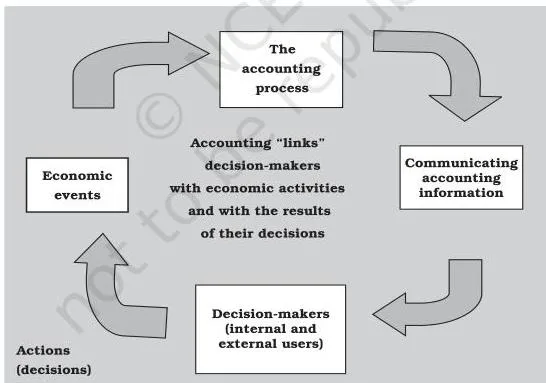
Figure 1.1 (NCERT, p. 2) is the chapter’s own map of the accounting process. Keep it next to the definition: accounting is a chain of interlinked activities that begins with identifying transactions and ends with the preparation of financial statements (NCERT, p. 7). Every later chapter of the book fits somewhere on this chain.
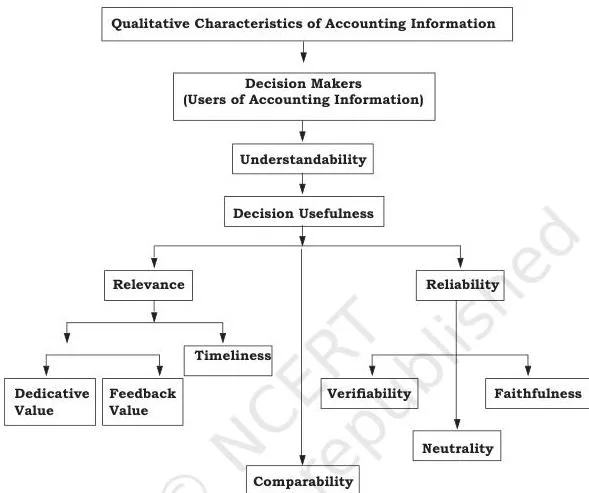
Figure 1.3 (NCERT, p. 11) shows the four characteristics together: reliability, relevance, understandability and comparability. Under reliability, NCERT adds what dependable information must be — credible, verifiable by independent parties using the same method, neutral and faithful (NCERT, p. 9). A short-answer question can ask for any one of these, so learn all four, not just the names.
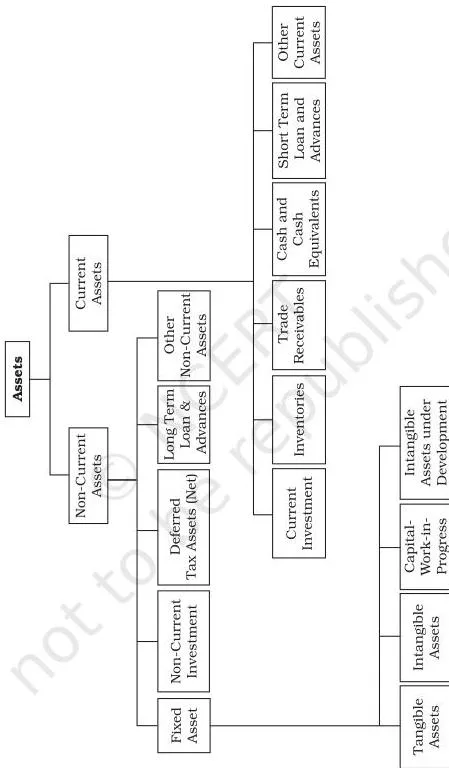
Figure 1.4 (NCERT, p. 17) shows the two-way split of assets into current and non-current. The rule that decides which bucket an item enters is NCERT’s Box 5 (NCERT, p. 18): current items are involved in the operating cycle, are realised or settled within 12 months, are held primarily for trading, or are cash or cash equivalent.
Inventory held for sale passes these tests and is current; machinery and goodwill fail them and are non-current.

Figure 1.5 (NCERT, p. 18) applies the same split to liabilities. An amount owed to a supplier for goods bought on credit is a current liability — it is settled within the operating cycle. A three-year bank loan is non-current. The same four Box 5 tests drive both figures, and Activity 1 on p. 24 is a practice run of exactly this classification.
The Core Idea: Accounting as a Process
Accounting is not a single act — it is a chain of four activities, and the chapter’s whole definition rests on that chain. If an event cannot survive all four steps, it stays out of the books.
An economic event is a happening of consequence to a business, made up of transactions that are measurable in monetary terms (NCERT, p. 4). It can be an external event, between the enterprise and an outsider — a sale to a customer, a purchase from a supplier, rent paid to a landlord.
Or it can be an internal event, entirely between the enterprise’s own departments — stores supplying raw material to the manufacturing department, or wages paid to employees (NCERT, p. 4).
| Step | What happens in it | What fails this step | NCERT page |
|---|---|---|---|
| Identification | Observing activities and selecting events of financial character that relate to the organisation | The value of human resources, changes in managerial policies, appointment of personnel — important, but not recorded | p. 5 |
| Measurement | Quantifying transactions in monetary terms — rupees and paise, including estimates | Signing a contract or appointing a managing director — cannot yet be quantified in money | p. 5 |
| Recording | Entering identified and measured events in the books in chronological order | — | p. 5 |
| Communication | Passing the right information to the right person at the right time through reports — daily, weekly, monthly or quarterly | — | p. 5 |
The organisation whose events get recorded can be any business enterprise — profit or not-for-profit, a sole proprietorship, partnership, cooperative society, company, local authority or municipal corporation (NCERT, p. 6).
Worked example (original numbers): a mobile phone retailer sells phones worth ₹ 2,40,000 on credit to a customer.
This one business event moves through all four steps.
Step 1 — Identification: the sale is an external economic event of financial character, so it is selected for recording (NCERT, p. 5).
Step 2 — Measurement: the event is quantified in monetary terms as ₹ 2,40,000 receivable from the customer (NCERT, p. 5).
Step 3 — Recording: the credit sale is entered in the books in the order it happened — now, not when cash arrives (NCERT, p. 5).
Step 4 — Communication: the sale feeds into reports, such as a daily sales summary or a monthly statement of receivables, so management and outsiders get the information in time (NCERT, p. 5).
Counter-example: signing a two-year supply contract is a real business decision, but it records nothing. The event cannot be measured in money until actual transactions — purchases, payments, deliveries — take place (NCERT, p. 5).
Who Uses Accounting Information and What Each User Needs
Accounting is called the language of business because it communicates financial information to decision-makers (NCERT, p. 6). NCERT divides users into internal users (management at all levels) and external users (everyone outside the enterprise), and lists what each group wants.
| User group | Internal or external | Information it wants | NCERT page |
|---|---|---|---|
| Owners / shareholders | External | Satisfactory return on investment; financial health of the business | p. 6 |
| Directors and managers | Internal | Internal and external comparisons; evaluating performance; strengths and weaknesses; solvency | p. 6–7 |
| Creditors (banks, financial institutions, debenture-holders) | External | Whether they will be paid; liquidity — the ability to pay debts as they fall due | p. 7 |
| Prospective investors | External | Whether to invest money in the enterprise | p. 7 |
| Government and regulators (Registrar of Companies, customs, IRDA, RBI) | External | Taxes — VAT, income tax, customs, excise; legal obligations under the Companies Act 2013 and SEBI | p. 7 |
| Investors and potential investors (detailed) | External | Risks and return on investment | p. 13 |
| Unions and employee groups | External | Stability, profitability and distribution of wealth within the business | p. 13 |
| Lenders and financial institutions | External | Creditworthiness; ability to repay loans and pay interest | p. 13 |
| Suppliers and creditors | External | Whether amounts owed will be repaid when due; continued existence of the business | p. 13–14 |
| Customers | External | Continued existence of the business; continued supply of products, parts and after-sales service | p. 14 |
| Government and other regulators (detailed) | External | Allocation of resources; compliance with regulations | p. 14 |
| Social responsibility groups (e.g. environmental groups) | External | Impact on the environment and its protection | p. 14 |
| Competitors | External | Relative strengths and weaknesses of the competition; benchmarking — used for strategic purposes rather than shared wealth | p. 14 |
One nuance students miss: unlike every other group, competitors do not share in the company’s wealth — they use the information for strategic purposes (NCERT, p. 14). The chapter’s Test Your Understanding III (NCERT, p. 14) is a matching exercise on exactly these groups.
Qualitative Characteristics: What Makes Accounting Information Useful
Information is decision-useful only if it carries all four qualities NCERT lists, and Figure 1.3 shows them together (NCERT, p. 9). A characteristic is called qualitative because it is a property of the information itself, not a rule for recording it.
| Quality | What it means | NCERT page |
|---|---|---|
| Reliability | Users can depend on it; free from error and bias; credible, verifiable by independent parties using the same method, neutral and faithful | p. 9 |
| Relevance | Available in time; helps prediction and feedback; influences decisions by helping form predictions about outcomes, or by confirming or correcting past evaluations | p. 10 |
| Understandability | Decision-makers interpret the message in the same sense the sender intended; presented intelligibly without sacrificing relevance or reliability | p. 10–11 |
| Comparability | Reports belong to a common period and use a common unit of measurement and format, so users can compare the entity over time and with other entities | p. 11–12 |
Memory aid — anchor the initials with four short lines (a memory trick only; the table above carries the real definitions):
- R — Right figures you can depend on (Reliability)
- R — Right information, available in time (Relevance)
- U — Understood the way it was meant (Understandability)
- C — Compared on a common scale (Comparability)
Test Your Understanding II on p. 12 asks you to name three steps that would make a company’s financial statements understandable and decision-useful — the hint points straight at these four qualities, so it works as the chapter’s own check on this section.
The Objectives of Accounting: Four Jobs the Process Performs
The basic objective of accounting, as an information system, is to provide useful information to its users (NCERT, p. 12). NCERT splits that aim into four jobs, and short-answer questions often ask you to enumerate them.
- Maintenance of records. A systematic record of all financial transactions in the books of account. Even a brilliant manager cannot remember every purchase, sale, receipt and payment; recorded information is verifiable and acts as evidence (NCERT, p. 12).
- Calculation of profit and loss. The owners want to know periodically whether the business earned profit or incurred loss. Profit is the excess of revenue over expenses for the period (NCERT, p. 12–13).
- Depiction of financial position. Assets and liabilities at the end of the accounting period, set out in a statement known as the balance sheet (position statement) (NCERT, p. 13).
- Providing information to users. Information communicated through reports, statements, graphs and charts; internal users such as management get timely information on cost of sales and profitability, while external users rely on the financial statements (NCERT, p. 13–14).
Worked example with original numbers: a stationery business earns revenue of ₹ 8,40,000 in a year and incurs expenses of ₹ 7,20,000.
- Step 1: revenue for the year, ₹ 8,40,000.
- Step 2: expenses for the year, ₹ 7,20,000.
- Step 3: revenue exceeds expenses (₹ 8,40,000 is greater than ₹ 7,20,000), so the business earned a profit of ₹ 1,20,000.
Step 4 (check): if expenses had instead been ₹ 9,10,000, they would exceed revenue, giving a loss of ₹ 70,000.
The Role of Accounting — and the Three Branches
Accounting describes and analyses a mass of business data, classifies and summarises it, and reduces it to reports and statements that show financial condition and results (NCERT, p. 14). That is why its role matters far beyond book-keeping.
- As a language — the language of business, used to communicate information about enterprises (NCERT, p. 15).
- As a historical record — a chronological record of financial transactions at the actual amounts involved (NCERT, p. 15).
- As current economic reality — a means of determining true income, namely the change of wealth over time (NCERT, p. 15–16).
- As an information system — a process that links an information source (the accountant) to receivers (external users) through a channel of communication (NCERT, p. 16).
- As a commodity — specialised information viewed as a service in demand in society (NCERT, p. 16).
One limitation to remember: accounting relates to past transactions and is quantitative and financial in nature, so it does not provide qualitative and non-financial information (NCERT, p. 14). Students routinely forget this point when answering questions on the role of accounting.
Different user needs gave rise to three branches of accounting (NCERT, p. 8–10):
| Branch | What it does | Who it serves | NCERT page |
|---|---|---|---|
| Financial accounting | Keeps a systematic record of financial transactions and prepares financial reports to measure organisational success and financial soundness; relates to the past period and is monetary in nature | All stakeholders, through the stewardship function | p. 8–10 |
| Cost accounting | Analyses expenditure to ascertain the cost of products manufactured or services rendered; helps fix prices and control costs | Management, for costing information and decisions | p. 8–10 |
| Management accounting | Supplies internal information for planning, controlling and decision-making; draws on financial and cost accounting for budgeting, profitability, pricing and capital-expenditure decisions | Management inside the organisation | p. 9–10 |
The 20 Basic Accounting Terms, Explained Simply
These twenty terms are the working vocabulary of accountancy — every later chapter assumes you know them. The definitions below are plain-language versions of what NCERT prints on pages 16–21, grouped by how the terms relate.
The unit and its events:
| Term | Plain meaning | NCERT page |
|---|---|---|
| Entity | A reality with a definite individual existence; the specific business enterprise (Super Bazaar, ITC Limited) for which the accounting system is set up | p. 16 |
| Transaction | An event involving some value between two or more entities — purchase of goods, receipt of money, payment to a creditor; it can be a cash transaction or a credit transaction | p. 16 |
Resources and claims:
| Term | Plain meaning | NCERT page |
|---|---|---|
| Assets | Economic resources of the enterprise that can be expressed in monetary terms and are used in its operations; classified as current and non-current (Figure 1.4) | p. 16 |
| Liabilities | Obligations or debts the enterprise must pay in the future; they represent creditors’ claims on the firm’s assets; classified as current and non-current (Figure 1.5) | p. 18 |
| Capital | The amount invested by the owner, in cash or assets; for the business entity it is an obligation and a claim on the assets, so it appears on the liabilities side | p. 18 |
| Debtors | Persons or entities who owe the enterprise for goods or services bought on credit; shown as sundry debtors on the asset side of the balance sheet | p. 21 |
| Creditors | Persons or entities the enterprise owes for goods or services received on credit; shown as sundry creditors on the liabilities side | p. 21 |
The operating flow:
| Term | Plain meaning | NCERT page |
|---|---|---|
| Purchases | The total goods procured by the business on cash and on credit, for use or sale | p. 20 |
| Sales | Total revenues from goods or services sold or provided to customers; cash sales or credit sales | p. 19 |
| Goods | The products in which the business unit deals — what it buys and sells or produces and sells; items bought for use in the business are not goods | p. 20 |
| Stock | Goods, spares and other items on hand; closing stock is what lies unsold at the end of the period, opening stock at the beginning | p. 21 |
| Revenues | Amounts earned by selling products or providing services — sales revenue — plus commission, interest, dividends, royalties and rent received; also called income | p. 19 |
| Expenses | Costs incurred in earning revenue, measured by the cost of assets consumed or services used — depreciation, rent, wages, salaries, interest | p. 19 |
| Expenditure | Spending money or incurring a liability for a benefit, service or property; if the benefit ends within a year it is an expense, and if it lasts longer it becomes an asset | p. 19 |
Results, the owner and evidence:
| Term | Plain meaning | NCERT page |
|---|---|---|
| Profit | The excess of revenues over related expenses in an accounting year; profit increases the investment of the owners | p. 19 |
| Gain | A profit that arises from events incidental to the business — sale of a fixed asset, winning a court case, appreciation in the value of an asset | p. 19 |
| Loss | The excess of expenses over revenues; it decreases owner’s equity; also money or money’s worth lost without any benefit in return, such as goods lost by theft or fire | p. 19–20 |
| Drawings | Withdrawal of money and/or goods by the owner from the business for personal use; drawings reduce the investment of the owners | p. 20 |
| Discount | A deduction in the price of goods sold; trade discount off the list price at sale time, or cash discount to a debtor for paying within the stipulated period | p. 20 |
| Voucher | The documentary evidence of a transaction — a cash memo for cash purchases, an invoice for credit purchases, a receipt for payments | p. 20 |
Pairs the chapter asks you to distinguish (NCERT, p. 23):
| Pair | The distinction | NCERT page |
|---|---|---|
| Debtors and creditors | Debtors owe money to the business; creditors are owed by the business. Debtors sit on the asset side, creditors on the liabilities side | p. 21 |
| Profit and gain | Profit is the excess of revenues over related expenses of the period; gain is profit from incidental events such as the sale of a fixed asset | p. 19 |
| Expense and expenditure | Expense is spending whose benefit is exhausted within a year; expenditure is any spending for benefit, and the part whose benefit lasts over a year becomes an asset | p. 19 |
| Capital and drawings | Capital is the amount the owner invests in the firm; drawings are the owner’s withdrawals of money or goods for personal use, which reduce that investment | p. 18, 20 |
Quick self-test (original amounts): classify each item as an asset, liability, capital, revenue, expense, gain or loss, then check the key below.
- A shopkeeper keeps ₹ 25,000 cash in the till.
- The business takes a bank loan of ₹ 1,25,000 for three years.
- Furniture worth ₹ 38,000 is bought for the office.
- Rent of ₹ 12,000 is received from letting out part of the building.
- An old delivery van with a book value of ₹ 65,000 is sold for ₹ 80,000.
Answer key:
- Asset — cash is an economic resource of the business.
- Liability — a non-current liability, repayable after more than a year (Box 5, p. 18).
- Asset — the benefit lasts more than a year, so this expenditure is treated as an asset (p. 19).
- Revenue — NCERT lists rent received among revenue items (p. 19).
- The van was an asset; the surplus of ₹ 15,000 over book value is a gain, because it comes from an event incidental to the business (p. 19). The book’s own Test Your Understanding V has the same shape — machinery costing ₹ 40,000 sold for ₹ 45,000 gives a gain of ₹ 5,000 (p. 21, 24).
Common Mistakes in Chapter 1 and How to Avoid Them
These are the places students reading this chapter slip, and NCERT’s own review material exposes most of them. Each row names the mistake, the correct rule, and a way to check your answer.
| The mistake | The correct rule | How to check your answer |
|---|---|---|
| Recording a personal payment as a business transaction — e.g. paying a son’s fees from a personal bank account | Only events that involve the business entity and are of financial character are recorded; a personal payment is not a business transaction | Ask: does this change the business’s own financial position? (NCERT, p. 15) |
| Naming preparation of financial statements as the last step of the accounting process | The last step is communication of information to users | Learn the chain in order: identify, measure, record, communicate (NCERT, p. 15) |
| Saying that clearly presented information shows relevance | Clear presentation reflects understandability | Ask which quality is about the receiver grasping the message (NCERT, p. 15) |
| Treating a common unit and format as promoting reliability | A common unit of measurement and a common format of reporting promote comparability | Ask which quality lets you compare across time and between entities (NCERT, p. 15) |
| Calling capital an asset | Capital is the owner’s claim — an obligation of the business — so it is shown on the liabilities side | Check which side of the balance sheet the item sits on (NCERT, p. 18) |
| Calling anything a business buys ‘goods’ | Goods are only what the business deals in; chairs are goods for a furniture dealer but an asset for a stationer | Ask: is this item for resale in this business, or for use? (NCERT, p. 20) |
| Mixing up trade discount and cash discount | Trade discount is deducted from the list price at the time of sale; cash discount rewards a debtor for paying within the stipulated period | Ask when the deduction is given — at sale or at payment? (NCERT, p. 20) |
| Treating every spending as an expense | Spending whose benefit ends within a year is an expense; spending whose benefit lasts more than a year becomes an asset | Ask how long the benefit lasts (NCERT, p. 19) |
| Expecting non-financial events to appear in the books | Appointing a manager or signing a contract is not recorded until a financial transaction occurs | Ask: can this be measured in rupees and paise right now? (NCERT, p. 5) |
| Guessing the current/non-current classification in Activity 1 | Apply the four Box 5 tests: operating cycle, 12-month rule, trading purpose, cash or cash equivalent | Machinery and goodwill are non-current assets; inventory is a current asset; sundry creditors are a current liability (NCERT, p. 18, 24) |
What the Chapter Prepares You For
NCERT prints six learning objectives on the first page of the chapter (NCERT, p. 1). If you can do all six, you have mastered Chapter 1. The reading map below shows where each objective is taught.
| Learning objective | Where the chapter teaches it |
|---|---|
| State the meaning and need of accounting | Section 1.1, p. 2–6 — the four-activity definition and its aspects |
| Discuss accounting as a source of information | Section 1.2, p. 7–12 — information system, branches, qualitative characteristics |
| Identify the internal and external users of accounting information | Sections 1.1.4 to ‘Why Do the Users Want Accounting Information?’, p. 6–7 |
| Explain the objectives of accounting | Section 1.3, p. 12–14 |
| Describe the role of accounting | Section 1.4, p. 14–16 |
| Explain the basic terms used in accounting | Section 1.5, p. 16–21 |
The chapter’s own closing questions show the shapes a question on this chapter can take (NCERT, p. 22–24):
- Definition questions — ‘Define accounting’ (p. 22).
- Enumeration questions — ‘Enumerate main objectives of accounting’ (p. 22).
- Distinction questions — ‘Distinguish between debtors and creditors; profit and gain’ (p. 23).
- User-need questions — ‘Describe the informational needs of external users’ (p. 23).
- Scenario application — Test Your Understanding V (p. 21–22) and the Activity 1 classification table (p. 24).
The twenty basic terms deserve special attention: every later chapter of this book reuses them, so a weak grasp here slows down everything that follows. Textbook contents and the examinable syllabus are not always identical — check the current official syllabus.
If you want revision support alongside the textbook, the Class 11 Accountancy notes and the Class 11 hub collect chapter-wise material for this book.
The same terms reappear when you reach the financial statements chapters — the CBSE notes pages and the Financial Statements II notes show them in use.
Key Takeaways from the Chapter
NCERT closes the chapter with a six-point summary tied to its learning objectives (NCERT, p. 22). Here is that summary in condensed form:
- Accounting is the process of identifying, measuring, measuring and communicating the economic events of an organisation to interested users.
- Accounting works as an information system — a source of information for decisions.
- Users include management at all levels, those with a direct financial interest (present and potential investors and creditors), and those with an indirect financial interest (regulatory agencies, tax authorities, customers, labour unions, trade associations, stock exchanges).
- Information should carry four qualitative characteristics: reliability, understandability, relevance and comparability.
- The objectives are to maintain records, calculate profit or loss, depict financial position, and make information available to users.
- Accounting is a means, not an end — it serves as the language of business, a historical record, current economic reality, an information system and a service to users.
Related Resources: Where Chapter 1 Leads
This listing is maintained for the 2026-27 academic session using the NCERT textbook information available to us. NCERT remains the authority for confirming the latest edition.
Chapter 1 is the foundation of the book — the process and the terms defined here are reused in every later chapter. These resources take you from here to the rest of Class 11 Accountancy.
- Class 11 Accountancy book page — the NCERT book page for Financial Accounting-I, listing its chapters.
- Class 11 books hub — every NCERT Class 11 book on this site.
- The next chapter in Class 11 Accountancy — continues directly from the basics laid down here.
Sources and Data Verification
- The figures and page references on this page come from the NCERT Class 11 Accountancy textbook Financial Accounting-I, Chapter 1 (Introduction to Accounting), current NCERT edition as published on ncert.nic.in.
- This page covers Chapter 1 of that book; it does not cover the other chapters of Financial Accounting-I or the syllabus of any other class.
- The listing is maintained for the current academic session. Verify the official file at the NCERT textbook portal for Financial Accounting-I.
- NCERT settles textbooks, editions and PDFs; CBSE settles the curriculum, syllabus and examinations. Textbook contents and the examinable syllabus are not always identical.
Frequently Asked Questions
What is the NCERT Class 11 definition of accounting?
Accounting is the process of identifying, measuring, recording and communicating the required information relating to the economic events of an organisation to the interested users of such information (NCERT, p. 2).
Who are the internal and external users of accounting information?
Internal users are management at all levels — chief executive, financial officer, plant and store managers, line supervisors. External users include present and potential investors, creditors (banks, financial institutions, debenture-holders), tax authorities, regulatory agencies, labour unions, trade associations, stock exchanges and customers (NCERT, p. 6, 13–14).
What are the four objectives of accounting in Class 11?
To maintain records of business transactions, to calculate profit or loss, to depict the financial position, and to make information available to users (NCERT, p. 12–14).
What is the difference between trade discount and cash discount?
Trade discount is a deduction of an agreed percentage from the list price at the time of selling; cash discount is a deduction given to a debtor for paying the amount within the stipulated period, and it encourages prompt payment (NCERT, p. 20).
Why is capital shown on the liabilities side of the balance sheet?
Because capital is the owner’s claim on the assets of the business; for the business entity it is an obligation, so it appears on the liabilities side (NCERT, p. 18).
What are the four qualitative characteristics of accounting information?
Reliability, relevance, understandability and comparability (NCERT, p. 9–12).
Reference: NCERT Class 11 Accountancy textbook, chapter 1, official edition on ncert.nic.in.
Explore Class 11 Accountancy Books
Related chapters:
- Financial Statements – I
- Theory Base of Accounting
- Recording of Transactions-I