Looking for Chemical Bonding and Molecular Structure Class 11 formulas? This sheet collects the calculation rules of NCERT Chapter 4 in one place: formal charge, dipole moment, bond order, bond length, average bond enthalpy, the LCAO construction of molecular orbitals, and the VSEPR and hybridisation rules that decide molecular shape.
Each formula is grouped by the chapter section it comes from, with the meaning and unit of every symbol, a line on when to use it, three worked examples with original numbers, and the specific mistakes students make when applying it.
For the full explanations and derivations, browse the Class 11 chemistry formulas collection and the chemistry formulas index on this site.
Formulas at a Glance
The table lists every formula on this sheet; symbols, units and conditions follow in the next sections.
| Purpose (what you are finding) | Formula |
|---|---|
| Formal charge on an atom in a Lewis structure | \( \text{F.C.} = V – L – \frac{1}{2}S \) |
| Bond length from the covalent radii of two bonded atoms | \( R = r_A + r_B \) |
| Average bond enthalpy of a polyatomic molecule | \( \Delta_{\text{avg}}H^\circ = \frac{\text{total bond dissociation enthalpy}}{\text{number of bonds broken}} \) |
| Dipole moment of a polar bond | \( \mu = Q \times r \) |
| Converting dipole moment from Debye to SI units | \( 1\ \text{D} = 3.33564 \times 10^{-30}\ \text{C m} \) |
| Bond order from molecular-orbital electron counts | \( \text{b.o.} = \frac{1}{2}(N_b – N_a) \) |
| Constructing molecular orbitals by LCAO | \( \psi_{MO} = \psi_A \pm \psi_B \) |
| MO energy order for \( O_2 \) and \( F_2 \) | \( \sigma 1s \lt \sigma^* 1s \lt \sigma 2s \lt \sigma^* 2s \lt \sigma 2p_z \lt (\pi 2p_x = \pi 2p_y) \lt (\pi^* 2p_x = \pi^* 2p_y) \lt \sigma^* 2p_z \) |
| MO energy order for \( Li_2 \), \( Be_2 \), \( B_2 \), \( C_2 \), \( N_2 \) | \( \sigma 1s \lt \sigma^* 1s \lt \sigma 2s \lt \sigma^* 2s \lt (\pi 2p_x = \pi 2p_y) \lt \sigma 2p_z \lt (\pi^* 2p_x = \pi^* 2p_y) \lt \sigma^* 2p_z \) |
| VSEPR repulsion order between electron pairs | \( \text{lp-lp} \gt \text{lp-bp} \gt \text{bp-bp} \) |
| Steps of ionic-bond formation | \( M(g) \rightarrow M^+(g) + e^- \); \( X(g) + e^- \rightarrow X^-(g) \) |
All Formulas, Grouped by Topic
The groups follow the chapter’s own sub-topics, from Lewis structures to hydrogen bonding.
Formal Charge
The formal charge tells you how the valence electrons of a Lewis structure are distributed among the atoms. Each atom is assigned all of its lone-pair electrons plus one electron of every shared pair (NCERT, p. 105).
\[ \text{F.C.} = V – L – \frac{1}{2}S \]
The structure with the smallest formal charges on its atoms is generally the lowest-energy structure, so this calculation decides between possible Lewis structures.
Before counting, adjust for charge: for an anion, add one electron for each negative charge; for a cation, subtract one electron for each positive charge (NCERT, p. 104).
The Lewis symbols below show the valence electrons that \( V \) counts — the dots around each element symbol.

Ionic or Electrovalent Bond
Ionic bond formation runs through three steps (NCERT, p. 107):
\[ M(g) \rightarrow M^+(g) + e^- \quad \text{(ionization enthalpy)} \]
\[ X(g) + e^- \rightarrow X^-(g) \quad \text{(electron gain enthalpy)} \]
\[ M^+(g) + X^-(g) \rightarrow MX(s) \quad \text{(lattice formation)} \]
Ionic bonds form most easily between elements with low ionization enthalpy and a strongly negative electron gain enthalpy.
The lattice enthalpy — the energy needed to separate one mole of a solid ionic compound into gaseous ions — is what finally stabilises the crystal (NCERT, p. 108).
For NaCl, ionization (495.8 kJ mol⁻¹) plus electron gain (−348.7 kJ mol⁻¹) leaves +147.1 kJ mol⁻¹, but lattice formation releases −788 kJ mol⁻¹, more than repaying the cost (NCERT, p. 107).
Bond Length
Bond length is the equilibrium distance between the nuclei of two bonded atoms, measured spectroscopically or by diffraction (NCERT, p. 108).
\[ R = r_A + r_B \]
\( r_A \) and \( r_B \) are covalent radii, each about half the distance between two like atoms joined by a covalent bond. The van der Waals radius, measured between nonbonded atoms, is larger and is not the radius used in this formula.
Bond Enthalpy
Bond dissociation enthalpy is the energy needed to break one mole of a particular bond in the gaseous state: H–H = 435.8, O=O = 498 and N≡N = 946.0 kJ mol⁻¹ (NCERT, p. 109).
In a polyatomic molecule, each bond may break at a different energy — the two O–H bonds in water need 502 and 427 kJ mol⁻¹ — so chemists quote the average bond enthalpy:
\[ \Delta_{\text{avg}}H^\circ = \frac{\text{total bond dissociation enthalpy}}{\text{number of bonds broken}} \]
For water, \( (502 + 427)/2 = 464.5\ \text{kJ mol}^{-1} \). The average is used because a bond’s energy changes with its chemical environment.
Bond Order
In the Lewis description, bond order is simply the number of bonds between two atoms — 1, 2 or 3 for single, double and triple bonds (NCERT, p. 110).
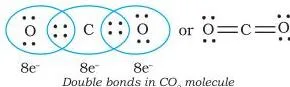
Two useful facts accompany bond order. Isoelectronic molecules and ions have identical bond orders: \( F_2 \) and \( O_2^{2-} \) both have bond order 1, while \( N_2 \), CO and \( NO^+ \) all have bond order 3.
With increasing bond order, bond enthalpy increases and bond length decreases (NCERT, p. 110). The data below show the trend.
| Molecule | Bond order | Bond length (pm) | Bond enthalpy (kJ mol⁻¹) |
|---|---|---|---|
| \( H_2 \) | 1 | 74 | 435.8 |
| \( O_2 \) | 2 | 121 | 498 |
| \( N_2 \) | 3 | 109 | 946.0 |
Polarity of Bonds and Dipole Moment
The dipole moment of a polar bond is the product of the magnitude of the charge and the distance between the centres of charge (NCERT, p. 111):
\[ \mu = Q \times r \]
\[ 1\ \text{D} = 3.33564 \times 10^{-30}\ \text{C m} \]
Dipole moment is a vector; in Lewis structures it is drawn as a crossed arrow with the head pointing towards the negative end.
For a polyatomic molecule the net moment is the vector sum of its bond dipoles. Symmetric molecules — \( BeF_2 \), \( CO_2 \), \( BF_3 \), \( CCl_4 \) — have zero net dipole moment because equal bond dipoles cancel, while bent \( H_2O \) has \( \mu = 1.85\ \text{D} \) (NCERT, p. 112).
VSEPR Theory
Electron pairs in the valence shell repel one another and settle at maximum distance. Repulsion decreases in the order (NCERT, p. 113):
\[ \text{lp-lp} \gt \text{lp-bp} \gt \text{bp-bp} \]
A lone pair occupies more space than a bond pair, so lone pairs compress bond angles: \( NH_3 \) is 107° and \( H_2O \) 104.5° instead of 109.5°, and even the bent \( AB_2E \) shape is squeezed from 120° to about 119.5° (NCERT, pp. 115–116).
| Electron pairs around central atom | Arrangement | Molecular shape | Example |
|---|---|---|---|
| 2 | linear, 180° | linear | \( BeCl_2 \) |
| 3 | trigonal planar, 120° | trigonal planar | \( BF_3 \) |
| 4 | tetrahedral, 109.5° | tetrahedral | \( CH_4 \), \( NH_4^+ \) |
| 5 | trigonal bipyramidal, 90° and 120° | trigonal bipyramidal | \( PCl_5 \) |
| 6 | octahedral, 90° | octahedral | \( SF_6 \) |
The table above is for central atoms with no lone pairs. With lone pairs the shapes become bent, trigonal pyramidal, see-saw, T-shape, square pyramidal and square planar (NCERT, pp. 114–115).
Hybridisation
Hybridisation mixes valence orbitals of slightly different energies into the same number of equivalent hybrid orbitals; the set then points in the directions of minimum repulsion (NCERT, p. 121).
Conditions: the orbitals must be in the valence shell and have nearly equal energy; electron promotion is not essential, and filled orbitals may also take part (NCERT, p. 122).
| Hybridisation | Orbitals mixed | Geometry | Bond angle | Examples |
|---|---|---|---|---|
| \( sp \) | one \( s \) + one \( p \) | linear | 180° | \( BeCl_2 \) |
| \( sp^2 \) | one \( s \) + two \( p \) | trigonal planar | 120° | \( BCl_3 \), \( BF_3 \) |
| \( sp^3 \) | one \( s \) + three \( p \) | tetrahedral | 109.5° | \( CH_4 \), \( NH_3 \), \( H_2O \) |
| \( dsp^2 \) | \( d \) + \( s \) + two \( p \) | square planar | 90° | \( [Ni(CN)_4]^{2-} \) |
| \( sp^3d \) | \( s \) + three \( p \) + \( d \) | trigonal bipyramidal | 90°, 120° | \( PCl_5 \), \( PF_5 \) |
| \( sp^3d^2 \) | \( s \) + three \( p \) + two \( d \) | octahedral | 90° | \( SF_6 \), \( [Co(NH_3)_6]^{3+} \) |
s-character: \( sp \) hybrids have 50% s-character, \( sp^3 \) hybrids 25% s-character and 75% p-character (NCERT, p. 122).
Molecular Orbital Theory
Molecular orbitals are built by the linear combination of atomic orbitals (LCAO). Two orbitals of comparable energy and proper symmetry give one bonding and one antibonding MO (NCERT, p. 127):
\[ \psi_{MO} = \psi_A \pm \psi_B \]
\[ \sigma = \psi_A + \psi_B \quad \text{(bonding)}, \qquad \sigma^* = \psi_A – \psi_B \quad \text{(antibonding)} \]
Bonding MOs are lower in energy than the atomic orbitals that formed them; antibonding MOs are higher. Combination needs nearly equal energies, the same symmetry about the molecular axis, and maximum overlap (NCERT, p. 128).
Electrons fill the MOs from the bottom, using the energy order that belongs to the molecule (NCERT, p. 129):
\[ O_2,\ F_2:\quad \sigma 1s \lt \sigma^* 1s \lt \sigma 2s \lt \sigma^* 2s \lt \sigma 2p_z \lt (\pi 2p_x = \pi 2p_y) \lt (\pi^* 2p_x = \pi^* 2p_y) \lt \sigma^* 2p_z \]
\[ Li_2,\ Be_2,\ B_2,\ C_2,\ N_2:\quad \sigma 1s \lt \sigma^* 1s \lt \sigma 2s \lt \sigma^* 2s \lt (\pi 2p_x = \pi 2p_y) \lt \sigma 2p_z \lt (\pi^* 2p_x = \pi^* 2p_y) \lt \sigma^* 2p_z \]
For \( O_2 \) and \( F_2 \), \( \sigma 2p_z \) lies below the \( \pi 2p \) pair; for \( Li_2 \), \( Be_2 \), \( B_2 \), \( C_2 \) and \( N_2 \) the order is reversed.
Stability, bond length and magnetism follow from the bond order (NCERT, p. 130):
\[ \text{b.o.} = \frac{1}{2}(N_b – N_a) \]
A positive bond order means a stable molecule; zero or negative means unstable. Higher bond order means shorter bond length and higher bond enthalpy. If all MOs are doubly occupied the substance is diamagnetic; singly occupied MOs make it paramagnetic — this is why \( O_2 \) is paramagnetic.
Representative MO configurations:
- \( H_2: (\sigma 1s)^2 \) — bond order 1, diamagnetic
- \( He_2: (\sigma 1s)^2(\sigma^* 1s)^2 \) — bond order 0, does not exist
- \( Li_2: KK(\sigma 2s)^2 \) — bond order 1, diamagnetic
- \( C_2: KK(\sigma 2s)^2(\sigma^* 2s)^2(\pi 2p_x^2 = \pi 2p_y^2) \) — bond order 2, diamagnetic
- \( O_2: KK(\sigma 2s)^2(\sigma^* 2s)^2(\sigma 2p_z)^2(\pi 2p_x^2 = \pi 2p_y^2)(\pi^* 2p_x^1 = \pi^* 2p_y^1) \) — bond order 2, paramagnetic
Hydrogen Bonding
A hydrogen bond is the attraction between a hydrogen atom of one molecule and a highly electronegative atom (F, O or N) of another. The covalent bond is drawn as a solid line and the hydrogen bond as a dotted line (NCERT, p. 132):
\[ H^{\delta+} – F^{\delta-}\ \cdots\ H^{\delta+} – F^{\delta-} \]
H-bonds are intermolecular (between molecules, as in HF and water) or intramolecular (within one molecule, as in o-nitrophenol).
What Each Symbol Means
| Symbol | What it means | Unit / nature |
|---|---|---|
| \( \text{F.C.} \) | formal charge on an atom in a Lewis structure | number of unit charges (dimensionless) |
| \( V \) | valence electrons of the free atom | count of electrons |
| \( L \) | non-bonding (lone pair) electrons on the atom | count of electrons |
| \( S \) | bonding (shared) electrons in the bonds of that atom | count of electrons |
| \( R \) | bond length | pm (picometres) |
| \( r_A, r_B \) | covalent radii of the two bonded atoms | pm (picometres) |
| \( \Delta_e H^\circ \) | bond dissociation enthalpy | kJ mol⁻¹ |
| \( \Delta_{\text{avg}}H^\circ \) | average (mean) bond enthalpy | kJ mol⁻¹ |
| \( \mu \) | dipole moment | D (1 D = 3.33564 × 10⁻³⁰ C m) |
| \( Q \) | magnitude of the separated charge | C (coulomb) |
| \( r \) | distance between the centres of positive and negative charge | m (metre) |
| \( N_b \) | electrons in bonding molecular orbitals | count |
| \( N_a \) | electrons in antibonding molecular orbitals | count |
| \( \psi_A, \psi_B \) | wave functions of the combining atomic orbitals | amplitude of the electron wave |
| \( \sigma, \sigma^* \) | bonding and antibonding sigma molecular orbitals | orbital labels |
| lp, bp | lone pair and bond pair of electrons | electron-pair labels |
When to Use Each Formula
| Formula or rule | Use it when | Condition to remember |
|---|---|---|
| \( \text{F.C.} = V – L – \frac{1}{2}S \) | you must choose the most stable Lewis structure for a molecule or ion | the best structure carries the smallest formal charges |
| \( R = r_A + r_B \) | you know the covalent radii and need a single-bond length | both atoms are in the same bonded molecule |
| Average bond enthalpy | the molecule is polyatomic and its bonds break at different energies | divide the total dissociation enthalpy by the number of bonds broken |
| \( \mu = Q \times r \) | you need the polarity of a single bond | for the whole molecule, add bond dipoles as vectors |
| \( 1\ \text{D} = 3.33564 \times 10^{-30}\ \text{C m} \) | you want \( \mu \) in SI units to compare molecules | multiply the Debye value by the conversion factor |
| \( \text{b.o.} = \frac{1}{2}(N_b – N_a) \) | you have written the MO configuration and need stability, bond length or magnetism | positive b.o. = stable; count \( N_b \) with the correct energy order |
| Energy order for \( O_2 \), \( F_2 \) | writing MO configurations of \( O_2 \), \( O_2^{2-} \), \( F_2 \) and similar species | \( \sigma 2p_z \) fills before the \( \pi 2p \) pair |
| Energy order for \( Li_2 \) – \( N_2 \) | writing MO configurations of \( N_2 \), \( C_2 \), \( B_2 \), \( Li_2 \), \( Be_2 \) | \( \pi 2p \) pair fills before \( \sigma 2p_z \) |
| \( \text{lp-lp} \gt \text{lp-bp} \gt \text{bp-bp} \) | predicting shape and angle distortions caused by lone pairs | lone pairs occupy more space and shrink bond angles |
| \( M(g) \rightarrow M^+ + e^- \), \( X + e^- \rightarrow X^- \) | deciding whether an ionic bond is likely between two elements | low ionization enthalpy + strongly negative electron gain enthalpy |
Worked Examples
Each example below selects the formula first, then substitutes. The exercise set for this chapter (Questions 4.1–4.40) draws heavily on these calculations — Lewis structures, VSEPR shapes, dipole moment and bond order. For formulas of other chapters, see the chemistry formulas index.
Worked Example 1: Formal Charges in the Carbonate Ion
Select the formula.
Formal charge counts the electrons each atom owns in a Lewis structure:
\[ \text{F.C.} = V – L – \frac{1}{2}S \]
Step 1 — carbon.
In \( CO_3^{2-} \), carbon is central with one C=O double bond and two C–O single bonds: \( V = 4 \), \( L = 0 \), \( S = 8 \).
\[ \text{F.C. (C)} = 4 – 0 – \frac{1}{2}(8) = 0 \]
Step 2 — the double-bonded oxygen.
\( V = 6 \), \( L = 4 \) (two lone pairs), \( S = 4 \).
\[ \text{F.C. (O, double bonded)} = 6 – 4 – \frac{1}{2}(4) = 0 \]
Step 3 — each single-bonded oxygen.
\( V = 6 \), \( L = 6 \) (three lone pairs), \( S = 2 \).
\[ \text{F.C. (O, single bonded)} = 6 – 6 – \frac{1}{2}(2) = -1 \]
Final answer: formal charges are 0 on carbon and the double-bonded oxygen, and \( -1 \) on each single-bonded oxygen. Check: \( 0 + 0 + (-1) + (-1) = -2 \), which equals the charge on the carbonate ion.
Worked Example 2: Bond Order of the Nitrogen Molecule
Select the formula.
For homonuclear diatomic molecules the bond order comes from the MO configuration:
\[ \text{b.o.} = \frac{1}{2}(N_b – N_a) \]
Step 1 — count electrons.
Nitrogen (\( Z = 7 \)) contributes seven electrons, so \( N_2 \) has 14.
It belongs to the \( Li_2 \)–\( N_2 \) family, so fill using the order in which the \( \pi 2p \) pair lies below \( \sigma 2p_z \):
\[ N_2:\ (\sigma 1s)^2(\sigma^* 1s)^2(\sigma 2s)^2(\sigma^* 2s)^2(\pi 2p_x)^2(\pi 2p_y)^2(\sigma 2p_z)^2 \]
Step 2 — count bonding and antibonding electrons.
\( N_b = 10 \), \( N_a = 4 \).
\[ \text{b.o.} = \frac{1}{2}(10 – 4) = 3 \]
Final answer: the N≡N bond has bond order 3, with no unpaired electrons (diamagnetic). Check against the chapter’s data: \( N_2 \) has the shortest bond (109 pm) and the highest bond enthalpy (946.0 kJ mol⁻¹) of the three diatomics, matching “higher bond order → shorter bond, higher enthalpy” (NCERT, p. 110).
Worked Example 3: Dipole Moment and Partial Charge in Hydrogen Chloride
Select the formula.
Dipole moment is charge times separation distance (NCERT, p. 111):
\[ \mu = Q \times r \]
Step 1 — gather data.
HCl has \( \mu = 1.07\ \text{D} \) (Table 4.5) and \( r = 127\ \text{pm} \) (Table 4.3).
Convert to SI with the factor \( 1\ \text{D} = 3.33564 \times 10^{-30}\ \text{C m} \):
\[ \mu = 1.07 \times 3.33564 \times 10^{-30} = 3.57 \times 10^{-30}\ \text{C m} \]
Step 2 — rearrange for the charge.
\( r = 127 \times 10^{-12}\ \text{m} \), so \[ Q = \frac{\mu}{r} = \frac{3.57 \times 10^{-30}}{127 \times 10^{-12}} = 2.81 \times 10^{-20}\ \text{C} \]
Final answer: the partial charges on H and Cl are about \( \pm 2.81 \times 10^{-20}\ \text{C} \). Compared with the electronic charge (\( 1.60 \times 10^{-19}\ \text{C} \)), this is roughly 18%, so the H–Cl bond is about 18% ionic — polar, but far from fully ionic.
Common Mistakes to Avoid
| Mistake | Correct rule | How to check your answer |
|---|---|---|
| Forgetting that a negative charge adds electrons when drawing a Lewis structure | Add one electron per negative charge and subtract one per positive charge before distributing shared pairs | Redraw and recount: the total must equal the atoms’ valence electrons adjusted for the charge |
| Computing formal charge without halving the shared electrons | \( \text{F.C.} = V – L – \frac{1}{2}S \) | Add up all formal charges; the total must equal the net charge of the species |
| Adding bond dipoles like ordinary numbers instead of vectors | The net dipole moment of a molecule is the vector sum of its bond dipoles | Symmetric shapes (\( BeF_2 \), \( CO_2 \), \( BF_3 \), \( CCl_4 \)) have \( \mu = 0 \) despite polar bonds |
| Using the \( O_2 \)/F₂ MO energy order for nitrogen | For \( Li_2 \), \( Be_2 \), \( B_2 \), \( C_2 \), \( N_2 \) the \( \pi 2p \) pair lies below \( \sigma 2p_z \) | Write the full \( N_2 \) configuration and check that it gives bond order 3 |
| Quoting one bond enthalpy for a polyatomic molecule | Use average bond enthalpy = total dissociation enthalpy ÷ number of bonds broken | For water, \( (502 + 427)/2 = 464.5\ \text{kJ mol}^{-1} \) |
| Ignoring lone-pair compression in \( sp^3 \) molecules | \( NH_3 \) has 107° and \( H_2O \) 104.5°, not 109.5° | Draw the electron-pair arrangement: lone pairs occupy more space than bond pairs |
Frequently Asked Questions
Why is O₂ paramagnetic even though it has a double bond?
The MO configuration of \( O_2 \) is \( (\sigma 1s)^2(\sigma^* 1s)^2(\sigma 2s)^2(\sigma^* 2s)^2(\sigma 2p_z)^2(\pi 2p_x)^2(\pi 2p_y)^2(\pi^* 2p_x)^1(\pi^* 2p_y)^1 \). The two antibonding \( \pi^* \) orbitals are each singly occupied, so \( O_2 \) has two unpaired electrons and is paramagnetic (NCERT, p. 130).
A Lewis structure cannot show this; it is the key success of MO theory.
What is the difference between bond dissociation enthalpy and average bond enthalpy?
Bond dissociation enthalpy is the energy needed to break one mole of a specific bond in the gaseous state. In polyatomic molecules the same bond type can break at different energies — the two O–H bonds of water need 502 and 427 kJ mol⁻¹ — so the average is the total dissociation enthalpy divided by the number of bonds broken (NCERT, p. 109).
How does dipole moment help decide the shape of a molecule?
Symmetric molecules — linear \( CO_2 \) and \( BeF_2 \), trigonal planar \( BF_3 \), tetrahedral \( CCl_4 \) and \( CH_4 \) — have zero net dipole moment even though their bonds are polar, because equal bond dipoles cancel as vectors. Bent \( H_2O \) (1.85 D) and pyramidal \( NH_3 \) (1.47 D) have nonzero moments, which is direct evidence that the molecule is not symmetric (NCERT, p. 112).
When should I use the second MO energy order?
Use the order with \( (\pi 2p_x = \pi 2p_y) \) below \( \sigma 2p_z \) for \( Li_2 \), \( Be_2 \), \( B_2 \), \( C_2 \) and \( N_2 \). Use the other order — with \( \sigma 2p_z \) below the \( \pi 2p \) pair — for \( O_2 \) and \( F_2 \). Mixing them up gives wrong configurations and wrong bond orders (NCERT, p. 129).
All values on this sheet are printed in the official NCERT textbook; you can verify any of them directly on the NCERT website: ncert.nic.in.
Reference: NCERT Class 11 Chemistry textbook, chapter Chemical Bonding and Molecular Structure.
Explore Class 11 Chemistry Formulas
More for this chapter:
Class 11 Chemistry on LearnCBSE:
Related chapters: