
These redox reactions class 11 notes condense Chapter 7 of the NCERT Chemistry Part II textbook into a revision-ready page — definitions, oxidation number rules, balancing methods, reaction types, titrations and electrode processes, each trimmed to what an exam answer needs.
Work through the chapter the way a teacher would build it: classical oxygen-and-hydrogen definitions first, then electron transfer, then the oxidation number as the working tool, and finally the four reaction families, the two balancing methods, titrations and electrode processes.
Tables carry most of the content so you can revise at speed, and every worked example shows each step, because the steps carry the marks. You can verify any equation against the official textbook, downloadable from the NCERT portal (the Class 11 Chemistry Part II PDF, kech201).
Reference: NCERT Class 11 Chemistry Part II textbook, Chapter 7 “Redox Reactions” (pp. 236-255).
Redox Reactions in the Real World: Chapter Map and the Core Rule
The governing rule of the whole chapter is stated at the very start: where there is oxidation, there is always reduction (NCERT, p. 1). The electrons lost by one species are gained by another, so the two processes never travel alone — which is why the class is called redox.
The chapter reads the same reaction through three definition tiers, each more general than the last:
- Classical — oxidation and reduction by oxygen, hydrogen, or the transfer of electronegative and electropositive elements.
- Electron transfer — oxidation as loss of electrons, reduction as gain.
- Oxidation number — oxidation as an increase, reduction as a decrease, in the oxidation number.
The real-world reach is wide (NCERT, p. 1). Redox drives burning of fuels for energy, electrochemical extraction of reactive metals, manufacture of compounds like caustic soda, operation of dry and wet batteries, and corrosion of metals. Environmental issues such as the hydrogen economy (liquid hydrogen fuel) and the ozone hole are also redox phenomena.
The chapter closes by linking redox to electrode processes and cells (NCERT, pp. 15-17), where the same electron transfer is routed through a wire — the gateway to Class 12 electrochemistry. For the full set, see the Class 11 Chemistry notes hub and the wider CBSE notes collection.
Classical Definitions: Oxidation and Reduction by Oxygen and Hydrogen
The oldest meaning of oxidation was simply the addition of oxygen. The term broadened in steps until it covered every case below (NCERT, p. 2).
Oxidation is the addition of oxygen or an electronegative element to a substance, or the removal of hydrogen or an electropositive element from it. Grounded examples:
- \( 2\text{Mg(s)} + \text{O}_2\text{(g)} \rightarrow 2\text{MgO(s)} \) — oxygen added to magnesium (eq. 7.1)
- \( \text{S(s)} + \text{O}_2\text{(g)} \rightarrow \text{SO}_2\text{(g)} \) — oxygen added to sulphur (eq. 7.2)
- \( \text{CH}_4\text{(g)} + 2\text{O}_2\text{(g)} \rightarrow \text{CO}_2\text{(g)} + 2\text{H}_2\text{O(l)} \) — hydrogen removed from methane (eq. 7.3)
- \( 2\text{H}_2\text{S(g)} + \text{O}_2\text{(g)} \rightarrow 2\text{S(s)} + 2\text{H}_2\text{O(l)} \) — hydrogen removed from H2S (eq. 7.4)
- \( \text{Mg(s)} + \text{F}_2\text{(g)} \rightarrow \text{MgF}_2\text{(s)} \) — electronegative fluorine added (eq. 7.5)
- \( 2\text{K}_4[\text{Fe(CN)}_6]\text{(aq)} + \text{H}_2\text{O}_2\text{(aq)} \rightarrow 2\text{K}_3[\text{Fe(CN)}_6]\text{(aq)} + 2\text{KOH(aq)} \) — electropositive potassium removed
Reduction is the removal of oxygen or an electronegative element, or the addition of hydrogen or an electropositive element. Classic examples:
- \( 2\text{HgO(s)} \xrightarrow{\Delta} 2\text{Hg(l)} + \text{O}_2\text{(g)} \) — oxygen removed from mercuric oxide (eq. 7.8)
- \( 2\text{FeCl}_3\text{(aq)} + \text{H}_2\text{(g)} \rightarrow 2\text{FeCl}_2\text{(aq)} + 2\text{HCl(aq)} \) — chlorine removed from ferric chloride (eq. 7.9)
- \( \text{CH}_2=\text{CH}_2\text{(g)} + \text{H}_2\text{(g)} \rightarrow \text{CH}_3\text{-CH}_3\text{(g)} \) — hydrogen added to ethene (eq. 7.10)
- \( 2\text{HgCl}_2\text{(aq)} + \text{SnCl}_2\text{(aq)} \rightarrow \text{Hg}_2\text{Cl}_2\text{(s)} + \text{SnCl}_4\text{(aq)} \) — mercury added to mercuric chloride (eq. 7.11)
Notice how eq. 7.11 does two jobs at once: HgCl2 gains mercury (reduction) while SnCl2 gains chlorine (oxidation). This pairing is the reason the class is named redox.
Practise spotting the species on these NCERT reactions (Problem 7.1, NCERT p. 2):
- \( \text{H}_2\text{S(g)} + \text{Cl}_2\text{(g)} \rightarrow 2\text{HCl(g)} + \text{S(s)} \) — H2S is oxidised (hydrogen removed), Cl2 is reduced (hydrogen added).
- \( 3\text{Fe}_3\text{O}_4\text{(s)} + 8\text{Al(s)} \rightarrow 9\text{Fe(s)} + 4\text{Al}_2\text{O}_3\text{(s)} \) — Al is oxidised (oxygen added), Fe3O4 is reduced (oxygen removed).
- \( 2\text{Na(s)} + \text{H}_2\text{(g)} \rightarrow 2\text{NaH(s)} \) — needs the electronegativity idea; the next section and Problem 7.2 settle it.
Electron Transfer View: Half Reactions and the Agents
Because NaCl, Na2O and Na2S are ionic — better written Na+Cl-, (Na+)2O2-, (Na+)2S2- — each reaction splits into two half reactions, one losing electrons and one gaining them (NCERT, p. 3).
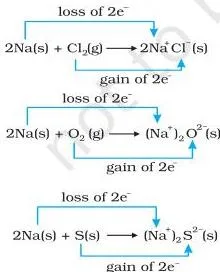
The half reactions for sodium chloride formation (eq. 7.12) show the electrons explicitly:
\[ 2\text{Na(s)} \rightarrow 2\text{Na}^+\text{(g)} + 2\text{e}^- \]
\[ \text{Cl}_2\text{(g)} + 2\text{e}^- \rightarrow 2\text{Cl}^-\text{(g)} \]
Adding the halves returns the overall reaction. This gives the four compact definitions used throughout the chapter:
- Oxidation — loss of electron(s) by any species.
- Reduction — gain of electron(s) by any species.
- Oxidising agent (oxidant) — acceptor of electron(s).
- Reducing agent (reductant) — donor of electron(s).
Problem 7.2 shows why the electron view matters. In \( 2\text{Na(s)} + \text{H}_2\text{(g)} \rightarrow 2\text{NaH(s)} \), the ionic form is Na+H-. Splitting it:
\[ 2\text{Na(s)} \rightarrow 2\text{Na}^+\text{(g)} + 2\text{e}^- \]
\[ \text{H}_2\text{(g)} + 2\text{e}^- \rightarrow 2\text{H}^-\text{(g)} \]
So sodium is oxidised and hydrogen is reduced — a fact the classical view alone could not reveal.
Competitive Electron Transfer: Building the Order Zn > Cu > Ag
Place a zinc strip in aqueous copper nitrate for about an hour: the strip is coated with reddish copper, the blue colour of Cu2+ fades, and passing H2S through the colourless solution (made alkaline with ammonia) gives white zinc sulphide, proving Zn2+ formed (NCERT, p. 4).
\[ \text{Zn(s)} + \text{Cu}^{2+}\text{(aq)} \rightarrow \text{Zn}^{2+}\text{(aq)} + \text{Cu(s)} \quad (7.15) \]
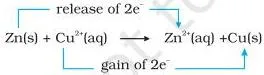
Zinc loses electrons (oxidation); copper ions gain them (reduction). The complementary experiment — a copper strip in zinc sulphate — gives no detectable Cu2+ even by the extremely sensitive black CuS test, so the equilibrium of eq. 7.15 greatly favours products over reactants.
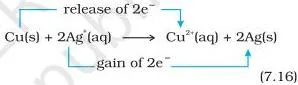
Copper in silver nitrate develops a blue colour from Cu2+: Cu is oxidised to Cu2+ and Ag+ is reduced to Ag, with equilibrium favouring products.
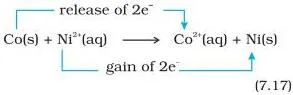
By contrast, cobalt in nickel sulphate reaches equilibrium with both Co2+ and Ni2+ at moderate concentrations — neither reactants nor products dominate.
This competition for electrons mirrors the competition for protons among acids, and suggests a table of metals ranked by electron-releasing tendency. The three experiments rank the metals Zn > Cu > Ag, the basis of the metal activity series or electrochemical series (NCERT, p. 4-5). The same competition designs galvanic cells, where chemical reactions supply electrical energy — studied in Class XII.
The equilibrium reasoning here connects to the chemical equilibrium chapter in our Class 11 notes.
Oxidation Number Rules: Six Steps to Any Element’s Oxidation State
Covalent reactions do not show clean electron transfer — in \( 2\text{H}_2\text{(g)} + \text{O}_2\text{(g)} \rightarrow 2\text{H}_2\text{O(l)} \) the electron shift is only partial. To track it, chemists invented the oxidation number: the charge an atom would have if every electron pair in its bonds belonged entirely to the more electronegative atom.
It is a book-keeping device, not a real charge (NCERT, p. 5-6).
“Oxidation number” and “oxidation state” mean the same thing (NCERT, p. 6). Assign them with six rules:
- Free elements (H2, O2, Cl2, O3, P4, S8, Na, Mg, Al) have oxidation number zero for every atom.
- Monatomic ions carry the ion’s charge: Na+ = +1, Mg2+ = +2, Fe3+ = +3, Cl- = −1. Alkali metals are +1 in all compounds, alkaline earth metals +2, aluminium +3.
- Oxygen is most commonly −2. Exceptions: peroxides (H2O2, Na2O2) = −1; superoxides (KO2, RbO2) = −1/2; bonded to fluorine, OF2 = +2 and O2F2 = +1.
- Hydrogen is +1, except in binary metal hydrides (LiH, NaH, CaH2) where it is −1.
- Fluorine is always −1. Other halogens are −1 as halide ions, but positive in oxoacids and oxoanions (e.g., Cl in ClO-).
- Sum rule: the oxidation numbers in a neutral compound add to zero; in a polyatomic ion they add to the ion’s charge (the three O and one C in \( \text{CO}_3^{2-} \) must sum to −2).
Memory device — the F-O-H check before you assign: run this list first and you catch most mistakes:
- F is always −1 (no exceptions).
- O is −2, unless in a peroxide (−1), a superoxide (−1/2), or bonded to F (+2 in OF2, +1 in O2F2).
- H is +1, unless bonded to a metal in a binary hydride (−1).
- Then solve for the target element by rule 6 (sum = charge).
The highest oxidation number of a representative element rises across a period (group number for groups 1-2, group minus 10 otherwise). In period 3 it climbs from +1 to +7 (NCERT, p. 6):
| Group | 1 | 2 | 13 | 14 | 15 | 16 | 17 |
|---|---|---|---|---|---|---|---|
| Element | Na | Mg | Al | Si | P | S | Cl |
| Compound | \( \text{NaCl} \) | \( \text{MgSO}_4 \) | \( \text{AlF}_3 \) | \( \text{SiCl}_4 \) | \( \text{P}_4\text{O}_{10} \) | \( \text{SF}_6 \) | \( \text{HClO} \) |
| Highest oxidation state | +1 | +2 | +3 | +4 | +5 | +6 | +7 |
Stock notation (from Alfred Stock) writes the oxidation number as a Roman numeral after the metal (NCERT, p. 7): Au(I)Cl and Au(III)Cl3; Sn(II)Cl2 and Sn(IV)Cl4. The numeral identifies the state — Hg2(I)Cl2 is the reduced form of Hg(II)Cl2.
Redox Definitions Table: Terms Side by Side
Here are the key terms at a glance, combining the electron-transfer statements with the oxidation-number statements exam answers quote:
| Term | Meaning | Example |
|---|---|---|
| Oxidation | Loss of electron(s); increase in oxidation number | \( \text{Na} \rightarrow \text{Na}^+ + \text{e}^- \) |
| Reduction | Gain of electron(s); decrease in oxidation number | \( \text{Cl}_2 + 2\text{e}^- \rightarrow 2\text{Cl}^- \) |
| Oxidising agent (oxidant) | Electron acceptor; it is reduced, its oxidation number falls | \( \text{Cl}_2 \), \( \text{KMnO}_4 \), \( \text{O}_2 \) |
| Reducing agent (reductant) | Electron donor; it is oxidised, its oxidation number rises | \( \text{Na} \), \( \text{Zn} \), \( \text{Al} \) |
| Half reaction | One side of a redox pair showing electrons explicitly | \( \text{Zn} \rightarrow \text{Zn}^{2+} + 2\text{e}^- \) |
| Oxidation number | Book-keeping charge assuming complete electron transfer to the more electronegative atom | O = −2, but −1 in \( \text{H}_2\text{O}_2 \) |
| Stock notation | Roman numeral after a metal giving its oxidation state | Sn(II)Cl2, Sn(IV)Cl4 |
| Redox couple | Oxidised and reduced forms of a species in a half reaction | \( \text{Zn}^{2+}/\text{Zn} \), \( \text{Cu}^{2+}/\text{Cu} \) |
One reaction through all three definition tiers. Take \( \text{Mg} \rightarrow \text{MgO} \) and read it three ways:
| Definition tier | What it says for the magnesium atom |
|---|---|
| Classical | Magnesium is oxidised because oxygen is added to it. |
| Electron transfer | Mg loses two electrons (oxidation); O gains them (reduction). |
| Oxidation number | Mg rises 0 → +2 (oxidation); O falls 0 to −2 (reduction). |
Worked Examples: Finding Oxidation Numbers Step by Step
Method first: apply rule 6 (sum equals charge), taking oxygen as −2 and hydrogen as +1, and let the target element be the unknown.
Example A: Nitrogen in ammonium nitrate, NH4NO3
Step 1: Split ammonium nitrate into its ions, \( \text{NH}_4^+ \) and \( \text{NO}_3^- \).
The two nitrogen atoms sit in different environments, so each has its own oxidation number.
Step 2: In \( \text{NH}_4^+ \), hydrogen is +1 (4 × +1 = +4).
The ion’s total is +1, so \( N = +1 – 4 = -3 \).
Step 3: In \( \text{NO}_3^- \), oxygen is −2 (3 × −2 = −6).
The ion’s total is −1, so \( N = -1 + 6 = +5 \).
Final answer: Nitrogen is −3 in the ammonium ion and +5 in the nitrate ion. The average (+1) hides the reality of two different nitrogen atoms in one compound.
Example B: Chlorine in bleaching powder, Ca(OCl)Cl
- Step 1: Bleaching powder contains Ca2+ with one hypochlorite ion, \( \text{OCl}^- \), and one chloride ion, \( \text{Cl}^- \).
- Step 2: In \( \text{OCl}^- \), oxygen is −2, so \( Cl = -1 + 2 = +1 \).
- Step 3: The ionic chloride has oxidation number −1 by rule 2.
Final answer: The two chlorine atoms are +1 (hypochlorite part) and −1 (simple chloride). The same technique solves Stock notation questions like NCERT Problem 7.3 (HAuCl4 → Au(III), Tl2O → Tl(I), FeO → Fe(II), Fe2O3 → Fe(III), CuI → Cu(I), CuO → Cu(II), MnO → Mn(II), MnO2 → Mn(IV)).
Four Families of Redox Reactions: Combination, Decomposition, Displacement, Disproportionation
Redox reactions sort into four families (NCERT, pp. 8-11). Each row gives the pattern, the redox condition, and grounded examples:
| Family | Pattern | Redox condition | Grounded examples |
|---|---|---|---|
| Combination | \( A + B \rightarrow C \) | At least one reactant in elemental form; all combustion reactions are redox | \( \text{C} + \text{O}_2 \rightarrow \text{CO}_2 \), \( 3\text{Mg} + \text{N}_2 \rightarrow \text{Mg}_3\text{N}_2 \), \( \text{CH}_4 + 2\text{O}_2 \rightarrow \text{CO}_2 + 2\text{H}_2\text{O} \) |
| Decomposition | One compound breaks into two or more components | At least one product in elemental state | \( 2\text{H}_2\text{O} \rightarrow 2\text{H}_2 + \text{O}_2 \), \( 2\text{NaH} \rightarrow 2\text{Na} + \text{H}_2 \), \( 2\text{KClO}_3 \rightarrow 2\text{KCl} + 3\text{O}_2 \); NOT redox: \( \text{CaCO}_3 \rightarrow \text{CaO} + \text{CO}_2 \) |
| Displacement | \( X + YZ \rightarrow XZ + Y \) | Metal displaces metal, or non-metal displaces non-metal | \( \text{Zn} + \text{CuSO}_4 \), \( \text{V}_2\text{O}_5 + 5\text{Ca} \), \( \text{TiCl}_4 + 2\text{Mg} \), \( \text{Cr}_2\text{O}_3 + 2\text{Al} \); hydrogen and halogen displacements |
| Disproportionation | One element in an intermediate state forms a higher AND a lower state | Element must exist in at least three oxidation states | \( 2\text{H}_2\text{O}_2 \rightarrow 2\text{H}_2\text{O} + \text{O}_2 \), \( \text{P}_4 + 3\text{OH}^- + 3\text{H}_2\text{O} \rightarrow \text{PH}_3 + 3\text{H}_2\text{PO}_2^- \), \( \text{S}_8 + 12\text{OH}^- \rightarrow 4\text{S}^{2-} + 2\text{S}_2\text{O}_3^{2-} + 6\text{H}_2\text{O} \), \( \text{Cl}_2 + 2\text{OH}^- \rightarrow \text{ClO}^- + \text{Cl}^- + \text{H}_2\text{O} \) |
Hydrogen displacement spans three reagents: alkali metals and Ca/Sr/Ba from cold water, Mg and Fe from steam, and many metals from acids. \( 2\text{Na} + 2\text{H}_2\text{O} \rightarrow 2\text{NaOH} + \text{H}_2 \); \( 2\text{Fe} + 3\text{H}_2\text{O} \xrightarrow{\Delta} \text{Fe}_2\text{O}_3 + 3\text{H}_2 \); \( \text{Zn} + 2\text{HCl} \rightarrow \text{ZnCl}_2 + \text{H}_2 \).
The rate of H2 evolution falls from Mg (fastest) to Fe (slowest); native metals Ag and Au do not react even with hydrochloric acid. These acid reactions are the laboratory route to dihydrogen.
Halogen displacement follows oxidising power, which falls from F2 to I2 down group 17. Cl2 displaces Br- and I- (basis of the layer test); Br2 displaces I-. But F2 is so reactive it attacks water — \( 2\text{H}_2\text{O} + 2\text{F}_2 \rightarrow 4\text{HF} + \text{O}_2 \) — so F2 displacement is not done in water.
Recovery of halogens from halides, \( 2\text{X}^- \rightarrow \text{X}_2 + 2\text{e}^- \), is an oxidation; Cl-, Br- and I- are oxidised chemically, but F- can only be converted to F2 electrolytically.
Disproportionation is special (NCERT, p. 10): one element in an intermediate state is simultaneously oxidised and reduced. The \( \text{Cl}_2 + 2\text{OH}^- \rightarrow \text{ClO}^- + \text{Cl}^- + \text{H}_2\text{O} \) reaction is the basis of household bleaching — the hypochlorite ion oxidises colour-bearing stains to colourless compounds.
The fluorine exception: \( 2\text{F}_2 + 2\text{OH}^- \rightarrow 2\text{F}^- + \text{OF}_2 + \text{H}_2\text{O} \). Being the most electronegative element, fluorine cannot take a positive oxidation state, so it cannot disproportionate (that would require oxidising it from 0 to a positive state).
Similarly, in Problem 7.5, \( \text{ClO}_4^- \) does not disproportionate because chlorine is already at its highest state, +7, while ClO-, ClO2- and ClO3- do. The oxidation-number rise of carbon in these fuels (−4 in \( \text{CH}_4 \) to +4 in \( \text{CO}_2 \)) is explored further in our organic chemistry notes.
Problem 7.6 is a quick self-check on classification when methane burning to CO2 is contrasted with lead nitrate decomposition (eq. 7.24-vs-7.28 pattern): N2 + O2 → 2NO is combination; 2Pb(NO3)2 → 2PbO + 4NO2 + O2 is decomposition; NaH + H2O → NaOH + H2 is hydrogen displacement; 2NO2 + 2OH- → NO2- + NO3- + H2O is disproportionation (N moves +4 → +3 and +5).
Fractional Oxidation Numbers: Why the Average Can Hide the Truth
Some compounds give fractional oxidation numbers by the rules — \( \text{C}_3\text{O}_2 \) (C = 4/3), \( \text{Br}_3\text{O}_8 \) (Br = 16/3), and \( \text{Na}_2\text{S}_4\text{O}_6 \) (S = 2.5). Fractions are unsettling because electrons are never shared or transferred in fractions (NCERT, p. 11).
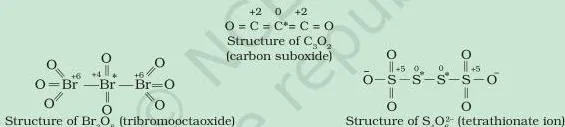
The fraction is an average; the structure shows whole numbers. In \( \text{C}_3\text{O}_2 \), two terminal carbons are +2 each and the middle carbon 0 (average 4/3). In \( \text{Br}_3\text{O}_8 \), two terminal bromines are +6 each and the middle +4 (average 16/3). In \( \text{S}_4\text{O}_6^{2-} \), the two extreme sulphurs are +5 each and the two middle ones 0 — the reality is +5, 0, 0, +5, not 2.5 each.
Fe3O4, Mn3O4 and Pb3O4 are mixed oxides with fractional metal states. Genuine fractional cases do exist: \( \text{O}_2^+ \) is +1/2 and \( \text{O}_2^- \) is −1/2.
Problem 7.7 explained: Pb3O4 behaves as 2 mol PbO + 1 mol PbO2. In PbO2, lead is +4 and can act as an oxidant; PbO is a basic oxide. With HCl, PbO2 oxidises Cl- to Cl2 (redox) while PbO neutralises acid (acid-base). With HNO3, only the acid-base reaction happens because PbO2 is passive toward an oxidising acid. One compound, two chemistries.
Balancing Redox Equations: The Oxidation Number Method in Five Steps
Use this method when the formulas and products are known (NCERT, p. 12):
- Write the correct formula for each reactant and product.
- Assign oxidation numbers and identify the atoms that change.
- Calculate the increase and decrease per atom, then per molecule/ion; multiply by integers so increase = decrease. (Sanity check: if two substances are reduced and nothing is oxidised — or the reverse — the formulas or oxidation numbers are wrong.)
- Balance ionic charge: add H+ in acidic solution, OH- in basic solution.
- Add H2O to balance hydrogen, then verify oxygen — equal oxygen means the equation is balanced.
Grounded example, Problem 7.8 (NCERT, pp. 12-13): \( \text{Cr}_2\text{O}_7^{2-} + \text{SO}_3^{2-} \rightarrow \text{Cr}^{3+} + \text{SO}_4^{2-} \) in acid. Chromium drops +6 → +3 (decrease 3 per atom, 6 for the pair); sulphur rises +4 → +6 (increase 2). Equalising gives 2Cr3+ and 3SO4 2-. Adding 8H+ then 4H2O balances charge and atoms:
\[ \text{Cr}_2\text{O}_7^{2-}\text{(aq)} + 3\text{SO}_3^{2-}\text{(aq)} + 8\text{H}^+\text{(aq)} \rightarrow 2\text{Cr}^{3+}\text{(aq)} + 3\text{SO}_4^{2-}\text{(aq)} + 4\text{H}_2\text{O(l)} \]
Original worked example — balance \( \text{Zn} + \text{NO}_3^- \rightarrow \text{Zn}^{2+} + \text{NH}_4^+ \) in acidic medium:
- Step 1: Skeletal equation: \( \text{Zn(s)} + \text{NO}_3^-\text{(aq)} \rightarrow \text{Zn}^{2+}\text{(aq)} + \text{NH}_4^+\text{(aq)} \).
- Step 2: Assign oxidation numbers.
Zn goes 0 → +2 (increase 2 per atom).
N in NO3- is +5; N in NH4+ is −3 (decrease 8 per atom).
Step 3: Equalise the change — each Zn rises 2, each N falls 8, so multiply Zn by 4: total rise 4 × 2 = 8 equals the fall of 8.
\[ 4\text{Zn} + \text{NO}_3^- \rightarrow 4\text{Zn}^{2+} + \text{NH}_4^+ \]
Step 4: Balance charge in acid.
LHS: −1; RHS: 4(+2) + (+1) = +9.
Add 10H+ to the LHS.
\[ 4\text{Zn} + \text{NO}_3^- + 10\text{H}^+ \rightarrow 4\text{Zn}^{2+} + \text{NH}_4^+ \]
Step 5: Balance hydrogen with water.
LHS H = 10; RHS H (NH4+) = 4, so add 3H2O to the RHS, which also supplies the three oxygen atoms.
\[ 4\text{Zn(s)} + \text{NO}_3^-\text{(aq)} + 10\text{H}^+\text{(aq)} \rightarrow 4\text{Zn}^{2+}\text{(aq)} + \text{NH}_4^+\text{(aq)} + 3\text{H}_2\text{O(l)} \]
Final check: atoms — 4 Zn, 1 N, 3 O, 10 H on each side; charge — +9 on both sides. Balanced.
Balancing Redox Equations: The Half Reaction Method in Seven Steps
Split the reaction into two halves, balance each, and add (NCERT, pp. 13-14). The grounded example is the oxidation of Fe2+ by \( \text{Cr}_2\text{O}_7^{2-} \) in acid:
- Write the unbalanced ionic equation: \( \text{Fe}^{2+} + \text{Cr}_2\text{O}_7^{2-} \rightarrow \text{Fe}^{3+} + \text{Cr}^{3+} \).
- Separate halves: \( \text{Fe}^{2+} \rightarrow \text{Fe}^{3+} \) (oxidation) and \( \text{Cr}_2\text{O}_7^{2-} \rightarrow \text{Cr}^{3+} \) (reduction).
- Balance atoms other than O and H in each half: multiply Cr3+ by 2.
- In acid, add H2O to balance O and H+ to balance H: \( \text{Cr}_2\text{O}_7^{2-} + 14\text{H}^+ \rightarrow 2\text{Cr}^{3+} + 7\text{H}_2\text{O} \).
- Add electrons to balance charge: \( \text{Fe}^{2+} \rightarrow \text{Fe}^{3+} + \text{e}^- \); \( \text{Cr}_2\text{O}_7^{2-} + 14\text{H}^+ + 6\text{e}^- \rightarrow 2\text{Cr}^{3+} + 7\text{H}_2\text{O} \). Multiply the oxidation half by 6.
- Add the halves and cancel electrons.
- Verify atoms and charges match on both sides.
\[ 6\text{Fe}^{2+}\text{(aq)} + \text{Cr}_2\text{O}_7^{2-}\text{(aq)} + 14\text{H}^+\text{(aq)} \rightarrow 6\text{Fe}^{3+}\text{(aq)} + 2\text{Cr}^{3+}\text{(aq)} + 7\text{H}_2\text{O(l)} \quad (7.58) \]
Basic medium conversion trick: balance as if acidic first, then add one OH- to each side for every H+, and combine H+ + OH- → H2O (Problem 7.10 uses this to reach \( 6\text{I}^- + 2\text{MnO}_4^- + 4\text{H}_2\text{O} \rightarrow 3\text{I}_2 + 2\text{MnO}_2 + 8\text{OH}^- \)).
The same zinc reaction by half reactions — every electron count shown:
- Step 1: Skeletal: \( \text{Zn} + \text{NO}_3^- \rightarrow \text{Zn}^{2+} + \text{NH}_4^+ \).
- Step 2: Split: oxidation \( \text{Zn} \rightarrow \text{Zn}^{2+} + 2\text{e}^- \); reduction \( \text{NO}_3^- \rightarrow \text{NH}_4^+ \).
- Step 3: Balance the reduction half — O: add 3H2O to the right; H: add 10H+ to the left; charge: LHS −1 + 10 − 8 = +1 = RHS +1.
\[ \text{NO}_3^- + 10\text{H}^+ + 8\text{e}^- \rightarrow \text{NH}_4^+ + 3\text{H}_2\text{O} \]
- Step 1: Equalise electrons — multiply the zinc half by 4: \( 4\text{Zn} \rightarrow 4\text{Zn}^{2+} + 8\text{e}^- \).
- Step 2: Add the halves and cancel the 8 electrons.
\[ 4\text{Zn(s)} + \text{NO}_3^-\text{(aq)} + 10\text{H}^+\text{(aq)} \rightarrow 4\text{Zn}^{2+}\text{(aq)} + \text{NH}_4^+\text{(aq)} + 3\text{H}_2\text{O(l)} \]
Step 6 (verification — the step that earns the mark): atoms — 4 Zn, 1 N, 3 O, 10 H each side; charge — left −1 + 10 = +9, right 4(+2)+(+1) = +9.
Final answer: identical to the oxidation number method result, as expected.
Redox Titrations: Self Indicators, Diphenylamine and the Iodine-Starch End Point
Just as acid-base titrations use a pH indicator, redox titrations find the strength of a reductant or oxidant with a redox-sensitive indicator. NCERT gives three strategies (NCERT, p. 15):
| Titrant | Indicator strategy | End-point signal |
|---|---|---|
| \( \text{KMnO}_4 \) | Self indicator (intense violet reagent) | First lasting pink tinge appears at \( \text{MnO}_4^- \) as low as \( 10^{-6}\ \text{mol dm}^{-3} \) — minimal overshoot past the equivalence point |
| \( \text{K}_2\text{Cr}_2\text{O}_7 \) | Not self-coloured; uses diphenylamine | Diphenylamine is oxidised just after the equivalence point to an intense blue colour |
| Iodine methods | Starch indicator | I2 gives intense blue with starch; the blue disappears as thiosulphate consumes the I2 |
In iodine methods, Cu2+ oxidises iodide — \( 2\text{Cu}^{2+}\text{(aq)} + 4\text{I}^-\text{(aq)} \rightarrow \text{Cu}_2\text{I}_2\text{(s)} + \text{I}_2\text{(aq)} \) (eq. 7.59) — and the liberated iodine is measured against thiosulphate, \( \text{I}_2 + 2\text{S}_2\text{O}_3^{2-} \rightarrow 2\text{I}^- + \text{S}_4\text{O}_6^{2-} \) (eq. 7.60). I2 stays in solution as KI3.
The equivalence point is where the reductant and oxidant are equal in mole stoichiometry.
Electrode Processes: Redox Couples and the Daniell Cell
The beaker reaction Zn + Cu2+ can be run with the two solutions separate. A beaker of copper sulphate holds a copper rod; another of zinc sulphate holds a zinc rod.
Each metal/solution interface carries both the oxidised and reduced form of a species — a redox couple, written with the oxidised form first, separated by a vertical line or slash (solid/solution interface): Zn2+/Zn and Cu2+/Cu (NCERT, p. 16).
The solutions connect through a salt bridge — a U-tube of KCl or NH4NO3 solution solidified with agar-agar jelly — which gives electrical contact without letting the liquids mix. A metallic wire with an ammeter and switch joins the rods. This assembly is the Daniell cell.

Trace the circuit as the figure shows:
- Zinc rod (anode): Zn loses electrons, Zn2+ enters solution — the oxidation half.
- External wire: electrons travel through the metallic wire, not directly to Cu2+.
- Copper rod (cathode): arriving electrons reduce Cu2+ to metallic copper — the reduction half.
- Salt bridge: ions migrate through it inside the cell, completing the circuit; current flows opposite to electron flow.
With the switch off, no reaction and no current. With it on, electrons move through the wire, ions carry charge through the salt bridge, and current flows only because a potential difference exists between the two electrodes.
Each electrode has an electrode potential. When every species is at unit concentration (gases at 1 atm) and the temperature is 298 K, the potential is the standard electrode potential, E°; by convention E° of H+/H2 is 0.00 V (NCERT, pp. 16-17).
Reading the sign: a negative E° means the couple is a stronger reducing agent than H+/H2; a positive E° means it is a weaker reducing agent than H+/H2 (NCERT, p. 17).
Redox at work — applications you can cite:
- Corrosion of metals (rusting of iron) is a redox process: the metal is oxidised (loses electrons) while environmental oxygen is reduced (NCERT, p. 1).
- Bleaching by hypochlorite: \( \text{Cl}_2 + 2\text{OH}^- \rightarrow \text{ClO}^- + \text{Cl}^- + \text{H}_2\text{O} \) makes hypochlorite, which oxidises colour-bearing stains to colourless compounds (NCERT, p. 10).
- The Daniell cell converts the same Zn/Cu2+ chemistry into electrical energy by routing the electron transfer through a wire (NCERT, pp. 15-16).
Standard Electrode Potential Table: Reading the Numbers
Table 7.1 lists standard electrode potentials for reduction processes (oxidised form + \( n\text{e}^- \) → reduced form) at 298 K; ions are aqueous, gases shown as g and solids as s (NCERT, p. 17). Key rows:
| Reaction (reduction) | E° / V |
|---|---|
| \( \text{F}_2\text{(g)} + 2\text{e}^- \rightarrow 2\text{F}^- \) | +2.87 |
| \( \text{Cl}_2\text{(g)} + 2\text{e}^- \rightarrow 2\text{Cl}^- \) | +1.36 |
| \( \text{O}_2\text{(g)} + 4\text{H}^+ + 4\text{e}^- \rightarrow 2\text{H}_2\text{O} \) | +1.23 |
| \( \text{Br}_2 + 2\text{e}^- \rightarrow 2\text{Br}^- \) | +1.09 |
| \( \text{I}_2\text{(s)} + 2\text{e}^- \rightarrow 2\text{I}^- \) | +0.54 |
| \( \text{Cu}^{2+} + 2\text{e}^- \rightarrow \text{Cu(s)} \) | +0.34 |
| \( 2\text{H}^+ + 2\text{e}^- \rightarrow \text{H}_2\text{(g)} \) | 0.00 |
| \( \text{Pb}^{2+} + 2\text{e}^- \rightarrow \text{Pb(s)} \) | −0.13 |
| \( \text{Zn}^{2+} + 2\text{e}^- \rightarrow \text{Zn(s)} \) | −0.76 |
| \( \text{Mg}^{2+} + 2\text{e}^- \rightarrow \text{Mg(s)} \) | −2.36 |
| \( \text{Li}^+ + \text{e}^- \rightarrow \text{Li(s)} \) | −3.05 |
The more negative the E°, the stronger the reducing agent. Li (E° = −3.05 V) is the strongest reductant on this list; F2 (+2.87 V) the strongest oxidant. The numbers reproduce the beaker order — Zn (−0.76 V) is a better reducing agent than Cu (+0.34 V), which beats Ag (+0.80 V).
The table predicts feasible reactions, aids metallurgical extraction, and leads into the Class 12 study of cells.
Common Mistakes in Redox Problems
| Students write… | Correct rule | How to check your answer |
|---|---|---|
| “Oxygen is always −2” | −2 normally, but −1 in peroxides, −1/2 in superoxides, +2 in OF2, +1 in O2F2 | Is there an O–O bond, or is O bonded to F? |
| “Hydrogen is always +1” | +1 except −1 in binary metal hydrides (NaH, CaH2) | Is H bonded to a metal in a two-element compound? |
| “Fractional oxidation states are real atom states” | They are averages; structure shows whole numbers (C3O2: +2, +2, 0) | Draw the structure before quoting a fraction |
| “The oxidant is the electron donor” | The oxidant is reduced — it gains electrons, its oxidation number falls | Oxidation number going down → that species is the oxidant |
| “Add H+ in a basic medium” | Use OH- in base; balance as if acidic, then convert each H+ with OH- | Read the question: acid → H+, base → OH- |
| “Every decomposition is redox” | Only if an element is produced; CaCO3 → CaO + CO2 changes no oxidation numbers | Check every element’s oxidation number before and after |
| “Half reactions skip charge balancing” | Electrons must balance charge before halves are added | Charge left must equal charge right in each half |
Misconception autopsy — oxidation number is not valency. Valency is the combining capacity of an atom, a whole number with no sign. Oxidation number is a book-keeping charge with a sign — positive, negative, or even fractional. In \( \text{SO}_2 \), sulphur has oxidation number +4; in \( \text{SO}_3 \), +6.
The sign and the fractional possibility (as in \( \text{S}_4\text{O}_6^{2-} \): +5, 0, 0, +5) are what valency never captures — in \( \text{H}_2\text{S} \) sulphur’s oxidation number is −2 while its valency stays 2.
Exam Notes: The Steps That Earn the Mark
Redox answers are marked on the working, not the final word. These are the steps that earn the marks:
- Write the oxidation number over every atom that changes before you classify anything — spotting the changed element is the classification.
- Name the element whose oxidation number changes, then state which species is the oxidant (the one reduced, gaining electrons) and which the reductant (the one oxidised, losing electrons).
- Choose H+ or OH- from the stated medium — acid for H+, base for OH-. The wrong ion means a wrong equation.
- Balance atoms first, then charge with electrons in half reactions — never reverse the order.
- End with the atom-and-charge verification; it is a step, not a courtesy.
- Use Stock notation (Sn(II), Fe(III)) when a metal shows variable valence; the Roman numeral identifies the state.
- Know the classification traps: CaCO3 decomposition is NOT redox; F2 cannot disproportionate; ClO4- cannot disproportionate because Cl is already +7.
These patterns belong to the chapter’s exam-facing Class 11 notes library; they are revision habits, not a list of predicted questions.
Redox Reactions Class 11 Notes: One-Page Revision Recap
This redox reactions class 11 notes recap squeezes the chapter into one table for the night before the exam:
| Concept | What to remember | Example from this chapter |
|---|---|---|
| Oxidation / reduction | Loss/gain of electrons, or increase/decrease of oxidation number; always simultaneous | \( \text{Na} \rightarrow \text{Na}^+ + \text{e}^- \); \( \text{Cl}_2 + 2\text{e}^- \rightarrow 2\text{Cl}^- \) |
| Oxidant / reductant | Oxidant is reduced (gains electrons); reductant is oxidised (loses) | In \( \text{Zn} + \text{Cu}^{2+} \), Zn is reductant, Cu2+ oxidant |
| Oxidation number rules | O = −2 except peroxides, superoxides, OF2; H = +1 except hydrides; F = −1; sum = charge | \( \text{NH}_4\text{NO}_3 \): N = −3 and +5 |
| Four reaction types | Combination, decomposition, displacement, disproportionation | \( \text{CaCO}_3 \rightarrow \text{CaO} + \text{CO}_2 \) is NOT redox (no element formed) |
| Balancing acid vs base | Acid → H+; base → OH- (balance acidic first, then convert) | \( 4\text{Zn} + \text{NO}_3^- + 10\text{H}^+ \rightarrow 4\text{Zn}^{2+} + \text{NH}_4^+ + 3\text{H}_2\text{O} \) |
| Redox couple / E° | Oxidised form / reduced form; negative E° = stronger reductant | \( \text{Zn}^{2+}/\text{Zn} \) (−0.76 V) beats \( \text{Cu}^{2+}/\text{Cu} \) (+0.34 V) |
The three-tier comparison table in the definitions section shows the same reaction through classical, electron-transfer and oxidation-number definitions — return to it whenever you need the three definition sets side by side.
Frequently Asked Questions on Redox Reactions
Why does fluorine not show disproportionation reactions like chlorine does?
Fluorine is the most electronegative element and cannot exhibit a positive oxidation state. Disproportionation needs an element to rise to a higher state (be oxidised), but fluorine from 0 can only stay zero or go negative — so with alkali it gives \( 2\text{F}_2 + 2\text{OH}^- \rightarrow 2\text{F}^- + \text{OF}_2 + \text{H}_2\text{O} \) instead of forming a hypohalite.
How do I decide whether to add H+ ions or OH- ions while balancing a redox equation?
Read the stated medium: acidic solution → use H+; basic solution → use OH-. For a basic medium the safe route is to balance as if acidic first, then add one OH- for each H+ to both sides and combine H+ + OH- → H2O (NCERT, p. 13).
Why is the decomposition of calcium carbonate not a redox reaction?
Because no element is formed or lost — no oxidation number changes. Calcium stays +2, carbon +4, oxygen −2 throughout, and both products are compounds. A decomposition is redox only when an elemental product appears.
What is the difference between oxidation number and valency?
Valency is the combining capacity of an atom — a whole number with no sign. Oxidation number is a book-keeping charge with a sign, and it can even be fractional (an average). Sulphur has oxidation number −2 in H2S, +4 in SO2, +6 in SO3 — while in S4O6 2- the four sulphurs are +5, 0, 0, +5. Valency never carries a sign or an average.
Why is hydrogen assigned oxidation number -1 in NaH but +1 in HCl?
Because oxidation number follows electronegativity. In HCl, chlorine is more electronegative, so the shared pair belongs to Cl and H is +1. In NaH, hydrogen is more electronegative than sodium, so H holds the shared pair and is −1 (the metal-hydride exception).
Is the reaction of zinc with copper sulphate a displacement reaction or a redox reaction?
Both — it is one reaction seen two ways. Zn displaces copper from its salt (metal displacement), and simultaneously Zn is oxidised (0 → +2) while Cu2+ is reduced (→ 0), so it is redox. Displacement is a subtype within redox, not a separate category.
Explore Class 11 Chemistry Notes
Class 11 Chemistry on LearnCBSE:
Related chapters: