
These Recording of Transactions II Class 11 notes condense Chapter 4 of the NCERT Accountancy book Financial Accounting-I into a revision-ready form. You get the six special purpose books — cash book, purchases book, purchases return book, sales book, sales return book and journal proper — with their formats, posting rules, balancing steps and the GST columns of the analytical books.
These notes follow the 2026-27 session of the CBSE curriculum.
The whole idea of this chapter is to split the journal into smaller specialised books, so it assumes you already know journal entries and ledger posting from Chapter 3. If those feel shaky, revise the Recording of Transactions-I notes first — the journal proper here is simply the old journal, kept for transactions no special book covers.
Everything below is built for revision speed: a key-terms table, each book’s format and rules, two fully worked cash books with new numbers, the six calculation rules that carry the arithmetic, eight common mistakes with corrections, and a master revision table. Keep the NCERT textbook beside you for the formal formats — the official chapter PDF is linked at the end.
Why the Journal Is Split into Six Subsidiary Books
A small business can record every transaction in one book — the journal. As the business expands, journalising each transaction separately becomes cumbersome, so transactions of a similar nature are grouped into special journals, also called daybooks or subsidiary books. Whatever no special journal can take is recorded in the residual journal proper (NCERT, p. 99).
The six special purpose books are:
- Cash Book — all cash receipts and payments.
- Purchases Book — credit purchases of goods.
- Purchases Return (Return Outwards) Book — goods sent back to suppliers.
- Sales Book — credit sales of goods.
- Sales Return (Return Inwards) Book — goods returned by customers.
- Journal Proper — everything the other five do not cover.
The chapter gives two clear benefits of these books (NCERT, p. 99): they are economical, since repetitive entries are copied without describing each transaction again, and they make division of labour possible — different clerks can handle different books.
This page is one piece of the Class 11 Accountancy notes set, and the decision flow below is how you route any transaction to its correct book.
Decision flow: where does this transaction go?
- Is cash or the bank account moving? Use the Cash Book — single column if only cash moves, double column if cash and bank both move, or petty cash for small recurring payments.
- No cash involved. Is it a credit purchase of goods? Purchases Book. Is it a credit sale of goods? Sales Book.
- Are goods going back to a supplier? Purchases Return Book. Are goods coming back from a customer? Sales Return Book.
- Anything else — a credit purchase of an asset, an opening entry, adjustments, errors, closing entries? Journal Proper.
One boundary is strict: cash sales and cash purchases always go to the Cash Book, never to the Sales or Purchases books — those two record credit transactions of goods only.
Key Terms at a Glance: The Vocabulary of This Chapter
Twelve terms carry the whole chapter. Learn these first; every rule below is built on them.
| Term | Meaning in plain words | Example |
|---|---|---|
| Subsidiary books (special journals, daybooks) | Books that each record transactions of one similar nature; the journal split into parts (NCERT, p. 99) | All credit purchases in the Purchases Book |
| Cash book | Book of original entry for all cash receipts and payments; serves as both journal and cash account (p. 100) | Deposit of ₹15,000 entered in the cash book |
| Contra entry | Entry whose two aspects both sit inside the cash book; marked C and never posted (p. 106) | Cash deposited into bank |
| Overdraft | Credit balance in the bank column when withdrawals exceed deposits (p. 106) | Bank column ends with a credit figure |
| Pay-in-slip | Bank form for depositing cash or cheques; the counterfoil is returned signed as the receipt (p. 103) | Depositing a customer’s cheque |
| Trade discount | Deduction from the list price, subtracted before the amount is recorded (p. 125) | 10% off a list of ₹16,500 — record ₹14,850 |
| Debit note | Note the buyer prepares to debit the supplier, usually for goods returned (p. 128) | Sent to the supplier with defective goods |
| Credit note | Note the seller prepares to credit the customer for goods returned (p. 128) | Sent to the customer when goods come back |
| Imprest amount | The fixed sum given to the petty cashier at the start of a period (p. 109) | ₹2,000 given on 01 May |
| Dishonour of a cheque | The bank returns the cheque unpaid, usually for insufficient funds (p. 106) | Customer’s cheque bounces; the earlier entry is restored |
| Endorsement | Writing payment instructions for a named person on the back of an order cheque and signing it (p. 105) | Transferring an order cheque to another party |
| Journal proper | The residual book for transactions no special journal covers (p. 139) | Opening entry at the start of a year |
Single Column Cash Book: Receipts on the Left, Payments on the Right
The single column cash book records all cash transactions in chronological order, with one amount column on each side — it is the complete record of cash receipts and cash payments. It is used when all receipts and payments are in cash (NCERT, p. 100). The eight-column skeleton is always the same:
| Dr. | Cr. | ||||||
|---|---|---|---|---|---|---|---|
| Date | Receipts | L.F. | Amount ₹ | Date | Payments | L.F. | Amount ₹ |
| … | Balance b/d and every cash receipt | … | … | … | Every cash payment | … | … |
The book opens with Balance b/d (cash in hand) and then records entries date-wise. The L.F. (ledger folio) column carries the posting reference when an amount is transferred to the ledger.
Posting rule. Every name on the debit side is credited in its ledger account, because cash came in; every name on the credit side is debited, because cash went out (NCERT, p. 101).
When Roopa Traders receive ₹12,000 from Gurmeet, the row “Gurmeet” appears on the debit side and Gurmeet’s account is credited; the furniture bought for cash on the credit side debits the Furniture account.
Balancing rule (NCERT, p. 114). The cash column can never show a credit balance — cash payments can never exceed receipts plus the opening cash in hand.
So the balance is always a debit balance: write “Balance c/d” on the smaller (credit) side so the two sides agree, then bring it down as “Balance b/d” at the top of the debit side for the next period.
Source documents. Receipts are recorded from the duplicate copy of the receipt issued by the cashier; payments, from any bill, invoice or receipt on the basis of which payment was made. These payment documents, called vouchers, are serially numbered and filed (NCERT, p. 114).
Note on discounts. When a receipt or payment is “in full settlement”, the discount element is not recorded in a single column cash book — only the actual cash amount is entered, and the discount surfaces later in the personal account. Example A in the worked examples section builds this book from scratch, discounts and all.
Double Column Cash Book: Cash and Bank in One Book
When bank transactions are large in number, the cash book gains a second amount column on each side — one for cash, one for bank. Keeping the bank column inside the cash book gives a ready view of the bank account’s position from time to time.
All payments into the bank go on the left (debit) side and all withdrawals and payments through the bank go on the right (credit) side (NCERT, p. 106). A current account earns no interest, and the bank charges a small incidental charge for its services (p. 103).
Bank Documents You Must Recognise
To deposit cash or a cheque, the depositor fills a pay-in-slip. It has a counterfoil, which the bank cashier signs and returns as the receipt (NCERT, p. 103). The bank also issues blank cheque forms to the account holder; the drawer writes the payee’s name after the printed word Pay.
A cheque can be crossed to make payment safer. Fig. 4.4 below lays out the main types of crossing the chapter discusses.
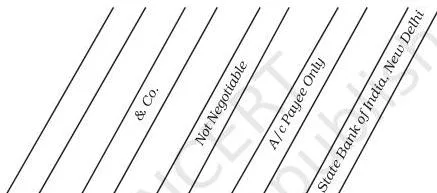
Under an A/c payee only crossing, the amount can be deposited only in the account of the person named on the cheque. Under a special crossing, the name of a bank is written between two parallel lines, and payment can be made only to that bank (NCERT, p. 105).
A bearer cheque can be passed on by mere delivery; an order cheque needs endorsement — writing on the back an instruction to pay a named person and signing it — followed by delivery (p. 105).
Contra Entries: When Cash and Bank Meet
A contra entry is a transaction whose two aspects both appear inside the cash book — cash against bank. It is recorded on both sides at once and marked C in the L.F. column, telling the bookkeeper never to post it to the ledger (NCERT, pp. 105-106, 108).
Think of it like moving money between a mobile wallet and its linked bank account: the total wealth does not change, only where it sits — so no ledger account is touched.
The three situations that create a contra entry:
- Cash deposited into bank — bank column debited, cash column credited.
- Cash withdrawn from bank — cash column debited, bank column credited (the reverse).
- Cheque received but deposited on a later day — on the receipt date it is treated as cash (cash column); on the deposit date it moves to the bank column through a contra entry (NCERT, p. 106).
Overdraft, Dishonour and Bank Charges
Overdraft. The bank column is balanced like the cash column, but it may end with a credit balance — that happens when withdrawals from the bank exceed deposits, and the credit balance is called an overdraft (NCERT, p. 106).
Dishonoured cheque. When a received cheque is returned unpaid — usually from insufficient funds in the customer’s account — the firm restores the old position by entering the cheque amount on the credit side in the bank column in the customer’s name (NCERT, p. 106). The customer’s debt is thereby revived.
Bank charges and interest. If the bank debits the firm for interest, commission or other charges, the entry goes on the credit side in the bank column; if the bank credits the firm (interest, commission), the entry goes on the debit side (NCERT, p. 106).
Ledger consequence. When the bank column exists, no separate bank account is opened in the ledger — the column serves as the bank account (NCERT, p. 108). The bank column’s story continues in the Bank Reconciliation Statement, where the cash book’s bank balance is checked against the bank’s own record. And what about the many small payments that would clutter this book?
That is exactly what petty cash is for, next.
Petty Cash Book: Small Payments under the Imprest System
Conveyance, cartage, postage, telegrams and other small payments repeat constantly. If all of them went through the main cash book, the cashier would be overburdened and the book would become bulky. Large organisations therefore appoint a petty cashier, who keeps a separate petty cash book under the imprest system (NCERT, p. 109).
How the imprest cycle works. A definite sum — say ₹2,000 — is given to the petty cashier at the start of a period. This is the imprest amount. The petty cashier spends out of it through the period; at the end, the head cashier reimburses exactly what was spent, so the next period again opens with the full imprest amount (NCERT, p. 109).
In the chapter’s illustration the petty cashier spends ₹1,487 out of ₹2,000, keeps a balance of ₹513, and is reimbursed ₹1,487 (p. 112).
Real-life analogy. The imprest amount works like a mobile wallet top-up limit. Spending draws the balance down; the reimbursement tops it back up to the same fixed limit. The busy head cashier handles only the periodic top-up, never each small item.
Format. The debit side has one Amount Received column. The credit side has an Amount paid column, then analysis columns for the common heads — Postage; Telephone & Telegram; Conveyance; Stationery; Miscellaneous — followed by a Remarks column for the nature of each payment (NCERT, pp. 109-110).
Payments that have no separate column go into the Miscellaneous column, with the nature noted in Remarks (p. 110).
Three advantages (NCERT, p. 110):
- It saves the chief cashier’s time and effort — large cash transactions get full attention.
- It gives effective control over cash disbursements — division of work makes fraud and embezzlement harder.
- It keeps the main cash book convenient — petty details would make it bulky, and the materiality principle says insignificant details need not appear in the main cash book.
Posting from the petty cash book (NCERT, p. 111). At period end the book is balanced: the difference between total receipts and total payments is the cash with the petty cashier. In the ledger:
| Purpose | Debit | Credit |
|---|---|---|
| Advance of the imprest at period start | Petty cash account | Cash account |
| Period-end allocation of expenses | Each expense account with its analysis-column total (written “Petty cash account”) | Petty cash account with the total spent (“Sundries as per petty cash book”) |
| Reimbursement of the amount spent | Petty cash account | Cash account |
The three cash books compared.
| Feature | Single column | Double column | Petty cash |
|---|---|---|---|
| Amount columns on each side | One — Cash | Two — Cash and Bank | Amount received, total paid, plus analysis columns |
| Transactions recorded | Cash receipts and payments | Cash and bank transactions | Small repetitive payments (conveyance, postage, stationery…) |
| Contra entries | None | Marked C; never posted | None |
| Ledger account replaced | Cash account | Cash and bank accounts | None — a separate petty cash account is kept in the ledger |
| Balance behaviour | Always a debit balance | Cash always debit; bank may be credit (overdraft) | Balance carried forward; imprest restored by reimbursement |
| Maintained by | The cashier | The cashier | The petty cashier |
Purchases Book and Purchases Return Book: Credit Purchases Only
The Purchases Book records only credit purchases of goods. The ruling has three parts (NCERT, p. 125):
- Cash purchases — Cash Book.
- Credit purchases of assets such as office equipment, furniture or a building — Journal Proper (or Cash Book if paid in cash).
- Credit purchases of goods — Purchases Book.
The source document is the invoice or bill received from the supplier. Entries are made with the net amount of the invoice; trade discount and other invoice details are not recorded (NCERT, p. 125).
| Date | Invoice No. | Name of Supplier (Account to be credited) | L.F. | Amount ₹ |
|---|---|---|---|---|
| One row per invoice, in date order; the amount is the net value after trade discount. | ||||
Posting (NCERT, pp. 125-126). Each supplier’s account is credited daily with its individual amount. The monthly total of the book is then debited to the Purchases account, narrated “Sundries as per purchases journal”.
Purchases Return Book. When goods bought on credit are sent back — because they are defective or not up to quality — the entry lands here. For every return, the buyer prepares a debit note in duplicate and sends the original to the supplier; the debit note is the source document (NCERT, p. 127).
The format is the purchases book format with a Debit Note No. column in place of Invoice No., and the heading reads “Account to be debited”.
Posting (NCERT, p. 129). The supplier’s account is debited with its return amount; the Purchases Return account is credited with the periodical total.
Debit note vs credit note (NCERT, pp. 127-128, 131).
| Question | Debit note | Credit note |
|---|---|---|
| Who prepares it? | The buyer | The seller |
| When? | Goods returned to the supplier, or an extra sum recoverable from a party | Goods returned by the customer, or credit due to a party |
| Whose account changes? | Supplier’s account is debited | Customer’s account is credited |
| Which book does it feed? | Purchases Return Book | Sales Return Book |
| Any convention? | — | Commonly made in red ink (NCERT, p. 128) |
Direction memory rule. The buyer debits the supplier, so the buyer sends a debit note. The seller credits the customer, so the seller sends a credit note. The note’s own name tells you the ledger action of the person preparing it.
Sales Book and Sales Return Book: Credit Sales Only
The Sales Book mirrors the Purchases Book. Cash sales go into the Cash Book; the Sales Book records only credit sales of goods (merchandise) (NCERT, p. 129). The source document is the sales invoice issued to the customer — prepared in two or more copies, with one kept by the bookkeeper for the sales journal (pp. 129-130).
| Date | Invoice No. | Name of Customer (Account to be debited) | L.F. | Amount ₹ |
|---|---|---|---|---|
| One row per invoice, in date order; the amount is the net value after trade discount. | ||||
Posting (NCERT, p. 130). Individual customer accounts are debited daily; the monthly total is credited to the Sales account, narrated “Sundries as per sales book”. An extra column may be added to the book to record sales tax recovered from customers and later paid to the government — the GST section below extends this idea (pp. 129-130).
Sales Return Book. When a customer returns goods, the seller prepares a credit note in duplicate; the credit note is the source document for this book (NCERT, p. 131). The format carries a Credit Note No. column and the heading reads “Account to be credited”.
Posting (NCERT, p. 132). The customer’s account is credited with the return; the Sales Return account is debited with the periodical total.
The symmetry of the four books:
| Purchases side | Sales side |
|---|---|
| Purchases Book — credit purchases of goods | Sales Book — credit sales of goods |
| Purchases Return Book — goods returned to suppliers | Sales Return Book — goods returned by customers |
| Source: invoice from the supplier | Source: sales invoice issued to the customer |
| Supplier’s account is credited | Customer’s account is debited |
| Debit note feeds the return book | Credit note feeds the return book |
Analytical Books under GST: Trade Discount and Tax Columns
Under GST, the purchases and sales books become analytical books by adding tax columns. The NCERT format uses these columns: Detail, Total, Purchases (or Sales), CGST, SGST, IGST (NCERT, pp. 137-138). The Detail column carries the working — quantities, rates, the discount and the tax addition — while the summary columns carry the final figures.
The order of calculation is the critical part: list price, less trade discount, giving the taxable value; add GST on the taxable value; the result is the invoice total. An intra-state supply (both parties in the same state) attracts CGST and SGST; an inter-state supply attracts IGST.
Worked walk-through with new numbers. M/s Gupta Trading of Delhi buys the following in one month:
| Supplier | Detail | Total (₹) | Purchases (₹) | CGST (₹) | SGST (₹) | IGST (₹) |
|---|---|---|---|---|---|---|
| Delhi supplier (intra-state) | 30 steel tiffins @ ₹400 each = 12,000; 15 flasks @ ₹300 each = 4,500; list price 16,500; less trade discount 10% (1,650); taxable value 14,850; add CGST @ 6% and SGST @ 6% | 16,632 | 14,850 | 891 | 891 | — |
| Jaipur supplier (inter-state) | 10 hand blenders @ ₹1,200 each = 12,000; less trade discount 5% (600); taxable value 11,400; add IGST @ 12% | 12,768 | 11,400 | — | — | 1,368 |
| Total | 29,400 | 26,250 | 891 | 891 | 1,368 |
Watch the two mechanisms: the intra-state purchase splits the tax into CGST and SGST, while the inter-state purchase carries the whole tax as IGST. The same logic applies to the analytical sales book, where the Sales column carries the net value after trade discount and the tax columns carry CGST/SGST or IGST (NCERT, pp. 138-139).
Note on rates. GST rates are always supplied in the question. What the exercise tests is the mechanism — discount first, then the correct split of the tax — not your memory of the rate.
Journal Proper: The Residual Book for Everything Else
The journal proper (also called the journal residual) records transactions that find no place in the special journals (NCERT, p. 139). It is the catch-all: if a transaction is not cash, and not a credit purchase, sale or return of goods, it lands here.
The five types of journal proper entries (NCERT, pp. 139-140):
| Type | What it records | One example |
|---|---|---|
| 1. Opening entry | Opening balances of assets, liabilities and capital to open the new year’s books | Opening a new set of books with balances brought forward |
| 2. Adjustment entries | Updating ledger accounts on an accrual basis at period end | Rent outstanding, prepaid insurance, depreciation, commission received in advance |
| 3. Rectification entries | Correcting errors in recording transactions and posting them | Fixing an amount wrongly written in the journal |
| 4. Transfer (closing) entries | Closing nominal accounts and the drawings account at year end | Sales, purchases, opening stock, incomes, gains and expenses closed to the Trading and Profit and Loss Account; drawings transferred to capital |
| 5. Other entries | Sundry transactions no other book takes | See the list below |
The “other entries” list (NCERT, p. 140):
- Cancellation of discount allowed or received earlier when a cheque is dishonoured.
- Credit purchase or sale of items other than goods (an asset, for example).
- Goods withdrawn by the owner for personal use.
- Goods distributed as samples for sales promotion.
- Endorsement and dishonour of bills of exchange.
- Transactions relating to consignment and joint venture.
- Loss of goods by fire, theft or spoilage.
Memory device — “Our Accounts Rarely Trouble Others”.
- O — Opening entry
- A — Adjustment entries
- R — Rectification entries
- T — Transfer (closing) entries
- O — Other entries
The phrase’s five starting letters match the five categories — run through them when you must decide whether a transaction belongs in the journal proper.
Worked Examples: Building the Books Step by Step
Two fully worked books with new numbers follow — none of the figures repeats a textbook illustration value. The method is named first, then every step is shown.
Example A: Single Column Cash Book — M/s Bluebird Books, March 2025
Method: single column cash book balancing — record every cash receipt on the debit side and every payment on the credit side, then equalise the two sides with Balance c/d.
- Step 1: Open the book on 01 March 2025 with the cash in hand: write “Balance b/d” on the debit side with ₹45,000.
- Step 2: Classify each transaction as a receipt or a payment and enter the rows in date order.
Receipts: from Meera ₹18,500 (03 Mar), cash sales ₹26,400 (06 Mar), from Tanvi ₹16,800 (23 Mar).
Payments: office furniture ₹9,800 (09 Mar), goods for cash ₹22,700 (12 Mar), to Anil ₹11,300 (15 Mar), stationery ₹2,150 (19 Mar), rent ₹6,000 (27 Mar), salary ₹12,000 (29 Mar), deposited into bank ₹15,000 (31 Mar).
Leave the L.F.
column blank — it is filled later when the entries are posted to the ledger.
Step 3: Ignore the two settlement discounts.
Meera’s claim of ₹19,000 settled for ₹18,500 hides a ₹500 discount; Anil’s ₹11,500 settled for ₹11,300 hides ₹200.
A single column cash book records only the actual cash amounts — these discounts appear later in the personal accounts, not here.
Step 4: Total both sides.
Receipts: ₹1,06,700.
Payments: ₹78,950.
Step 5: Insert the balance.
Balance c/d = ₹1,06,700 – ₹78,950 = ₹27,750, written on the smaller (credit) side so the two sides now agree at ₹1,06,700.
Step 6: Bring the balance down as “Balance b/d” ₹27,750 on the debit side on 01 April 2025 — the book opens next month with this figure.
The completed book:
| Dr. | Cr. | ||||||
|---|---|---|---|---|---|---|---|
| Date | Receipts | L.F. | Amount ₹ | Date | Payments | L.F. | Amount ₹ |
| 2025 Mar 01 | Balance b/d | 45,000 | Mar 09 | Furniture | 9,800 | ||
| Mar 03 | Meera | 18,500 | Mar 12 | Purchases | 22,700 | ||
| Mar 06 | Sales | 26,400 | Mar 15 | Anil | 11,300 | ||
| Mar 23 | Tanvi | 16,800 | Mar 19 | Stationery | 2,150 | ||
| Mar 27 | Rent | 6,000 | |||||
| Mar 29 | Salary | 12,000 | |||||
| Mar 31 | Bank | 15,000 | |||||
| Mar 31 | Balance c/d | 27,750 | |||||
| 1,06,700 | 1,06,700 | ||||||
| Apr 01 | Balance b/d | 27,750 | |||||
Final answer: the cash book closes with a debit balance of ₹27,750 (cash in hand), brought down as Balance b/d on 01 April.
Example B: Double Column Cash Book — M/s Shine Electronics, April 2025
Method: double column cash book with contra entries, a dishonoured cheque and bank charges — keep the cash and bank columns separate, mark every contra entry C, and never post a C entry.
- Step 1: Enter the opening balances on the debit side: Balance b/d cash ₹28,000 and bank ₹70,000.
- Step 2: Same-day cheque — Vikram’s cheque for ₹24,000 (04 Apr) is deposited the same day, so it enters the bank column directly on the debit side.
- Step 3: Next-day cheque — Kavita’s cheque for ₹14,600 is received on 12 Apr but deposited on 14 Apr.
On 12 Apr it is treated as cash (cash column debit ₹14,600).
On 14 Apr it is moved by a contra entry: bank column debit ₹14,600, cash column credit ₹14,600.
Step 4: Record the other two contra entries.
On 16 Apr cash of ₹18,000 is deposited into the bank: bank column debit ₹18,000, cash column credit ₹18,000.
On 24 Apr cash of ₹9,000 is withdrawn for office use: cash column debit ₹9,000, bank column credit ₹9,000.
Mark C in the L.F.
column against all contra rows.
Step 5: Dishonour — Vikram’s cheque bounces on 27 Apr.
Enter ₹24,000 on the credit side in the bank column under Vikram, restoring his debt exactly as before the cheque.
Step 6: Bank charges of ₹350 (28 Apr) go on the credit side in the bank column.
Interest of ₹1,250 credited by the bank (30 Apr) goes on the debit side in the bank column.
- Step 1: Enter the remaining payments: goods purchased by cheque ₹31,500 (07 Apr), cheque to Anant ₹12,800 (20 Apr), rent by cheque ₹6,000 (29 Apr) — all credit the bank column; salaries paid in cash ₹15,500 (30 Apr) credit the cash column.
- Step 2: Total and balance.
The cash column totals ₹70,800 on each side, leaving a cash balance of ₹22,700.
The bank column totals ₹1,27,850 on each side, leaving a bank balance of ₹44,200.
Insert both as Balance c/d and bring them down on 01 May.
The completed book:
| Dr. | Cr. | ||||||||
|---|---|---|---|---|---|---|---|---|---|
| Date | Receipts | L.F. | Cash ₹ | Bank ₹ | Date | Payments | L.F. | Cash ₹ | Bank ₹ |
| 2025 Apr 01 | Balance b/d | 28,000 | 70,000 | Apr 07 | Purchases | 31,500 | |||
| Apr 04 | Vikram | 24,000 | Apr 14 | Bank | C | 14,600 | |||
| Apr 10 | Sales | 19,200 | Apr 16 | Bank | C | 18,000 | |||
| Apr 12 | Kavita | 14,600 | Apr 20 | Anant | 12,800 | ||||
| Apr 14 | Cash | C | 14,600 | Apr 24 | Cash | C | 9,000 | ||
| Apr 16 | Cash | C | 18,000 | Apr 27 | Vikram | 24,000 | |||
| Apr 24 | Bank | C | 9,000 | Apr 28 | Bank charges | 350 | |||
| Apr 30 | Interest | 1,250 | Apr 29 | Rent | 6,000 | ||||
| Apr 30 | Salary | 15,500 | |||||||
| Apr 30 | Balance c/d | 22,700 | 44,200 | ||||||
| 70,800 | 1,27,850 | 70,800 | 1,27,850 | ||||||
| May 01 | Balance b/d | 22,700 | 44,200 | ||||||
Posting consequences: Purchases, salaries, rent and bank charges are debited in the ledger; Sales and Interest are credited; Vikram’s account is debited ₹24,000 on dishonour, reversing the earlier receipt. The six rows marked C never reach the ledger. Because the bank column exists, no bank account is opened in the ledger (NCERT, p. 108).
Final answer: cash balance ₹22,700 and bank balance ₹44,200, both brought down as Balance b/d on 01 May 2025.
The Calculation Rules in This Chapter: Balance, Discount, GST and Imprest
This chapter has no algebraic formulas to memorise, but six arithmetic rules carry every numerical answer. Amounts are in ₹ and rates in % wherever they apply.
| Rule | How to compute it | Where it applies |
|---|---|---|
| 1. Balancing an account or cash book | Balance c/d = total of the larger side minus total of the smaller side; write it on the smaller side so both totals agree | Every ledger account and both cash books (NCERT, p. 114) |
| 2. Cash column always debit | Payments can never exceed receipts plus the opening cash | Cash columns of the single and double column cash books (NCERT, p. 114) |
| 3. Overdraft — the exception | When withdrawals from the bank exceed deposits, the bank column shows a credit balance (overdraft) | Bank column of the double column cash book (NCERT, p. 106) |
| 4. Trade discount | Net amount = list price minus trade discount; enter only the net amount | Purchases and sales books (NCERT, p. 125) |
| 5. GST | Taxable value = list price minus trade discount; GST = taxable value at the given rate; invoice total = taxable value plus GST. Intra-state supply: CGST + SGST; inter-state supply: IGST | Analytical purchases and sales books (NCERT, pp. 137-139) |
| 6. Imprest reimbursement | Amount spent = imprest amount minus cash left with the petty cashier; reimbursement equals the amount spent, restoring the imprest | Petty cash book (NCERT, pp. 109, 112) |
Two places the usual pattern breaks: the overdraft in the bank column (rule 3), and a cheque deposited a day after receipt, which needs a two-step treatment — cash column first, then a contra move to the bank column.
Common Mistakes in Subsidiary Books and How to Fix Them
These eight slips are the ones students actually repeat. Each row gives the error, the correct rule, and the reason that makes the rule natural.
| Students write… | Correct is… | Why — and how to check |
|---|---|---|
| Posting a contra entry to the ledger | Leave it out — entries marked C are internal cash-to-bank movements and are never posted (NCERT, pp. 106, 108) | No third account exists; scan the L.F. column for C and skip those rows |
| Recording cash purchases in the Purchases Book | Cash purchases belong to the Cash Book; the Purchases Book records only credit purchases of goods (NCERT, p. 125) | Ask “did cash move?” — if yes, the Cash Book takes it |
| Confusing the debit note with the credit note | The buyer sends a debit note for goods returned to the supplier; the seller sends a credit note for goods returned by the customer (NCERT, pp. 127-128, 131) | Who is preparing the note? The note’s name matches that party’s ledger action — debit for the buyer, credit for the seller |
| Making a separate entry for trade discount | Deduct the discount before recording; enter only the net amount (NCERT, p. 125) | The invoice shows the working; the books carry the net figure only |
| Showing a dishonoured cheque on the debit side | It goes on the credit side in the bank column, in the customer’s name (NCERT, p. 106) | It reverses the earlier receipt and revives the customer’s debt — check that the two effects cancel |
| Giving the cash column a credit balance | Impossible — payments can never exceed receipts plus opening cash; only the bank column can be overdrawn (NCERT, p. 114) | Cash balances always appear on the debit side when brought down |
| Debiting the Sales account with the sales return total | The periodical total is debited to the Sales Return account; individual customer accounts are credited (NCERT, pp. 131-132) | Sales Return is a deduction from sales, kept in its own account — that is why the account exists |
| Entering a credit purchase of furniture in the Purchases Book | The Purchases Book takes goods (merchandise) only; a credit purchase of an asset goes to the Journal Proper (NCERT, p. 125) | Ask “is this goods meant for resale?” — furniture is not |
Exam Notes: How to Present a Complete Answer
A complete answer to this chapter’s exercises must show the following seven things — each is an element the question itself demands, not an optional extra.
- Reproduce the full format. Show both Dr and Cr sides with dates, an L.F. (or J.F.) column, and every amount column headed ₹. A skeleton format omits the very structure being tested.
- Balance to agree. After inserting Balance c/d on the smaller side, the two totals must match; bring the balance down as Balance b/d on the opposite side for the next period (NCERT, p. 114).
- Mark every contra entry C in the L.F. column and exclude it from posting (NCERT, p. 106).
- Post parties daily and totals periodically. Individual supplier and customer accounts are posted daily; the Purchases, Sales and Returns accounts receive only the period total, narrated “Sundries as per…” (NCERT, pp. 126-127, 130-131).
- Petty cash answers need the analysis columns totalled separately and the reimbursement shown — balance = amount received minus the total paid (NCERT, pp. 109-112).
- Analytical (GST) answers must show the detail working in order: list price, less trade discount, taxable value, add CGST/SGST or IGST, invoice total (NCERT, pp. 137-139).
- When a transaction states “in full settlement”, the single column cash book receives only the actual cash amount; the discount is reflected later in the personal account, never in the cash book.
Revision Recap: All Six Books in One Table
Everything in this chapter reduces to six books and two questions — is it cash, and is it goods on credit? The master table below maps each book to what it records, its source document and its postings.
| Book | What is recorded | Source document | Individual postings | Periodic total postings |
|---|---|---|---|---|
| Single Column Cash Book | Cash receipts and payments | Duplicate receipts; numbered vouchers | Debit-side names credited; credit-side names debited | None — the book itself is the cash account |
| Double Column Cash Book | Cash and bank receipts and payments | Pay-in-slips, cheques, receipts, vouchers | Same rule; contra entries marked C are skipped | None — the book itself is the cash and bank accounts |
| Petty Cash Book | Small repetitive payments (conveyance, postage, stationery…) | Petty cash vouchers | Each expense account debited with its analysis-column total | Petty cash account credited with the total spent (“Sundries as per petty cash book”) |
| Purchases Book | Credit purchases of goods only | Invoice or bill received from the supplier | Supplier accounts credited daily | Purchases account debited with the monthly total |
| Purchases Return Book | Goods returned to suppliers | Debit note | Supplier accounts debited daily | Purchases Return account credited with the periodical total |
| Sales Book | Credit sales of goods only | Sales invoice (one copy kept by the bookkeeper) | Customer accounts debited daily | Sales account credited with the monthly total |
| Sales Return Book | Goods returned by customers | Credit note | Customer accounts credited daily | Sales Return account debited with the periodical total |
| Journal Proper | Opening, adjustment, rectification, transfer (closing) and other entries | Various vouchers, notes and memos | Every entry posted individually | None |
The chain of recording runs: transaction, subsidiary book, ledger, and finally the trial balance in the next stage of the accounting process.
These notes are part of the Class 11 Accountancy notes collection; the bank column of the double column cash book leads directly into the Bank Reconciliation Statement. For the wider set of subjects, see the Class 11 notes and the complete CBSE notes index.
For the formal formats and the full set of chapter illustrations, open the official NCERT Chapter 4 PDF on the NCERT website.
Reference: NCERT Class 11 Accountancy textbook, chapter Recording of Transactions-II.
FAQs: Last-Minute Doubts, Quickly Answered
1. Which transactions go into the Purchases Book and which into the Cash Book?
Credit purchases of goods go into the Purchases Book; cash purchases of the same goods go into the Cash Book. A credit purchase of an asset — furniture, machinery or a building — is not goods, so it goes to the Journal Proper (NCERT, pp. 125, 139). Ask the two questions in order: is it goods, and is it on credit?
2. What is a contra entry in the double column cash book and why is it marked C?
A contra entry is a transaction between cash and bank, such as cash deposited into the bank or withdrawn from it. Because both aspects fall inside the cash book, it is written on both sides — once in the cash column, once in the bank column — and marked C in the L.F. column (NCERT, p. 106).
The C means the entry is not posted to the ledger, since no outside account is involved (NCERT, p. 108).
3. Who sends a debit note and who sends a credit note, and where are they recorded?
The buyer sends a debit note when goods are returned to the supplier; it is recorded in the Purchases Return Book (NCERT, p. 127). The seller sends a credit note when a customer returns goods; it is recorded in the Sales Return Book (NCERT, p. 131).
Remember the direction: the buyer debits the supplier, so the note is a debit note; the seller credits the customer, so the note is a credit note.
4. Why can the cash column never have a credit balance when the bank column can?
Cash payments can never exceed the cash actually available — receipts plus the opening balance — so the cash column always ends with a debit balance (NCERT, p. 114). The bank column is different: a bank allows withdrawals beyond the deposit, creating an overdraft, and that appears as a credit balance in the bank column (NCERT, p. 106).
5. How does the imprest system of petty cash work?
The petty cashier receives a fixed sum — the imprest amount, say ₹2,000 — at the start of a period and makes all small payments from it (NCERT, p. 109). At the end of the period the head cashier reimburses exactly what was spent, so the next period again opens with the full ₹2,000.
In the chapter’s example, ₹1,487 was spent out of ₹2,000, leaving ₹513, and ₹1,487 was reimbursed (NCERT, p. 112).
6. Is trade discount recorded anywhere in the subsidiary books?
No. The trade discount is deducted before recording, and the purchases and sales books carry only the net amount of the invoice (NCERT, p. 125). The discount appears on the invoice itself, never as a separate entry in the subsidiary books.
Explore Class 11 Accountancy Notes
- Class 11 Accountancy Notes
- Class 11 CBSE Notes
- CBSE Notes for Classes 1 to 12
- Previous: Recording of Transactions-I
- Next: Bank Reconciliation Statement
Class 11 Accountancy on LearnCBSE:
Related chapters:
- Introduction to Accounting notes
- Theory Base of Accounting notes
- Trial Balance and Rectification of Errors notes