
These Introduction to Accounting Class 11 notes condense NCERT’s opening accountancy chapter into a fast revision map: the full meaning of accounting, the four-step process behind it, who uses the information and why, the objectives and roles of accounting, and a complete glossary of all 20 basic terms.
Everything is organised for a quick re-read before a class test, with original worked examples and the common mistakes students make with these terms. The notes follow the NCERT Class 11 Accountancy textbook (Financial Accounting-I) for the 2026-27 session.
Use the jump menu to skip to the section you need. If a definition feels shaky, start with the glossary tables — most Chapter 1 questions are vocabulary questions in disguise. The worked examples use fresh numbers, so practise the reasoning rather than memorising outcomes.
Accounting as an Information System: What Chapter 1 Covers
For centuries, accounting was confined to the financial record-keeping function of the accountant. The chapter opens by showing how that role has shifted: the modern accountant is no longer a mere recorder of transactions but a member of the decision-making team who supplies relevant information (NCERT, p. 1).
That is why the opening introduces new growth areas — forensic accounting, e-commerce, financial planning and environmental accounting — and why accounting itself has been raised to the level of an information system: it collects data and communicates economic information about the organisation to a wide variety of users whose decisions and actions relate to its performance (NCERT, p. 2).
The chapter builds six blocks, each tied to a learning objective (NCERT, pp. 1-2): the meaning and need of accounting; accounting as a source of information; the internal and external users of accounting information; the objectives of accounting; the role of accounting; and the basic terms used in accounting.
This page follows that same arc, so the revision order matches the teaching order.
These notes are part of our full set of Class 11 Accountancy notes, which sits inside the wider Class 11 notes collection in the CBSE notes library. When Chapter 1 is clear, move straight to Chapter 2, Theory Base of Accounting, which explains the rules behind the terms you learn here.
If you want to verify a page-level detail, the official NCERT PDF of Chapter 1 of Financial Accounting-I is available on the NCERT website.
Meaning of Accounting: From ‘Art of Recording’ to a Full Process
The definition of accounting grew in three steps, each widening the scope (NCERT, pp. 2-3):
| Source (year) | What it stressed |
|---|---|
| AICPA (1941) | Accounting as the art of recording, classifying and summarising, in a significant manner and in terms of money, the transactions and events that are at least partly of financial character, and interpreting the results. |
| American Accounting Association (1966) | Accounting as the process of identifying, measuring and communicating economic information to permit informed judgments and decisions by users of information. |
| Accounting Principles Board of AICPA (1970) | The function of accounting is to provide quantitative information, primarily financial in nature, about economic entities, intended to be useful in making economic decisions. |
Putting the three together gives the NCERT definition: accounting is the process of identifying, measuring, recording and communicating the required information relating to the economic events of an organisation to the interested users of such information (NCERT, p. 3). These four process words are the same four words a complete answer must repeat.
A short history strip explains where this definition came from (NCERT, pp. 3-4):
- ~4000 B.C. — payments of wages and taxes recorded on clay tablets in Babylonia and Egypt; Egyptian treasuries sent day-wise reports to the Wazirs and month-wise reports to the kings.
- Greece — accounting was used to apportion revenues among treasuries and to maintain totals of receipts, payments and the balance of government transactions.
- Rome (700 B.C. – 400 A.D.) — receipts and payments were recorded in a memorandum or daybook and then posted to ledgers monthly.
- China — a sophisticated form of government accounting existed as early as 2000 B.C.
- India — Kautilya’s Arthashastra, written about twenty-three centuries ago, described how accounting records had to be maintained.
- 1494 — Luca Pacioli’s Summa de Arithmetica became the first book on double entry book-keeping. Pacioli did not claim to have invented the system but spread its knowledge, and he used the modern terms Debit (Dr.) and Credit (Cr.) — from the Italian debito (owed) and credito (trust or belief).
The Accounting Process: From Economic Events to Communication
The whole chapter turns on one figure. Fig 1.1, “Showing the process of accounting” (NCERT, p. 2), sets out linked steps that begin with identification of transactions and end with the preparation of financial statements; the chapter later calls this “a definite process of interlinked activities” (NCERT, p. 7). Read it as a flow: identification → measurement → recording → communication.
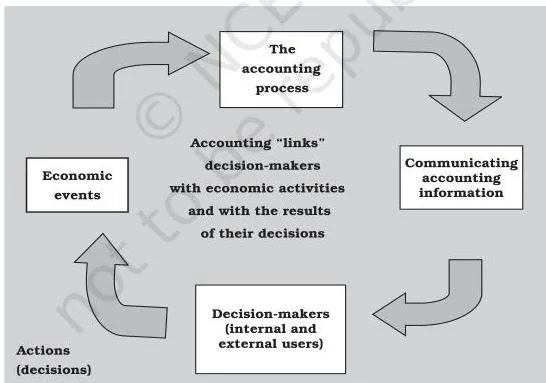
Economic events come first. An economic event is a happening of consequence to a business organisation, consisting of transactions that can be measured in monetary terms (NCERT, p. 4). One event can hold many transactions: buying a machine involves the purchase, its transport, site preparation, installation and trial runs. Events are of two kinds:
- External events — between the organisation and an outsider: sale of merchandise to customers, rendering services, purchase of materials from suppliers, payment of rent to the landlord.
- Internal events — entirely between the internal wings of an enterprise: supply of raw material from the stores department to the manufacturing department, or payment of wages to employees.
The four steps of the process (NCERT, pp. 5-6):
- Identification — deciding which events are of financial character and relate to the organisation, and therefore belong in the books. A sale, a purchase or a salary payment is recorded; the appointment of personnel is not.
- Measurement — quantifying transactions in financial terms using monetary units, rupees and paise, as the measuring unit (estimates are permitted). If an event cannot be quantified in money, it is not considered for recording.
- Recording — entering the identified and measured events in the books of account in monetary terms and in chronological order, summarised as per well-established practice.
- Communication — sending the pertinent information to the right person at the right time through accounting reports, which may be daily, weekly, monthly or quarterly. The accountant’s ability to present information clearly matters here.
The definition also fixes two more elements (NCERT, p. 6): the organisation — a business enterprise with a for-profit or not-for-profit motive, such as a sole proprietorship, partnership firm, cooperative society, company or local authority — and the interested users of the information, covered next.
Memory device: “I Measure Real Cash.” Each word cues one step in order — Identify, Measure, Record, Communicate.
Users of Accounting Information: Internal and External
Accounting is called the language of business because it is the means by which financial information about an enterprise is communicated to those who need it for decisions (NCERT, p. 6).
Users fall into two broad categories: internal users — the chief executive, financial officer, vice presidents, business unit managers, plant managers, store managers and line supervisors — and external users, who include present and potential investors, creditors (banks, financial institutions, debenture-holders and other lenders), tax authorities and regulatory agencies.
The table below links each user group to the specific question accounting must answer for it — the pattern the chapter builds in two places (NCERT, pp. 6-7 and 13-14).
| User group | Internal or external | Main question it wants answered |
|---|---|---|
| Owners / shareholders | External | Are we getting a satisfactory return on our investment? Is the company financially healthy? |
| Management (directors, managers) | Internal | How are we performing against industry figures? Is invested money generating an adequate return while the firm stays able to pay its debts? |
| Creditors and lenders | External | Will we be paid on time? They look particularly at liquidity — the ability to pay debts as they become due (NCERT, p. 7). |
| Prospective investors | External | Should we invest in this business? (They assess risk and return on investment.) |
| Tax and regulatory agencies (income tax, customs, RBI, IRDA, Registrar of Companies) | External | Are taxes such as VAT, income tax, customs and excise correctly paid, and are legal obligations under the Companies Act 2013 and SEBI met? |
| Employees and unions | External | Is the business stable and profitable, and how is wealth distributed within it? |
| Customers | External | Will the business survive so that products, parts and after-sales service keep being supplied? |
| Suppliers | External | Will the amounts owed to us be repaid when due, and will the business continue to exist? |
| Competitors | External | What are the relative strengths and weaknesses of the firm? (Used for comparison and benchmarking.) |
| Social responsibility groups (e.g. environmental groups) | External | What is the impact of the business on the environment, and how is the environment being protected? |
Two points worth fixing in memory. First, since the primary function of accounting is to support decisions, it is a means to an end, the end being the decision the information makes possible (NCERT, p. 6). Second, external users have limited authority, ability and resources to obtain information themselves, so they depend on the financial statements (NCERT, p. 13).
Long-term lenders in particular want information on the company’s creditworthiness and its ability to repay loans and pay interest (NCERT, p. 13).
Qualitative Characteristics: The Four Filters of Useful Information
Accurate information is not enough — it must be usable. The four qualitative characteristics are the filters that decide whether accounting information is decision-useful: reliability, relevance, understandability and comparability (NCERT, p. 9).
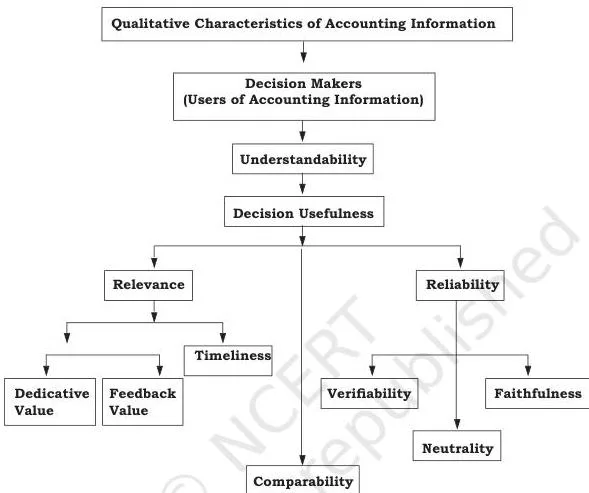
Fig 1.3 (NCERT, p. 11) presents the four characteristics as the attributes an information system must carry for its output to be useful. It is a ready-made answer frame: name all four, define each in one line, then attach its sub-points.
| Characteristic | What it demands of the information | Key sub-points |
|---|---|---|
| Reliability | Users must be able to depend on it; the information must faithfully represent the transactions or events it claims to describe. | Free from error and bias; credible; verifiable by independent parties using the same measurement method; neutral and faithful (NCERT, p. 9). |
| Relevance | The information must influence decisions — and must arrive in time to do so. | Available in time; helps in prediction and feedback; helps form predictions about outcomes of past, present or future events and/or confirms or corrects past evaluations (NCERT, p. 10). |
| Understandability | Decision-makers must interpret the information in the same sense in which it was prepared and conveyed to them. | Clear presentation; comparable information shown in the most intelligible manner without sacrificing relevance or reliability (NCERT, pp. 10-11). |
| Comparability | Users must be able to compare the entity over different time periods and with other entities. | Accounting reports must belong to a common period, use a common unit of measurement and follow a common format of reporting (NCERT, p. 12). |
Why these four? Each guards one failure mode: unreliable information misleads, irrelevant information distracts, incomprehensible information is ignored, and non-comparable information cannot be benchmarked against anything.
Self-check (Test Your Understanding-II, NCERT, p. 12): as a senior accountant, what three steps would you take to make your company’s financial statements understandable and decision-useful? The chapter’s own answer: ensure reliability (verifiability, faithfulness, neutrality), ensure relevance through timeliness, and then check understandability and comparability (NCERT, p. 23).
Branches of Accounting: Financial, Cost and Management
The differing needs of internal and external users pushed accounting to split into three sub-disciplines (NCERT, p. 8). The comparison table lines them up by purpose, time orientation and main users — useful both as a revision table and as the shape of a complete answer to a “differentiate” question.
| Branch | What it does | Time orientation | Main users |
|---|---|---|---|
| Financial accounting | Keeps a systematic record of financial transactions and prepares financial reports — the profit and loss account and the balance sheet — to measure organisational success and financial soundness (NCERT, pp. 8, 10). | Past period; serves the stewardship function; monetary in nature | All stakeholders, mainly external users |
| Cost accounting | Analyses expenditure to ascertain the cost of products manufactured or services rendered, fixes prices, controls costs and supplies costing information for decision-making (NCERT, pp. 8-10). | Not labelled in the chapter; centred on current product costing and control | Management, for costing, pricing and cost control |
| Management accounting | Provides accounting information to people within the organisation for decision-making, planning and controlling; draws mainly from financial and cost accounting and generates future-related quantitative and qualitative information such as sales forecasts, cash flows and manpower needs (NCERT, p. 9). | Future-oriented | Management (internal users) |
The chapter also flags new areas that have gained prominence as the scope of accounting has widened: human resource accounting, social accounting and responsibility accounting (NCERT, p. 9).
Objectives of Accounting: Four Jobs the System Must Do
The basic objective of accounting as an information system is to provide useful information to interested users, both external and internal, delivered mainly through financial statements — the profit and loss account and the balance sheet (NCERT, p. 12). That broad aim breaks into four jobs.
- Maintenance of records of business transactions. A systematic record of all financial transactions is kept in the books because no manager can accurately remember the volume of purchases, sales, receipts and payments that occur daily. The recorded information also enables verifiability and acts as evidence (NCERT, p. 12).
- Calculation of profit and loss. Owners want to know periodically whether the business earned profit or suffered loss. A profit and loss account for the period is prepared from the records of incomes and expenses. Profit is the excess of revenue over expenses; if expenses exceed revenue, the difference is loss (NCERT, pp. 12-13).
- Depiction of financial position. A proper record of resources owned (assets) and claims against those resources (liabilities) allows preparation of the balance sheet — the position statement — at the end of every accounting period (NCERT, p. 13).
- Providing accounting information to its users. The information generated is communicated as reports, statements, graphs and charts. Internal users (management) receive timely information on cost of sales and profitability; external users, who have limited means to obtain information themselves, rely on the financial statements (NCERT, p. 13).
Role of Accounting: Five Views, One Language
Accounting has played changing roles as economies and societal demands grew. Each role is a different view of the same activity: describing and analysing a mass of data through measurement, classification and summarisation, then reducing it to reports that show the financial condition and results of operations of an enterprise (NCERT, p. 14). The chapter presents five views:
- As a language — the language of business, used to communicate information about enterprises.
- As a historical record — a chronological record of financial transactions at the actual amounts involved.
- As current economic reality — the means of determining the true income of an entity, that is, the change of wealth over time.
- As an information system — a process that links an information source (the accountant) to a set of receivers (external users) through a channel of communication.
- As a commodity / service — specialised information as a service in demand, which accountants are willing and able to provide (NCERT, pp. 15-16).
Two guard rails keep the role in focus. First, accounting is a means to an end, not an end in itself — the end is the decision helped by the availability of accounting information (NCERT, p. 6). Second, its limitation: accounting information relates to past transactions and is quantitative and financial in nature, so it does not provide qualitative or non-financial information.
Users must keep this limitation in view while using accounting information (NCERT, p. 14).
Basic Accounting Terms: All 20 Terms in One Glossary
Chapter 1’s vocabulary is the foundation of the whole subject. The two tables below cover every term the chapter defines (NCERT, pp. 16-21) — first the balance-sheet terms, then the performance and other terms. Each row is compressed to one line so you can self-test by covering the example column.
Balance-sheet terms
| Term | Meaning | Quick example / reminder |
|---|---|---|
| Entity | A reality with a definite individual existence; the specific business enterprise for which the accounting system is devised. | Super Bazaar, ITC Limited. |
| Transaction | An event involving some value between two or more entities; may be cash or credit. | Purchase of goods, receipt of money, payment to a creditor. |
| Assets | Economic resources of an enterprise that can be usefully expressed in monetary terms and that provide economic benefit. | A fleet of delivery trucks owned by Super Bazaar. |
| Liabilities | Obligations or debts the enterprise must pay in the future; they represent creditors’ claims on the firm’s assets. | A three-year bank loan; goods bought on credit. |
| Capital | The amount invested by the owner, in cash or assets; a claim on the business’s assets, shown on the liabilities side of the balance sheet. | Cash brought in by the owner at start-up. |
| Debtors | Persons or entities who owe the enterprise for goods or services bought on credit. | A customer who bought on credit; shown as sundry debtors on the asset side. |
| Creditors | Persons or entities the enterprise owes for goods or services provided on credit. | A supplier who sold on credit; shown as sundry creditors on the liabilities side. |
| Stock (inventory) | Goods, spares and other items on hand; closing stock is goods lying unsold at the end of the period, opening stock is the stock at the beginning. | Unsold goods at the end of the year. |
| Goods | The products in which the business deals — what it buys and sells or produces and sells. | For a furniture dealer, chairs and tables are goods; for others, furniture is an asset or an expense. |
| Purchases | Total goods procured, on cash or credit, for use or sale; in a trading concern these are for resale, in a manufacturing concern they are raw materials to be processed. | Cash purchases plus credit purchases. |
| Sales | Total revenues from goods sold or services provided to customers; may be cash sales or credit sales. | Revenue earned by a retailer. |
Performance and other terms
| Term | Meaning | Quick example / reminder |
|---|---|---|
| Revenue (income) | Amounts earned by selling products or providing services; also commission, interest, dividends, royalties and rent received. | Interest earned by a bank on loans. |
| Expenses | Costs incurred in the process of earning revenue, generally measured by the cost of assets consumed or services used. | Wages, salaries, rent, depreciation. |
| Expenditure | Spending money or incurring a liability for some benefit, service or property; benefit exhausted within a year → expense; benefit beyond a year → asset. | Monthly repairs (revenue expenditure) vs purchase of furniture (capital expenditure). |
| Profit | Excess of a period’s revenues over its related expenses; it increases the owners’ investment. | Revenue ₹100 minus expenses ₹60 → profit ₹40. |
| Gain | Profit that arises from events or transactions incidental to business. | Sale of a fixed asset, winning a court case, appreciation in asset value. |
| Loss | Excess of a period’s expenses over its revenues; also money or money’s worth lost without receiving any benefit in return, and loss on sale of fixed assets; it decreases owner’s equity. | Goods lost by theft or fire. |
| Discount | A deduction in the price of goods. Trade discount = percentage off the list price at the time of sale; cash discount = deduction from the amount due, given at the time of payment to encourage prompt payment. | Manufacturer → wholesaler → retailer trade discounts; early-payment cash discount. |
| Voucher | The documentary evidence in support of a transaction. | Cash memo, invoice, receipt. |
| Drawings | Withdrawal of money and/or goods by the owner from the business for personal use; it reduces the owners’ investment. | Owner taking cash from the business till. |
For the balance-sheet terms, two NCERT diagrams show how assets and liabilities are split.
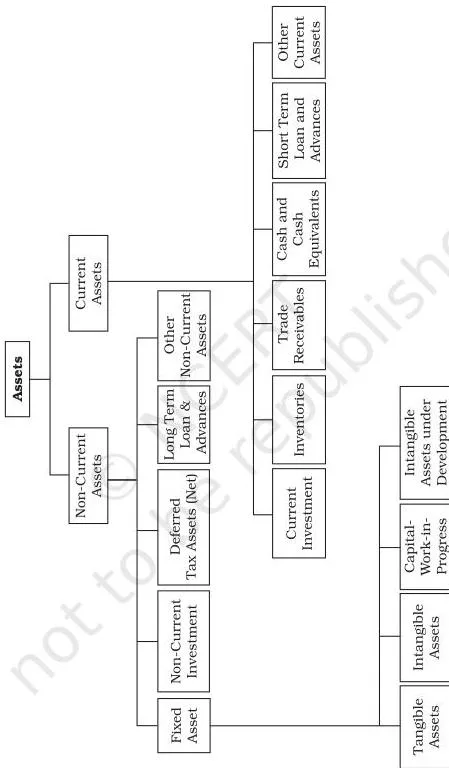
Figure 1.4 maps the two broad classes of assets: current and non-current (NCERT, p. 17). When a question asks what an asset is and what its types are, this classification is half the answer.
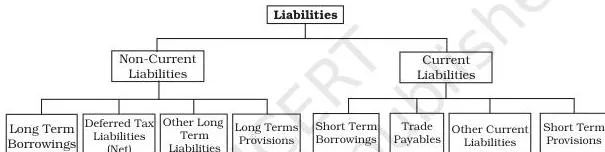
Figure 1.5 does the same for liabilities: current and non-current (NCERT, p. 18). To tell the two apart, NCERT’s list gives four tests (NCERT, p. 18):
- Operating cycle — current assets and liabilities are involved in the operating cycle.
- Twelve months — current assets are realised and current liabilities are settled within 12 months.
- Primarily for trading — current items are held mainly for trading.
- Cash or cash equivalent — current items are cash or cash equivalents.
Try it (based on the chapter’s Activity 1): sort these items into one of four columns — current asset, non-current asset, current liability, non-current liability: machinery, sundry creditors, cash at bank, goodwill, bills payable, land and building, furniture, inventory, sundry debtors, patents, loan from bank, investments, computer software, motor vehicles, air-conditioners, loose tools.
Use the four tests above: cash at bank is current by test 4; machinery fails the 12-month test and the trading test, so it is non-current; sundry creditors are settled within 12 months (test 2), so they are current. Sort the rest yourself, then check your reasoning against Figures 1.4 and 1.5.
Profit and Loss: The Only Calculation in This Chapter
Chapter 1 computes profit as the difference between revenue and expenses (NCERT, pp. 12-13, 19), and also asks for gain and total losses in the Sunrise problem. All amounts are measured in rupees.
\[ \text{Profit} = \text{Revenue} – \text{Expenses} \]
\[ \text{Loss} = \text{Expenses} – \text{Revenue} \]
Profit is the excess of a period’s revenues over its related expenses; it increases the owners’ investment. Loss is the excess of a period’s expenses over its revenues; it decreases owner’s equity.
The word loss also covers money or money’s worth lost without receiving any benefit in return — such as goods destroyed by theft or fire — and losses on the sale of fixed assets (NCERT, p. 19).
Worked Example: Apply the Terms and Compute Profit (Original Numbers)
Example 1: Compute profit from revenues and expenses
A coaching centre earns fees of ₹8,50,000 in a year. It pays rent of ₹1,20,000, salaries of ₹2,40,000 and electricity bills of ₹40,000. Find its profit.
- Step 1: Identify the revenue — fees are income earned by providing services: ₹8,50,000.
- Step 2: Identify the expenses — rent, salaries and electricity are all costs incurred in the process of earning that revenue.
\[ \text{Total expenses} = 1{,}20{,}000 + 2{,}40{,}000 + 40{,}000 = 4{,}00{,}000 \]
Step 3: Apply profit = revenue − expenses.
\[ \text{Profit} = 8{,}50{,}000 – 4{,}00{,}000 = 4{,}50{,}000 \]
Final answer: Profit = ₹4,50,000 for the year.
Example 2: Classify every item of a small business
Kiran started a bakery with ₹5,00,000 as capital. During the year she: bought an oven for ₹90,000 and flour for ₹1,20,000; sold cakes for ₹2,00,000 (₹1,50,000 for cash and ₹50,000 on credit to Hotel Blue); paid wages of ₹30,000 and rent of ₹20,000; withdrew ₹15,000 for personal use; lost ₹8,000 of goods in a fire; and sold an old van for ₹70,000 against a book value of ₹60,000.
Classify each item, with the amount and the reason.
| Item | Amount | Classification | Reason (from the chapter’s definitions) |
|---|---|---|---|
| Initial capital | ₹5,00,000 | Capital | Amount invested by the owner; it is a claim on the business’s assets, so it is shown on the liabilities side of the balance sheet. |
| Oven | ₹90,000 | Fixed asset (capital expenditure) | The benefit of this purchase lasts more than a year, so it is treated as an asset, not an expense. |
| Flour | ₹1,20,000 | Purchases | Raw material procured for processing into finished goods and sale — a purchase for a manufacturing concern. |
| Cash sales | ₹1,50,000 | Revenue | Amount earned by selling cakes — income from selling products. |
| Credit sales to Hotel Blue | ₹50,000 | Revenue + Debtor | The sale creates revenue of ₹50,000, and Hotel Blue, owing that amount, is a debtor — shown as sundry debtors on the asset side. |
| Wages | ₹30,000 | Expense | Cost of services used in the process of earning revenue. |
| Rent | ₹20,000 | Expense | Cost incurred for the business premises while earning revenue. |
| Drawings | ₹15,000 | Drawings | Withdrawal of cash by the owner for personal use; it reduces the owner’s investment, not the period’s profit. |
| Goods lost by fire | ₹8,000 | Loss | Money’s worth lost without receiving any benefit in return — a loss, not an expense. |
| Sale of old van | ₹70,000 | Gain (₹10,000) | Book value was ₹60,000; the extra ₹10,000 is a profit from an incidental event (sale of a fixed asset) — a gain, not routine revenue. |
Notice how the chapter’s vocabulary does the classifying: an equal “rupee outflow” can be a purchase, an expense, a loss or a drawing depending on what it buys and for whom. That distinction — not the arithmetic — is what Chapter 1 actually teaches.
Common Mistakes in Chapter 1 and the Correct Idea
Each row below is a misconception students commonly carry into Chapter 2. The correction always traces back to a definition in this chapter (NCERT, pp. 18-21).
| Students write … | Correct is … (because …) |
|---|---|
| “Accounting is the same as book-keeping.” | Book-keeping is only the recording function. Accounting is wider — it identifies, measures, records and then communicates and interprets information. The chapter itself notes that today’s accountant is not a “glorified book-keeper” (NCERT, p. 9). |
| “Drawings are an expense.” | Drawings are the owner’s withdrawal of money or goods for personal use; they reduce the owner’s investment, never the profits of the period (NCERT, p. 20). |
| “Capital brought in by the owner is revenue.” | Capital is an obligation — a claim on the business’s assets — so it is shown on the liabilities side. Revenue is income earned by selling products or providing services (NCERT, pp. 18-19). |
| “Debtors and creditors are the same kind of claim.” | They are opposites. Debtors owe the enterprise, so they appear on the asset side as sundry debtors; creditors are owed by the enterprise, so they appear on the liabilities side as sundry creditors (NCERT, p. 21). |
| “Profit and gain mean the same thing.” | Profit is the excess of a period’s revenues over its related expenses — the normal result of operations. A gain is profit from an incidental event such as selling a fixed asset or winning a court case (NCERT, p. 19). |
| “Goods lost by fire is an expense.” | It is a loss — money’s worth lost without receiving any benefit in return. Expenses are the costs incurred in the process of earning revenue (NCERT, p. 19). |
| “Trade discount and cash discount are the same.” | Trade discount is a deduction from the list price at the time of sale, offered from manufacturers to wholesalers and from wholesalers to retailers. Cash discount is a deduction from the amount due, given at the time of payment to encourage prompt payment (NCERT, p. 20). |
| “Fixed assets like machinery are current assets.” | They are non-current. Machinery is not part of the operating cycle, is not realised within 12 months and is not held primarily for trading — it fails tests 1-3 of Box 5 (NCERT, p. 18). |
How to Write Strong Answers to the Chapter’s NCERT Questions
The chapter’s exercise asks short, medium and long questions (NCERT, pp. 22-23). Each type has its own discipline:
- Definition questions (“Define accounting”) — must name all four process words: identify, measure, record, communicate, and link them to economic events and interested users. A single line saying “accounting records transactions” is incomplete because it drops three of the four steps.
- Distinction questions (“Distinguish between debtors and creditors; profit and gain”) — the complete structure is a two-column table by basis: meaning, nature (asset versus liability, or recurring versus incidental), effect on owner’s equity or investment, and the side of the balance sheet where the item appears. Two separate paragraphs risk missing half the bases.
- Enumerate questions (“Enumerate the main objectives of accounting”, “Enumerate the information needs of management”) — list every point and add a one-line explanation to each; a bare list reads as incomplete.
- Long answers (“What is accounting? Define its objectives”, “Explain the qualitative characteristics of accounting information”, “Describe the role of accounting in the modern world”) — use the sequence define → explain each element → give an original example → close with the limitation or the link to users. For qualitative characteristics, that means all four characteristics with their sub-points; for role, the five views plus the “means, not an end” idea and the quantitative, past-oriented limitation (NCERT, p. 14).
- Term-explanation questions (“Giving examples, explain: fixed assets, short-term liability, revenue, capital, expenses”) — pair each term with a definition and a one-line example; the glossary tables above are exactly this shape.
- End-product questions (“State the end product of financial accounting”) — name the financial statements: the profit and loss account and the balance sheet (NCERT, p. 12).
Where an answer can lean on a diagram, walk the figure step by step: the flow of Fig 1.1 gives the four process steps in order, and Fig 1.3 supplies the four qualitative characteristics with their key attributes.
Quick Revision Recap: The Whole Chapter in One Table
One table built on the chapter’s own learning objectives (NCERT, p. 1) is enough for the night-before revision.
| Learning objective | One-line takeaway | Keep these words |
|---|---|---|
| Meaning of accounting | Accounting is the process of identifying, measuring, recording and communicating information about economic events to interested users. | Identify, measure, record, communicate. |
| Accounting as a source of information | The interlinked steps of the process generate information that is disseminated to users for decisions; generation is a means, not an end. | Information system; dissemination. |
| Users of accounting information | Internal (management) and external (investors, creditors, tax and regulatory agencies, employees, customers, suppliers, competitors, social groups). | Liquidity for creditors. |
| Qualitative characteristics | Reliability, relevance, understandability and comparability make information decision-useful. | Free from error and bias; timely; common unit and format. |
| Objectives of accounting | Maintain records, calculate profit or loss, depict financial position, and provide information to users. | Profit and loss account; balance sheet. |
| Role of accounting | Language of business, historical record, current economic reality, information system and service; accounting is a means, not an end. | Quantitative and financial; limitation: no qualitative information. |
| Basic terms | Twenty terms, from entity, transaction and assets to drawings, voucher and discount. | Debtors vs creditors; trade vs cash discount. |
FAQs on NCERT Class 11 Accounting Chapter 1
What is the definition of accounting in Class 11 NCERT?
Accounting is the process of identifying, measuring, recording and communicating the required information relating to the economic events of an organisation to the interested users of such information (NCERT, p. 3).
This NCERT definition grew from three earlier ones: the AICPA (1941) called accounting an art, the AAA (1966) a process of identifying, measuring and communicating, and the Accounting Principles Board (1970) stressed quantitative, financial information useful for economic decisions (NCERT, pp. 2-3).
Why is accounting called the language of business?
Because it is the means by which financial information about an enterprise is communicated to its users (NCERT, p. 6). Like a language, it uses standard reports — the profit and loss account and the balance sheet — that a wide variety of interested parties can interpret and act on for decisions.
What is the difference between book-keeping and accounting?
Book-keeping is the routine recording of transactions, while accounting is the wider process that identifies and measures events, records them, and then communicates and interprets the resulting information for decisions (NCERT, p. 5).
The chapter makes the same point differently: the role of the accountant has shifted from a mere recorder of transactions to a provider of relevant information to the decision-making team (NCERT, p. 1).
Which economic events are not recorded in accounting and why?
Events that are not of a financial character, or that cannot be quantified in monetary terms, are not recorded (NCERT, p. 5). For example, the value of human resources, the appointment of a new managing director, signing of contracts and changes in personnel do not enter the books, because measurement in rupees is the test every event must pass.
How are assets and liabilities classified as current and non-current?
By the four tests in Box 5: current items are involved in the operating cycle, are realised or settled within 12 months, are held primarily for trading, and are cash or cash equivalents; items that fail these tests are non-current (NCERT, p. 18). Figures 1.4 and 1.5 show the resulting split for assets and for liabilities (NCERT, pp. 17-18).
What is the difference between profit and gain?
Profit is the excess of a period’s revenues over its related expenses — the normal, recurring result of carrying on business. Gain is profit that arises from events or transactions incidental to business, such as the sale of a fixed asset, winning a court case or appreciation in the value of an asset (NCERT, p. 19).
Reference: NCERT Class 11 Accountancy textbook (Financial Accounting-I), chapter Introduction to Accounting.
Explore Class 11 Accountancy Notes
- Class 11 Accountancy Notes
- Class 11 CBSE Notes
- CBSE Notes for Classes 1 to 12
- Next: Theory Base of Accounting
Class 11 Accountancy on LearnCBSE:
Related chapters:
- Recording of Transactions-I notes
- Recording of Transactions-II notes
- Bank Reconciliation Statement notes