
Real Numbers in CBSE board papers
CBSE asked 155 different Real Numbers questions in the Class 10 Mathematics board papers of 2023, 2024, 2025 and 2026 (main and compartment exams, Standard and Basic courses). 28 of these questions have a worked solution on this page, and 32 more are on the 1-mark questions page. Most of them test Section 1.2, The Fundamental Theorem of Arithmetic (104 of 155).
Where Real Numbers questions came from, 2023–2026
A question printed in several question-paper sets counts once in each table. A question asked in two exams counts in both rows of the first table.
Questions by exam
| Year | Exam | Questions asked | Marks | Question types |
|---|---|---|---|---|
| 2026 | Main | 25 | 16 × 1 mark · 2 × 2 marks · 7 × 3 marks | 14 MCQs, 2 Assertion–Reason and 9 written answers |
| 2025 | Main | 45 | 31 × 1 mark · 2 × 2 marks · 12 × 3 marks | 24 MCQs, 7 Assertion–Reason and 14 written answers |
| 2025 | Compartment | 4 | 2 × 2 marks · 1 × 3 marks · 1 × 4 marks | 1 case study and 3 written answers |
| 2024 | Main | 43 | 15 × 1 mark · 15 × 2 marks · 13 × 3 marks | 14 MCQs, 1 Assertion–Reason and 28 written answers |
| 2024 | Compartment | 11 | 3 × 1 mark · 2 × 2 marks · 6 × 3 marks | 2 MCQs, 1 Assertion–Reason and 8 written answers |
| 2023 | Main | 44 | 16 × 1 mark · 14 × 2 marks · 14 × 3 marks | 11 MCQs, 3 Assertion–Reason and 30 written answers |
| 2023 | Compartment | 10 | 2 × 1 mark · 6 × 2 marks · 2 × 3 marks | 2 MCQs and 8 written answers |
Questions by NCERT section and marks
| NCERT section | 1 mark | 2 marks | 3 marks | 4 marks | Total |
|---|---|---|---|---|---|
| 1.2 The Fundamental Theorem of Arithmetic | 54 | 34 | 15 | 1 | 104 |
| 1.3 Revisiting Irrational Numbers | 18 | 8 | 23 | 0 | 49 |
| Mixed topics | 0 | 1 | 1 | 0 | 2 |
| All questions | 72 | 43 | 39 | 1 | 155 |
Most-tested sections
- 1.2 The Fundamental Theorem of Arithmetic: 104 questions
- 1.3 Revisiting Irrational Numbers: 49 questions
From 2023 to 2026, CBSE took most Real Numbers questions from Section 1.2 (104 of 155). These counts describe past papers; they are not predictions.
Topics in Real Numbers
Each NCERT section of the chapter, in book order: what CBSE asked from it and where to practise it.
1.2 The Fundamental Theorem of Arithmetic
Every composite number can be expressed as a product of primes. This factorisation is unique, apart from the order of the prime factors. For any two positive integers a and b, HCF(a,b) × LCM(a,b) = a × b.
How to answer questions on this section
- Use a factor tree to write each number as powers of primes in ascending order.
- For HCF, take the smallest power of each common prime factor.
- For LCM, take the greatest power of each prime factor involved.
- For ending-zero checks, see whether both 2 and 5 appear in the prime factorisation.
- For expressions like 7×11×13+13, factor out the common prime to show it is composite.
Mistakes to avoid in this section
- Using HCF × LCM = product for three numbers; it holds only for two positive integers.
- Saying a number ends in zero when 5 is present; it needs both 2 and 5.
- Changing the order of prime factors and calling it a different factorisation; order is ignored.
CBSE asked 104 questions from this section in the 2023–2026 papers (54 of 1 mark; 34 of 2 marks; 15 of 3 marks; 1 of 4 marks): 45 MCQs, 7 Assertion–Reason, 1 case study and 51 written answers. 52 were printed in Standard papers and 52 in Basic papers.
| Marks | Questions asked | Years | Asked in Standard | Asked in Basic |
|---|---|---|---|---|
| 1 mark | 54 | 2023, 2024, 2025, 2026 | 29 | 25 |
| 2 marks | 34 | 2023, 2024, 2025, 2026 | 16 | 18 |
| 3 marks | 15 | 2023, 2024, 2025, 2026 | 7 | 8 |
| 4 marks | 1 | 2025 | 0 | 1 |
The figure below is the NCERT book’s own worked example for this section; the sentence under it is the book’s.
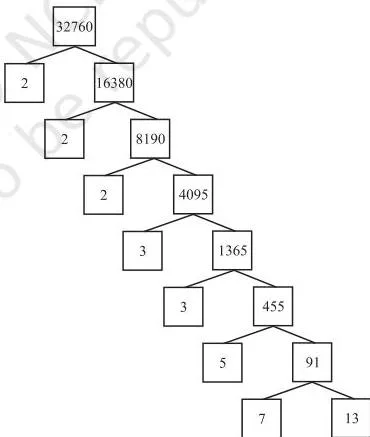
Solved on this page: question 4, question 5, question 6, question 7, question 12, question 13, question 14, question 15, question 16, question 17, question 18, question 19, question 20, question 21, question 22, question 23, question 24, question 25, question 26, question 27, question 28. 24 more of these are solved on the 1-mark questions page.
1.3 Revisiting Irrational Numbers
An irrational number cannot be written as a/b with integers a, b and b not zero. To prove √p is irrational for a prime p, assume it is rational, reduce the fraction, and reach a contradiction. The key tool is Theorem 1.2: if a prime p divides a², then p divides a. A rational plus an irrational is irrational. A non-zero rational times an irrational is irrational.
How to answer questions on this section
- Assume the given number is rational and write it as a/b in lowest terms, so a and b have no common factor except 1.
- For √p, square both sides of b√p = a to get p b² = a².
- By Theorem 1.2, because p divides a², p divides a; write a = p c.
- Substitute a = p c into p b² = a² and divide by p to get b² = p c², so p divides b too.
- For a + b√p with b non-zero, isolate √p; for products, divide by the non-zero rational. Then use known irrationality.
Mistakes to avoid in this section
- Forgetting to say a and b have no common factor except 1 before using the contradiction.
- Applying Theorem 1.2 when the divisor is not prime; it requires p to be prime.
- Saying any rational times an irrational is irrational; zero times an irrational is rational.
CBSE asked 49 questions from this section in the 2023–2026 papers (18 of 1 mark; 8 of 2 marks; 23 of 3 marks): 13 MCQs, 5 Assertion–Reason and 31 written answers. 25 were printed in Standard papers and 28 in Basic papers (4 in both).
| Marks | Questions asked | Years | Asked in Standard | Asked in Basic |
|---|---|---|---|---|
| 1 mark | 18 | 2023, 2024, 2025, 2026 | 10 | 8 |
| 2 marks | 8 | 2023, 2024, 2025 | 5 | 3 |
| 3 marks | 23 | 2023, 2024, 2025, 2026 | 10 | 17 |
A question printed in both courses is counted in both columns (4 in both).
Solved on this page: question 1, question 2, question 3, question 8, question 9, question 10, question 11. 8 more of these are solved on the 1-mark questions page.
2 more questions use several sections at once; the tables above count them under Mixed topics.
Key ideas used on this page
The Fundamental Theorem of Arithmetic
Proof by contradiction
LCM by the prime factorisation method
HCF (Highest Common Factor) by the prime factorisation method
Used in question 15
For any two positive integers a and b, HCF(a, b) × LCM(a, b) = a × b.
Used in question 18
Fundamental Theorem of Arithmetic and the definition of a composite number
Used in question 20
HCF by the prime factorisation method
Used in question 25
5 solved questions last asked in 2026
Q1. Prove that \(\sqrt{5}\) is an irrational number.
- Marks
- 3
- Level
- Standard / Basic
- Asked in
- 27 paper sets
- Years
- 2023, 2024, 2025, 2026
- Compartment
- 2023, 2024
- Topic
- 1.3 Revisiting Irrational Numbers
- Source
- (CBSE 2026 Mathematics Standard, Set 30/2/1, Q26, 3 marks)
- Status
- Answer checked step by step
Step-by-step solution
Step 1: Assume the opposite
½ markAssume, to the contrary, that √5 is rational. Then √5 = p/q, where p and q are coprime integers and q ≠ 0.
Why? We need a starting assumption. A rational number can be written as p/q with integers p and q, q ≠ 0. We also take p and q coprime so that the fraction is in lowest terms.
Step 2: Square and apply the theorem
1 markSquaring both sides: 5q² = p². So 5 divides p². By Theorem 1.2, 5 divides p. Write p = 5c.
Why? Squaring removes the square root and gives an equation in integers. The theorem lets us move from '5 divides p²' to '5 divides p'.
Step 3: Show q is also divisible by 5
1 markSubstitute p = 5c: 5q² = 25c², so q² = 5c². Hence 5 divides q², and by Theorem 1.2, 5 divides q.
Why? Substituting p = 5c shows the same argument applies to q. This is the second half needed for the contradiction.
Step 4: Contradiction and conclusion
½ markThus 5 divides both p and q, contradicting that p and q are coprime. Therefore √5 is irrational.
Why? If 5 divides both p and q, then p and q have a common factor, which contradicts the earlier statement that they are coprime. So the assumption must be false.
Marks: ½ + 1 + 1 + ½ = 3 · Split as in the CBSE marking scheme, 2025 · Standard 30/6/1 Q26 (the marks split is taken from the 2025 Standard paper, where this question also appeared)
Answer:
√5 is irrational.
Common mistakes to avoid
- Stating √5 = p/q but not saying p and q are coprime; then the contradiction loses its force.
- Concluding 5 divides p directly from 5 divides p² without using the theorem.
- Stopping after showing 5 divides p; the contradiction needs 5 to divide q as well.
Q2. Prove that \(\sqrt{3}\) is an irrational number.
- Marks
- 3
- Level
- Standard / Basic
- Asked in
- 23 paper sets
- Years
- 2023, 2024, 2025, 2026
- Compartment
- 2024
- Topic
- 1.3 Revisiting Irrational Numbers
- Source
- (CBSE 2026 Mathematics Standard, Set 30/1/1, Q26, 3 marks)
- Status
- Answer checked step by step
Step-by-step solution
Step 1: Assume the opposite
½ markAssume, to the contrary, that √3 is rational. Then √3 = a/b, where a and b are coprime integers and b ≠ 0.
Why? This is the starting assumption of proof by contradiction. Coprime means a and b have no common factor except 1; this makes the later contradiction valid.
Step 2: Square and use the prime divisibility property
1 markSquaring both sides gives 3b² = a². So 3 divides a², and hence 3 divides a.
Why? Squaring removes the square root. The step '3 divides a², so 3 divides a' is the prime divisibility property used in NCERT Example 5.
Step 3: Show b is also divisible by 3
1 markWrite a = 3c for some integer c. Then 3b² = 9c², so b² = 3c². Hence 3 divides b², and so 3 divides b.
Why? Substituting shows b is also divisible by 3. Now both a and b have 3 as a common factor.
Step 4: State the contradiction and conclusion
½ markThis contradicts the fact that a and b are coprime. Therefore our assumption is wrong, so √3 is irrational.
Why? The contradiction proves the assumption false, so the opposite statement is true.
Marks: ½ + 1 + 1 + ½ = 3 · Split as in the CBSE marking scheme, 2026 · Standard 30/3/2 Q31 (the marks split is taken from the 2026 Standard paper, where this question also appeared)
Answer:
√3 is irrational.
Common mistakes to avoid
- Forgetting to state that a and b are coprime; then the common factor 3 is not a contradiction.
- Writing √3 = a/b without saying b ≠ 0; division by zero is not allowed.
- Concluding that 3 divides a without using the prime divisibility property; the proof is incomplete.
- Stopping after showing 3 divides a; you must also show 3 divides b to get the contradiction.
Q3. Prove that \(\sqrt{2}\) is an irrational number.
- Marks
- 3
- Level
- Standard / Basic
- Asked in
- 16 paper sets
- Years
- 2023, 2025, 2026
- Topic
- 1.3 Revisiting Irrational Numbers
- Source
- (CBSE 2026 Mathematics Basic, Set 430(B), Q26, 3 marks)
- Status
- Answer checked step by step
Step-by-step solution
Step 1: Assume the contrary
½ mark (suggested)Assume, to the contrary, that √2 is rational. Then √2 = a/b, where a and b are coprime integers and b ≠ 0.
Why? This is the starting move of proof by contradiction. Coprime means a and b have no common factor except 1; we need that condition so that a later common factor becomes a contradiction.
Step 2: Show 2 divides a
1 mark (suggested)Squaring both sides, a² = 2b². So 2 divides a². By the result that if a prime p divides a² then p divides a, 2 divides a. So a = 2c for some integer c.
Why? Squaring removes the square root and turns the assumption into an equation about integers. The result about primes lets us conclude that 2 must be a factor of a, not just of a².
Step 3: Show 2 divides b
1 mark (suggested)Substitute a = 2c in a² = 2b²: (2c)² = 2b², so 4c² = 2b², i.e. b² = 2c². So 2 divides b², and hence 2 divides b.
Why? Putting a = 2c lets us apply the same prime result to b. Now both a and b are forced to be even.
Step 4: Contradiction and conclusion
½ mark (suggested)Thus a and b have common factor 2, contradicting that a and b are coprime. Hence our assumption is wrong. Therefore √2 is irrational.
Why? The assumption said a and b are coprime, but the working shows they share the factor 2. This contradiction proves the assumption was false, so the opposite statement is true.
Marks: ½ + 1 + 1 + ½ = 3 · Suggested split (CBSE’s usual pattern for 3-mark questions)
Answer:
√2 is irrational.
Common mistakes to avoid
- Forgetting to state that a and b are coprime; then the final contradiction has nothing to contradict.
- Using the result 'if p divides a² then p divides a' without saying p is prime; it is false for composite numbers.
- Squaring √2 = a/b incorrectly, for example forgetting to square b.
- Stopping after showing both a and b are even, without writing the contradiction and the final conclusion.
Q4. Two numbers are in the ratio 3 : 5 and their LCM is 180. Find the HCF of these two numbers.
- Marks
- 2
- Level
- Standard
- Years
- 2026
- Topic
- 1.2 The Fundamental Theorem of Arithmetic
- Source
- (CBSE 2026 Mathematics Standard, Set 30(B), Q21, 2 marks)
- Status
- Verified solution
Step-by-step solution
Step 1: Let the numbers be 3x and 5x
½ markLet the two numbers be 3x and 5x.
Why? A ratio means both numbers are multiples of the same common factor, so one unknown x can represent both numbers.
Step 2: Use HCF × LCM = product
1 markSince HCF = x, HCF × LCM = product gives x × 180 = 3x × 5x. As x > 0, 180 = 15x, so x = 12.
Why? The relation between HCF, LCM and the product turns the given ratio and LCM into one equation, which is then solved for x.
Step 3: State the HCF
½ markHence, HCF = 12.
Why? Since x was the common factor, the HCF is already known once x is found.
Marks: ½ + 1 + ½ = 2 · Split as in the CBSE marking scheme, 2026 · Standard 30(B) Q21
Answer:
HCF = 12
✓ Answer matches the CBSE marking scheme, 2026 Main, Paper 30(B).
Open CBSE’s official marking scheme for the 2026 main exam to see how the board gives marks for this question.
Common mistakes to avoid
- Using the numbers 3 and 5 themselves and ignoring the common factor x, which gives HCF 1.
- Taking the product 15x² as the LCM; the LCM is 15x because 3 and 5 are coprime.
- Giving the numbers 36 and 60 as the answer instead of the HCF 12.
Q5. Find the smallest 5-digit number exactly divisible by 24 and 36.
- Marks
- 2
- Level
- Basic
- Years
- 2026
- Topic
- 1.2 The Fundamental Theorem of Arithmetic
- Source
- (CBSE 2026 Mathematics Basic, Set 430(B), Q21, 2 marks)
- Status
- Verified solution
Step-by-step solution
Step 1: Find the LCM of 24 and 36
1 mark (suggested)24 = 2³ × 3, 36 = 2² × 3². LCM(24, 36) = 2³ × 3² = 72.
Why? A number divisible by both 24 and 36 is a common multiple of them. The least positive common multiple is the LCM, so finding the LCM first turns the problem into finding the smallest 5-digit multiple of 72.
Step 2: Find the smallest 5-digit multiple of 72
1 mark (suggested)10000 ÷ 72 gives quotient 138 and remainder 64. The required number is 10000 + (72 − 64) = 10008.
Why? 10000 is the smallest 5-digit number. The quotient tells how many full multiples of 72 are below 10000, and the remainder is what is left after subtracting that multiple. Adding the shortfall to the next multiple gives the required number.
Marks: 1 + 1 = 2 · Suggested split (CBSE’s usual pattern for 2-mark questions)
Answer:
10008
✓ Answer matches the CBSE marking scheme, 2026 Main, Paper 430(B).
Open CBSE’s official marking scheme for the 2026 main exam to see how the board gives marks for this question.
Common mistakes to avoid
- Finding the HCF, 12, instead of the LCM; the required number must be a common multiple of 24 and 36.
- Adding the remainder 64 to 10000 and writing 10064; the remainder is not the amount to add, the shortfall to the next multiple is.
- Stopping at 72, the LCM, because it is not a 5-digit number.
5 solved questions last asked in 2025
Q6. Ranjita, Neha and Salma start weaving sweaters at the same time for the children of an orphan home. They need 15, 18 and 20 days, respectively, to complete a sweater. After how many days will all of them start making a new sweater again ? By that time how many sweaters will have been competed by them ?
- Marks
- 3
- Level
- Standard
- Asked in
- 3 paper sets
- Compartment
- 2025
- Topic
- 1.2 The Fundamental Theorem of Arithmetic
- Source
- (CBSE 2025 Compartment Mathematics Standard, Set 30/S/1, Q31, 3 marks)
- Status
- Answer checked step by step
Step-by-step solution
Step 1: Find the LCM of 15, 18 and 20
1 mark (suggested)The required time is LCM(15, 18, 20). Prime factorisation: 15 = 3 × 5, 18 = 2 × 3², 20 = 2² × 5. So LCM(15, 18, 20) = 2² × 3² × 5 = 180.
Why? LCM means the least common multiple, the smallest number divisible by 15, 18 and 20. Prime factorisation means writing a number as a product of its primes. All three start a new sweater together on common multiples of their times, so the first such day is this LCM.
Step 2: Find the number of sweaters completed
1 mark (suggested)In 180 days: Ranjita = 180/15 = 12, Neha = 180/18 = 10, Salma = 180/20 = 9. Together = 12 + 10 + 9 = 31.
Why? Once the common time is known, dividing it by each person's time for one sweater gives how many sweaters each finishes in that period.
Step 3: State the answer
1 mark (suggested)Required time = 180 days. Sweaters completed: Ranjita = 12, Neha = 10, Salma = 9; total = 31.
Why? This states the two answers asked in the question: the common restart day and the number of sweaters completed by then.
Marks: 1 + 1 + 1 = 3 · Suggested split (CBSE’s usual pattern for 3-mark questions)
Answer:
After 180 days; Ranjita 12, Neha 10, Salma 9 sweaters each (31 sweaters in all).
Common mistakes to avoid
- Adding the three times and giving 53 days instead of finding the LCM.
- Finding the HCF instead of the LCM.
- Taking a later common multiple such as 360 instead of the least common multiple 180.
- Giving only the total 31 sweaters without saying how many each person completed.
Q7. Show that \(45^n\) can not end with the digit 0, n being a natural number. Write the prime number 'a' which on multiplying with \(45^n\) makes the product end with the digit 0.
- Marks
- 2
- Level
- Basic
- Asked in
- 3 paper sets
- Years
- 2025
- Topic
- 1.2 The Fundamental Theorem of Arithmetic
- Source
- (CBSE 2025 Mathematics Basic, Set 430/4/1, Q21, 2 marks)
- Status
- Verified solution
Step-by-step solution
Step 1: Prime factorisation of 45ⁿ
1 mark (suggested)45 = 3² × 5, so 45ⁿ = (3² × 5)ⁿ = 3²ⁿ × 5ⁿ.
Why? This is the set-up. It writes 45ⁿ as a product of primes, so we can see exactly which primes are present.
Step 2: Apply the ending-in-0 condition and find a
1 mark (suggested)A number ending in 0 is divisible by 10 = 2 × 5. The factorisation 3²ⁿ × 5ⁿ has no factor 2, so by the Fundamental Theorem of Arithmetic, 45ⁿ cannot end in 0. Multiplying by the prime a = 10 ÷ 5 = 2 supplies the missing 2. Hence 45ⁿ × a ends in 0.
Why? Ending in 0 means having both prime factors 2 and 5. Comparing the factorisations gives the conclusion and the missing prime.
Marks: 1 + 1 = 2 · Suggested split (CBSE’s usual pattern for 2-mark questions)
Answer:
a = 2
✓ Answer matches the CBSE marking scheme, 2025 Main, Paper 430/4/1.
Open CBSE’s official marking scheme for the 2025 main exam to see how the board gives marks for this question.
Common mistakes to avoid
- Stopping after writing 45 = 3² × 5; you must also state that the missing factor 2 means 45ⁿ is not divisible by 10.
- Choosing 5 as the missing prime because 45 ends in 5; 5 is already present, and without 2 the product still cannot end in 0.
- Thinking divisibility by 5 is enough for ending in 0; a multiple of 5 can end in 0 or 5, so 45ⁿ can end in 5 instead.
Q8. Prove that \(\left(5\sqrt{3} + \frac{2}{3}\right)\) is an irrational number given that \(\sqrt{3}\) is an irrational number.
- Marks
- 3
- Level
- Standard
- Asked in
- 2 paper sets
- Years
- 2025
- Topic
- 1.3 Revisiting Irrational Numbers
- Source
- (CBSE 2025 Mathematics Standard, Set 30/3/1, Q27, 3 marks)
- Status
- Verified solution
Step-by-step solution
Step 1: Assume the number is rational
1 mark (suggested)Assume, to the contrary, that 5√3 + 2/3 is rational. Then 5√3 + 2/3 = a/b, where a and b are coprime integers and b ≠ 0.
Why? Proof by contradiction starts by assuming the opposite of what we must prove. 'Coprime' means a and b have no common factor except 1, so the fraction is in lowest terms.
Step 2: Isolate √3
1 mark (suggested)5√3 = a/b − 2/3 = (3a − 2b)/(3b), so √3 = (3a − 2b)/(15b).
Why? Rearrange the assumed equation so that √3 stands alone. If the assumption is true, the right side must be a rational number.
Step 3: Reach the contradiction
1 mark (suggested)Since a and b are integers and b ≠ 0, (3a − 2b)/(15b) is rational. So √3 is rational, which contradicts the given fact that √3 is irrational. Hence the assumption is wrong. Therefore, 5√3 + 2/3 is irrational.
Why? A quotient of integers with a non-zero denominator is rational. The contradiction means the assumption was false, so the original number must be irrational.
Marks: 1 + 1 + 1 = 3 · Suggested split (CBSE’s usual pattern for 3-mark questions)
Answer:
5√3 + 2/3 is irrational.
✓ Answer matches the CBSE marking scheme, 2025 Main, Paper 30/3/1.
Open CBSE’s official marking scheme for the 2025 main exam to see how the board gives marks for this question.
Common mistakes to avoid
- Forgetting to divide by 5 after isolating 5√3, so the denominator stays 3b instead of 15b.
- Not stating that (3a − 2b) and 15b are integers with 15b ≠ 0, which is needed to call the fraction rational.
- Stopping after writing √3 as a fraction and not connecting it to the given fact that √3 is irrational.
- Assuming the number is irrational at the start; the proof must assume it is rational and then contradict that.
Q9. Prove that \(\left(4\sqrt{2} + \frac{5}{3}\right)\) is an irrational number given that \(\sqrt{2}\) is an irrational number.
- Marks
- 3
- Level
- Standard
- Years
- 2025
- Topic
- 1.3 Revisiting Irrational Numbers
- Source
- (CBSE 2025 Mathematics Standard, Set 30/3/2, Q26, 3 marks)
- Status
- Verified solution
Step-by-step solution
Step 1: Assume the opposite
1 mark (suggested)Assume, to the contrary, that 4√2 + 5/3 is rational. Then 4√2 + 5/3 = a/b, where a and b are coprime integers and b ≠ 0.
Why? We start by assuming the opposite of what we must prove. If this assumption forces a false statement, then the original statement is proved.
Step 2: Isolate √2
1 mark (suggested)4√2 = a/b − 5/3 = (3a − 5b)/(3b), so √2 = (3a − 5b)/(12b). Since a and b are integers, (3a − 5b)/(12b) is rational.
Why? We rearrange the assumed equation to express √2 as a quotient of integers. That is the only way to force the contradiction.
Step 3: Contradiction and conclusion
1 mark (suggested)Thus √2 is rational, which contradicts the given fact that √2 is irrational. Hence 4√2 + 5/3 is irrational.
Why? The given fact says √2 is irrational, so the conclusion from the previous step is impossible. This ends the proof.
Marks: 1 + 1 + 1 = 3 · Suggested split (CBSE’s usual pattern for 3-mark questions)
Answer:
4√2 + 5/3 is irrational.
✓ Answer matches the CBSE marking scheme, 2025 Main, Paper 30/3/2.
Open CBSE’s official marking scheme for the 2025 main exam to see how the board gives marks for this question.
Common mistakes to avoid
- Forgetting that √2 is multiplied by 4, so after isolating you must divide by 4; writing √2 = (3a − 5b)/(3b) is wrong.
- Not stating that a and b are coprime and b ≠ 0; the definition of a rational number requires this.
- Stopping after showing √2 is rational, without explicitly saying this contradicts the given fact and concluding the original number is irrational.
Q10. If \(\sqrt{7}\) is an irrational number, then prove that \(2\sqrt{7}\) is also an irrational number.
- Marks
- 2
- Level
- Standard
- Compartment
- 2025
- Topic
- 1.3 Revisiting Irrational Numbers
- Source
- (CBSE 2025 Compartment Mathematics Standard, Set 30/S/2, Q22, 2 marks)
- Status
- Verified solution
Step-by-step solution
Step 1: Assume the contrary
½ markAssume, to the contrary, that 2√7 is rational. Then 2√7 = a/b, where a and b are coprime integers and b ≠ 0.
Why? To prove by contradiction, we start by assuming the opposite of what we want to prove.
Step 2: Rearrange the equation
½ markRearranging, √7 = a/(2b).
Why? Isolating √7 lets us compare it with the given fact that √7 is irrational.
Step 3: Show √7 is rational
½ markSince a and b are integers, a/(2b) is rational. So √7 is rational.
Why? A rational number divided by a non-zero integer is still rational, so the assumption forces √7 to be rational.
Step 4: State the contradiction
½ markThis contradicts the fact that √7 is irrational. Hence 2√7 is irrational.
Why? The contradiction shows the assumption was wrong, so the statement is true.
Marks: ½ + ½ + ½ + ½ = 2 · Split as in the CBSE marking scheme, 2025 Compartment · Standard 30/S/2 Q22
Answer:
2√7 is irrational.
✓ Answer matches the CBSE marking scheme, 2025 Compartment, Paper 30/S/2.
Open CBSE’s official marking scheme for the 2025 compartment exam to see how the board gives marks for this question.
Common mistakes to avoid
- Assuming √7 is rational instead of assuming 2√7 is rational; the contradiction must start with the number in the question.
- Forgetting to state that a and b are coprime; the definition of a rational number in lowest terms needs this.
- Writing that a/(2b) is an integer; it is only rational, which is enough.
- Stopping after showing √7 is rational without stating the contradiction with the given fact.
12 solved questions last asked in 2024
Q11. Prove that \(\frac{2 - \sqrt{3}}{5}\) is an irrational number, given that \(\sqrt{3}\) is an irrational number.
- Marks
- 3
- Level
- Standard
- Asked in
- 2 paper sets
- Years
- 2024
- Topic
- 1.3 Revisiting Irrational Numbers
- Source
- (CBSE 2024 Mathematics Standard, Set 30/4/1, Q30, 3 marks)
- Status
- Answer checked step by step
Step-by-step solution
Step 1: Assume the contrary
½ markLet (2 − √3)/5 = a/b, where a and b are coprime integers and b ≠ 0.
Why? This is the starting point of a proof by contradiction: we suppose the number is rational and show this forces √3 to be rational.
Step 2: Isolate √3
1 mark2 − √3 = 5a/b, so √3 = 2 − 5a/b = (2b − 5a)/b.
Why? Rearranging turns the assumed rational expression into an expression for √3, which lets us compare it with the known fact that √3 is irrational.
Step 3: Right side is rational
½ markSince a and b are integers, (2b − 5a)/b is a rational number.
Why? A quotient of integers with a non-zero denominator is exactly what a rational number is, so √3 would be rational.
Step 4: State the contradiction
½ markThis contradicts the given fact that √3 is irrational.
Why? The assumption leads to a statement that is already known to be false.
Step 5: Conclude
½ markTherefore (2 − √3)/5 is irrational.
Why? In proof by contradiction, a false consequence proves the original assumption wrong, so the number must be irrational.
Marks: ½ + 1 + ½ + ½ + ½ = 3 · Split as in the CBSE marking scheme, 2024 · Standard 30/4/3 Q29 (the marks split is taken from the 2024 Standard paper, where this question also appeared)
Answer:
(2 − √3)/5 is irrational.
Common mistakes to avoid
- Forgetting that (2 − √3)/5 = a/b means 2 − √3 = 5a/b, not 2 − √3 = a/b.
- Skipping the statement that (2b − 5a)/b is rational; the contradiction only works if this is clearly said.
- Trying to prove the result directly without first assuming the number is rational.
Q12. Find LCM and HCF of two numbers 336 and 54, using prime-factorisation method.
- Marks
- 3
- Level
- Basic
- Years
- 2024
- Topic
- 1.2 The Fundamental Theorem of Arithmetic
- Source
- (CBSE 2024 Mathematics Basic, Set 430/3/1, Q26, 3 marks)
- Status
- Verified solution
Step-by-step solution
Step 1: Prime factorisation of 336 and 54
1 mark (suggested)336 = 2⁴ × 3 × 7, 54 = 2 × 3³.
Why? Prime factorisation is the first step of the prime factorisation method; it lists the prime factors of each number so HCF and LCM can be read from them.
Step 2: HCF using common prime factors
1 mark (suggested)HCF = 2¹ × 3¹ = 6.
Why? HCF is built from only the primes common to both numbers, using the smallest power of each common prime.
Step 3: LCM using all prime factors
1 mark (suggested)LCM = 2⁴ × 3³ × 7 = 3024. Hence, HCF = 6 and LCM = 3024.
Why? LCM uses every prime that appears in either number, with the greatest power of each, so the result is a multiple of both numbers.
Marks: 1 + 1 + 1 = 3 · Suggested split (CBSE’s usual pattern for 3-mark questions)
Answer:
HCF = 6 and LCM = 3024
✓ Answer matches the CBSE marking scheme, 2024 Main, Paper 430/3/1.
Open CBSE’s official marking scheme for the 2024 main exam to see how the board gives marks for this question.
Common mistakes to avoid
- Taking the greatest power of each common prime for HCF: 2⁴ × 3³ = 432, not 6.
- Forgetting the prime 7 while taking LCM: 2⁴ × 3³ = 432, not 3024.
- Taking the smallest power of every prime factor for LCM: 2 × 3 × 7 = 42, not 3024.
Q13. Find the HCF and LCM of 96 and 404, using prime-factorisation method.
- Marks
- 3
- Level
- Basic
- Years
- 2024
- Topic
- 1.2 The Fundamental Theorem of Arithmetic
- Source
- (CBSE 2024 Mathematics Basic, Set 430/3/2, Q29, 3 marks)
- Status
- Verified solution
Step-by-step solution
Step 1: Prime factorisation of 96 and 404
1 mark (suggested)96 = 2⁵ × 3; 404 = 2² × 101
Why? Prime factorisation is the method the question asks for. Writing both numbers as products of primes shows which prime factors they share and which are different.
Step 2: HCF
1 mark (suggested)HCF = 2² = 4
Why? The HCF uses only the primes common to both numbers, each with its smallest power. Here the only common prime is 2.
Step 3: LCM
1 mark (suggested)LCM = 2⁵ × 3 × 101 = 9696. Hence, HCF = 4 and LCM = 9696.
Why? The LCM must contain every prime that appears in either number, each with its greatest power, so that both 96 and 404 divide it.
Marks: 1 + 1 + 1 = 3 · Suggested split (CBSE’s usual pattern for 3-mark questions)
Answer:
HCF = 4 and LCM = 9696
✓ Answer matches the CBSE marking scheme, 2024 Main, Paper 430/3/2.
Open CBSE’s official marking scheme for the 2024 main exam to see how the board gives marks for this question.
Common mistakes to avoid
- For HCF, taking the greatest power of the common prime 2 (2⁵) instead of the smallest power (2²).
- For LCM, forgetting the prime 101, which appears only in 404, and writing only 2⁵ × 3.
- For LCM, using the smaller power of 2 (2²) instead of the greatest power (2⁵).
- Not checking the answer with the relation HCF × LCM = a × b, so an arithmetic slip goes unnoticed.
Q14. Find the HCF and LCM of 260 and 910 by prime-factorisation method.
- Marks
- 3
- Level
- Basic
- Years
- 2024
- Topic
- 1.2 The Fundamental Theorem of Arithmetic
- Source
- (CBSE 2024 Mathematics Basic, Set 430/3/3, Q30, 3 marks)
- Status
- Verified solution
Step-by-step solution
Step 1: Prime factorisation
1 mark (suggested)260 = 2² × 5 × 13 and 910 = 2 × 5 × 7 × 13
Why? The prime-factorisation method needs each number written as a product of primes first.
Step 2: HCF
1 mark (suggested)HCF = 2¹ × 5¹ × 13¹ = 130
Why? HCF takes the smallest power of each prime common to both numbers.
Step 3: LCM and final answer
1 mark (suggested)LCM = 2² × 5 × 7 × 13 = 1820. Hence, HCF = 130 and LCM = 1820.
Why? LCM takes the greatest power of every prime that appears in either number. The last sentence states both results asked for.
Marks: 1 + 1 + 1 = 3 · Suggested split (CBSE’s usual pattern for 3-mark questions)
Answer:
HCF = 130 and LCM = 1820
✓ Answer matches the CBSE marking scheme, 2024 Main, Paper 430/3/3.
Open CBSE’s official marking scheme for the 2024 main exam to see how the board gives marks for this question.
Common mistakes to avoid
- Taking 2² in the HCF because 260 has 2², instead of taking the smallest common power 2¹.
- Including 7 in the HCF because 910 has 7, even though 260 does not have 7.
- Writing the LCM with only the common primes and leaving out 7.
- Confusing which answer is HCF and which is LCM.
Q15. Find the greatest number which divides 65 and 117 completely.
- Marks
- 2
- Level
- Basic
- Compartment
- 2024
- Topic
- 1.2 The Fundamental Theorem of Arithmetic
- Source
- (CBSE 2024 Compartment Mathematics Basic, Set 430(B), Q24, 2 marks)
- Status
- Verified solution
Step-by-step solution
Step 1: Prime factorise both numbers
1 mark (suggested)65 = 5 × 13; 117 = 3² × 13.
Why? Prime factorisation writes each number as a product of primes, so the common prime factors can be seen.
Step 2: Find the HCF
1 mark (suggested)HCF = 13. The greatest number which divides 65 and 117 completely is 13.
Why? The HCF is the product of the smallest power of each common prime factor; 13 is the only common prime factor, so it is the greatest number that divides both.
Marks: 1 + 1 = 2 · Suggested split (CBSE’s usual pattern for 2-mark questions)
Answer:
13
✓ Answer matches the CBSE marking scheme, 2024 Compartment, Paper 430(B).
Open CBSE’s official marking scheme for the 2024 compartment exam to see how the board gives marks for this question.
Common mistakes to avoid
- Writing 117 = 3 × 39 and stopping, then giving 3 as the answer even though 3 does not divide 65.
- Giving 5 because 65 = 5 × 13, without checking that 5 does not divide 117.
- Giving 585, the LCM of 65 and 117, because the question asks for the greatest number that divides both; the required number is the HCF, not the LCM.
Q16. Find the LCM of 231 and 396 by prime factorisation method.
- Marks
- 2
- Level
- Basic
- Years
- 2024
- Topic
- 1.2 The Fundamental Theorem of Arithmetic
- Source
- (CBSE 2024 Mathematics Basic, Set 430/2/3, Q23, 2 marks)
- Status
- Verified solution
Step-by-step solution
Step 1: Prime factorise both numbers
1 mark (suggested)231 = 3 × 7 × 11; 396 = 2² × 3² × 11
Why? The prime factorisation method begins by writing each number as a product of primes. This gives the prime factors needed to build the LCM.
Step 2: Find the LCM
1 mark (suggested)LCM = 2² × 3² × 7 × 11 = 2772
Why? The LCM must contain every prime that appears in either number, using the greatest power of each prime. This gives the smallest number divisible by both 231 and 396.
Marks: 1 + 1 = 2 · Suggested split (CBSE’s usual pattern for 2-mark questions)
Answer:
2772
✓ Answer matches the CBSE marking scheme, 2024 Main, Paper 430/2/3.
Open CBSE’s official marking scheme for the 2024 main exam to see how the board gives marks for this question.
Common mistakes to avoid
- Using the smallest power of each common prime instead of the greatest power of every prime; this gives 33, which is the HCF.
- Forgetting 7 because it appears only in 231; the LCM must include every prime that appears in either number.
- Using an incomplete factorisation of 396, such as missing one factor of 2 or one factor of 3, and getting a wrong LCM.
Q17. Find the HCF of 45, 54, 270 using prime factorization method.
- Marks
- 2
- Level
- Basic
- Years
- 2024
- Topic
- 1.2 The Fundamental Theorem of Arithmetic
- Source
- (CBSE 2024 Mathematics Basic, Set 430/4/2, Q23, 2 marks)
- Status
- Verified solution
Step-by-step solution
Step 1: Prime factorisation of 45, 54 and 270
1 mark (suggested)45 = 3² × 5; 54 = 2 × 3³; 270 = 2 × 3³ × 5
Why? Writing each number as a product of primes lets us compare the common prime factors and their powers.
Step 2: Find the HCF
1 mark (suggested)Only 3 is common to all three numbers. HCF = product of the smallest power of each common prime factor = 3² = 9.
Why? The HCF can contain only primes present in every number, and each such prime is taken with its smallest power among the numbers.
Marks: 1 + 1 = 2 · Suggested split (CBSE’s usual pattern for 2-mark questions)
Answer:
9
✓ Answer matches the CBSE marking scheme, 2024 Main, Paper 430/4/2.
Open CBSE’s official marking scheme for the 2024 main exam to see how the board gives marks for this question.
Common mistakes to avoid
- Taking the smallest power of every prime factor, including primes that are not common to all the numbers.
- Confusing HCF with LCM: HCF uses smallest powers of common primes, while LCM uses greatest powers of all primes involved.
- Calling 2 or 5 common because they appear in some of the numbers, even though they are not present in all three.
Q18. Given that HCF (306, 1314) = 18, find LCM of (306, 1314).
- Marks
- 2
- Level
- Basic
- Years
- 2024
- Topic
- 1.2 The Fundamental Theorem of Arithmetic
- Source
- (CBSE 2024 Mathematics Basic, Set 430/4/3, Q24, 2 marks)
- Status
- Verified solution
Step-by-step solution
Step 1: Use the HCF–LCM relation
1 markHCF(306, 1314) × LCM(306, 1314) = 306 × 1314 = 402084
Why? This relation connects the given HCF to the unknown LCM, so substituting the known values turns the problem into a simple division.
Step 2: Calculate the LCM
1 markLCM(306, 1314) = 402084 ÷ 18 = 22338
Why? Dividing the product of the two numbers by the HCF isolates the LCM and gives its value.
Marks: 1 + 1 = 2 · Split as in the CBSE marking scheme, 2024 · Basic 430/4/3 Q24
Answer:
22338
✓ Answer matches the CBSE marking scheme, 2024 Main, Paper 430/4/3.
Open CBSE’s official marking scheme for the 2024 main exam to see how the board gives marks for this question.
Common mistakes to avoid
- Taking 306 × 1314 = 402084 as the LCM itself, without dividing by HCF 18; the LCM is 22338, not 402084.
- Using the HCF 9 from the similar exercise for 306 and 657 instead of the given HCF 18; this gives 402084 ÷ 9 = 44676, not 22338.
Q19. Can the number \((15)^n\) , \(n\) being a natural number, end with the digit 0 ?
Give reasons.
- Marks
- 2
- Level
- Standard
- Years
- 2024
- Topic
- 1.2 The Fundamental Theorem of Arithmetic
- Source
- (CBSE 2024 Mathematics Standard, Set 30/2/1, Q21, 2 marks)
- Status
- Verified solution
Step-by-step solution
Step 1: Prime factorisation of \((15)^n\)
1 mark15 = 3 × 5, so \((15)^n\) = \((3 × 5)^n\) = \(3^n\) × \(5^n\). Thus the prime factorisation of \((15)^n\) contains only the primes 3 and 5.
Why? Prime factorisation shows exactly which primes can appear in \((15)^n\), and the Fundamental Theorem of Arithmetic lets us compare these primes with the primes needed for ending in 0.
Step 2: Condition for ending with 0
1 markIf a number ends with digit 0, it is divisible by 10 = 2 × 5, so 2 must be a prime factor of it. Since \(3^n\) × \(5^n\) has no prime factor 2, \((15)^n\) cannot end with digit 0.
Why? Ending in 0 forces divisibility by both 2 and 5. Comparing the primes required with the primes present in \((15)^n\) gives the conclusion.
Marks: 1 + 1 = 2 · Split as in the CBSE marking scheme, 2024 · Standard 30/2/1 Q21
Answer:
No, \((15)^n\) cannot end with the digit 0 for any natural number n.
✓ Answer matches the CBSE marking scheme, 2024 Main, Paper 30/2/1.
Open CBSE’s official marking scheme for the 2024 main exam to see how the board gives marks for this question.
Common mistakes to avoid
- Saying that because 15 ends in 5, \((15)^n\) must end in 0 for some n; ending in 0 also requires the factor 2.
- Checking only divisibility by 5; ending in 0 requires divisibility by both 2 and 5.
Q20. Explain why \(7 \times 11 \times 13 + 13\) and \(7 \times 6 \times 5 \times 4 \times 3 \times 2 \times 1 + 5\) are composite numbers.
- Marks
- 2
- Level
- Standard
- Years
- 2024
- Topic
- 1.2 The Fundamental Theorem of Arithmetic
- Source
- (CBSE 2024 Mathematics Standard, Set 30/2/2, Q23, 2 marks)
- Status
- Verified solution
Step-by-step solution
Step 1: First number is composite
1 mark (suggested)7×11×13+13 = 13(7×11+1) = 13×78 = 2×3×13². It is a product of primes, so it is composite.
Why? Taking out the common factor 13 shows the whole sum is a product of two whole numbers greater than 1. The full prime factorisation makes this clear.
Step 2: Second number is composite
1 mark (suggested)7×6×5×4×3×2×1+5 = 5(7×6×4×3×2×1+1) = 5×1009. It has factors 5 and 1009, both greater than 1, so it is composite.
Why? Taking out the common factor 5 shows the whole sum is a product of two whole numbers greater than 1. Therefore it has more than two factors.
Marks: 1 + 1 = 2 · Suggested split (CBSE’s usual pattern for 2-mark questions)
Answer:
Both numbers are composite.
✓ Answer matches the CBSE marking scheme, 2024 Main, Paper 30/2/2.
Open CBSE’s official marking scheme for the 2024 main exam to see how the board gives marks for this question.
Common mistakes to avoid
- Thinking a number is prime just because it is odd or large; here both sums have hidden factors 13 and 5.
- Stopping at 13×78 or 5×1009 without stating that both factors are greater than 1, which is what proves the number is composite.
- Factorising only the product part, like 7×11×13, and not the added 13 or 5.
Q21. Can the number \(8^n\), n being a natural number, end with the digit 0 ? Give reasons.
- Marks
- 2
- Level
- Standard
- Years
- 2024
- Topic
- 1.2 The Fundamental Theorem of Arithmetic
- Source
- (CBSE 2024 Mathematics Standard, Set 30/2/3, Q25, 2 marks)
- Status
- Verified solution
Step-by-step solution
Step 1: Condition for ending with 0
1 mark (suggested)If \(8^n\) ends with the digit 0, then it is divisible by 5, so 5 must be a prime factor of \(8^n\).
Why? This changes the question about the last digit into a question about prime factors, which the Fundamental Theorem of Arithmetic can decide.
Step 2: Prime factorisation of \(8^n\)
1 mark (suggested)\(8^n\) = \((2³)^n\) = \(2^{3n}\), so the only prime factor of \(8^n\) is 2. By the Fundamental Theorem of Arithmetic, 5 cannot appear in its factorisation. Hence, \(8^n\) cannot end with the digit 0.
Why? This gives the complete prime factorisation of \(8^n\), so the uniqueness part of the theorem rules out the factor 5.
Marks: 1 + 1 = 2 · Suggested split (CBSE’s usual pattern for 2-mark questions)
Answer:
No.
✓ Answer matches the CBSE marking scheme, 2024 Main, Paper 30/2/3.
Open CBSE’s official marking scheme for the 2024 main exam to see how the board gives marks for this question.
Common mistakes to avoid
- Saying \(8^n\) ends with 0 because 8 is even; a number ending in 0 must also be divisible by 5.
- Forgetting to mention the uniqueness of prime factorisation, which is the reason 5 cannot appear.
- Writing \(8^n\) = \(2^{3n}\) but not connecting it to the condition of divisibility by 5.
Q22. Three bells toll at intervals of 9, 12 and 15 minutes respectively. If they start tolling together, after what time will they next toll together ?
- Marks
- 2
- Level
- Standard
- Years
- 2024
- Topic
- 1.2 The Fundamental Theorem of Arithmetic
- Source
- (CBSE 2024 Mathematics Standard, Set 30/4/1, Q21, 2 marks)
- Status
- Verified solution
Step-by-step solution
Step 1: Prime factorisation of the intervals
1 mark (suggested)9 = 3², 12 = 2² × 3, 15 = 3 × 5.
Why? The prime factorisation method needs each interval written as powers of primes before the LCM can be built.
Step 2: Find the LCM and state the time
1 mark (suggested)LCM = 2² × 3² × 5 = 180. The bells will next toll together after 180 minutes.
Why? The LCM collects the highest power of every prime, giving the smallest common multiple; that is the next time all three toll together.
Marks: 1 + 1 = 2 · Suggested split (CBSE’s usual pattern for 2-mark questions)
Answer:
180 minutes
✓ Answer matches the CBSE marking scheme, 2024 Main, Paper 30/4/1.
Open CBSE’s official marking scheme for the 2024 main exam to see how the board gives marks for this question.
Common mistakes to avoid
- Adding the three intervals instead of finding the LCM.
- Taking the HCF, which gives the common factor of the intervals, not the next common tolling time.
- Forgetting to write the unit, minutes, in the final answer.
6 solved questions last asked in 2023
Q23. Find the LCM and HCF of 92 and 510, using prime factorisation.
- Marks
- 2
- Level
- Basic
- Asked in
- 3 paper sets
- Years
- 2023
- Topic
- 1.2 The Fundamental Theorem of Arithmetic
- Source
- (CBSE 2023 Mathematics Basic, Set 430/1/1, Q23, 2 marks)
- Status
- Answer checked step by step
Step-by-step solution
Step 1: Prime factorisation of 92 and 510
1 mark (suggested)Prime factorisation gives: 92 = 2² × 23 and 510 = 2 × 3 × 5 × 17.
Why? The prime factorisation method needs each number written as a product of primes, because HCF and LCM are read from these prime factors.
Step 2: Find HCF and LCM
1 mark (suggested)HCF = 2¹ = 2; LCM = 2² × 3 × 5 × 17 × 23 = 23460. Hence, HCF = 2 and LCM = 23460.
Why? HCF takes the smallest power of each common prime factor, while LCM takes the greatest power of every prime factor that appears in either number.
Marks: 1 + 1 = 2 · Suggested split (CBSE’s usual pattern for 2-mark questions)
Answer:
HCF = 2 and LCM = 23460
Common mistakes to avoid
- For HCF, taking the greatest power of the common prime instead of the smallest power gives 4, which is wrong.
- Leaving out a prime factor while finding LCM, such as forgetting 17 or 23, gives a value smaller than the true LCM.
- Stopping the factorisation too early, for example writing 92 = 2 × 46 without factorising 46 completely.
Q24. Find the HCF of the numbers 540 and 630, using prime factorization method.
- Marks
- 2
- Level
- Basic
- Asked in
- 3 paper sets
- Years
- 2023
- Topic
- 1.2 The Fundamental Theorem of Arithmetic
- Source
- (CBSE 2023 Mathematics Basic, Set 430/2/1, Q22, 2 marks)
- Status
- Verified solution
Step-by-step solution
Step 1: Prime factorisation of 540
½ mark540 = 2² × 3³ × 5
Why? We need each number as powers of primes so that common primes can be compared.
Step 2: Prime factorisation of 630
½ mark630 = 2 × 3² × 5 × 7
Why? The second number must be in the same form to see which primes appear in both.
Step 3: HCF by smallest powers
1 markHCF = 2¹ × 3² × 5¹ = 90
Why? HCF uses the smallest power of each prime common to both numbers.
Marks: ½ + ½ + 1 = 2 · Split as in the CBSE marking scheme, 2023 · Basic 430/2/1 Q22
Answer:
HCF = 90
✓ Answer matches the CBSE marking scheme, 2023 Main, Paper 430/2/1.
Open CBSE’s official marking scheme for the 2023 main exam to see how the board gives marks for this question.
Common mistakes to avoid
- Taking the greatest power of each common prime instead of the smallest power; this gives a number that does not divide both.
- Including 7 because it is a prime factor of 630, even though it is not a factor of 540.
- Stopping the factorisation early (for example, not dividing 270 further) and then missing the common prime 3 or 5.
Q25. Find the greatest number which divides 85 and 72 leaving remainders 1 and 2 respectively.
- Marks
- 2
- Level
- Standard
- Asked in
- 2 paper sets
- Years
- 2023
- Topic
- 1.2 The Fundamental Theorem of Arithmetic
- Source
- (CBSE 2023 Mathematics Standard, Set 30/1/1, Q24, 2 marks)
- Status
- Answer checked step by step
Step-by-step solution
Step 1: Form the numbers 84 and 70
1 markLet the required number be d. Then d divides 85 − 1 = 84 and 72 − 2 = 70.
Why? A divisor that leaves a remainder must divide the number minus that remainder. This changes the remainder condition into a plain divisibility condition, so the problem becomes finding a common divisor of 84 and 70.
Step 2: Find the HCF
1 mark84 = 2² × 3 × 7 and 70 = 2 × 5 × 7, so HCF = 2 × 7 = 14. Hence the required greatest number = 14.
Why? The greatest number that divides both 84 and 70 is their HCF. Prime factorisation shows the common prime factors, and taking the smallest power of each common prime factor gives the HCF.
Marks: 1 + 1 = 2 · Split as in the CBSE marking scheme, 2023 · Standard 30/1/1 Q24
Answer:
14
Common mistakes to avoid
- Dividing 85 and 72 directly instead of first subtracting the remainders 1 and 2.
- Finding the LCM instead of the HCF; the question asks for the greatest number that divides both, which is the HCF.
- Taking HCF as 2 only and missing the common prime factor 7.
Q26. Using prime factorisation, find HCF and LCM of 96 and 120.
- Marks
- 2
- Level
- Standard
- Asked in
- 2 paper sets
- Years
- 2023
- Topic
- 1.2 The Fundamental Theorem of Arithmetic
- Source
- (CBSE 2023 Mathematics Standard, Set 30/5/1, Q23, 2 marks)
- Status
- Verified solution
Step-by-step solution
Step 1: Prime factorisation of 96 and 120
1 mark96 = 2⁵ × 3; 120 = 2³ × 3 × 5.
Why? This is the first step of the prime factorisation method. The HCF and LCM are read from these factorisations, so both numbers must be written as products of primes.
Step 2: HCF and LCM
1 markHCF = 2³ × 3 = 24; LCM = 2⁵ × 3 × 5 = 480.
Why? HCF uses the smallest power of each common prime; LCM uses the greatest power of every prime that appears. This gives the required values.
Marks: 1 + 1 = 2 · Split as in the CBSE marking scheme, 2023 · Standard 30/5/1 Q23
Answer:
HCF = 24, LCM = 480
✓ Answer matches the CBSE marking scheme, 2023 Main, Paper 30/5/1.
Open CBSE’s official marking scheme for the 2023 main exam to see how the board gives marks for this question.
Common mistakes to avoid
- Using the greatest power of a common prime for HCF, for example taking 2⁵ instead of 2³, gives a number larger than the HCF.
- Leaving out 5 when finding LCM because 5 is not common to both numbers; LCM must include every prime that appears in either number.
- Stopping at a partial factorisation such as 96 = 2 × 48; HCF and LCM need the complete prime factorisation with powers.
Q27. Find LCM of 576 and 512 by prime factorization.
- Marks
- 2
- Level
- Basic
- Years
- 2023
- Topic
- 1.2 The Fundamental Theorem of Arithmetic
- Source
- (CBSE 2023 Mathematics Basic, Set 430/5/1, Q21, 2 marks)
- Status
- Verified solution
Step-by-step solution
Step 1: Prime factorisation
1 mark (suggested)576 = \(2^6 \times 3^2\), 512 = \(2^9\)
Why? This is the first step of the prime factorisation method: each number must be written as a product of primes before the LCM can be read off.
Step 2: Find LCM
1 mark (suggested)LCM = \(2^9 \times 3^2 = 4608\). Hence, the LCM of 576 and 512 is 4608.
Why? The LCM uses the greatest power of every prime that appears in either factorisation, so both the 2 and the 3 are included.
Marks: 1 + 1 = 2 · Suggested split (CBSE’s usual pattern for 2-mark questions)
Answer:
4608
✓ Answer matches the CBSE marking scheme, 2023 Main, Paper 430/5/1.
Open CBSE’s official marking scheme for the 2023 main exam to see how the board gives marks for this question.
Common mistakes to avoid
- Taking the smallest powers of the common prime factors gives 64, which is the HCF, not the LCM.
- Forgetting that 576 also has the prime factor 3, so the LCM misses the factor 9.
- Writing 512 as \(2^8\) is wrong because \(2^8\) is 256.
Q28. Find HCF of 660 and 704 by prime factorization.
- Marks
- 2
- Level
- Basic
- Years
- 2023
- Topic
- 1.2 The Fundamental Theorem of Arithmetic
- Source
- (CBSE 2023 Mathematics Basic, Set 430/5/2, Q24, 2 marks)
- Status
- Verified solution
Step-by-step solution
Step 1: Prime factorise both numbers
1 mark (suggested)660 = 2² × 3 × 5 × 11; 704 = 2⁶ × 11
Why? The prime factorisation method needs each number written as a product of primes first; only then can the common factors be compared.
Step 2: Take common primes with smallest powers
1 mark (suggested)HCF = 2² × 11 = 44. Hence, the HCF of 660 and 704 is 44.
Why? The HCF uses only primes common to both numbers, each with the smaller exponent; this gives the largest number that divides both.
Marks: 1 + 1 = 2 · Suggested split (CBSE’s usual pattern for 2-mark questions)
Answer:
HCF = 44
✓ Answer matches the CBSE marking scheme, 2023 Main, Paper 430/5/2.
Open CBSE’s official marking scheme for the 2023 main exam to see how the board gives marks for this question.
Common mistakes to avoid
- Taking the greatest power of each common prime factor instead of the smallest power.
- Forgetting the common prime 11 and giving only 2².
- Using all prime factors with their greatest powers, which gives the LCM, not the HCF.
Most repeated Real Numbers questions
The questions CBSE printed in the most question-paper sets, 2023–2026. Each one is solved where the line points.
- Printed in 27 question-paper sets (2023, 2024, 2025, 2026, 2023 compartment and 2024 compartment) · 3 marks · Standard and Basic · question 1 on this page
- Printed in 23 question-paper sets (2023, 2024, 2025, 2026 and 2024 compartment) · 3 marks · Standard and Basic · question 2 on this page
- Printed in 16 question-paper sets (2023, 2025 and 2026) · 3 marks · Standard and Basic · question 3 on this page
- Printed in 6 question-paper sets (2025 and 2026) · 1 mark · Basic · on the 1-mark questions page
- Printed in 4 question-paper sets (2025 and 2026) · 1 mark · Basic · on the 1-mark questions page
Official papers behind this chapter
Real Numbers was asked in 119 of the 120 question-paper sets of 2023–2026. The table names the official CBSE files for each exam in which it was asked.
The board publishes the question papers on cbse.gov.in and the marking schemes on cbse.gov.in, where you can see how marks are given.
| Year | Exam | Course | Sets with a Real Numbers question | Question paper | Marking scheme |
|---|---|---|---|---|---|
| 2026 | Main | Standard (041) | 10 of 10 question-paper sets had a Real Numbers question | Open CBSE's official question paper for the 2026 main exam (one ZIP file of about 61.9 MB, Class 10 Maths Standard and Basic together) to read the full paper. | Open CBSE's official marking scheme for the 2026 main exam (one ZIP file of about 22.8 MB, Class 10 Maths Standard (041)) to see how marks are given. |
| 2026 | Main | Basic (241) | 10 of 10 question-paper sets had a Real Numbers question | Open CBSE's official question paper for the 2026 main exam (one ZIP file of about 61.9 MB, Class 10 Maths Standard and Basic together) to read the full paper. | Open CBSE's official marking scheme for the 2026 main exam (one ZIP file of about 29.1 MB, Class 10 Maths Basic (241)) to see how marks are given. |
| 2025 | Main | Standard (041) | 17 of 17 question-paper sets had a Real Numbers question | Open CBSE's official question paper for the 2025 main exam (one ZIP file of about 54.5 MB, Class 10 Maths Standard (041)) to read the full paper. | Open CBSE's official marking scheme for the 2025 main exam (one ZIP file of about 56.9 MB, Class 10 Maths Standard and Basic together) to see how marks are given. |
| 2025 | Main | Basic (241) | 12 of 12 question-paper sets had a Real Numbers question | Open CBSE's official question paper for the 2025 main exam (one ZIP file of about 49.9 MB, Class 10 Maths Basic (241)) to read the full paper. | Open CBSE's official marking scheme for the 2025 main exam (one ZIP file of about 56.9 MB, Class 10 Maths Standard and Basic together) to see how marks are given. |
| 2025 | Compartment | Standard (041) | 3 of 3 question-paper sets had a Real Numbers question | Open CBSE's official question paper for the 2025 compartment exam (one ZIP file of about 3.4 MB, Class 10 Maths Standard (041)) to read the full paper. | Open CBSE's official marking scheme for the 2025 compartment exam (one ZIP file of about 8.1 MB, Class 10 Maths Standard (041)) to see how marks are given. |
| 2025 | Compartment | Basic (241) | 3 of 3 question-paper sets had a Real Numbers question | Open CBSE's official question paper for the 2025 compartment exam (one ZIP file of about 2.4 MB, Class 10 Maths Basic (241)) to read the full paper. | Open CBSE's official marking scheme for the 2025 compartment exam (one ZIP file of about 18.7 MB, Class 10 Maths Basic (241)) to see how marks are given. |
| 2024 | Main | Standard (041) | 13 of 14 question-paper sets had a Real Numbers question | Open CBSE's official question paper for the 2024 main exam (one ZIP file of about 35.3 MB, Class 10 Maths Standard (041)) to read the full paper. | Open CBSE's official marking scheme for the 2024 main exam (one ZIP file of about 23.4 MB, Class 10 Maths Standard (041)) to see how marks are given. |
| 2024 | Main | Basic (241) | 14 of 14 question-paper sets had a Real Numbers question | Open CBSE's official question paper for the 2024 main exam (one ZIP file of about 43.4 MB, Class 10 Maths Basic (241)) to read the full paper. | Open CBSE's official marking scheme for the 2024 main exam (one ZIP file of about 23.8 MB, Class 10 Maths Basic (241)) to see how marks are given. |
| 2024 | Compartment | Standard (041) | 3 of 3 question-paper sets had a Real Numbers question | Open CBSE's official question paper for the 2024 compartment exam (one ZIP file of about 3.2 MB, Class 10 Maths Standard (041)) to read the full paper. | Open CBSE's official marking scheme for the 2024 compartment exam (one ZIP file of about 7.1 MB, Class 10 Maths Standard (041)) to see how marks are given. |
| 2024 | Compartment | Basic (241) | 4 of 4 question-paper sets had a Real Numbers question | Open CBSE's official question paper for the 2024 compartment exam (one ZIP file of about 2.2 MB, Class 10 Maths Basic (241)) to read the full paper. | Open CBSE's official marking scheme for the 2024 compartment exam (one ZIP file of about 5.6 MB, Class 10 Maths Basic (241)) to see how marks are given. |
| 2023 | Main | Standard (041) | 12 of 12 question-paper sets had a Real Numbers question | Open CBSE's official question paper for the 2023 main exam (one ZIP file of about 44 MB, Class 10 Maths Standard (041)) to read the full paper. | Open CBSE's official marking scheme for the 2023 main exam (one ZIP file of about 17.4 MB, Class 10 Maths Standard (041)) to see how marks are given. |
| 2023 | Main | Basic (241) | 12 of 12 question-paper sets had a Real Numbers question | Open CBSE's official question paper for the 2023 main exam (one ZIP file of about 49.4 MB, Class 10 Maths Basic (241)) to read the full paper. | Open CBSE's official marking scheme for the 2023 main exam (one ZIP file of about 26 MB, Class 10 Maths Basic (241)) to see how marks are given. |
| 2023 | Compartment | Standard (041) | 3 of 3 question-paper sets had a Real Numbers question | Open CBSE's official question paper for the 2023 compartment exam (one ZIP file of about 7.6 MB, Class 10 Maths Standard (041)) to read the full paper. | Open CBSE's official marking scheme for the 2023 compartment exam (one ZIP file of about 3.3 MB, Class 10 Maths Standard (041)) to see how marks are given. |
| 2023 | Compartment | Basic (241) | 3 of 3 question-paper sets had a Real Numbers question | Open CBSE's official question paper for the 2023 compartment exam (one ZIP file of about 7.2 MB, Class 10 Maths Basic (241)) to read the full paper. | Open CBSE's official marking scheme for the 2023 compartment exam (one ZIP file of about 7.5 MB, Class 10 Maths Basic (241)) to see how marks are given. |
Continue studying
To revise the lessons behind these questions, read NCERT Chapter 1 (official PDF), the chapter exactly as NCERT publishes it on ncert.nic.in.
Sources and data verification
The counts on this page come from 120 CBSE Class 10 Mathematics question-paper sets: 62 Standard (041) and 58 Basic (241), from the main exams of 2023, 2024, 2025 and 2026 and the compartment exams of 2023, 2024 and 2025. A question printed in several sets counts once; these counts describe past papers and are not predictions.
CBSE settles the question papers and the marking schemes: each question is reproduced as printed in its CBSE paper, with its year, paper code and question number, and each answer shown here matches the official marking scheme or answer key. NCERT settles the textbook: chapter and section names follow NCERT Mathematics Class X (reprint 2026-27).
Every solution is original. The mark beside each step follows the official CBSE marking scheme where the scheme shows it; a mark labelled “(suggested)” follows the board’s usual pattern for that type of question.
The official question-paper and marking-scheme links on this page were checked and open on 9 October 2026.
Reference: CBSE Class 10 Mathematics board question papers via cbse.gov.in; all solutions are original. learncbse.net is an independent website and is not affiliated with CBSE or NCERT.