
Public nutrition and health class 12 students: this is the official NCERT Chapter 3 PDF from Human Ecology and Family Sciences Part I, followed by a plain-language walkthrough of what the chapter teaches. The chapter begins at printed page 45 and runs about 15 pages, closing with Practical 1 on page 60. The official file from ncert.nic.in is right below.
NCERT Class 12 Home Science Chapter 3 Public Nutrition and Health PDF
Open the official file — NCERT Class 12 Home Science Chapter 3 Public Nutrition and Health PDF — directly from NCERT’s own server; it is the same chapter the official textbook portal lists for Class 12 Home Science, and it begins at printed page 45. The chapter closes with Practical 1 on page 60.
Reference: NCERT Class 12 Human Ecology and Family Sciences textbook, chapter 3, official edition on ncert.nic.in.
| What the chapter holds | Count | Where it is used |
|---|---|---|
| Printed pages | 15 | |
| Figures with NCERT captions | 3 | |
| Tables | 1 | |
| Exercise questions | 6 | answered in our NCERT Solutions |
| Activities | 4 | |
| Official NCERT PDF | Download the chapter PDF | the chapter exactly as NCERT publishes it |
Chapter 3 at a glance: what the PDF contains
Chapter 3 is descriptive rather than computational: it teaches through definitions, statistics, programme lists and one comparison table — Table 3.1 on pages 55-56, which sets the medicinal approach against the food-based approach. It ends with review questions and a practical in which you plan and cost supplementary foods for preschoolers.
The counts table below shows how much of this the chapter holds, taken from the book’s own structure.
Public Nutrition and Health Class 12: what the chapter covers
Use this section as a map: each entry names one part of the chapter and the printed page where it begins, so you can jump straight to the topic you need.
- Learning objectives — what you should be able to do after finishing the chapter (p. 45).
- Introduction — why the word ‘public’ changes the picture: collective action to protect whole populations (p. 45).
- Significance — the malnutrition statistics and the cost of not acting (pp. 46-47).
- What is Public Health Nutrition? — the field’s definition, and what a community is (p. 48).
- Nutritional Problems of India — protein-energy malnutrition first, then micronutrient deficiencies (pp. 49-53).
- Strategies and interventions — food-based versus nutrient-based approaches, including Table 3.1 (pp. 53-56).
- Nutrition programmes and health care — the programme list and the three levels of health care (pp. 56-57).
- Scope — the public nutritionist’s key areas, work settings and career avenues (pp. 57-59).
- Activities, key terms and review questions (pp. 58-59).
- Practical 1 — planning and costing supplementary foods for anganwadi preschoolers (p. 60).
Key concepts: the ideas that carry the chapter
Public health nutrition exists because India cannot solve malnutrition case by case: the problems are too widespread and their causes too interconnected for one doctor or one dietitian. The chapter’s whole argument is that prevention must happen at the level of whole populations — through policies, programmes and community action.
From the individual to the whole population: what ‘public’ changes
You already know the WHO definition of health; the word ‘public’ adds the idea that society acts together. Public health is the collective action taken by society to protect and promote the health of whole populations (NCERT, p. 45).
Public health nutrition is the field concerned with promoting good health by preventing nutrition-related illness in populations, through government policies and programmes (NCERT, p. 48). A community is a specific group of people who share common characteristics — a common language, similar living conditions, a common lifestyle or the same health problem (NCERT, p. 48).
This is what separates public nutrition from clinical nutrition and dietetics: the public professional works with the community, especially its vulnerable groups, rather than with a single patient (NCERT, p. 48).
The chapter also lays out the professional’s working cycle — identify the problem and its magnitude, understand how and why it occurs, plan strategies, implement them, and evaluate the impact (NCERT, p. 48).
Why it matters: the statistics and the double burden
The chapter opens its case with the national evidence. Malnutrition is the underlying cause of at least 50 per cent of deaths of children under five years of age (NCERT, p. 46).
- Almost one-fifth of Indian infants are low birth weight babies — under 2500 g — with effects that can persist into adult life and can even lead to child mortality (NCERT, p. 46).
- Growth retardation is widespread among pre-schoolers from socio-economically disadvantaged families, and almost half of children suffer mild or moderate undernutrition (NCERT, p. 46).
- A large proportion of children and adults have micronutrient deficiencies, also known as hidden hunger. The micronutrients of most concern are iron, zinc, vitamin A, vitamin C, vitamin D, iodine, folic acid and vitamin B12 (NCERT, p. 46).
- The cost is measurable: productivity losses of more than 10 per cent of lifetime earnings per individual, and 2-3 per cent of GDP for the nation (NCERT, p. 46).
India mostly faces undernutrition, but overnutrition is rising too. More sedentary lifestyles and diets heavy in processed and fast foods — burgers, pizzas, biscuits, soft drinks, samosas — lead to weight gain, obesity and diseases like hypertension, heart disease and diabetes (NCERT, p. 47).
Because both problems exist together, India faces the double burden of malnutrition — the coexistence of undernutrition and overnutrition (NCERT, p. 47). Communicable diseases such as HIV/AIDS and tuberculosis hit hardest among those who are not optimally nourished (NCERT, p. 47).
PEM: underweight, stunting, wasting, marasmus and kwashiorkor
Protein-energy malnutrition (PEM) is the first nutritional problem the chapter examines. It comes from taking in less food than the body requires — insufficient energy and protein — and it is assessed through anthropometric measurements such as weight, height and head-chest circumference (NCERT, p. 49).
Children are at greatest risk, though PEM also affects the elderly and people with diseases like TB and AIDS (NCERT, p. 49).
Three body-measurement terms describe it, and they are easy to mix up. The simple rule is: underweight is weight too low for age, stunting is height too low for age, and wasting is weight too low for height (NCERT, p. 50). If the comparison includes height and age, it is stunting; if only weight and height are compared, it is wasting.
Two severe forms complete the vocabulary. Marasmus is severe undernutrition from deficiency of food and energy overall; kwashiorkor is severe undernutrition caused by protein deficiency (NCERT, p. 50). Ask which nutrient is missing — all food in general (marasmus) or protein specifically (kwashiorkor).
Hidden hunger: iron, vitamin A and iodine
The chapter’s second problem family is micronutrient deficiency, which it calls hidden hunger (NCERT, pp. 50-51): a person can appear adequately fed and still lack the vitamins and minerals the body needs. Three deficiencies carry the public health weight.
- IDA — iron-deficiency anaemia (pp. 51-52): the most common nutritional disorder in the world. Vulnerable groups are women of child-bearing age, adolescent girls, pregnant women and school-age children. Haemoglobin production falls, so any exertion causes breathlessness; fatigue, pallor of the conjunctiva, tongue and nail beds follow, and children’s attention, memory and concentration are affected.
- VAD — vitamin A deficiency (p. 52): starts as night blindness and progresses to complete blindness if untreated; it lowers resistance to infection, creating a vicious cycle between VAD and infection, and it is the most common cause of childhood blindness.
- IDD — iodine deficiency disorders (pp. 52-53): iodine is needed for the thyroid hormone; deficiency enlarges the thyroid as goitre in adults and manifests as cretinism in children. Deficiency in pregnancy causes mental retardation and congenital abnormalities that are irreversible. IDD is common in the Himalayan-belt states (Jammu and Kashmir to Arunachal Pradesh) and also in Andhra Pradesh, Karnataka, Kerala, Maharashtra and Madhya Pradesh; it affects about 13 per cent of the world’s population, with 30 per cent at risk.
To keep the three straight, link each deficiency to the organ its nutrient feeds — Blood needs iron (IDA), the Eye needs vitamin A (VAD), the Thyroid needs iodine (IDD). Remember BET.
Two strategies for one problem: food-based and nutrient-based approaches
Once the problems are clear, the chapter asks how to intervene. The government coordinates action through POSHAN Abhiyaan, launched in Jhunjhunu, Rajasthan in March 2018, which targets stunting, under-nutrition and anaemia among young children, women and adolescent girls, and low birth weight (NCERT, p. 53).
On the ground, interventions fall into two broad strategies. Food-based (diet-based) strategies use food as the tool: dietary diversification and modification, horticulture such as home gardening, nutrition and health education, and food fortification. They are preventive, sustainable, cost-effective, adaptable to cultural and dietary traditions, and carry no risk of overdose (NCERT, pp. 53-54).
The nutrient-based (medicinal) approach gives supplements of vitamin A, iron and folic acid to those at risk of deficiency — a short-term strategy that can be expensive and hard to cover fully (NCERT, p. 54).
The chapter compares the two approaches in Table 3.1 (NCERT, pp. 55-56). The table below uses the same criteria.
| Intervention | Appropriate for | Advantages | Challenges |
|---|---|---|---|
| Nutrient supplementation (medicinal) | Therapeutic treatment; prevention programmes for a specific nutrient and specific target groups | Timely; sustainable | More costly than other measures; narrow scope of coverage |
| Fortification (food-based) | Prevention — universal, for all | Highly cost-effective; wide coverage; sustainable | Requires research and the food industry’s participation; does not build awareness or long-term dietary change |
| Dietary diversification (food-based) | Prevention — universal, for all | Highly cost-effective; wide coverage; sustainable; provides many micronutrients at once; improves food security | Requires changes in eating behaviour; needs economic development; needs changes in agricultural policy |
The long-term goal, the chapter insists, is to shift away from supplementation towards food-based approaches (NCERT, p. 54).
India’s nutrition programmes and the three levels of health care
The chapter expects you to know which programme does what, not just the names. It groups the programmes operating in the country as follows (NCERT, p. 56).
| Programme type | Examples | Who it serves (as the book names) |
|---|---|---|
| Early childhood care and development | Integrated Child Development Services (ICDS) | Pregnant and nursing mothers; infants and young children up to 6 years |
| Nutrient deficiency control | National Prophylaxis Programme for Prevention of Blindness due to Vitamin A deficiency; National Nutritional Anaemia Prophylaxis Programme; National Iodine Deficiency Disorder Control Programme | Children, pregnant women and nursing mothers (for iron, vitamin A, folic acid and iodine) |
| Food supplementation | Mid-Day Meal Programme | Target group not named in this chapter |
| Food security | Public Distribution System; Antodaya Anna Yojana; Annapurna; National Food for Work | Target group not named in this chapter |
| Self-employment and wage employment | Self-employment and wage employment schemes | The book calls these social safety net programmes |
Health care itself is organised at three levels (NCERT, p. 57). The primary level is the individual, family or community’s first contact with the health system, delivered through a network of primary health centres (PHCs). The secondary level resolves more complex problems through district hospitals and community health centres, which act as the first referral level.
The tertiary level — medical college hospitals, regional hospitals, specialised hospitals and AIIMS — handles the most complex cases.
The public nutritionist at work
The chapter ends its teaching by showing where this knowledge leads. The public nutritionist — also called the community nutritionist — needs training in key areas that mix science with communication and management (NCERT, p. 57):
- nutritional science and needs throughout the life cycle;
- nutritional assessment and nutritional care;
- food science;
- educational methods, mass media and communication;
- programme management.
Work settings named in the chapter (pp. 57-58) include hospital outreach programmes; ICDS at different levels; government consultancy, advisory and policy-making committees; government development programmes, voluntary organisations, NGOs and international organisations such as UNICEF, USAID, GAIN, Nutrition International, Tata Trust and IFPRI; large-scale feeding programmes; school health programmes; and corporate CSR work on food and nutrition security.
Career avenues (p. 59) run from community nutritionist in PSM departments of hospitals, to government nutrition programmes such as ICDS and the Food and Nutrition Board, voluntary organisations, consultancy, school and industry counselling, teaching and academics, and research.
Figures in the chapter, explained
Three visuals carry much of the chapter’s meaning. Each is reproduced below with its caption and an explanation of what to look at, so you can use it in an answer.
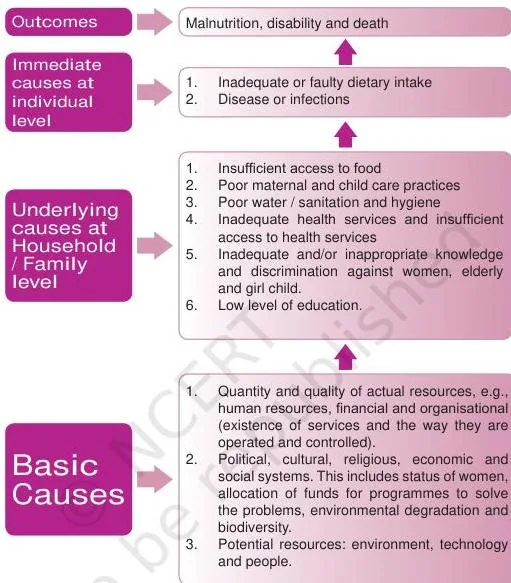
The factor web above is not a chain — poverty is the underlying cause, and around it sit economic factors (availability of financial resources), agricultural policy (production and prices of foodstuffs), health care facilities and their access, government policy and political will, and socio-cultural factors (NCERT, pp. 48-50).
The chapter also names the everyday realities: poor sanitation, households without safe drinking water, and working days lost to water-borne diseases (NCERT, p. 48). If an answer asks why undernutrition persists despite all the programmes, this web is the answer — food alone is not the fix.
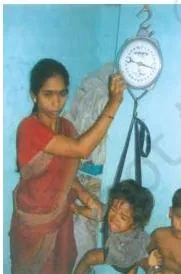
The photograph above shows the nutrient-based or medicinal strategy in action: iron and folic acid delivered as supplements to vulnerable groups — children, pregnant women and nursing mothers — which the chapter calls a short-term measure (NCERT, pp. 54-56). Contrast it with Table 3.1, where supplementation is described as costlier and narrower in coverage than food-based strategies.
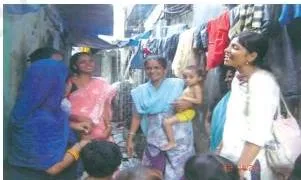
The photograph above shows assessment — how the field actually finds the problems it then treats. Weighing a child is an anthropometric measurement, the same tool family the chapter names for assessing PEM: weight, height and head-chest circumference (NCERT, p. 49). Weight-for-age detects underweight, which is exactly the term Review Question 1 asks you to define.
Key terms and definitions from the chapter
This table is the fastest way to learn the vocabulary the chapter expects you to reproduce. Review Question 1 asks for most of these terms by name, and the chapter’s own key-terms list on page 59 adds the rest.
| Term | Meaning in one line | NCERT page |
|---|---|---|
| Nutritional status | The state of the body’s nutrition relative to its needs; the chapter’s mission is to maintain optimal nutritional status in the population | p. 45 |
| Undernutrition | The body getting less than it needs — seen in India as low birth weight, growth retardation and micronutrient deficiency | pp. 46-47 |
| Overnutrition | Intake beyond need, causing undesirable weight gain, overweight and obesity | p. 47 |
| Malnutrition | The umbrella term for both undernutrition and overnutrition; the underlying cause of at least 50 per cent of under-five deaths | pp. 46-47 |
| Low birth weight | Birth weight below 2500 g (2.5 kg); affects about one-fifth of Indian infants | p. 46 |
| Public health | Collective action by society to protect and promote the health of whole populations | p. 45 |
| Public health nutrition | The field that promotes good health by preventing nutrition-related illness in populations through policies and programmes | p. 48 |
| Community | A specific group of people sharing common characteristics — language, conditions, lifestyle or a health problem | p. 48 |
| Double burden of malnutrition | The coexistence of undernutrition and overnutrition in the same nation | p. 47 |
| PEM (protein-energy malnutrition) | Malnutrition from inadequate intake of the macronutrients — energy and protein | p. 49 |
| Underweight | Body weight less than adequate for age | p. 50 |
| Stunting | Height less than adequate for age — short stature | p. 50 |
| Wasting | Weight not adequate relative to height | p. 50 |
| Marasmus | Severe undernutrition due to deficiency of food and energy | p. 50 |
| Kwashiorkor | Severe undernutrition caused by protein deficiency | p. 50 |
| Hidden hunger | The chapter’s term for micronutrient deficiency | pp. 46, 51 |
| IDA (iron-deficiency anaemia) | The most common nutritional disorder in the world; low haemoglobin because iron for the blood is lacking | pp. 51-52 |
| VAD (vitamin A deficiency) | Deficiency that causes night blindness progressing to blindness and lowers resistance to infection | p. 52 |
| IDD (iodine deficiency disorders) | A spectrum of disabling conditions from fetal life to adulthood caused by inadequate dietary intake of iodine | p. 53 |
| Goitre | Enlarged thyroid — the most common sign of iodine deficiency in adults | p. 53 |
| Cretinism | The form iodine deficiency takes in children | p. 53 |
| Public nutrition | A special body of knowledge from the nutritional, biological, behavioural, social and managerial sciences; the art and science of promoting health through society’s organised efforts | p. 48 |
| Nutrition programmes | Government schemes such as ICDS, the nutrient deficiency control programmes, Mid-Day Meal and the food security programmes | p. 56 |
| Community health | Listed among the chapter’s key terms; build it from ‘community’ (p. 48) and the three levels of health care (p. 57) | pp. 48, 57 |
Common mistakes students make in this chapter
The exam-clear student is the one who keeps the chapter’s distinctions straight. Each row below names a confusion students actually make, the correct rule, and a quick way to check yourself.
| Mistake | Correct rule | How to check your answer |
|---|---|---|
| Stunting and wasting swapped | Stunting is height too low for age; wasting is weight too low for height; underweight is weight too low for age (p. 50) | Ask which two measurements are compared: height with age → stunting; weight with height → wasting |
| Marasmus and kwashiorkor swapped | Marasmus = deficiency of food and energy overall; kwashiorkor = protein deficiency (p. 50) | Ask what is missing: all food → marasmus; protein only → kwashiorkor |
| Hidden hunger treated as ordinary hunger | It is micronutrient deficiency, which can exist even when energy intake looks adequate (pp. 46, 51) | Ask whether calories or vitamins and minerals are the issue |
| Fortification confused with supplementation | Fortification is food-based, universal and cost-effective; supplementation is medicinal, targeted and short-term (Table 3.1, pp. 55-56) | Ask who receives it: everyone (fortification) or at-risk groups (supplementation) |
| ICDS confused with the prophylaxis programmes | ICDS is an outreach programme for young children and mothers; the prophylaxis programmes target specific micronutrient deficiencies (p. 56) | Ask what the programme covers: all-round early childhood care or one nutrient |
| Public nutrition confused with clinical nutrition | Public works at population level with vulnerable groups; clinical works with individual patients (p. 48) | Ask who the client is: one patient or a whole group |
| IDA consequences mixed with IDD | Iron deficiency hits the blood and cognition; iodine deficiency hits the thyroid — goitre and cretinism (pp. 51-53) | Ask which organ the nutrient feeds: blood (BET rule) or thyroid |
Review questions and where the answers are
The chapter tells you what it thinks matters: the six review questions on page 59 and the learning objectives on page 45. Use the table below to jump from a question to the pages that answer it.
| Review question | What it asks | Where the answer is |
|---|---|---|
| 1 | Explain the terms: stunting, low birth weight baby, IDD, wasting, double burden of malnutrition, marasmus, kwashiorkor, community | pp. 46-53 |
| 2 | Discuss the strategies that can be adopted to combat public nutrition problems | pp. 53-56 |
| 3 | What is public health nutrition? | p. 48 |
| 4 | What are the common nutritional problems facing India? | pp. 49-53 |
| 5 | What are the consequences of IDA and IDD? | pp. 51-53 |
| 6 | What is the scope of public health nutrition? List some career choices | pp. 57-59 |
The learning objectives on page 45 also make a good self-check. After studying, you should be able to:
- explain the significance and scope of public nutrition;
- name the nutritional problems of public health significance;
- list the government programmes that tackle them;
- describe the role and functions of a public health nutritionist;
- state the knowledge and skills a career in public health nutrition requires.
One honest note: textbook contents and the examinable syllabus are not always identical. Check the current Class 12 Home Science syllabus on the official CBSE website before deciding what to prioritise.
Practical 1 and the four activities in this chapter
This chapter pairs its theory with one practical the book expects you to perform — developing and costing supplementary foods for preschoolers.
It also suggests four activities (pp. 58-59): a visit to anganwadis (ICDS centres) with a PowerPoint presentation; an interactive session with a medical officer from a PSM department, PHC or municipal corporation on undernutrition; an exhibition on nutritional problems in India; and browsing the websites of WHO, UNICEF, POSHAN Abhiyaan and the Ministries of Health and of Women and Child Development.
Practical 1 (p. 60) has a clear brief. The class divides into four groups, and each group plans two recipes for 5 servings, staying within a cost limit the teacher sets — not more than ₹5 per serving. Group A plans recipes that are good sources of energy and protein; Group B, iron; Group C, vitamin A or beta carotene; Group D, calcium.
Costing is the arithmetic the practical actually tests. The worked check below uses original numbers — your own prices will differ, but the rule is the same.
Step 1: Group A prices a 5-serving recipe at ₹23.50.
Divide the total by the number of servings.
\[ 23.50 \div 5 = 4.70 \]
- Step 1: Compare with the cap: \( 4.70 \leq 5.00 \), so this recipe is inside the limit.
- Step 2: A modified version of the recipe costs ₹27.
The per-serving cost is now \( 27 \div 5 = 5.40 \), which is \( \gt 5.00 \) — the recipe breaks the cap.
Step 4: Revise the recipe, for example by swapping a costly ingredient for a cheaper local one (groundnuts instead of almonds), and re-cost until the per-serving figure falls at or below ₹5.
Rule to remember: \( \text{cost per serving} = \text{total cost} \div \text{number of servings} \), kept at or below ₹5.
One note saves students real work: the book states you are not required to calculate the nutritive values of the recipes (NCERT, p. 60). Evaluation covers serving size, cost, suitability for preschoolers, appearance, taste and acceptability by children.
What to remember from Chapter 3
This chapter has no printed summary block, so this recap is built from its learning objectives (p. 45) and its key terms (p. 59).
- Public health nutrition works on populations, not individual patients; its mission is to prevent both undernutrition and overnutrition (p. 45).
- India’s core statistics: about one-fifth of infants born with low birth weight, and almost half of children mildly or moderately undernourished (p. 46).
- India faces the double burden of malnutrition — undernutrition and overnutrition coexisting (p. 47).
- PEM is measured through anthropometry: underweight (weight for age), stunting (height for age), wasting (weight for height); the severe forms are marasmus (food and energy deficiency) and kwashiorkor (protein deficiency) (pp. 49-50).
- Hidden hunger is micronutrient deficiency; the big three are iron (IDA — blood), vitamin A (VAD — eye) and iodine (IDD — thyroid) (pp. 51-53).
- Food-based strategies (diversification, home gardening, nutrition education, fortification) are the sustainable long-term goal; supplementation is short-term and targeted (p. 54; Table 3.1, pp. 55-56).
- Know the programme types: ICDS, nutrient deficiency control, Mid-Day Meal, food security, and self-employment and wage employment schemes (p. 56).
- Health care runs at three levels: primary (PHCs), secondary (district hospitals, CHCs as first referral), tertiary (medical college and specialised hospitals) (p. 57).
- A public nutritionist needs science plus communication and programme-management skills, and works in hospitals, ICDS, government, NGOs and industry (pp. 57-59).
- Practical 1: two recipes per group, 5 servings each, within ₹5 per serving — and you do not calculate nutritive values (p. 60).
Related resources
This listing is maintained for the 2026-27 academic session using the NCERT textbook information available to us. NCERT remains the authority for confirming the latest edition.
Chapter 3 sits in Unit II of Human Ecology and Family Sciences Part I. To move through the rest of the book, see the next chapter, Food Processing and Technology, other chapters such as Fashion Design and Merchandising, and the Class 12 Home Science notes page, which lists the whole book — including this chapter’s predecessor in Unit II.
For the rest of your Class 12 subjects, use the Class 12 hub; the wider CBSE notes library covers earlier classes as well. You can verify any textbook edition on the official NCERT textbook portal, and check the current Class 12 Home Science syllabus on the CBSE website — textbook contents and the examinable syllabus are not always identical.
Sources and data verification
The facts on this page come from one place — the NCERT textbook itself. Here is precisely what this page covers and what it does not.
- The figures and page references describe the NCERT Class XII Home Science textbook Human Ecology and Family Sciences Part I, Chapter 3 ‘Public Nutrition and Health’, official edition on ncert.nic.in.
- This page covers that one chapter only — not the rest of Part I or Part II of the book.
- The listing is maintained for the current academic session using the NCERT information available to us.
- NCERT settles textbooks, editions and PDFs; CBSE settles curriculum, syllabus and examinations.
Frequently asked questions
What is the difference between stunting, wasting and being underweight?
All three are signs of protein-energy malnutrition, but each uses a different measurement: underweight is weight too low for age, stunting is height too low for age, and wasting is weight too low for height (NCERT, p. 50). If the comparison involves height and age, it is stunting; if weight is compared with height, it is wasting.
What does hidden hunger mean in this chapter?
Hidden hunger is the chapter’s name for micronutrient deficiency — a lack of iron, zinc, vitamin A, iodine and other vitamins and minerals (NCERT, pp. 46, 51). It is called ‘hidden’ because a person can appear adequately fed while still lacking the micronutrients the body needs.
What is the double burden of malnutrition that India faces?
It is the coexistence of undernutrition and overnutrition in the same country: undernutrition (low birth weight, stunting, wasting) remains widespread, while overweight, obesity and diet-related diseases rise as diets shift to processed and fast foods and lifestyles become more sedentary (NCERT, p. 47). Both problems demand different responses from policymakers, doctors and nutritionists.
What is the difference between food based and nutrient based strategies?
Food-based strategies — dietary diversification, home gardening, nutrition education and fortification — are preventive, sustainable, cost-effective and carry no overdose risk. Nutrient-based strategies give supplements of vitamin A, iron and folic acid to at-risk groups; they act quickly but are short-term, costly, and hard to cover fully (NCERT, p. 54; Table 3.1, pp. 55-56).
The chapter’s long-term goal is to shift away from supplementation towards food-based approaches.
What do students have to do in Practical 1 of this chapter?
In groups, plan two low-cost supplementary food recipes for 5 servings each, using locally available foods, within a teacher-set limit of not more than ₹5 per serving. Group A targets energy and protein, Group B iron, Group C vitamin A or beta carotene, and Group D calcium.
You are not required to calculate nutritive values — evaluation covers serving size, cost, suitability for preschoolers, appearance, taste and acceptability (NCERT, p. 60).
Where are the answers to the review questions of this chapter?
All six review questions sit on page 59. Question 1 (terms) is answered on pages 46-53, question 2 (strategies) on pages 53-56, question 3 (what is public health nutrition) on page 48, question 4 (common problems) on pages 49-53, question 5 (IDA and IDD consequences) on pages 51-53, and question 6 (scope and careers) on pages 57-59. The mapping table in the review questions section above shows the full list.
Reference: NCERT Class 12 Human Ecology and Family Sciences textbook, chapter 3, official edition on ncert.nic.in.
Explore Class 12 Home Science Books
Class 12 Home Science on LearnCBSE:
Related chapters:
- Work, Livelihood and Career
- Food Quality and
- Human Development and Family Studies