
This is the official NCERT Class 12 Accountancy Part II chapter 6, Cash Flow Statement (AS-3) — the cash flow statement class 12 chapter that explains how companies report the movement of cash and cash equivalents across operating, investing and financing activities.
The printed chapter runs about 46 pages, from NCERT page 240 to page 286, and the official PDF is directly below. Every section, exhibit and exercise set is mapped on this page with its NCERT page number, so you can follow along with the book or revise from your phone.
Download the Cash Flow Statement Class 12 NCERT PDF
The chapter file is the official NCERT Class 12 Accountancy Part II PDF hosted on ncert.nic.in — the same printed pages, tables and illustrations that appear in the book.
Open the official cash flow statement class 12 NCERT PDF from ncert.nic.in to read the full chapter free of charge, or keep it saved on your phone for revision.
| What the chapter holds | Count | Where it is used |
|---|---|---|
| Printed pages | 46 | |
| Sections in the chapter | 11 | |
| Figures with NCERT captions | 1 | |
| Tables | 90 | |
| Worked examples | 15 | solved step by step in our NCERT Solutions |
| Official NCERT PDF | Download the chapter PDF | the chapter exactly as NCERT publishes it |
The Chapter in Brief: Sections, Figures and Exercises
The chapter is arranged to be read in one direction: it explains why the cash flow statement exists before it shows how to build one.
It opens with learning objectives and the statement’s place in company financial reporting, then works through purpose (sections 6.1-6.2), definitions (6.3-6.4), the three-way classification of activities (6.5), the computation of cash from operating, investing and financing activities (6.6-6.7), and finally the preparation of complete statements from two balance sheets (6.8).
The chapter closes with a list of the terms it introduced, a short summary, and three sets of questions — short answer, long answer and numerical — with the chapter’s own check-your-understanding exercises placed at the points where each skill is introduced.
What This Chapter Covers, Section by Section
The chapter builds skill in layers: it fixes definitions first, because the classification that every numerical question depends on cannot work without them. The tour below follows the book’s own order, with the printed page where each block begins.
- 6.1 Objectives of Cash Flow Statement (p. 242) — what the statement shows, and the information it gives users about an enterprise’s ability to generate cash and about the timing and certainty of its generation.
- 6.2 Benefits of Cash Flow Statement (p. 242) — how the statement helps users evaluate net assets, liquidity and solvency, and why it improves comparability between enterprises.
- 6.3 Cash and Cash Equivalents (p. 243) — the AS-3 definitions of cash and of cash equivalents, including the three-months-or-less maturity test.
- 6.4 Cash Flows (p. 243) — what counts as a cash inflow and a cash outflow, with everyday examples such as collecting from trade receivables.
- 6.5 Classification of Activities (pp. 244-247) — the three heads — operating, investing, financing — with their examples, the treatment of extraordinary items, interest, dividend and taxes, and non-cash transactions. Exhibit 6.1 belongs to this section.
- 6.6 Ascertaining Cash Flow from Operating Activities (pp. 248-257) — direct versus indirect method, the proposed dividend adjustment, the working capital rule and the indirect-method proforma (Exhibit 6.4), demonstrated in Illustrations 2-4.
- 6.7 Ascertainment of Cash Flow from Investing and Financing Activities (pp. 258-260) — the ledger-account technique for finding missing purchases and sales, shown in Illustrations 5-6.
- 6.8 Preparation of Cash Flow Statement (pp. 261-275) — complete statements from two balance sheets, including the closing check that opening cash and cash equivalents plus the net increase equals the closing figure (Illustrations 7-10).
- Terms Introduced in the Chapter and Summary (pp. 275-276) — the chapter’s vocabulary list and its closing summary.
- Question sets (pp. 276-286) — short answer, long answer and numerical sets, with the printed answers to the check-your-understanding exercises.
Core Concepts: Cash Equivalents, Activities and Adjustments
These are the handful of ideas that decide whether the numerical questions at the end of the chapter are solvable. Master them in this order and the illustrations become practice rather than puzzles.
What counts as cash and cash equivalents
As per AS-3, cash is cash in hand plus demand deposits with banks (NCERT, p. 243). Cash equivalents are short-term, highly liquid investments readily convertible into a known amount of cash, with an insignificant risk of change in value (NCERT, p. 243).
An investment normally qualifies as a cash equivalent only when it matures within three months or less of the date of acquisition. Shares are excluded, apart from cases such as preference shares bought shortly before their redemption date, where the risk of non-repayment is insignificant (NCERT, p. 243).
The three activity heads and the classification test
The classification test has three heads, each defined by AS-3. Operating activities are the principal revenue-generating activities of the enterprise — for a garment manufacturer, buying raw material, incurring manufacturing expenses and selling garments (NCERT, p. 244).
Investing activities are the acquisition and disposal of long-term assets and other investments not included in cash equivalents (NCERT, p. 244). Financing activities are the activities that change the size and composition of the owners’ capital and the borrowings of the enterprise (NCERT, p. 245).
Two cautions follow. A single transaction can split across heads, and the same activity can sit in different heads for different enterprises — buying shares is an operating activity for a share brokerage firm but an investing activity for other enterprises (NCERT, p. 246).
Where interest, dividend and tax go
Interest, dividends and taxes are the items that students classify wrongly most often, because the head depends on the type of enterprise. The table below is the chapter’s rule on NCERT page 247.
| Item | Non-financial enterprise | Financial enterprise |
|---|---|---|
| Interest received | Investing inflow | Operating inflow |
| Dividend received | Investing inflow | Operating inflow |
| Interest paid | Financing outflow | Operating outflow |
| Dividend paid | Financing outflow | Financing outflow |
| Income tax on operating profit | Operating outflow | Operating outflow |
| Dividend distribution tax | Financing outflow, alongside dividend paid | Financing outflow, alongside dividend paid |
| Capital gains tax on sale of fixed assets | Investing outflow | Investing outflow |
For a financial enterprise — one whose main business is lending and borrowing — interest paid, interest received and dividend received are all operating, while dividend paid remains financing (NCERT, p. 247).
Taxes follow the activity that generated them: income tax on operating profit is operating, dividend distribution tax travels with dividend paid under financing, and capital gains tax on the sale of fixed assets is investing (NCERT, p. 247).
Direct method and indirect method
AS-3 allows either route. The direct method discloses the major classes of gross cash receipts and gross cash payments — cash collected from customers, cash paid to suppliers (NCERT, p. 249).
The indirect method starts from net profit or loss before tax and extraordinary items and adjusts it for non-cash items, for deferrals or accruals of operating receipts, and for items of income and expense that belong to investing or financing activities (NCERT, p. 249).
Both methods produce the same cash from operating activities — the chapter says so explicitly after Illustration 2 (NCERT, p. 253) — and because companies mostly use the indirect method in practice (NCERT, p. 249), the chapter teaches that route.
The working capital adjustment rule
The statement of profit and loss is prepared on accrual basis, so recorded profit is not the same as cash received.
The indirect method reverses accrual effects with one rule: an increase in current assets and a decrease in current liabilities are deducted from operating profit, while a decrease in current assets and an increase in current liabilities are added (NCERT, pp. 251-252).
Example: if trade receivables rise from Rs. 20,000 to Rs. 25,000, then Rs. 5,000 of revenue is in profit but the cash has not yet arrived — so cash from operations falls by Rs. 5,000 and the increase is deducted.
Worked example: the indirect method step by step
Work through this example with numbers not used in the text. A company reports profit after tax of Rs. 1,80,000, depreciation of Rs. 40,000, goodwill written off of Rs. 10,000, and a profit on sale of machinery of Rs. 15,000.
During the year it made a provision of Rs. 60,000 for income tax, received an income tax refund of Rs. 8,000, and paid interest of Rs. 12,000 on a long-term loan.
The working capital position changed as follows: trade receivables rose by Rs. 20,000; inventories fell by Rs. 12,000; trade payables rose by Rs. 25,000; outstanding expenses fell by Rs. 4,000; and prepaid expenses rose by Rs. 3,000.
The provision for tax account stood at Rs. 75,000 at the start of the year and Rs. 85,000 at the end.
The solution runs in six steps, shown as blocks in the table: rebuild net profit before tax; reverse non-cash and non-operating items; adjust for working capital; extract the tax actually paid; add back the tax refund; and arrive at net cash from operating activities.
| Particulars | Working | Amount (Rs.) |
|---|---|---|
| Net profit before tax and extraordinary items | 1,80,000 + 60,000 − 8,000 | 2,32,000 |
| Add back: depreciation | Non-cash item | + 40,000 |
| Add back: goodwill written off | Non-cash item | + 10,000 |
| Add back: finance cost (interest on loan) | Financing outflow | + 12,000 |
| Less: profit on sale of machinery | Investing income | − 15,000 |
| Operating profit before working capital changes | 2,79,000 | |
| Less: increase in trade receivables | Cash not yet received | − 20,000 |
| Add: decrease in inventories | Stock sold, cash realised | + 12,000 |
| Add: increase in trade payables | Suppliers paid less than purchases | + 25,000 |
| Less: decrease in outstanding expenses | Old unpaid expense now paid | − 4,000 |
| Less: increase in prepaid expenses | Cash paid before expense is charged | − 3,000 |
| Cash generated from operations | 2,89,000 | |
| Less: income tax paid | 75,000 + 60,000 − 85,000 | − 50,000 |
| Add: income tax refund received | + 8,000 | |
| Net cash from operating activities | 2,47,000 |
Step 1 rebuilds the pre-tax profit because tax is handled at the end of the operating section. Step 2 reverses items that either move no cash (depreciation, goodwill) or belong to other activity heads (finance cost, profit on sale).
Step 3 reverses accrual effects. Step 4 reads the tax actually paid off the provision account, and step 5 adds back the refund that step 1 removed from the starting profit.
Finding missing amounts with ledger accounts
Balance sheets give asset values, not the transactions behind them. This is the technique the chapter uses to find the hidden purchase or sale: draw the asset account at cost, place the two balance-sheet figures and the disposal entries in it, and the missing figure emerges as the balancing amount (method of Illustration 5, NCERT, pp. 258-260).
Take a company whose machinery at cost stood at Rs. 4,00,000 at the start of the year and Rs. 5,50,000 at the end. Accumulated depreciation ran from Rs. 1,50,000 to Rs. 1,70,000.
During the year, a machine costing Rs. 60,000 with accumulated depreciation of Rs. 35,000 was sold for Rs. 30,000. Depreciation of Rs. 55,000 was charged for the year.
The machinery account below finds the purchases. The profit on sale is Rs. 5,000 — the sale price minus the book value of Rs. 25,000 (Rs. 60,000 − Rs. 35,000).
| Dr. — Machinery Account | Rs. | Cr. — Machinery Account | Rs. |
|---|---|---|---|
| Balance b/d | 4,00,000 | Bank — sale proceeds | 30,000 |
| Statement of Profit and Loss — profit on sale | 5,000 | Accumulated depreciation (on machine sold) | 35,000 |
| Bank — new machinery purchased (balancing figure) | 2,10,000 | Balance c/d | 5,50,000 |
| Total | 6,15,000 | Total | 6,15,000 |
The account balances, so the balancing figure of Rs. 2,10,000 is the cash paid for new machinery. The investing section then reads directly from it.
| Cash flows from investing activities | Rs. |
|---|---|
| Sale of machinery | 30,000 |
| Purchase of new machinery (balancing figure in machinery account) | (2,10,000) |
| Net cash used in investing activities | (1,80,000) |
Check the result with the accumulated depreciation account: opening balance Rs. 1,50,000 plus depreciation charged Rs. 55,000 minus the Rs. 35,000 removed with the machine sold equals the closing balance of Rs. 1,70,000. If this account does not balance, the purchase figure is wrong.
Walkthrough of the Chapter’s Classification Exhibit
The chapter’s central reference table — Exhibit 6.1, Classification of Cash inflows and Cash Outflows Activities (NCERT, p. 247) — sorts every cash flow into one of the three heads and shows inflow and outflow examples side by side. It is the exhibit to keep open while doing the classification exercise ‘Test your Understanding – I’ (NCERT, p. 248).
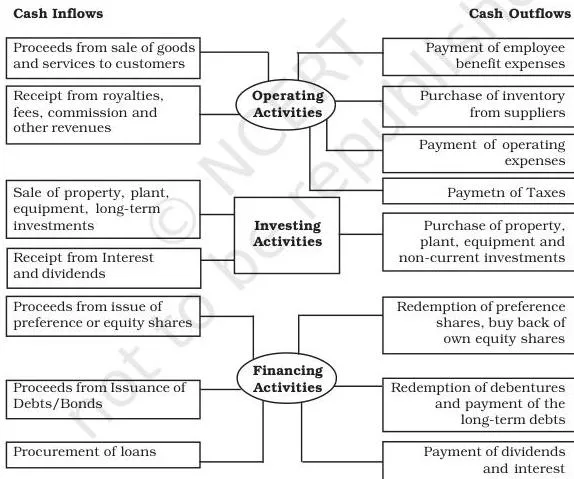
Three lessons from the exhibit matter beyond the chapter. First, every cash flow lands under exactly one head, so classification is a two-step test: which head, and is it an inflow or an outflow.
Second, one transaction can be split. When a fixed asset is bought on instalments, the interest element is a financing outflow while the loan element is an investing outflow (NCERT, p. 246).
Third, the same activity can classify differently for different enterprises. Purchase of shares is operating for a share brokerage firm and investing for other enterprises (NCERT, p. 246).
Use the exhibit as the key for ‘Test your Understanding – I’, where the chapter asks you to sort everyday transactions — purchase of machinery, proceeds from an equity issue, cash revenue from operations, and so on — into operating, investing, financing or cash equivalents. The printed answers sit at the end of the chapter on page 286.
Key Terms Defined: The Chapter’s Vocabulary
The chapter closes by listing the eleven terms it introduced (NCERT, p. 275), and definition-type questions draw on exactly this list. The table below restates each one plainly.
| Term | Meaning | Explained at |
|---|---|---|
| Cash | Cash in hand and demand deposits with banks | p. 243 |
| Cash Equivalents | Short-term, highly liquid investments readily convertible into known amounts of cash, with insignificant risk of change in value; normally three months’ maturity or less | p. 243 |
| Cash Inflows | Receipts of cash, such as collection from debtors or sale proceeds of an asset | p. 243 |
| Cash Outflows | Payments of cash, such as payment to suppliers or purchase of machinery | p. 243 |
| Non-cash item | An item that affects profit but involves no cash movement — depreciation, goodwill written off | p. 251 |
| Cash Flow Statement | The statement showing inflows and outflows of cash and cash equivalents, classified into operating, investing and financing activities | p. 242 |
| Operating Activities | The principal revenue-generating activities of an enterprise | p. 244 |
| Investing Activities | Acquisition and disposal of long-term assets and other investments not included in cash equivalents | p. 244 |
| Financing Activities | Activities that change the size and composition of owners’ capital and borrowings | p. 245 |
| Accounting Standard-3 (AS-3) | The standard under which cash flow statements are prepared, notified under the Companies Act, 2013 | p. 240 |
| Extraordinary Items | Non-recurring items such as loss from theft, earthquake or flood; disclosed separately | p. 247 |
Notice the pair to keep apart: cash equivalents are included in the statement, while non-cash transactions — no matter how large — are excluded (NCERT, pp. 247-248).
Mistakes Students Make in Cash Flow Questions
The chapter’s own ‘Test your Understanding’ exercises are placed exactly where students slip, and the printed answers (pp. 258 and 286) confirm the pattern. Each mistake below is named before you make it, with the correction and where the chapter explains it.
| Mistake | Correct rule | How to check your answer |
|---|---|---|
| Working capital rule applied backwards | Increase in current assets and decrease in current liabilities are deducted; decrease in current assets and increase in current liabilities are added (pp. 251-252) | Read each change as a cash effect: “debtors up Rs. 5,000” means cash down Rs. 5,000 |
| Starting from profit after tax instead of profit before tax | Add back the tax provision first, so you begin from net profit before tax and extraordinary items (pp. 253-255) | Your first line should read “Net profit before taxation and extraordinary items”, never the after-tax figure |
| Mishandling the previous year’s proposed dividend | It is added back to operating profit and the payment is shown as a financing outflow (pp. 249-250) | The dividend paid this year is last year’s proposed dividend, once approved by shareholders |
| Classifying interest and dividend without checking the enterprise | A financial enterprise treats interest and dividends received and interest paid as operating; a non-financial enterprise treats receipts as investing and payments as financing (p. 247) | Ask first: is this a financial enterprise? The answer changes the head |
| Including non-cash transactions in the statement | Acquisition of machinery by issue of shares, or redemption of debentures by shares, is excluded from the cash flow statement (pp. 247-248) | If no cash moved, it cannot appear in a cash flow statement |
| Treating gains and losses on sale alike | Gain on sale is deducted from profit; loss on sale is added back (p. 254). An income tax refund is added back (pp. 254-255) | Gains inflate profit without adding operating cash; losses reduce profit without removing operating cash |
Practising Chapter 6: What the Exercises Demand
Mastery is defined by the chapter’s learning objectives on p. 240: state the purpose and preparation of the statement, distinguish the three activities, and prepare the statement by both the direct and indirect method. The materials below drill each ability.
| Skill | Where it is practised | What a full answer needs |
|---|---|---|
| Definitions and classification reasoning | Short answer questions 1-8 (pp. 276-277); Test your Understanding – I (p. 248) | The AS-3 definition plus an example; for question 8, an illustration showing the same activity in different heads for different enterprises |
| Indirect-method adjustments | Illustrations 2-4 (pp. 252-257); numerical questions 1, 4 and 5 (pp. 276-278) | Every working note shown — pre-tax profit, non-cash add-backs, working capital changes, tax paid via the provision account |
| Cash paid for inventory | Numerical question 2 (p. 277) | Reconstruct purchases from inventory, then convert to cash paid using trade payables |
| Single-transaction classification | Numerical question 3 (p. 277) | Splitting the transaction — the cash element versus the bond — and classifying the cash part |
| Investing activities via ledger accounts | Illustration 5 (pp. 258-260); numerical question 6 (pp. 278-279) | Machinery and accumulated depreciation accounts, with the purchase or sale as the balancing figure |
| Complete statements from two balance sheets | Illustrations 7-10 (pp. 261-274); numerical questions 7-12 (pp. 279-285) | The three activity sections plus the closing check: opening cash + net increase = closing cash (Exhibit 6.2, p. 248) |
The habit that separates a correct statement from a marks-losing one is the working note. Write the ledger accounts (provision for tax, machinery, accumulated depreciation) exactly as the solutions print them, and finish with the closing check from Exhibit 6.2: opening cash and cash equivalents plus the net increase equals the closing figure (NCERT, p. 248).
Illustration 10 sets out the same company by both methods (NCERT, p. 261) and is the best single comparison for seeing why the two routes agree. Since companies mostly use the indirect method in practice (NCERT, p. 249), treat the indirect version as the default to master.
One honest caution: textbook contents and the examinable syllabus are not always identical — check the current official syllabus before deciding what to practise.
Key Takeaways from Chapter 6
This section distils what the chapter itself says matters — its closing summary (pp. 275-276) and its learning objectives (p. 240), restated in plain words.
- A cash flow statement helps in ascertaining the liquidity of an enterprise.
- Indian companies prepare and report it according to AS-3, notified as per the Companies Act, 2013.
- Cash flows are categorised into operating, investing and financing activities.
- The statement helps users judge the amount and certainty of cash flows the company can generate.
- The direct and indirect methods arrive at the same operating figure (NCERT, p. 253).
- After the chapter you should be able to state the statement’s purpose, separate the three activities, and prepare it by both methods.
Related Resources and the Official PDF
This listing is maintained for the 2026-27 academic session using the NCERT textbook information available to us. NCERT remains the authority for confirming the latest edition.
For the rest of the course, start from the Class 12 Accountancy book page or browse the full list of Class 12 NCERT books.
- Previous chapter: Accounting Ratios — the chapter that comes before this one
- Accounting Ratios revision notes — the same chapter in notes form
- Class 12 accountancy revision notes
- Class 12 revision hub
- NCERT notes library
The authoritative source for every NCERT textbook edition and PDF is NCERT’s official textbook download page on ncert.nic.in.
NCERT settles the textbook and its editions; CBSE settles the examinable syllabus.
Reference: NCERT Class 12 Accountancy textbook, chapter 6, official edition on ncert.nic.in.
Sources and Data Verification
The chapter details on this page describe the NCERT Class 12 Accountancy Part II textbook (Company Accounts and Analysis of Financial Statements), English edition, Chapter 6 Cash Flow Statement, pages 240-286.
The page covers this one chapter of the Class 12 Accountancy Part II book; it does not cover other Class 12 textbooks or other subjects, and it is maintained for the current academic session.
NCERT settles the textbook — its editions, contents and official PDFs. CBSE settles the curriculum, syllabus and examinations. A chapter appearing in a textbook does not by itself prove that every part of it is examinable; check the current official syllabus.
Frequently Asked Questions About the Cash Flow Statement Chapter
What is the meaning of cash and cash equivalents in a cash flow statement?
Cash means cash in hand plus demand deposits with banks. Cash equivalents are short-term, highly liquid investments that can be converted into a known amount of cash with an insignificant risk of change in value — normally investments with a maturity of three months or less from the date of acquisition.
Shares are excluded unless they are, for example, preference shares acquired close to their redemption date (NCERT, p. 243).
How are interest paid and interest received classified in a cash flow statement?
It depends on the enterprise. For a financial enterprise — whose main business is lending and borrowing — interest paid, interest received and dividend received are operating activities, while dividend paid stays a financing activity. For a non-financial enterprise, interest and dividends paid are financing outflows, and interest and dividends received are investing inflows (NCERT, p. 247).
Why is depreciation added back to net profit in the indirect method?
Depreciation is a non-cash item: it is charged in the statement of profit and loss, so it reduces reported profit, but no cash actually leaves the business. To convert profit into cash from operations, the amount is added back to net profit before tax (NCERT, pp. 250-251).
How is the previous year’s proposed dividend treated in a cash flow statement?
The previous year’s proposed dividend is declared and approved in the current year, so it becomes dividend payable now and is paid within 30 days of declaration (NCERT, p. 249). In the cash flow statement it is added back to the operating profit, and the actual payment is shown as an outflow under financing activities (NCERT, pp. 249-250).
What is the difference between the direct and indirect method of preparing a cash flow statement?
The direct method lists the major classes of gross cash receipts and gross cash payments, such as cash collected from customers and cash paid to suppliers. The indirect method starts from net profit before tax and extraordinary items and adjusts it for non-cash items, deferrals or accruals, and investing or financing incomes and expenses (NCERT, pp. 248-249).
Both methods arrive at the same cash from operating activities (NCERT, p. 253), and companies mostly use the indirect method (NCERT, p. 249).
Are non-cash transactions like the purchase of machinery by issuing shares included in the cash flow statement?
No. Investing and financing transactions that do not use cash or cash equivalents — such as acquiring machinery by issuing equity shares or redeeming debentures by issuing shares — are excluded from the cash flow statement. They are disclosed elsewhere in the financial statements so that all relevant information is still available (NCERT, pp. 247-248).
Explore Class 12 Accountancy Books
Related chapters:
- Accounting for Partnership: Basic Concepts
- Overview of
- Reconstitution of a Partnership Firm – Admission of a Partner