
This page gives you the official Accounting for Share Capital Class 12 chapter — Chapter 1 of the NCERT Accountancy Part II textbook, Company Accounts and Analysis of Financial Statements — a chapter that runs 74 printed pages and carries a company’s entire equity story: share issue, premium, forfeiture and reissue.
The official PDF is right below; underneath it, you will find a section-by-section map of the chapter and a plain-language explanation of its key ideas, so you can study from the book or revise from this page alone.
Download the NCERT Class 12 Accountancy Chapter 1 PDF
If you want to study from the source itself, the official NCERT Class 12 Accountancy Chapter 1 Accounting for Share Capital PDF is hosted on ncert.nic.in — the official NCERT edition — and covers the full 74-page chapter, including every worked illustration and the closing question sets.
The chapter comes from the NCERT textbook Accountancy: Company Accounts and Analysis of Financial Statements (Part II). Open the PDF alongside the explanations below, or use it first and come back to this page to revise.
| What the chapter holds | Count | Where it is used |
|---|---|---|
| Printed pages | 74 | |
| Sections in the chapter | 16 | |
| Figures with NCERT captions | 1 | |
| Tables | 96 | |
| Worked examples | 27 | solved step by step in our NCERT Solutions |
| Official NCERT PDF | Download the chapter PDF | the chapter exactly as NCERT publishes it |
Chapter at a Glance: What Is Inside the PDF
The table below shows what the chapter contains — its sections, figures, worked examples and exercise questions.
The chapter’s own learning objectives, printed on page 1, are:
- explain the basic nature of a joint stock company and the kinds of companies based on the liability of their members;
- describe the types of shares a company issues;
- account for shares issued at par, at a premium and at a discount, including oversubscription;
- account for forfeiture of shares and reissue of forfeited shares under varying situations;
- work out the amount to be transferred to capital reserve when forfeited shares are reissued, and prepare the share forfeiture account.
The chapter also ends with Terms Used in the Chapter, a Summary, and three closing question sets — Short Answer, Long Answer and Numerical Questions.
What This Chapter Covers: A Section-by-Section Map
Use this map to jump straight to the part of the chapter you are stuck on. Each row names the section as NCERT titles it, says what it teaches, and gives the printed page where it starts.
| Section | What it teaches | NCERT page |
|---|---|---|
| 1.1 Features of a Company | Artificial person, separate legal entity, limited liability, perpetual succession, common seal, transferable shares. | p. 1 |
| 1.2 Kinds of Companies | Classification by members’ liability (limited by shares, limited by guarantee, unlimited) and by number of members (public, private, one person company). | p. 2 |
| 1.3 Share Capital of a Company | Why thousands of shareholders merge into one Share Capital Account. | p. 3 |
| 1.3.1 Categories of Share Capital | Authorised, issued, subscribed, called-up, paid-up, uncalled and reserve capital. | p. 4 |
| 1.4 Nature and Classes of Shares | Preference shares and equity shares as defined by Section 43. | p. 6 |
| 1.5 Issue of Shares and Minimum Subscription | Prospectus, applications, allotment; minimum subscription at least 90% of the issued amount per SEBI guidelines. | p. 7 |
| 1.6 Accounting Treatment | The entry pattern for application, allotment and calls; ASBA. | p. 9 |
| 1.6.1 Calls in Arrears | Unpaid amounts on allotment or calls; entry; Table F interest ceiling of 10% p.a. | p. 16 |
| 1.6.2 Calls in Advance | Amounts received before calls are made; entry; Table F ceiling of 12% p.a. | p. 18 |
| 1.6.3 Over Subscription | The three alternatives open to directors for handling excess applications. | p. 24 |
| 1.6.4 Under Subscription | Fewer applications than shares offered; allot only what was applied for. | p. 30 |
| 1.6.5 Issue of Shares at a Premium | Securities Premium Reserve and its five statutory uses. | p. 30 |
| 1.6.6 Issue of Shares at a Discount | Ordinarily prohibited; only reissue of forfeited shares and sweat equity excepted. | p. 33 |
| 1.6.7 Consideration Other Than Cash | Paying vendors in fully paid shares; shares = amount payable ÷ issue price. | p. 33 |
| Private Placement and ESOP | Section 42 offers to a select group; employee stock options and their terms. | p. 36 |
| 1.7 Forfeiture of Shares | Cancelling a defaulting shareholder’s allotment; entries at par and at premium. | p. 37 |
| 1.7.1 Reissue of Forfeited Shares | Reissue at par, premium or discount; the discount cap; the capital reserve transfer. | p. 49 |
| Buy-back of Shares | Section 68; permitted sources, the 25% cap, the 2:1 debt-equity limit. | p. 55 |
Scattered through the chapter you will also find three Test your Understanding checks and Do it Yourself exercises after many illustrations.
Key Concepts: How Share Capital Accounting Works
Share capital accounting is the journal-entry trail a company follows when it collects money from the public in instalments. Every later topic in the chapter — premium, forfeiture, reissue — is a variation of the basic entries below.
Why a Company Has Share Capital
A company is an artificial person created by law, with a separate legal entity, limited liability and perpetual succession (NCERT, p. 1). It cannot generate its own capital, so it collects money from a large number of shareholders — and because that number is too large for a separate account per person, all contributions merge into one Share Capital Account (p. 3).
The chapter classifies that capital into seven categories. Keep the ladder straight and every balance-sheet question becomes simple:
| Category | Plain meaning |
|---|---|
| Authorised (Nominal/Registered) capital | The ceiling fixed by the Memorandum of Association; the company cannot issue more than this (p. 4). |
| Issued capital | The part of authorised capital actually offered for subscription, including shares to vendors and signatories (p. 4). |
| Subscribed capital | The part of issued capital the public actually applied for; equal to or less than issued capital (p. 4). |
| Called-up capital | The part of subscribed capital the company has asked shareholders to pay (p. 4). |
| Paid-up capital | Called-up capital actually received: called-up minus calls in arrears (p. 4). |
| Uncalled capital | Subscribed capital not yet called up; the company may collect it whenever it needs funds (p. 4). |
| Reserve capital | A portion of uncalled capital the company reserves to be called only on winding up, for creditors (p. 5). |
Two classes of shares exist under Section 43 (NCERT, p. 6): preference shares carry a preferential right to dividend and to repayment of capital at winding up; equity shares are every share that is not a preference share, with dividend varying with profits.
The Instalment Trail: Application, Allotment and Calls
Companies collect share money in instalments — application, allotment, then one or more calls — and each instalment gets its own temporary account. The flow is: prospectus invites the public, applications arrive with application money, allotment creates a binding contract, and calls collect the balance (NCERT, pp. 7-12).
Minimum subscription is the minimum amount, in the directors’ opinion, needed for the issue; per SEBI guidelines it cannot be less than 90% of the issued amount, and if it is not received the company must refund the entire subscription amount (NCERT, p. 8).
Rules that appear again and again in numerical questions (pp. 12-13):
- application money must be at least 5% of face value;
- no call may exceed 25% of face value;
- at least one month between two calls;
- at least 14 days’ notice for payment;
- calls must be made on a uniform basis on all shares of the same class.
ASBA (Applications Supported by Blocked Amount) is the SEBI process under which the bank blocks the application money and debits the applicant’s account only if securities are allotted (p. 11).
The standard entry pattern (pp. 9-12):
| Stage | Entry (general form) |
|---|---|
| Application money received | Bank A/c Dr — To Share Application A/c |
| Transfer on allotted shares | Share Application A/c Dr — To Share Capital A/c |
| Refund on rejected applications | Share Application A/c Dr — To Bank A/c |
| Amount due on allotment | Share Allotment A/c Dr — To Share Capital A/c |
| Excess application money adjusted | Share Application A/c Dr — To Share Allotment A/c |
| Receipt of allotment money | Bank A/c Dr — To Share Allotment A/c |
| Call money due | Share (First/Second/Final) Call A/c Dr — To Share Capital A/c |
| Call money received | Bank A/c Dr — To Share Call A/c |
The last call always carries the word “Final” in its name, and the same pattern holds for preference shares with “Preference” prefixed (pp. 12-13).
Calls in Arrears and Calls in Advance
These are the two opposite failures of the instalment system: a shareholder pays too late, or pays too early. The table below is the fastest way to keep the pair apart.
| Point | Calls in arrears | Calls in advance |
|---|---|---|
| What it is | Amount due on allotment or a call that a shareholder has not paid on time (p. 16). | Money received on calls the directors have not yet made (p. 18). |
| Entry at recognition | Calls in Arrears A/c Dr — To Share Call A/c | Bank A/c Dr — To Calls in Advance A/c |
| Entry at settlement | Bank A/c Dr — To Calls in Arrears A/c, To Interest on Calls in Arrears A/c | Calls in Advance A/c Dr — To Share Call A/c |
| Interest ceiling (Table F) | Not exceeding 10% p.a. | Not exceeding 12% p.a. |
| Balance-sheet home | Deducted from called-up capital in Notes to Accounts (pp. 16, 21-22). | A current liability under “other current liabilities”; never added to paid-up capital (p. 18). |
Over Subscription and Under Subscription
Over subscription — more applications than shares on offer — is a good problem for the company; under subscription is the reverse. Both change how application money is disposed of.
When applications exceed the offer, the directors have three alternatives (pp. 24-26):
| Alternative | What the directors do | Disposal of application money |
|---|---|---|
| 1. Accept some, reject the rest | Allot selected applications in full, reject the others outright. | Full refund on rejected applications (p. 24). |
| 2. Pro-rata allotment | Allot shares to all applicants in the ratio applied : offered. | Excess application money adjusted against allotment; any balance refunded or credited to calls in advance (p. 25). |
| 3. Combination | Reject some applications outright, give pro-rata allotment to the rest. | Refund on rejected; the excess of pro-rata applicants adjusted to allotment (pp. 25-26). |
Mini-example: a company offers 50,000 shares and receives applications for 60,000 shares, application money Rs 2 per share. Pro-rata allotment means five shares for every six applied. Money received is \(60{,}000 \times 2 = 1{,}20{,}000\); transfer \(50{,}000 \times 2 = 1{,}00{,}000\) to Share Capital, and credit the balance \(10{,}000 \times 2 = 20{,}000\) to Share Allotment.
The applicant who applied for six shares has paid Rs 12 for Rs 10 of capital — the extra Rs 2 rides against allotment. Under subscription is the opposite: fewer applications than shares offered, and the allotment is confirmed for the number actually applied for — subject always to the minimum subscription rule, failing which the entire subscription amount is refunded (p. 30).
Premium, Discount and Consideration Other Than Cash
The issue price can equal, exceed or fall below face value. The difference never sits in Share Capital: premium moves to a reserve, discount is almost never allowed.
When shares are issued at a premium, the excess is credited to Securities Premium Reserve, shown under Reserves and Surpluses (NCERT, p. 30). Premium is usually collected with allotment, sometimes with application, and rarely with calls (p. 30). Its five statutory uses (pp. 30-31):
- to issue fully paid bonus shares, within the unissued share capital;
- to write off preliminary expenses;
- to write off the expenses of, or commission paid, or discount allowed on any securities;
- to pay premium on redemption of preference shares or debentures;
- to buy back the company’s own shares.
The entry shape: Share Allotment A/c Dr — To Share Capital A/c, To Securities Premium Reserve A/c (p. 31).
Discount on issue is ordinarily prohibited; the chapter admits only two exceptions — reissue of forfeited shares and issue of sweat equity shares (p. 33).
For consideration other than cash, a vendor accepts fully paid shares for assets sold to the company. The number of shares is fixed by the formula (NCERT, p. 33):
\[ \text{Number of shares to be issued} = \frac{\text{Amount payable}}{\text{Issue price}} \]
Example: a vendor is owed Rs 4,80,000 for a building, and Rs 10 shares are issued at a 20% premium, i.e. at Rs 12. That gives \(4{,}80{,}000 \div 12 = 40{,}000\) shares.
The two-step entry is: Building A/c Dr to Vendor A/c for the purchase price; then Vendor A/c Dr to Share Capital A/c (\(40{,}000 \times 10 = 4{,}00{,}000\)) and to Securities Premium Reserve A/c (\(40{,}000 \times 2 = 80{,}000\)) (p. 34). At par, the count would be \(4{,}80{,}000 \div 10 = 48{,}000\) shares, with no premium entry.
Forfeiture of Shares and Their Reissue
Forfeiture cancels the allotment of a shareholder who has not paid what was due, and the company keeps the money already received. The master rule: reverse every entry for those shares except the premium already received (NCERT, p. 37).
At par (p. 37): Share Capital A/c Dr (the called-up amount) — To Share Forfeiture A/c (amount received), To the unpaid allotment/call account or Calls in Arrears A/c.
At a premium, two cases (pp. 39-40):
- Premium received in full — Securities Premium Reserve is not touched; Share Forfeiture is credited with the amount received excluding the premium.
- Premium not received (wholly or partly, usually because allotment money is unpaid) — Securities Premium Reserve A/c is also debited, for the premium not received.
Reissue rules (pp. 49-50):
- Forfeited shares may be reissued at par, at a premium, or at a discount.
- Discount on reissue cannot exceed the amount received on those shares at the initial issue, and is debited to Share Forfeiture A/c.
- The balance on reissued shares, after deducting the discount, is capital profit and transfers to Capital Reserve.
- When only part of the forfeited shares are reissued, only the proportionate balance transfers; the rest stays in Share Forfeiture for shares not yet reissued (p. 50).
Until the forfeited shares are reissued, the Share Forfeiture balance is shown as an addition to paid-up capital under Share Capital (pp. 37-38).
ASBA, Private Placement, ESOP and Buy-back
These four topics close the chapter, and their accounting is light — here the chapter mainly expects you to know the definitions and the rules.
- ASBA (p. 11): the bank blocks the application money and debits it only on allotment; if no securities are allotted, the block is removed.
- Private Placement (p. 36): Section 42 — an offer of securities to a select group through a private placement offer letter.
- ESOP (pp. 36-37): options given to employees and employee directors to subscribe at less than market value; the employee may or may not exercise the option.
- Buy-back (pp. 55-56): Section 68 — a company purchasing its own shares from existing shareholders (proportionate basis), the open market, odd-lot holders, or employees; capped at 25% of paid-up capital and free reserves, with a 2:1 debt-equity ratio limit, and a transfer to Capital Redemption Reserve equal to the nominal value when bought from free reserves.
ESOP’s key terms, as the chapter defines them (pp. 36-37):
| Term | Meaning |
|---|---|
| Grant | Giving the option to employees at a pre-determined price. |
| Grant date | The date of agreement on the option’s terms. |
| Vesting | The process that gives the employee the right to apply for shares. |
| Vesting period | The time between grant date and the satisfaction of all vesting conditions. |
| Exercise | The employee applying for shares against the vested option. |
| Exercise price | The price the employee pays to exercise the option. |
| Value of option | The difference between market price and issue price. |
Worked Example: A Premium Issue, Forfeiture and Reissue from Start to Finish
This one problem runs the whole chapter’s machinery — application, pro-rata allotment, premium, call, forfeiture and reissue — in exactly the shape a numerical question takes. Work it with pen and paper before reading the solution.
Problem. Ratna Ltd issues 20,000 equity shares of Rs 10 each at a premium of Rs 2 per share, payable Rs 4 on application, Rs 5 on allotment (including the premium) and Rs 3 on the first and final call. Applications are received for 24,000 shares; the directors make a pro-rata allotment and adjust the excess application money against allotment.
An allottee of 200 shares fails to pay the call, and those shares are forfeited. Later, 150 of the forfeited shares are reissued at Rs 8 each as fully paid. Pass the journal entries and show the share forfeiture workings.
Journal of Ratna Ltd
| Particulars | Debit (Rs) | Credit (Rs) |
|---|---|---|
| Bank A/c Dr To Share Application A/c (Application money received on 24,000 shares @ Rs 4 per share) |
96,000 | 96,000 |
| Share Application A/c Dr To Share Capital A/c To Share Allotment A/c (Application money on 20,000 shares transferred to capital; excess on 4,000 shares adjusted to allotment) |
96,000 | 80,000 16,000 |
| Share Allotment A/c Dr To Share Capital A/c To Securities Premium Reserve A/c (Allotment money due on 20,000 shares @ Rs 5 per share including premium Rs 2) |
1,00,000 | 60,000 40,000 |
| Bank A/c Dr To Share Allotment A/c (Allotment money received after adjusting excess application money) |
84,000 | 84,000 |
| Share First and Final Call A/c Dr To Share Capital A/c (Call money due on 20,000 shares @ Rs 3 per share) |
60,000 | 60,000 |
| Bank A/c Dr Calls in Arrears A/c Dr To Share First and Final Call A/c (Call money received except on 200 shares) |
59,400 600 |
60,000 |
| Share Capital A/c Dr To Share Forfeiture A/c To Calls in Arrears A/c (200 shares forfeited for non-payment of the call) |
2,000 | 1,400 600 |
| Bank A/c Dr Share Forfeiture A/c Dr To Share Capital A/c (150 forfeited shares reissued at Rs 8 per share as fully paid) |
1,200 300 |
1,500 |
| Share Forfeiture A/c Dr To Capital Reserve A/c (Profit on reissue of 150 shares transferred to capital reserve) |
750 | 750 |
Working notes
| Item | Calculation | Amount (Rs) |
|---|---|---|
| Application money received | \(24{,}000 \times 4\) | 96,000 |
| Transferred to Share Capital | \(20{,}000 \times 4\) | 80,000 |
| Excess adjusted to allotment | \(4{,}000 \times 4\) | 16,000 |
| Allotment due (capital + premium) | \(20{,}000 \times 3\) + \(20{,}000 \times 2\) | 1,00,000 |
| Allotment received | \(1{,}00{,}000 – 16{,}000\) | 84,000 |
| Call due / received / arrears | \(20{,}000 \times 3\) / \(19{,}800 \times 3\) / \(200 \times 3\) | 60,000 / 59,400 / 600 |
| Share Forfeiture at forfeiture | \(200 \times 7\) (application 4 + capital part of allotment 3) | 1,400 |
| Calls in arrears at forfeiture | \(200 \times 3\) | 600 |
| Reissue receipt | \(150 \times 8\) | 1,200 |
| Discount on reissue | \(150 \times (10 – 8)\) | 300 |
| Capital reserve transfer | \(150 \times 7 – 300\) | 750 |
| Balance left in Share Forfeiture | \(1{,}400 – 300 – 750\) = \(50 \times 7\) | 350 |
Two points here are the ones students usually miss. The defaulting allottee had paid the application money and the capital part of allotment money — Rs 7 per share — and the premium had been received in full, so the forfeiture entry leaves Securities Premium Reserve untouched (NCERT, p. 39).
Second, the reissue discount of Rs 2 per share is well within the Rs 7 per share received on the shares, so the whole discount is debited to Share Forfeiture (p. 49). The closing balance of Rs 350 equals the amount forfeited on the 50 shares not yet reissued, and it stays in Share Forfeiture until those shares are dealt with (p. 50).
Figure Walkthrough: The Categories of Share Capital Exhibit
The chapter’s one diagram, Exhibit 1.1 on NCERT page 5, shows at a glance how a company’s share capital is carved up. Read it once and the seven categories stop being a list to memorise.
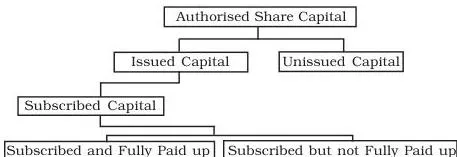
Follow the flow top to bottom. Authorised capital is the ceiling set by the Memorandum; from it comes issued capital — what is actually offered to the public — and the rest is unissued capital.
Issued capital becomes subscribed capital once the public applies for it, and from subscribed capital comes called-up capital — what the company has demanded — and then paid-up capital once the money is in.
The portion not yet called is uncalled capital, and the exhibit highlights its two branches: ordinary uncalled capital, which the company may call at any time, and Reserve Capital — the portion a company may reserve to be called only in the event of winding up, for its creditors (pp. 4-5).
The same categories appear as numbers in the Sunrise Company Ltd example that follows the exhibit. Sunrise has authorised capital of Rs 40,00,000 (4,00,000 shares of Rs 10), issues 2,00,000 shares for Rs 20,00,000, calls up Rs 8 per share (Rs 16,00,000), and — after calls in arrears of Rs 6,000 on 2,000 shares — shows subscribed but not fully paid capital of Rs 15,94,000 in the Notes to Accounts (p. 5).
Key Terms: A Quick Reference for This Chapter
When a term stops making sense mid-question, this table gives the one-line meaning and the NCERT page where the chapter explains it.
| Term | Meaning in one line | NCERT page |
|---|---|---|
| Company | An artificial person, a separate legal entity, existing only in the eyes of the law. | p. 1 |
| Shareholder | A person who contributes money to the company’s share capital and is one of its real owners. | p. 1 |
| Authorised capital | The maximum share capital a company may issue, fixed by the Memorandum; also called nominal or registered capital. | p. 4 |
| Issued capital | The part of authorised capital actually offered for subscription, including shares to vendors and signatories. | p. 4 |
| Subscribed capital | The part of issued capital that the public actually applied for. | p. 4 |
| Called-up capital | The part of subscribed capital the company has asked shareholders to pay. | p. 4 |
| Paid-up capital | Actually received: called-up capital minus calls in arrears. | p. 4 |
| Uncalled capital | Subscribed capital not yet called up; collectable later, as needed. | p. 4 |
| Reserve capital | Uncalled capital reserved to be called only on winding up, for creditors. | p. 5 |
| Calls in arrears | Amounts due on allotment or calls that shareholders have not paid. | p. 16 |
| Calls in advance | Money received on calls not yet made; a liability of the company. | p. 18 |
| Securities Premium Reserve | The separate account credited with the excess of issue price over face value; shown under Reserves and Surpluses. | p. 30 |
| Minimum subscription | The minimum amount, in the directors’ opinion, needed for the issue; at least 90% of the issued amount per SEBI guidelines. | p. 8 |
| Preference share | A share with preferential rights to dividend and to repayment of capital at winding up (Section 43). | p. 6 |
| Equity share | A share that is not a preference share (Section 43). | p. 6 |
| Share Forfeiture Account | The account credited with the money received on shares whose allotment has been cancelled. | p. 37 |
| Capital Reserve | The account that receives the capital profit on reissue of forfeited shares. | p. 49 |
| Private placement | An offer of securities to a select group through a private placement offer letter (Section 42). | p. 36 |
| ESOP | Employee Stock Option Plan — options to employees to subscribe at less than market value. | p. 36 |
| Buy-back | Purchase by a company of its own shares (Section 68). | p. 55 |
Common Mistakes Students Make in Share Capital Accounting
These are the slips the chapter’s own “Test your Understanding” checks and the forfeiture illustrations are built to catch. Name the error, note the rule, check your answer.
| Mistake | Correct rule | How to check your answer |
|---|---|---|
| Swapping the interest ceilings | Calls in arrears — max 10% p.a.; calls in advance — max 12% p.a. (Table F, pp. 16, 18). | Ask who is late: the shareholder (arrears, 10) or the company (advance, 12). |
| Debiting Securities Premium at forfeiture even though the premium was received | Premium received in full is never reversed; only the premium not received is debited (pp. 39-40). | Did the defaulting shareholder pay the allotment that carried the premium? If yes, no premium debit. |
| Allowing any discount on reissue | Discount on reissue cannot exceed the amount received on the forfeited shares (p. 49). | Compare the discount per share with the Share Forfeiture credit per share. |
| Transferring the whole Share Forfeiture balance to Capital Reserve | Only the proportionate balance relating to reissued shares is capital profit (p. 50). | Balance left = amount forfeited on shares not yet reissued. |
| Adding calls in advance to paid-up capital | Calls in advance is a current liability, shown separately under “other current liabilities” (p. 18). | Paid-up capital is called-up minus arrears — never plus advance. |
| Assuming paid-up capital can exceed called-up capital | False: paid-up = called-up − calls in arrears (pp. 4, 7). | Subtract arrears; if your paid-up figure is larger than called-up, rework it. |
| Misnaming the net-off in pro-rata allotment | Excess application money is adjusted against allotment; only the balance is received (p. 25). | Cash on allotment = amount due on allotment − excess application money adjusted. |
Exam Notes: How the Chapter Tests What You Learn
The chapter builds one skill above all: writing correct journal entries and presenting share capital in the balance sheet. Its own end matter tells you the levels at which it tests that skill.
- Short Answer Questions test definitions and distinctions — features of a company, kinds of companies, minimum subscription, classes of shares.
- Long Answer Questions test understanding — why a separate legal entity matters, why forfeiture is handled the way it is.
- Numerical Questions test the full entry trail and the balance-sheet presentation, following the pattern the illustrations model.
Notice the shape of the chapter’s own illustrations:
- Illustration 5 (Unique Pictures Limited) completes in a cash book and balance sheet (pp. 20-22).
- Illustration 13 (Ashok Limited) ends with a balance sheet in which the Share Forfeiture balance is added to paid-up capital (pp. 41-43).
- Illustration 14 (High Light India Ltd) runs forfeiture at a premium, partial reissue, and the capital reserve transfer (pp. 43-46).
A full numerical answer therefore needs every journal entry with its narration, the working notes, and the balance-sheet or Notes to Accounts presentation when asked. Work through the chapter’s illustrations in order before attempting its numerical questions.
And remember that textbook contents and the examinable syllabus are not always identical — check the current official CBSE syllabus for what is examinable this session.
Revision Summary: The Whole Chapter in One Page
This is a recall map, not a second set of notes. If you can tick each step, you have the chapter.
- The company — an artificial person with a separate legal entity, limited liability and perpetual succession (p. 1).
- The capital ladder — authorised → issued → subscribed → called-up → paid-up; paid-up = called-up − calls in arrears; uncalled and reserve capital on the side (pp. 4-5).
- The instalments — application, allotment, then calls; minimum subscription at least 90% of the issued amount; application money at least 5% of face value; calls capped at 25% of face value, one month apart, with 14 days’ notice (pp. 7-13).
- Arrears vs advance — 10% p.a. vs 12% p.a.; arrears reduces paid-up capital, advance is a current liability (pp. 16-18).
- Over/under subscription — accept-and-reject, pro-rata with adjustment, or a mix; under subscription allots only what was applied for (pp. 24-30).
- Premium and discount — premium to Securities Premium Reserve with five statutory uses; discount ordinarily banned; non-cash issue: shares = amount payable ÷ issue price (pp. 30-35).
- Forfeiture — reverse every entry except the premium received; debit Securities Premium only for the premium never received (pp. 37-40).
- Reissue — at par, premium or discount; discount capped at the amount received; only the proportionate profit on reissued shares reaches Capital Reserve (pp. 49-50).
Related Resources
This listing is maintained for the 2026-27 academic session using the NCERT textbook information available to us. NCERT remains the authority for confirming the latest edition.
Continue from here to the rest of the book, the rest of Class 12, or the revision versions of these chapters.
- NCERT Class 12 Accountancy book page — all chapters of this textbook.
- NCERT Class 12 books hub — every Class 12 subject.
- Next chapter: Issue and Redemption of Debentures — Chapter 2 of this book.
- Class 12 Accountancy revision notes — chapter-by-chapter notes, including Reconstitution of a Partnership Firm (Admission of a Partner) from the earlier book.
- Class 12 CBSE notes and the CBSE notes home for every class and subject.
Reference: NCERT Class 12 Accountancy textbook (Company Accounts and Analysis of Financial Statements), chapter 1, official edition on ncert.nic.in.
Sources and Data Verification
Four things, plainly:
- The figures and page numbers on this page describe the NCERT Class 12 Accountancy Part II textbook (Company Accounts and Analysis of Financial Statements), Chapter 1 — Accounting for Share Capital, current NCERT edition.
- This page covers that one chapter of that one book. It does not cover other Class 12 Accountancy chapters or other accountancy books.
- The listing is maintained for the current academic session using the NCERT information available to us.
- NCERT settles textbooks, editions and official PDFs; CBSE settles the curriculum, syllabus and examinations. A chapter’s presence in the textbook does not by itself prove it is examinable this session — check the current official CBSE syllabus. The authoritative source for NCERT textbooks is ncert.nic.in.
Frequently Asked Questions
What is the difference between calls in arrears and calls in advance?
Calls in arrears is money due on allotment or on a call that a shareholder has not paid on the due date (NCERT, p. 16); calls in advance is money a shareholder pays on calls the directors have not yet made (p. 18). They also differ in interest — up to 10% p.a. on arrears against up to 12% p.a.
on advance under Table F — and in the balance sheet, where arrears reduces called-up capital in Notes to Accounts while advance sits as a current liability.
Can shares be issued at a discount, and when?
As a general rule, no: a company cannot ordinarily issue shares at a discount (p. 33). The two cases the chapter accepts are reissue of forfeited shares and issue of sweat equity shares, and on reissue the discount cannot exceed the amount already received on those forfeited shares (p. 49).
What is the journal entry for forfeiture of shares issued at a premium?
It depends on whether the premium was received. If it was, the entry is Share Capital A/c Dr (called-up amount) — to Share Forfeiture A/c (amount received excluding premium) and to the unpaid calls/calls in arrears, and Securities Premium Reserve is untouched (p. 39).
If the premium was not received, Securities Premium Reserve A/c is also debited with the premium not received (p. 40).
How is excess application money adjusted in a pro rata allotment?
The excess application money is credited to the Share Allotment account, and the company receives only the balance of the allotment money in cash (p. 25). If the excess is more than the amount due on allotment, the surplus is refunded or credited to calls in advance (p. 25).
Where are calls in advance and the share forfeiture balance shown in the balance sheet?
Calls in advance appears under Equity and Liabilities as a current liability, in the sub-head “other current liabilities” — never added to paid-up capital (p. 18). The Share Forfeiture balance is added to paid-up capital under Share Capital while forfeited shares remain unreissued (pp. 37-38).
When is the share forfeiture balance transferred to capital reserve?
When forfeited shares are reissued, the balance relating to those shares, after deducting any discount allowed on reissue, is capital profit and is transferred to Capital Reserve (p. 49). If only part of the forfeited shares are reissued, only the proportionate balance transfers — the rest stays in Share Forfeiture for the shares not yet reissued (p. 50).
Explore Class 12 Accountancy Books
- Previous: Graphs and Charts
- Next: Issue and Redemption of Debentures
Related chapters:
- Accounting for Partnership: Basic Concepts
- Overview of
- Reconstitution of a Partnership Firm – Admission of a Partner