
Understanding Social Institutions Class 11 is Chapter 3 of NCERT’s Introducing Sociology — it runs from page 39 to page 61 (23 printed pages) and introduces five institutions: family, marriage and kinship; politics; economics; religion; and education. The official chapter PDF is right below, followed by a ground-up walkthrough of what the chapter teaches.
For the exact pages you are expected to read, get the official Understanding Social Institutions Class 11 chapter PDF from the NCERT textbook page at ncert.nic.in — the same text the printed book carries on pages 39 to 61, free to open, save or print.
| What the chapter holds | Count | Where it is used |
|---|---|---|
| Printed pages | 23 | |
| Figures with NCERT captions | 4 | |
| Tables | 1 | |
| Exercise questions | 7 | answered in our NCERT Solutions |
| Activities | 13 | |
| Official NCERT PDF | Download the chapter PDF | the chapter exactly as NCERT publishes it |
Understanding Social Institutions Class 11 — chapter at a glance
This is a map of what sits inside the PDF before you start reading. The table below shows how much the chapter holds — its sections, activities, exercises and captioned figures — while the sections after it explain what each part teaches.
What this chapter covers
This section tells you what the whole chapter argues, so the five institution areas make sense when you meet them one by one.
The chapter opens with a working definition: in the broadest sense, an institution works according to rules that are established or at least acknowledged by law or by custom, and its regular, continuous operation cannot be understood without those rules (NCERT, p. 40). Institutions impose constraints on individuals — and they also provide opportunities.
They range from macro institutions like the state to micro ones like the family, and people often treat an institution as an end in itself.
The chapter then names five central areas where important social institutions are located (NCERT, p. 39):
- family, marriage and kinship;
- politics;
- economics;
- religion;
- education.
Sociology contains rival ways of reading institutions, and the chapter sets up both before studying any one of them (NCERT, p. 41):
- Functionalist view — institutions are a complex set of social norms, beliefs, values and role relationships that arise in response to the needs of society; they exist to satisfy social needs. Family and religion are informal institutions; law and formal education are formal ones.
- Conflict view — individuals are not placed equally in society, so every institution operates in the interest of the dominant sections, be it class, caste, tribe or gender. The dominant section ensures that ruling-class ideas become the ruling ideas of society.
The guiding question the chapter repeats for each institution: how do social institutions constrain individuals and also offer them opportunities — and do they affect different sections of society unequally (NCERT, p. 41)? Its own example is the family: does it constrain and provide opportunities to men and women in the same way?
Family, marriage and kinship — why the family is not “natural”
This section covers the chapter’s first and longest institution area: the family, marriage and kinship. Its central move is to question the common-sense idea that the family is natural and unchanging.
No other social entity appears more “natural” than the family, and none seems more universal and unchanging — yet decades of field research across cultures show that family, marriage and kinship matter in all societies while taking different forms in each (NCERT, p. 42).
The family is also linked to economic, political, cultural and educational spheres; this is one reason sociology borrows from other disciplines, a point made in Chapter 1 (NCERT, p. 42).
The functionalist view regards the nuclear family as best equipped for industrial society: one adult works outside the home while the second cares for the home and children. In practice this means the husband takes the “instrumental” breadwinner role and the wife the “affective”, emotional role (NCERT, p. 42).
The chapter calls this vision questionable twice — it is gender-unjust, and empirical studies across cultures and history show it is untrue. It also refuses to generalise one society’s trend: Indian studies suggest families need not become nuclear in an industrial economy (NCERT, p. 42).
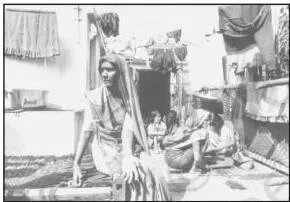
The figure above makes that point visually: what looks from inside a household like a purely private arrangement is connected to the economic and political rest of society (NCERT, p. 43). The chapter will demonstrate the same link when German state policy changes marriage rates.
A central Indian debate concerns the supposed shift from joint to nuclear families. The sociologist A.M. Shah shows the common-sense impression is wrong on both sides (NCERT, p. 43): nuclear families have always existed in India, particularly among deprived castes and classes — and the joint family has steadily increased since independence.
His reason is life expectancy, which rose from 32.5 to 55.4 years for men and from 31.7 to 55.7 years for women between 1941–50 and 1981–85 (NCERT, p. 43). More people now survive past 60, and most of these elderly people live in joint households.
This is why the chapter presents Shah as sociology questioning common sense: the belief that the joint family is fast eroding needs careful comparative and empirical testing before it is accepted (NCERT, p. 43).
When men migrate to urban areas, women are left to plough and manage the fields, and they often become the sole providers. Such arrangements are called female-headed households; widowhood, or a husband remarrying and stopping remittances, can create them too.
Among the Kolams, a tribal community in south-eastern Maharashtra and northern Andhra Pradesh, the female-headed household is an accepted norm (NCERT, p. 43).
Residence and authority also vary between societies. In matrilocal societies the newly married couple stays with the woman’s parents; in patrilocal societies it stays with the man’s (NCERT, p. 43). A patriarchal family structure exists where men exercise authority and dominance; matriarchy would mean women play the major role in decision-making.
The distinction to hold is this: while matrilineal societies exist — descent traced through the mother — the same cannot be claimed for matriarchal societies (NCERT, p. 43).
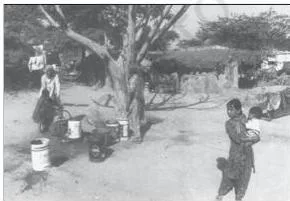
The figure asks you to separate two ideas: a family is a group linked by kin connections, while a residence is who lives under one roof. The two need not overlap — as when a man migrates for work and his family continues to live in the village home (NCERT, p. 43).
Families are linked to other social spheres, and families change. After German unification in the 1990s, marriage declined rapidly because the new German state withdrew the protection and welfare schemes families had earlier received; facing economic insecurity, people responded by refusing to marry (NCERT, p. 44). The book reads this as a case of unintended consequences, a concept from Chapter 1.
The wider lesson: macro-economic processes change family forms, but the direction of change need not be the same everywhere, and change does not mean the complete erosion of old norms — change and continuity co-exist (NCERT, p. 44).
The chapter then asks how gendered the family is. The belief that a male child will support parents in old age while a female child will leave on marriage makes families invest more in boys — even though a female baby has better biological chances of survival.
In India, infant mortality among female children is higher than among males in the lower age groups (NCERT, p. 44).
Marriage forms and the rules of endogamy and exogamy
Marriage exists in such variety that sociologists classify it by two criteria: the number of partners a person may have, and the rules about who may marry whom (NCERT, p. 45-46).
By number of partners, monogamy restricts an individual to one spouse at a time; even where polygamy is permitted, monogamy is in practice more widely prevalent. Marrying again after a spouse’s death or a divorce, while still holding only one spouse at a time, is called serial monogamy (NCERT, p. 46).
Remarriage after a wife’s death has long been the norm for men; for upper-caste Hindu widows the right was denied, and widow remarriage became a major issue in the 19th-century reform movements. Today nearly 10 per cent of all women in India — and 55 per cent of women over fifty — are widows (NCERT, p. 46).
Polygamy means more than one mate at one time, in two forms (NCERT, p. 46):
- Polygyny — one husband with two or more wives.
- Polyandry — one wife with two or more husbands, often a response to harsh economic conditions where a single male cannot adequately support a wife and children, and extreme poverty presses the group to limit its population.
Who chooses the partner also varies: in some societies parents and relatives decide, in others individuals are relatively free to choose (NCERT, p. 46). The rules of eligibility are classified as endogamy and exogamy:
- Endogamy requires marriage within the culturally defined group of which one is already a member — caste is the standard example.
- Exogamy, its reverse, requires marriage outside one’s own group.
Both rules refer to kinship units such as clan, caste, and racial, ethnic or religious groupings (NCERT, p. 46). In parts of north India, village exogamy is practised: daughters marry into families from villages far from home.
This ensures the bride’s smooth adjustment into her affinal home without interference from her own kinsmen; the geographical distance, plus the unequal relationship in the patrilineal system, kept married daughters from visiting their parents often.
Parting from the natal home was therefore a sad occasion, and it is the recurring theme of folk songs depicting the pain of departure (NCERT, p. 46-47).
These norms connect directly to gender inequality, and the chapter’s evidence is the sex ratio table (NCERT, p. 44-45):
| Year | Sex ratio | Year | Sex ratio |
|---|---|---|---|
| 1901 | 972 | 1961 | 941 |
| 1911 | 964 | 1971 | 930 |
| 1921 | 955 | 1981 | 934 |
| 1931 | 950 | 1991 | 926 |
| 1941 | 945 | 2001 | 933 |
| 1951 | 946 | 2011 | 940 |
Female foeticide has driven a sudden decline in the child sex ratio — from 934 girls per 1,000 boys in 1991 to 919 in 2011. The situation is gravest in prosperous states like Punjab, Haryana, Maharashtra and Uttar Pradesh; Punjab’s child sex ratio has fallen to 846 per 1,000 boys, and in some Haryana districts it is below 800 (NCERT, p. 44-45).
The book asks you to apply these ideas in three activities (NCERT, p. 44, 46): Activity 2 collects sayings such as the Telugu one — “Bringing up a daughter is like watering a plant in another’s courtyard”; Activity 4 collects wedding songs and asks how they reflect the social dynamics of marriage and gender relations; Activity 5 studies matrimonial advertisements and asks whether endogamy is still the prevalent norm.
Work and the economy — from craft to factory to flexible production
This section covers the second institution area, economics. Its first correction is that work is not the same as paid employment.
Work, whether paid or unpaid, is the carrying out of tasks that require mental and physical effort and produce goods and services catering to human needs (NCERT, p. 47-48). Much work never appears in official employment statistics.
The informal economy covers transactions outside the sphere of regular employment — sometimes cash for services, often the direct exchange of goods or services (NCERT, p. 48).
The chapter’s extract from Ismat Chughtai’s “Tiny’s Granny” makes the point in one life story: a child works at “odd jobs” from early childhood in return for two meals a day and cast-off clothes — work that no employment record ever counts (NCERT, p. 48).
In pre-modern societies most people worked in the fields or cared for livestock. Non-agricultural work meant mastering a craft through a lengthy apprenticeship, with one worker carrying out the whole production process from beginning to end. Modern economies have a highly complex division of labour: work is split into an enormous number of occupations in which people specialise (NCERT, p. 49).
Modern society also shifts where work happens. Before industrialisation, most work took place at home and was completed collectively by all household members. Industrial technology — machinery running on electricity and coal — separated work from home; factories owned by capitalist entrepreneurs became the focal point of development.
Workers trained for one specialised task and received wages; managers supervised them to enhance productivity and discipline (NCERT, p. 49-50).
The result is an enormous expansion of economic interdependence: we depend on a vast number of workers across the world for the products and services that sustain our lives. With few exceptions, people in modern societies no longer produce the food they eat, the houses they live in or the goods they consume (NCERT, p. 50).
India does not follow the same curve: the larger share of the population remains in rural agricultural and rural-based occupations, alongside an expanding service sector (NCERT, p. 49).
Industrial processes were broken into simple operations that could be precisely timed, organised and monitored. Mass production demands mass markets, and one of its most significant innovations was the moving assembly line; modern industry also needs expensive equipment and continuous monitoring — surveillance — of employees (NCERT, p. 50).
In recent decades there has been a shift to “flexible production” and “decentralisation of work”: under globalisation, growing competition between firms and countries makes firms organise production to suit changing market conditions (NCERT, p. 50-52).
The chapter’s case study is the garment export industry in Bangalore (NCERT, p. 51-52). The industry is part of a long supply chain: more than a hundred operations sit between the designer and the final consumer, and only 15 are in the manufacturer’s hands.
Because manufacturers can shift operations to other localities beyond the reach of unionists, workers cannot easily agitate for wage rises; instead, pressure has to be built on the retailer to push the government towards a higher wage structure.
The study’s vision is of an international opinion forum — a sign of how the new organisation of production and a body of customers outside the country have altered the economics and the politics of production (NCERT, p. 51-52).
The book also asks you to discuss two forms of production side by side — cloth production in a factory and the threshing of paddy in a village (NCERT, p. 50-52).
The activities in this section are small investigations: the proportion of Indians in rural occupations, the recent shift to the service sector, the time a master weaver takes to make one shawl, and where the food, houses and clothes you use come from (NCERT, p. 48-50).
Politics — power, authority and the modern state
This section covers the third institution area, politics, which the chapter defines through a single question: who gets power in society, and why do people obey?
Political institutions are concerned with the distribution of power in society (NCERT, p. 52). Power is the ability of individuals or groups to carry out their will even when opposed by others. Those who hold power do so at the cost of others; if some wield power, others do not.
Power is never held in isolation — it is always held in relation to others (NCERT, p. 52).
The chapter’s examples are deliberately everyday: family elders assigning domestic duties, a principal enforcing discipline in school, a General Manager distributing work among executives, a party president expelling a member (NCERT, p. 53).
Why do people comply? Because power is exercised through authority — the form of power accepted as legitimate, that is, as right and just. Authority is institutionalised because it is based on legitimacy: people accept the control of those in authority as fair and justified, and ideologies often help this process of legitimation (NCERT, p. 53).
Order does not require a modern state. Social anthropologists’ empirical studies of stateless societies, over sixty years ago, showed order maintained through balanced opposition between parts, cross-cutting alliances based on kinship, marriage and residence, and rites and ceremonies involving friends and foes (NCERT, p. 53-54).
The chapter then turns the question back on the reader: do such informal mechanisms also persist inside state societies?
A state exists where a political apparatus of government — institutions like a parliament or congress, plus civil service officials — rules over a given territory, backed by a legal system and the capacity to use military force (NCERT, p. 54).
Here the two perspectives split again: functionalists see the state as representing the interests of all sections of society; conflict theorists see it representing the dominant sections (NCERT, p. 54).
Modern states are defined by three ideas (NCERT, p. 54-55):
- Sovereignty — the undisputed political rule of a state over a given territorial area. The sovereign state did not at first carry rights of political participation; those were won through struggles that limited or overthrew monarchs — the French Revolution and the Indian independence struggle are the book’s two instances (NCERT, p. 54).
- Citizenship — membership of a political community, carrying rights (NCERT, p. 54-55):
- Civil rights — freedom to live where one chooses; freedom of speech and religion; the right to own property; equal justice before the law.
- Political rights — the right to participate in elections and stand for public office. Universal franchise came late: property qualifications initially excluded not only women but a large section of men; women waited longer still.
- Social rights — a minimum standard of economic welfare and security: health benefits, unemployment allowance, minimum wages. Broad social rights produced the welfare state in Western societies after the Second World War; socialist states went further, while most developing countries had virtually none. Today these rights are attacked as liabilities on the state and hindrances to economic growth.
- Nationalism — a set of symbols and beliefs giving the sense of being part of a single political community: the pride of being “Indian”, “British” or “French”. People always felt identity with family, clan or religious community, but nationalism appeared only with the development of the modern state. The contemporary world shows both a rapidly expanding global market and intense nationalist feelings and conflicts (NCERT, p. 55).
Sociologists study power far beyond the formal apparatus of government: its distribution between parties, classes, castes and communities based on race, language and religion, and inside associations like schools, banks and religious institutions whose aims are not primarily political. The scope runs from international movements — women’s, environmental — to village factions (NCERT, p. 55).
Activity 10 applies this wider sense of power: find out when women got voting rights in different countries, and ask why women remain so inadequately represented despite the right to vote and stand for office.
The activity itself hints at the answer — does the existing division of labour within families affect women’s participation in political life, and why is there a demand for 33 per cent reservation for women in parliament (NCERT, p. 54)?
Religion — the empirical, comparative study of the sacred
This section covers the fourth institution area, religion, and its first move is to separate sociology from theology: the sociological study of religion is empirical, not religious or theological.
The sociological study of religion does three things (NCERT, p. 55-56): it conducts empirical studies of how religions actually function in society and relate to other institutions; it uses a comparative method that places all societies on a level, helping the study avoid bias and prejudice; and it investigates religious beliefs, practices and institutions in relation to other aspects of society — religious life is made intelligible only by relating it to domestic, economic and political life.
Religion exists in all known societies, though beliefs and practices vary. The characteristics all religions share (NCERT, p. 56):
- a set of symbols invoking feelings of reverence or awe;
- rituals or ceremonies;
- a community of believers.
Rituals — praying, chanting, singing, fasting, eating or refraining from certain foods — are oriented towards religious symbols and so stand apart from ordinary habits. Lighting a diya to honour the divine differs in significance from lighting a room. All religions also involve collective ceremonials, usually in special places: churches, mosques, temples, shrines (NCERT, p. 56).
Religion is about the sacred realm, which every society distinguishes from the profane — a distinction sociologists follow from Durkheim (NCERT, p. 56). The gestures people make before entering a sacred place — covering or not covering the head, removing shoes, wearing particular clothes — share a common feeling of awe and respect. In most cases the sacred includes an element of the supernatural.
But keep the chapter’s caveat: early Buddhism and Confucianism had no conception of the supernatural, yet allowed sufficient reverence for things and persons they considered sacred (NCERT, p. 56).
Religion is not just private belief; it has a public character that bears on other institutions. Periodically there have been religious movements for social change — anti-caste movements, movements against gender discrimination (NCERT, p. 56).
Classical sociologists expected religion to lose influence as societies modernised; the concept secularisation describes this process. Contemporary events suggest a persisting role of religion in many aspects of society, and the chapter asks why you think this is so (NCERT, p. 56-57).
The chapter’s worked example of religion influencing the economy is Max Weber’s argument that Calvinism influenced the emergence and growth of capitalism (NCERT, p. 57). The Calvinists believed the world was created for the glory of God, so any work had to be done for His glory — making even mundane work an act of worship.
They also believed in predestination: whether one goes to heaven or hell is pre-ordained. Since no one could know their fate, people looked for signs of God’s will in their own occupations; consistent success in one’s work was read as a sign of God’s happiness.
The money earned was not for worldly consumption; the ethics of Calvinism was frugality, and investment became something like a holy creed. Investment — capital used to make more goods, more profit, more capital — is at the heart of capitalism. Weber’s conclusion: religion, in this case Calvinism, does influence economic development (NCERT, p. 57).
A boxed extract on the priests of Nasik (NCERT, p. 58) shows the same interdependence working the other way: after Independence, new employment and education opportunities changed religious specialists’ traditional lives, and coppersmiths who once supplied pilgrims’ pots moved into industry and business as demand for their wares became uncertain (Acharya 1974).
The chapter’s conclusion: religion cannot be studied as a separate entity. Political debates, economic situations and gender norms influence religious behaviour, and religious norms in turn influence — sometimes even determine — social understanding. Since women are half the world’s population, sociology asks what relationship this vast segment has with religion (NCERT, p. 57).
The chapter’s Exercise 5, “How does sociology study religion?”, is answered almost entirely from this section (NCERT, p. 61).
Education — formal schooling and the stratification debate
This section covers the fifth institution area, education, and the debate at its heart: does schooling bind society together, or does it reproduce its inequalities?
Education is a lifelong process involving formal and informal institutions of learning, but the chapter confines itself to school education (NCERT, p. 58). Sociology understands this need as the transmission — communication — of group heritage, common to all societies (NCERT, p. 58).
Simple societies needed no formal schooling: children learned customs and the broader way of life by participating in activities with adults.
Complex societies must make education formal and explicit because of the increasing economic division of labour, the separation of work from home, the need for specialised learning and skills, and the rise of state systems, nations, and complex sets of symbols and ideas (NCERT, p. 58-59).
Modern complex societies rest on abstract universalistic values, while simple societies depend on particularistic values based on family, kin, tribe, caste or religion. Schools are designed to promote uniformity, standardised aspirations and universalistic values — uniform dress is the chapter’s example, and it asks what other features promote standardisation (NCERT, p. 59).
For Durkheim, no society can survive without a common base — a certain number of ideas, sentiments and practices that education must inculcate in all children.
Education prepares the child for a special occupation and enables the child to internalise the core values of society; it maintains and renews the social structure, transmits and develops culture, and selects and allocates individuals to their future roles. Functionalists therefore speak in terms of general social needs and norms (NCERT, p. 59).
For sociologists who perceive society as unequally differentiated, education functions as a main stratifying agent — and the inequality of educational opportunity is itself a product of social stratification. We attend different kinds of schools according to our socio-economic background, and because of that we acquire different privileges and opportunities.
Some argue that schooling “intensifies the existing divide between the elite and the masses”: children in privileged schools learn to be confident, while children deprived of that may feel the opposite (Pathak 2002; NCERT, p. 59).
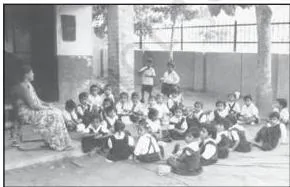
The visual of two types of schools sits exactly at this point in the book (NCERT, p. 59): it joins the conflict argument that schooling itself deepens the divide between the elite and the masses. The same social background decides who reaches a classroom at all.
The chapter’s evidence that caste and gender shape even basic attendance comes from the Pratichi Education Report (NCERT, p. 59-60). During the cultivation season, attendance from SC and ST children can be almost zero: the children take on household responsibilities while parents are out at work.
Girl children of these communities seldom attend school because they do both domestic and income-generating work — the report cites a ten-year-old girl who picks dry cow dung to sell. The report indicates how gender and caste discrimination impinge upon the chances of education.
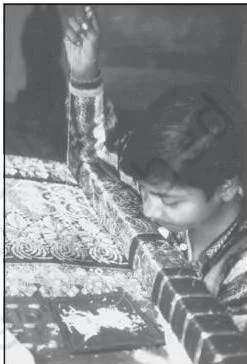
This visual belongs to the Pratichi evidence — the book places it beside the finding that who actually sits in a classroom is decided by caste and gender. The chapter wants you to connect it back to Chapter 1’s argument that a child’s chances of a good job are shaped by a host of social factors (NCERT, p. 59-60).
Activity 13 closes the section with a kindergarten study (Apple 1979) in which children learn that work activities are more important than play, that work includes any and all teacher-directed activities, and that work is compulsory while free-time activities are called play — the chapter asks what you think (NCERT, p. 59-60).
Definitions you need from the chapter
These are the definitions the chapter actually gives, gathered in one place for revision. Each is written in plain words; the book’s own glossary is at NCERT, p. 60-61.
| Term | Meaning (in the chapter’s sense) |
|---|---|
| Family | A group of persons directly linked by kin connections, whose adult members take responsibility for caring for children (NCERT, p. 47). |
| Kinship ties | Connections between individuals, established through marriage or through lines of descent that connect blood relatives (NCERT, p. 47). |
| Marriage | A socially acknowledged and approved sexual union between two adult individuals; married partners become kin to each other, and their wider families are connected (NCERT, p. 47). |
| Family of orientation | The family into which a person is born (NCERT, p. 47). |
| Family of procreation | The family a person enters through marriage (NCERT, p. 47). |
| Consanguineous kin | Relatives connected through “blood” (NCERT, p. 47). |
| Affines | Relatives connected through marriage (NCERT, p. 47). |
| Monogamy | One spouse at a time; marriage again after death or divorce while keeping one spouse at a time is serial monogamy (NCERT, p. 46). |
| Polygamy | Marriage with more than one mate at one time (NCERT, p. 46). |
| Polygyny | One husband with two or more wives (NCERT, p. 46). |
| Polyandry | One wife with two or more husbands; often a response to harsh economic conditions (NCERT, p. 46). |
| Endogamy | The rule of marrying within the culturally defined group of which one is already a member, such as caste (NCERT, p. 46). |
| Exogamy | The rule of marrying outside one’s own group (NCERT, p. 46). |
| Division of labour | The specialisation of work tasks into many different occupations combined within a production system (NCERT, p. 49). |
| Power | The ability of individuals or groups to carry out their will even when opposed by others (NCERT, p. 52). |
| Authority | Power accepted as legitimate, as right and just; institutionalised because it rests on legitimacy (NCERT, p. 53). |
| Sovereignty | The undisputed political rule of a state over a given territorial area (NCERT, p. 54). |
| Civil, political and social rights | Freedom of residence, speech, religion, property and equal justice; the right to vote and stand for office; the right to minimum economic welfare and security (NCERT, p. 54-55). |
| Nationalism | A set of symbols and beliefs giving the sense of being part of a single political community (NCERT, p. 55). |
| Sacred and profane | The sacred is the realm set apart and treated with reverence or awe; the profane is the ordinary realm of everyday life (NCERT, p. 56). |
| Secularisation | The process by which religion becomes less influential over spheres of life as societies modernise (NCERT, p. 56). |
One warning worth keeping separate: matrilineal describes how descent is traced, while matriarchy describes who holds decision-making power. Matrilineal societies exist; matriarchal societies cannot be claimed to (NCERT, p. 43).
Common mistakes students make in this chapter
These are the confusions the chapter itself warns against, named before you make them.
| Mistake | What the chapter says | How to check yourself |
|---|---|---|
| “All families are like mine — the nuclear family is natural.” | Field research across cultures shows family forms vary; the functionalist nuclear ideal (instrumental husband, affective wife) is gender-unjust and empirically untrue (NCERT, p. 42). | Does my example come from one society, or from comparative evidence? |
| “The joint family is fast eroding in India.” | A.M. Shah shows nuclear families have always existed in India, and the joint family has increased as life expectancy rose (NCERT, p. 42-43). | What happens to joint households when more people live past 60? |
| “Matrilineal means matriarchal.” | Matriliny describes descent; matriarchy describes women’s role in decision-making. Matrilineal societies exist; matriarchal ones cannot be claimed (NCERT, p. 43). | Is the claim about who decides, or about how descent is traced? |
| Mixing up endogamy and exogamy. | Endogamy = marriage within one’s group (e.g., caste); exogamy = marriage outside one’s group (NCERT, p. 46). | Endo- = within, exo- = outside. Ask: within or outside? |
| “Power and authority are the same thing.” | Power is the ability to carry out one’s will even when opposed; authority is that power accepted as legitimate, institutionalised through legitimacy (NCERT, p. 52-53). | Do people obey from compulsion, or because the rule seems right and just? |
| Reading “profane” as wicked or evil. | The profane is simply the ordinary realm of everyday life, as distinct from the sacred realm set apart with reverence (NCERT, p. 56). | The opposite of sacred is ordinary, not sinful. |
| “Religion always means belief in the supernatural.” | Early Buddhism and Confucianism had no conception of the supernatural, yet treated things and persons as sacred (NCERT, p. 56). | Test a religion against symbols, rituals and community of believers, not against the supernatural. |
| “Work means paid employment.” | Work is any task requiring mental and physical effort to produce goods and services catering to human needs, paid or unpaid; much informal-economy work is unrecorded (NCERT, p. 47-48). | Does the task produce goods or services that cater to human needs? Then it is work. |
Exam notes — what to be able to do with this chapter
This is what the chapter’s own exercises demand of you (NCERT, p. 61) — not a prediction of questions, but a map of what you should be able to do, and where the material sits.
| Exercise | What it asks | Where the material is |
|---|---|---|
| 1 | Note the marriage rules in your society and compare with classmates. | Marriage section: forms of marriage, endogamy and exogamy. |
| 2 | How membership, residence and interaction in the family change with broader changes, e.g. migration. | Family section: female-headed households, residence rules, German unification. |
| 3 | Write an essay on “work” covering the range of occupations and how they change. | Work and economy section: craft to factory to flexible production. |
| 4 | Discuss the rights that exist in your society and how they affect your life. | Politics section: civil, political and social rights. |
| 5 | How does sociology study religion? | Religion section: empirical, comparative and relational study. |
| 6 | Write an essay on school as a social institution, from reading and observation. | Education section: Durkheim, the conflict view, the Pratichi report — plus your own observations. |
| 7 | How do institutions interact, and can individuals resist and redefine them? | The whole chapter: both perspectives and the constrain-and-provide-opportunities question. |
Two study habits fit this chapter’s own method. First, since the book always pairs concepts with Indian evidence, test yourself by explaining each of the five institution areas in three or four sentences with one Indian example each — A.M. Shah’s joint family, the Kolams, the child sex ratio, the Bangalore garment industry, the Pratichi report.
Second, remember that textbook contents and the examinable syllabus are not always identical — check the current official CBSE syllabus for what is examinable.
Revision summary of the chapter
A one-sitting recap in the order the chapter itself argues.
- What an institution is (NCERT, p. 40). An institution works by rules established or acknowledged by law or custom; it constrains individuals and provides opportunities; institutions range from the state (macro) to the family (micro).
- Two perspectives (NCERT, p. 41). Functionalists see institutions answering society’s needs; conflict theorists see them serving dominant sections — and both lead to the question of whether institutions affect sections of society unequally.
- Family, marriage and kinship (NCERT, p. 42-47). They look universal but vary across societies; the family is linked to public spheres and changes with macro-economic processes (German unification), yet change and continuity co-exist; marriage is classified by number of partners and by endogamy and exogamy rules.
- Work and the economy (NCERT, p. 47-52). Work is broader than paid employment; modern work means a complex division of labour, the factory system and growing economic interdependence — and now flexible production, as in the Bangalore garment industry.
- Politics (NCERT, p. 52-55). Politics is the distribution of power; power acts through legitimate authority; the modern state rests on sovereignty, citizenship (civil, political and social rights) and nationalism.
- Religion (NCERT, p. 55-57). Studied empirically, comparatively and relationally; Durkheim’s sacred and profane; secularisation questioned by contemporary events; Weber’s Calvinism and capitalism argument as religion influencing economic development.
- Education (NCERT, p. 58-60). Transmission of group heritage; formal and explicit in complex societies; functionalist (core values, allocation) versus conflict (stratifying agent) accounts, with the Pratichi report’s evidence on caste and gender.
Close with the chapter’s own final question (NCERT, p. 61): are you entirely controlled by social institutions, or can you also resist and redefine them?
Related resources
This listing is maintained for the 2026-27 academic session using the NCERT textbook information available to us. NCERT remains the authority for confirming the latest edition.
Move to the chapters around this one without a new search.
- Class 11 Sociology notes — the book page for Introducing Sociology, where every chapter of this textbook lives. Chapter 2, Terms, Concepts and their Use in Sociology, is there too; it introduces the functionalist and conflict perspectives and the idea of unintended consequences that Chapter 3 keeps using.
- Class 11 hub — notes for all Class 11 subjects on this site.
- CBSE notes home — start here to search any class, subject or chapter.
- Chapter 4: Culture and Socialisation — the chapter that follows this one in the same textbook.
- Social Change and Social Order in Rural and Urban Society — a later chapter that returns to institutions in the context of change.
Sources and data verification
- The page references, figure captions and exercise numbers on this page describe Chapter 3, Understanding Social Institutions (pages 39–61), of the NCERT Class XI Sociology textbook Introducing Sociology, in the edition currently published on ncert.nic.in.
- This page covers only Chapter 3 of Introducing Sociology. It does not cover the other chapters of the book, and it is not a syllabus document.
- This listing is maintained for the current academic session using the NCERT information available to us.
- NCERT is the authority for textbook content, editions and PDFs; CBSE is the authority for the curriculum, syllabus and examinations. Textbook contents and the examinable syllabus are not always identical — check the current official CBSE syllabus for the subject.
FAQs
How long is NCERT Class 11 Sociology Chapter 3 and how is it organised?
The chapter runs from NCERT page 39 to page 61 of Introducing Sociology — 23 printed pages. It opens with the definition of social institutions and the functionalist and conflict perspectives, then studies five institution areas in turn: family, marriage and kinship; work and the economy; politics; religion; and education. It closes with a glossary, the exercises and a list of readings.
How does Chapter 3 connect to Chapters 1 and 2 of Introducing Sociology?
Chapter 1 set up the interaction of the individual and society, and Chapter 2 introduced the functionalist and conflict perspectives.
Chapter 3 applies both perspectives to every institution it studies, and it revisits two earlier ideas explicitly: the German unification example is presented as a case of unintended consequences (a Chapter 1 concept, NCERT, p. 44), and the education section recalls Chapter 2’s accounts of roles and stratification (NCERT, p. 59).
What is the difference between power and authority in this chapter?
Power is the ability of individuals or groups to carry out their will even when opposed by others — it is held at the cost of others and only in relation to them. Authority is power that is accepted as legitimate, that is, as right and just; it is institutionalised because it rests on legitimacy (NCERT, p. 52-53).
The same action — a principal punishing a student, a party president expelling a member — counts as authority only when people accept the control as fair and justified.
What do “sacred” and “profane” mean in the sociology of religion?
Following Durkheim, sociologists see every society as distinguishing a sacred realm from the profane. The sacred is set apart and treated with awe, recognition and respect; the profane is the ordinary realm of everyday life. “Profane” is not a judgement of evil — it simply means the everyday.
And the sacred need not involve the supernatural: early Buddhism and Confucianism had no conception of the supernatural, yet treated certain things and persons as sacred (NCERT, p. 56).
Are the Activities in the chapter important, or should I study only the main text?
The Activities (how many there are is in the at-a-glance table above) are the book’s way of making the concepts observable — collecting wedding songs, studying matrimonial advertisements, investigating rural occupations, or examining why women are under-represented in parliament.
Two repay close attention: Activity 5 asks whether endogamy is still the prevalent norm in marriage, and Activity 10 connects the division of labour within families to the demand for 33 per cent reservation for women in parliament. Read each activity once and attach it to the section it sits in; they are the best self-test of whether you can apply the concepts.
Which exercise asks about school as a social institution, and where do I find the material to answer it?
Exercise 6 asks you to write an essay on school as a social institution, drawing on both your reading and personal observation.
The material is in the Education section (NCERT, p. 58-60): Durkheim’s argument that education inculcates core values and allocates individuals to roles; the conflict view that schooling is a main stratifying agent that intensifies the divide between the elite and the masses (Pathak); and the Pratichi report’s evidence on how caste and gender shape attendance.
Your own observations of uniform, timetable and classroom rules can illustrate the standardisation the chapter describes.
Reference: NCERT Class 11 Sociology textbook, chapter 3, official edition on ncert.nic.in.
Explore Class 11 Sociology Books
- Previous: Social Change and Social Order in Rural and Urban Society
- Next: Culture and Socialisation
Class 11 Sociology on LearnCBSE:
Related chapters:
- Sociology and Society
- Social Structure, Stratification and Social Processes in Society
- Terms, Concepts and Their Use in Sociology