
This page gives you the official NCERT Class 11 Knowledge Traditions and Practices of India Chapter 5, “Astronomy in India” — the full chapter spanning textbook pages 78 to 98 — with the original NCERT PDF for the current academic session.
Astronomy in India Class 11 is not a list of dates. It is the story of how Indians read the sky to run their lives — festivals, farming, eclipses, journeys of the Sun — and of the mathematicians who made it all calculable. Below the download, the chapter is explained section by section, with its figures and exercises mapped.
| What the chapter holds | Count | Where it is used |
|---|---|---|
| Printed pages | 20 | |
| Figures with NCERT captions | 7 | |
| Tables | 2 | |
| Exercise questions | 13 | answered in our NCERT Solutions |
| Activities | 1 | |
| Official NCERT PDF | Download the chapter PDF | the chapter exactly as NCERT publishes it |
Official NCERT chapter PDF
NCERT publishes the official chapter on ncert.nic.in, the only authoritative source for the file. Opening it gives you the printed pages exactly as published, so every explanation below can be followed with the textbook in hand.
Download the Astronomy in India Class 11 chapter PDF to get the official NCERT text, figures and exercises of this chapter in a single file.
Chapter at a glance
The chapter narrates Indian astronomy from its ancient practical beginnings to today’s observatories, over textbook pages 78 to 98. It moves through the Hindu calendar, the geometry of eclipses, the Sun’s yearly drift, five major astronomers, the Kerala School, and Sawai Jai Singh’s observatories.
It then surveys modern Indian institutions and closes with exercises, project ideas, extended activities, internet resources, suggested readings and a glossary.
The table below lists the chapter’s sections, figures and exercises exactly as they appear in the official file.
What this chapter covers
The chapter’s opening makes a simple point: Indian astronomy began as a practical science needed for daily life, not as abstract theory. It also notes that Western historians of science have not given Indian astronomers full credit (NCERT, p. 79).
According to the book, four needs drove the ancient astronomers (NCERT, p. 79):
- devising calendars and reliable time-keeping devices to measure time;
- predicting when astronomical events such as eclipses would occur and how long they would last;
- noting the time of appearance of certain stars in the sky;
- observing the Sun, moon and planets.
Here is the route the chapter takes through its material:
- the calendar, pages 80–83;
- eclipses, pages 84–85;
- Uttarāyaṇa and Dakṣiṇāyana, pages 86–87;
- the astronomers from Āryabhaṭṭa to Bhāskara II, pages 86–89;
- the Kerala School and Jai Singh, page 90;
- modern India, pages 91–94.
Key concepts explained
Five or six ideas carry the whole chapter: a calendar that keeps lunar and solar years in step, the geometry that makes eclipses possible, the Sun’s yearly drift, and the specific astronomers who turned observation into mathematics. Each block below states the idea, the page it lives on, and why it matters.
The Hindu calendar: a luni-solar system
The Hindu calendar is luni-solar — it uses the Moon for festivals and the Sun for daily life (NCERT, p. 80). The machinery has four main parts.
- Pakṣas: a lunar month has two halves of about 15 days. Kṛṣṇapakṣa (कृष्णपक्ष, the dark half) begins with the full moon; Śuklapakṣa (शुक्लपक्ष, the bright half) with the new moon. Regional calendars differ on where the month begins (NCERT, p. 80).
- Sidereal vs observed month: the Moon’s orbital period relative to the stars is 27.3 days; observed from the moving earth it is about 29.5 days (NCERT, p. 80).
- Solar month and Saṅkrānti: a solar month runs from one Saṅkrānti — the day the Sun enters a Rāśi — to the next, and lasts 29 to 32 days. Months are named after the Nakṣatra seen on the full-moon day; Caitra is named after Citrā (NCERT, p. 81).
- Nakṣatras: 27 or 28 prominent stars, one linked to each day of the Moon’s motion, used to state the Moon’s position (NCERT, p. 81).
- Adhika māsa: the lunar year (about 354 days) is roughly 11 days shorter than the solar year (about 365.25 days). About every three years an extra month is inserted; the lunar month that contains no Saṅkrānti becomes the adhika māsa or malamāsa, and the year then has 13 months (NCERT, pp. 82–83).
- Tithi: the lunar date, set by the angular separation of the Sun and Moon. A new tithi begins every \( 12^\circ \) of separation; there are 30 tithis, each lasting 19 to 26 hours (NCERT, pp. 82–83).
The variable tithi exists because the Sun and Moon follow elliptic orbits, so their angular separation does not grow evenly. A tithi can outlast the day that began with it.
The book records two schools of thought: some take the tithi at sunrise as the day’s tithi even if it changes during the day, while others switch when it changes. This disagreement, on top of tithi lengths of 19 to 26 hours, is why a festival can fall on two consecutive days (NCERT, pp. 82–83).
Eclipses: what really happens, and the myth
An eclipse is a shadow event. The Moon has no light of its own; a solar eclipse occurs when the Moon comes between the earth and the Sun, a lunar eclipse when the earth comes between the Moon and the Sun (NCERT, p. 84).
The three bodies never touch, and the Sun keeps emitting its usual radiation. No special rays are released during an eclipse — the chapter calls this idea a widely prevalent myth. What truly endangers the eyes is looking directly at the Sun, which is risky on any day (NCERT, p. 84).
Eclipses happen only on full-moon or new-moon days, and even then only when the Moon is at a point the book calls a node. The Moon’s orbital plane is tilted to the earth’s; the two planes cross along the line of nodes, and its two end points are the nodes (NCERT, p. 85).
Those nodes were named Rāhu and Ketu, and around them grew the myth of two demons who devour the Sun. The chapter treats the story as a misunderstanding, not as astronomy (NCERT, p. 85).
Uttarāyaṇa and Dakṣiṇāyana: why the sunrise moves
Watch the sunrise from one spot for a year and its position creeps north, then south, then north again — one full cycle a year (NCERT, pp. 85–86).
When the Sun turns north from its maximum southern displacement, it enters Uttarāyaṇa; when it turns south from its maximum northern displacement, it enters Dakṣiṇāyana (NCERT, pp. 85–86). In practice the southward turn comes around 21 June (summer solstice) and the northward turn around 23 December (winter solstice) (NCERT, p. 87).
One date trap: about 2000 years ago Uttarāyaṇa began around 14 January. Because of precession — a slow swing in the direction of the earth’s axis — it now begins around 23 December (NCERT, p. 86).
The chapter’s cultural anchor is Bhīṣma, who chose to die only during the auspicious Uttarāyaṇa period (NCERT, p. 86).
You can watch the drift yourself: the activity on page 87 asks you to fix a marker, photograph the sunrise from the same spot every week for a year, and see the position shift with the seasons.
Five astronomers in one table
The chapter sketches five astronomer-mathematicians whose work built on each other (NCERT, pp. 86–89). The table gives period, place and highlight in one glance.
| Astronomer | Period and place | Contribution the chapter highlights |
|---|---|---|
| Āryabhaṭṭa | Born 476 CE near modern Patna; wrote the Āryabhaṇīyam at 23 (pp. 86–87) | Proposed the adhikamāsa intercalary month and the concept of week days; used the celestial sphere; held the earth spherical and rotating; devised alphabetic numerals; gave \( \pi \approx 3.1416 \); India’s first satellite is named after him |
| Varāhamihira | Early 6th century CE | Compiled the Pañcasiddhāntikā and Bṛhatsaṃhitā; ranked Sūryasiddhānta the best system; stated precession as 50.32 arcseconds per year (p. 88) |
| Bhāskara I | Born 600 CE | Commented on the Āryabhaṇīyam; improved the sine series; established positional-value writing and introduced the circle symbol for zero; India’s second satellite is named after him (p. 88) |
| Brahmagupta | 7th century CE | First to treat zero as a number; called positive and negative numbers fortune and debt; used \( \sqrt{10} \) for \( \pi \); showed a quadratic equation has two roots, one possibly negative; discovered the cyclic-quadrilateral area formula (pp. 88–89) |
| Bhāskara II | Born 1114 CE at Bijapur; headed the Ujjain observatory | Wrote Siddhāntaśīromāṇi and Karaṇakutūhala; said \( 3/0 \) is infinite; used letters for unknowns; gave the general solution of the Pell equation \( x^2 = 1 + py^2 \); wrote Līlavati and Bījagānita (p. 89) |
Kerala School and the Jantar Mantar
The Kerala School (14th–16th century) holds the chapter’s most striking priority claim. Parameśvara (1362–1455) mooted a heliocentric model, which Nilakantha developed around 1500 CE — before Copernicus’s formulation of 1543 (NCERT, p. 90).
The School also produced infinite power series for sine, cosine and arctangent, with proofs later given by Jyesthadeva — roughly a century before European calculus. The chapter is candid about the dispute: the method was never generalised to arbitrary functions, which is why full priority is denied (NCERT, p. 90).
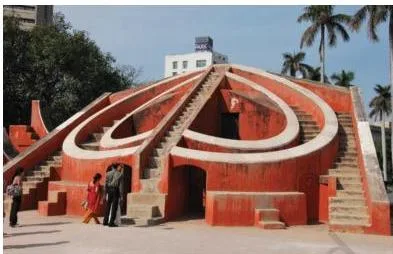
Later still, Sawai Jai Singh built the Jantar Mantar observatories at Delhi, Jaipur, Ujjain, Mathura and Varanasi between 1723 and 1735. Each has a giant triangular-gnomon sundial and other yantras from which planetary positions and eclipses were calculated with remarkable precision (NCERT, p. 90).
Modern India: observatories, telescopes and global projects
The second half of the chapter surveys modern instruments. The list below gives each facility and the result the chapter highlights (NCERT, pp. 90–94).
- Ooty Radio Telescope (ORT) — results on radio galaxies, quasars, supernovae and pulsars; aided asteroid discoveries (p. 91).
- GMRT, Pune — 30 fully steerable 45 m dishes in a Y-shaped array over 25 km; the world’s largest radio telescope at metre wavelengths; in routine operation since 2000; discovered the Saraswati supercluster (pp. 91, 93).
- Chandrayaan-I — confirmed the presence of water on the Moon (p. 91).
- IIA Bengaluru — Vainu Bappu Telescope at Kavalur, a 1 m Carl Zeiss and a 1.3 m JC Bhattacharya telescope; Kodaikanal Observatory (est. 1889), a solar physics observatory; the Indian Astronomical Observatory at Hanle, 4517 m up, with the 2 m Himalayan Chandra Telescope operated remotely from Bengaluru, plus the gamma-ray telescope HAGAR (pp. 91–92).
- ARIES Nainital — Sampurnanand, Devasthal Fast Optical Telescope, and the 3.6 m Devasthal Optical Telescope, India’s largest optical telescope, installed in 2016 (p. 92).
- IUCAA Pune — Giravali Observatory with a 2 m reflecting telescope (p. 92).
- PRL Ahmedabad — Mount Abu infrared observatory with a 1.2 m telescope, and Udaipur Solar Observatory with a 50 cm solar telescope, part of the GONG network (pp. 93–94).
- Global projects — India is a partner in the Thirty Meter Telescope (TMT), whose images will be twelve times sharper than Hubble’s; it is joining LIGO, the gravitational-wave observatory; and it is part of the Square Kilometer Array (SKA) (p. 94).
Figures in this chapter, explained

The key diagrams below are the ones this page teaches from — the zodiac chart, the two eclipse figures, the ARIES observatory and the supercluster illustration. Each is shown with a short reading of what it demonstrates.
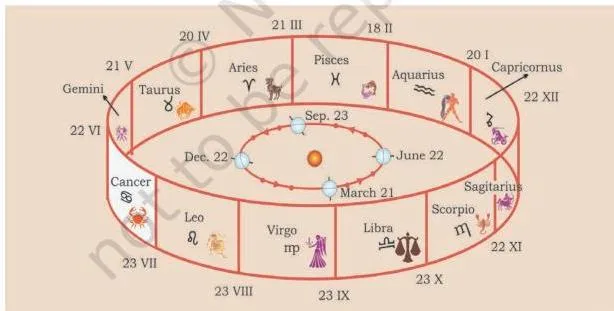
The zodiac chart is the key to the solar month (NCERT, p. 81). Twelve constellations ring the ecliptic — the Sun’s apparent yearly path — and the Sun spends about a month crossing each.
The day it enters a constellation is a Saṅkrānti, and the month runs from one Saṅkrānti to the next, which is why solar months are unequal, from 29 to 32 days.
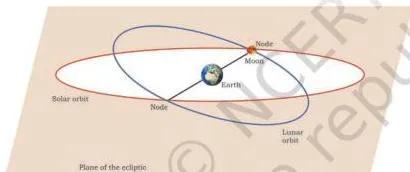
This diagram states the eclipse condition in one picture (NCERT, p. 85): for an eclipse, the Moon must stand on the line of nodes, so that Sun, Moon and Earth are in the same straight line. At any other position the Sun’s light is not blocked from the earth.
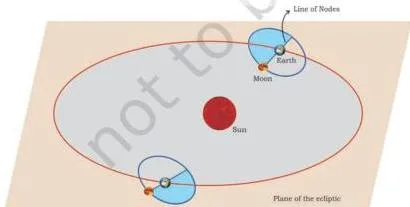
This second diagram answers the question “why so rarely?” (NCERT, p. 85). The Moon’s orbital plane is inclined to the earth’s, and the two planes intersect along the line of nodes whose end points are Rāhu and Ketu.
That tilt is why most new moons and full moons pass above or below the line-up — and why eclipses are special events.
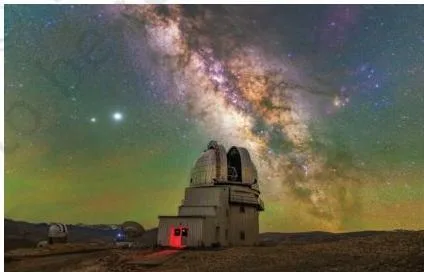
The ARIES photograph pairs with the modern-India section (NCERT, p. 92): three telescopes at Nainital, led by the 3.6 m Devasthal Optical Telescope, India’s largest optical telescope, installed in 2016.

The glossary illustration shows a supercluster — an association of galaxy clusters and groups on the largest scales of the universe (NCERT, p. 98). It gives the picture behind the chapter’s headline discovery: GMRT found the Saraswati supercluster, a massive collection of galaxies (NCERT, p. 91).
Key terms and definitions
This chapter uses Sanskrit astronomical terms as technical vocabulary, and closes with a glossary on page 98. The table below brings both together in plain words.
| Term | Plain meaning | Textbook page |
|---|---|---|
| Astronomy | The scientific study of celestial objects — their positions, motions, the radiation reaching us from them, and their nature | 98 |
| Eclipse | The darkening of one non-luminous object by the shadow of another; solar when the Moon’s shadow falls on the earth, lunar when the earth’s shadow falls on the Moon | 98 |
| Sidereal period | A planet’s true revolution period around the Sun; the earth’s is 365.256 days | 98 |
| Solstice | The points where the Sun reaches its greatest declination — around 23 December (winter) and 21 June (summer) | 98 |
| Spectrometer | An instrument for measuring the energy distribution of a particular type of radiation | 98 |
| Supercluster | An association of galaxy clusters and groups, made of a few rich clusters plus poorer groups and isolated galaxies | 98 |
| Nakṣatra | One of 27 or 28 prominent stars used to track the Moon’s daily position | 81 |
| Rāśi and Rāśi Cakra | Zodiacal constellation; the zodiac is a belt about 8° wide on either side of the ecliptic, holding 12 constellations | 80 |
| Saṅkrānti | The day the Sun enters a Rāśi; one solar month runs from one Saṅkrānti to the next | 81 |
| Tithi | Lunar date fixed by the Sun–Moon angular separation; changes every 12°, 30 in all, each lasting 19–26 hours | 82 |
| Adhika māsa / malamāsa | The extra lunar month inserted roughly every three years; the lunar month that contains no Saṅkrānti | 82 |
| Line of nodes; Rāhu and Ketu | The line where the Moon’s orbital plane meets the earth’s; its end points are the nodes, called Rāhu and Ketu | 85 |
| Uttarāyaṇa / Dakṣiṇāyana | The Sun’s northward journey, beginning at its maximum southern displacement / the southward journey, beginning at its maximum northern displacement | 85–86 |
Common mistakes to avoid
Most mistakes in this chapter come from confusing similar terms or repeating myths the book explicitly dismisses. The table names each trap, the correct rule, and a quick way to check yourself.
| Mistake | Correct rule | How to check your answer |
|---|---|---|
| “Eclipses must happen on every full moon and new moon.” | They occur only when the Moon is also at a node; the orbital planes are inclined, so most full and new moons miss the line-up (NCERT, p. 85). | Ask: is the Moon near the line of nodes that day? If not, no eclipse is possible. |
| “The Sun gives out harmful rays during an eclipse.” | The Sun is unchanged and emits its usual radiation; no special rays exist. Direct sunlight is always dangerous to the eyes (NCERT, p. 84). | Ask: would the Sun only be dangerous during eclipses? Staring at it harms eyes on any day. |
| “Rāhu and Ketu are demons that swallow the Sun.” | They are the two nodes — the end points of the line of nodes — given mythological names (NCERT, p. 85). | Ask: where do the two orbital planes meet? The end points of that line are Rāhu and Ketu. |
| “Kṛṣṇapakṣa starts with the new moon.” | Kṛṣṇapakṣa (dark half) begins with the full moon; Śuklapakṣa (bright half) with the new moon, though regional calendars vary the month start (NCERT, p. 80). | Ask: which fortnight follows the full moon? That is the dark half. |
| “The Moon orbits the earth in 29.5 days.” | 27.3 days is the sidereal period, measured relative to the stars; 29.5 days is the period seen from the moving earth (NCERT, p. 80). | Ask: relative to what? Stars — 27.3; moving earth — 29.5. |
| “Uttarāyaṇa always begins on 14 January.” | Precession has drifted it to around 23 December; 14 January was correct about 2000 years ago (NCERT, p. 86). | Ask: does the calendar keep the solstice fixed? No — the earth’s axis slowly turns. |
| Mixing up the three astronomers and zero. | Bhāskara I introduced the circle symbol for zero; Brahmagupta first treated zero as a number with working rules; Bhāskara II said division by zero gives infinity (NCERT, pp. 88–89). | Ask: symbol, number rules, division by zero — which name matches which idea? |
| “The Kerala School invented calculus.” | It developed infinite power series for sine, cosine and arctangent, with proofs — about a century before European calculus — but did not generalise the method to any function (NCERT, p. 90). | Ask: for which functions did the series exist? Only the ones the astronomers’ calculations needed. |
Exam notes: how the exercises map to the chapter
These are honest pointers grounded in the chapter’s own exercises — not exam predictions, and no weightage or guarantees. The table maps each closing exercise to the pages that answer it, so revision can target a weak spot directly.
| Exercise | What it asks | Where the answer lives |
|---|---|---|
| Q1 | Development of astronomy in India | Opening, pp. 78–79 |
| Q2 | Āryabhaṭṭa’s contribution | pp. 86–87 |
| Q3 | Kerala School contribution | p. 90 |
| Q4 | Why eclipses occur only on full or new moon days | pp. 84–85 |
| Q5 | Importance of tithi | pp. 82–83 |
| Q6 | Situations for solar and lunar eclipse | pp. 84–85 |
| Q7 | Why eclipse shadows are circular | Eclipse geometry, pp. 84–85 |
| Q8 | Institutions for radio astronomy research | pp. 91–93 |
| Q9 | Locations of large optical telescopes | pp. 91–92 |
| Q10 | LIGO full form and importance | p. 94 |
| Q11 | Astronomy as the study of the past | pp. 93–94 — distant objects show the universe’s past state |
| Q12 | City of Sawai Jai Singh’s observatory | p. 90 — Jaipur |
| Q13 | Matching exercise | Throughout pp. 80–90 |
The chapter’s last exercise is a matching question. The correct pairs are:
| Left item | Matches |
|---|---|
| Sūryasiddhānta | Varāhamihira |
| Lunar Year | 354 days |
| Nakṣatras | Moon |
| Nilakantha | Heliocentric solar system |
| Rāśi | Ecliptic |
| GONG | Udaipur |
| Jai Singh | Jantar Mantar observatories |
Textbook contents and the examinable syllabus are not always identical — check the current official CBSE syllabus before deciding what to revise. For a condensed revision walkthrough of this book, see the Class 11 Knowledge Traditions and Practices of India revision notes on this site.
Revision summary: the whole chapter in one sweep
Everything for the night before, in one pass. The timeline fixes the order; the takeaways fix the ideas.
| Period | Event |
|---|---|
| 476 CE | Āryabhaṭṭa born near modern Patna |
| ~500 CE | Āryabhaṇīyam written, when Āryabhaṭṭa was 23 |
| 600 CE | Bhāskara I born |
| 7th century CE | Brahmagupta’s work — zero treated as a number |
| 1114 CE | Bhāskara II born at Bijapur |
| 14th–16th century | Kerala School flourishes |
| ~1500 CE | Nilakantha’s heliocentric model |
| 1543 CE | Copernicus’s heliocentric formulation (comparison only) |
| 1723–1735 | Jantar Mantar observatories built at five cities |
| 1889 | Kodaikanal Observatory established |
| 2000 | GMRT begins routine operation |
| 2016 | DOT installed at Devasthal; gravitational waves announced |
| Future | TMT, LIGO-India, SKA |
Core takeaways from the chapter:
- Indian astronomy was a practical tradition driven by four needs: calendars, eclipse prediction, star timing, and watching the Sun, moon and planets (p. 79).
- The luni-solar calendar uses pakṣas, Nakṣatras, Saṅkrānti and the adhikamāsa to keep the ~354-day lunar year in step with the ~365.25-day solar year (pp. 80–83).
- Tithis vary from 19 to 26 hours because the Sun–Moon separation grows unevenly; that variation, plus the two schools on counting, is why festivals can spread over two days (pp. 82–83).
- An eclipse is a shadow event that needs the Moon at a node — the real reason not every full or new moon produces one (pp. 84–85).
- The Sun does not change during an eclipse, so no special rays exist; the actual hazard is direct sunlight (p. 84).
- Uttarāyaṇa now begins around 23 December and Dakṣiṇāyana around 21 June; precession moved these from about 14 January two millennia ago (pp. 86–87).
- The mathematical legacy of the five astronomers spans place value with zero, \( \pi \approx 3.1416 \), quadratic equations, the cyclic-quadrilateral formula and the Pell equation (pp. 86–89).
- Modern India runs world-class facilities — GMRT, the 3.6 m DOT, IAO Hanle — and partners in TMT, LIGO and SKA (pp. 91–94).
This is chapter 5 of the NCERT Class 11 Knowledge Traditions and Practices of India textbook, pages 78–98.
Related resources
This listing is maintained for the 2026-27 academic session using the NCERT textbook information available to us. NCERT remains the authority for confirming the latest edition.
Continue through the book and the wider Class 11 material from here.
- Knowledge Traditions and Practices of India Class 11 book page — full chapter list.
- NCERT Class 11 books hub — all Class 11 textbooks.
- Chapter 4 of this book — the chapter that precedes Astronomy in India.
- Chapter 6 of this book — the chapter that follows it.
- Indian Art and Architecture notes — a related chapter of this book.
- Mathematics in India notes — the chapter’s mathematical neighbour.
- Class 11 study material — notes across subjects.
- CBSE notes home.
The official NCERT website (ncert.nic.in) carries the authoritative edition of this textbook and every chapter PDF.
Reference: NCERT Class 11 Knowledge Traditions and Practices of India textbook, chapter 5, official edition on ncert.nic.in.
Sources and data verification
- The figures and content on this page describe the NCERT Class 11 Knowledge Traditions and Practices of India textbook, chapter 5, “Astronomy in India”, official edition published on ncert.nic.in, textbook pages 78–98.
- This page covers this one chapter of this one book — not the whole CBSE subject scheme.
- It is maintained for the current session using the NCERT information available to us.
- NCERT settles textbook editions and PDFs; CBSE settles curriculum, syllabus and examinations. Textbook contents and the examinable syllabus are not always identical — check the current official CBSE syllabus.
Frequently asked questions
Why do eclipses occur only on full moon or new moon days?
Only on those days can the Sun, Moon and Earth stand in the line an eclipse needs: a solar eclipse needs the Moon between the Earth and the Sun (new moon), and a lunar eclipse needs the Earth between them (full moon).
Even then the Moon must be at a node — where its tilted orbit crosses the Earth’s. That is why not every full moon or new moon brings an eclipse (NCERT, p. 85).
What is the difference between Uttarāyaṇa and Dakṣiṇāyana?
Uttarāyaṇa is the Sun’s northward journey, starting when the Sun turns north from its maximum southern displacement; Dakṣiṇāyana is the southward journey, starting when it turns south from its maximum northern displacement (NCERT, pp. 85–86).
Today the northward turn comes around 23 December (winter solstice) and the southward turn around 21 June (summer solstice). The dates have drifted because of precession: about 2000 years ago Uttarāyaṇa began around 14 January (NCERT, pp. 86–87).
What was the main contribution of the Kerala School of Astronomy?
Its landmark was the heliocentric idea: Parameśvara mooted it, and Nilakantha developed it around 1500 CE, before Copernicus’s 1543 formulation (NCERT, p. 90).
The School also produced infinite power series for sine, cosine and arctangent, with proofs later given by Jyesthadeva — about a century before European calculus. The method was not generalised to arbitrary functions, the reason the chapter gives for the disputed priority claim (NCERT, p. 90).
Why do some Hindu festivals fall on two consecutive days?
Because a tithi can be longer than one day. Tithis run 19 to 26 hours; when the tithi at sunrise lasts past the next sunrise, the same tithi is counted again the next day (NCERT, pp. 82–83).
A second school counts the tithi that begins during the day instead. The two conventions, on top of variable tithi length, are why a festival can land on two consecutive days.
What is the difference between a Nakṣatra and a Rāśi?
A Nakṣatra tracks the Moon; a Rāśi is a constellation on the Sun’s path. The 27 or 28 Nakṣatras are prominent stars, one linked to each day of the Moon’s sidereal period, used to state the Moon’s position (NCERT, p. 81).
Rāśis are the 12 zodiacal constellations of the Rāśi Cakra, a belt about 8° wide on either side of the ecliptic; the Sun crosses one Rāśi in about a month (NCERT, p. 80).
Is it true that the Sun emits harmful rays during a solar eclipse?
No. The Sun is unchanged during an eclipse and keeps emitting its usual radiation — the chapter calls the idea of special harmful rays a widely prevalent myth (NCERT, p. 84).
The genuine danger is looking directly at the Sun, which can damage the eyes at any time, so the chapter advises precautions whenever the Sun is observed.
Explore Class 11 Knowledge Traditions Practices of India Books
- Previous: Indian Art and Architecture
- Next: Mathematics in India
Class 11 Knowledge Traditions Practices of India on LearnCBSE:
Related chapters:
- Language and Literature of India
- Indian Philosophical Systems
- Performing Art Traditions in India