
This page covers 3 Mother’s Day Class 11 — Chapter 3 of the NCERT Class 11 English Snapshots reader, a complete one-act play by J.B. Priestley, not a story or an essay.
The play runs across printed pages 15–33 of the book, framed by a character list and stage directions. Below is the official NCERT chapter PDF, followed by a scene map, a character table, the play’s themes, its comic techniques and a guide to the five Reading with Insight questions.
For the full text, open the official NCERT Class 11 English Snapshots Chapter 3 Mother’s Day PDF on ncert.nic.in, where the play appears with its original stage directions, its character list and the Reading with Insight questions on page 33.
| What the chapter holds | Count | Where it is used |
|---|---|---|
| Printed pages | 20 | |
| Figures with NCERT captions | 1 | |
| Official NCERT PDF | Download the chapter PDF | the chapter exactly as NCERT publishes it |
3 Mother’s Day Class 11: chapter at a glance
The chapter is the complete text of Mother’s Day, a one-act play written in the 1950s about a housewife who is taken for granted. In this NCERT reader the play is headed by its character list and a long opening stage direction on page 15, and closed by a single exercise block, Reading with Insight, on page 33.
The contents table below shows the chapter’s sections, figures and question material at a glance.
What this chapter covers and how the play is built
The play has no printed act or scene divisions: the action sweeps from the fortune-telling straight to the final game of rummy. These five beats are the ones to follow while you read the PDF.
| Beat | What happens | Pages |
|---|---|---|
| 1. The fortune-telling | Mrs Fitzgerald has read Annie Pearson’s cards and tells Annie to put her foot down and be the boss of her own family. Annie agrees but admits she can never begin (NCERT, p. 15–17). | 15–17 |
| 2. The body swap | Mrs Fitzgerald makes Annie hold hands across the table, mutters her spell, and the two women change bodies. Each keeps the other’s voice and mannerisms, so “Mrs Pearson” turns bold and “Mrs Fitzgerald” nervous (NCERT, p. 17–18). | 17–18 |
| 3. Doris and Cyril | Doris wants her yellow silk ironed, Cyril wants tea and his things put out. Both meet a cool, smoking mother who answers with their own logic, up to the forty-hour week (NCERT, p. 19–23). | 19–23 |
| 4. George comes home | George is horrified by the stout, then by the news that the men at his club laugh at him as “Pompy-ompy Pearson” — and Cyril confirms it (NCERT, p. 25–26). | 25–26 |
| 5. The reversal | Mrs Fitzgerald insists they change back because the family is miserable. She warns Annie to apologise for nothing, and the evening ends in rummy with George’s “No, Mother — whatever you say” (NCERT, p. 30–32). | 30–32 |
Notice the shape: beats 1 and 2 set the trick up, beats 3 and 4 are the two waves of confrontation, and beat 5 is the reversal. The experiment is stopped not because it failed but because Mrs Fitzgerald cannot bear watching the family suffer (p. 30).
Characters: who is who in the Pearson family
The character list on page 15 names five people in two households. Keep this table open while you read — each row also records the trait the play satirises and the page where it shows.
| Character | Who they are | Trait the play satirises | Where it shows |
|---|---|---|---|
| Mrs Annie Pearson | MRS PEARSON, the mother, in her forties, “a pleasant but worried-looking woman” | Lets her family treat her like the servant in the house — the central target | p. 16 |
| George Pearson | MRS PEARSON’s husband, about fifty, “solemn, self-important, pompous” | Club-going self-importance — he never notices he is the club’s standing joke | p. 25–26 |
| Doris Pearson | The daughter, early twenties, pretty, spoilt — “pleasant enough if she had not been spoilt” | Expects her mother to iron her yellow silk and her tea ready, then sulks when refused | p. 19–20 |
| Cyril Pearson | The son, “the masculine counterpart of Doris” | Orders his mother about — “snap out of it, Ma” — and expects his mending done | p. 21 |
| Mrs Fitzgerald | The next-door neighbour, older, heavier, “a strong and sinister personality”, who has “learnt it out East” | Not the target but the instrument — she refuses to let Annie go soft afterwards | p. 15–16, 31–32 |
The stage directions do much of the character work: Doris comes bursting in, George enters solemn and slow, and the opening direction demands “sharply contrasting” voices (p. 15). Quoting a stage direction shows you are reading the text as a play, not as a story.
The scene that tells you how to read the play
The play opens with an illustration on page 15, and it fixes the contrast the whole comedy depends on. Read it together with the stage direction beside it.
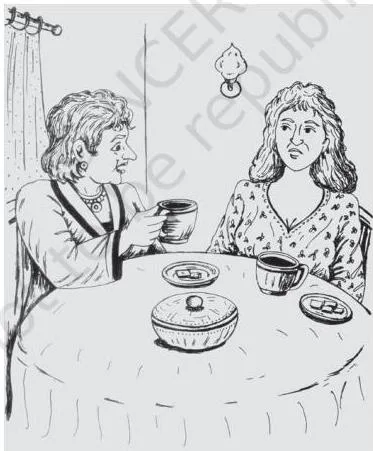
The illustration on page 15 shows the two women exactly where the opening direction places them — opposite each other at the small table with tea-cups, saucers and the fortune-telling cards. The caption is the play’s first line, “Yes, thank you, Mrs Fitzgerald”.
Then the direction insists the two voices be sharply contrasting: Mrs Pearson light and flurried, “with a touch of suburban Cockney”; Mrs Fitzgerald deep, “rather Irish”. That contrast is the whole engine of the comedy — after the swap each woman keeps the other’s voice and mannerisms, so the family hears Annie’s familiar voice speaking words no Annie would ever say.
The cards matter too: the fortune Mrs Fitzgerald reads is the play’s thesis, “All depends on yourself now” (p. 16).
The same direction fixes the set: a settee up right, armchairs down left and down right, a central table, and two doors — one to the front door and stairs, one to the kitchen. The whole play of door-banging confrontations works on that ground plan.
Key concepts: what the play is actually about
Mother’s Day looks like family farce, but Priestley is making a serious point. Mrs Fitzgerald names it on page 16: Annie is treated as “the servant in the house”. Four ideas carry the meaning.
- The status of the mother — Annie runs after her family, takes orders, stays home every night while the others go out; Mrs Fitzgerald calls it “the ruin of them as well as you” (p. 16).
- Satire through inversion — “Mrs Pearson” gives the family their own logic back: the eight-hour day becomes “Forty-hour week for all now” (p. 23) and George is told to try his no-beer complaint on the club barman (p. 26).
- The body-swap device — the spell lets the timid woman speak boldly in front of the family, without them ever knowing who is talking (p. 17–18).
- The 1950s context — the play is “written in the 1950s” (p. 33), when wives were expected to serve and husbands spent their evenings out; question 2 of Reading with Insight asks what a modern writer would raise today.
The play’s answer is not revolution but a firm hand: after the swap is undone, the family agrees to rummy, and George’s last line is “No, Mother — whatever you say” (p. 32).
Where the comedy comes from
Students usually feel the play is funny but cannot say why. Five comic techniques do the work, each with a page-backed example.
- Reversal of expectation — Doris expects “You always do” to settle the ironing dispute; the reply is “Well, this time I don’t” (p. 19–20).
- Comic deflation — Cyril’s brisk “Haven’t too much time” is met with “I’ve plenty of time” (p. 21).
- The family’s logic turned back on them — the hours exchange ends “Forty-hour week for all now” (p. 23).
- Dramatic irony — the family never realises they are arguing with Mrs Fitzgerald, but the audience watched the swap happen, so every bewildered “What’s the matter with you?” lands twice as hard.
- Incongruity — the timid mother figure smoking, drinking stout, and announcing that the club men laugh at George as “Pompy-ompy Pearson” (p. 26).
The humour does the satirical work: it makes the criticism of the family acceptable — you laugh at Doris and Cyril first, and only afterwards notice how much unpaid work the play is defending.
Key terms a play chapter expects you to know
A play-text chapter is examined through the language of drama. These are the terms this chapter needs, with where each one appears in the play.
| Term | What it means here | Where it shows in the play |
|---|---|---|
| One-act play | A play complete in a single act, with no scene or act divisions | The play runs without breaks from page 15 to the curtain on page 33 |
| Stage direction | The playwright’s instructions on set, movement, voice and manner, set apart from the dialogue | Opening direction on p. 15; “this little scene should be acted very carefully” before the spell on p. 18 |
| Satire | Making a serious criticism visible through comedy and exaggeration | The servant-in-the-house lecture of p. 16; the impossible swap itself |
| Caricature | Exaggerating a single trait until it becomes ridiculous | Doris and Cyril as spoilt children; George as “Pompy-ompy Pearson” (p. 26) |
| Dramatic irony | The audience knows something the characters do not | The family never learns about the body swap |
| Body swap | A device in which two personalities exchange bodies | The spell “Arshtatta dum” on p. 17–18, undone on p. 31 |
Reading with Insight: the five questions and how to answer them
This play-text chapter has no comprehension questions woven into the play itself; Reading with Insight on page 33 is the whole question set. Here is what each of its five questions is really asking.
- Q1 — the issues. “This play, written in the 1950s, is a humorous and satirical depiction of the status of the mother in the family. What are the issues it raises?” Name the issues: the mother’s unpaid, unthanked service; the family’s selfishness; the expectation that she stays home while the others go out. Evidence: Mrs Fitzgerald’s speech on p. 16.
- Q1’s second half — caricature or genuine. “Do you think it caricatures these issues…? How does the play resolve the issues? Do you agree with the resolution?” Answer both halves: the exaggeration — the absurd swap, “Pompy-ompy Pearson” — is the satire; the servant-in-the-house line is the genuine problem. Then give your own judgment of the resolution.
- Q2 — then and now. “If you were to write about these issues today…” — bridge to today’s households: who is expected to put things out, iron clothes, keep meals ready, and stay home. Use concrete, modern examples.
- Q3 — why drama. “Is drama a good medium for conveying a social message?” Point out that the play shows rather than tells: we watch the family’s shock, hear the wrong voice, and see the stout and the cigarette on stage.
- Q4 — performance. “Read the play out in parts. Enact the play on a suitable occasion.” This is an acting activity, not a pen-and-paper question; it tests whether the play works aloud.
- Q5 — discussion. “Discuss in groups plays or films with a strong message of social reform that you have watched.” Also an activity — bring real examples and explain how each one carried its message.
Common mistakes students make about this play
Four misreadings cost marks here. The first is by far the most common.
| Mistake | Correct rule | How to check your answer |
|---|---|---|
| Confusing who is in whose body | After the spell, Mrs Pearson’s body carries Mrs Fitzgerald’s personality and Mrs Fitzgerald’s body carries Mrs Pearson’s. The bold, sharp speaker is Mrs Fitzgerald; the nervous one is Mrs Pearson | Ask: who is being bossy in this line — that personality is Mrs Fitzgerald, speaking through Annie’s body |
| Calling the swap impossible and dismissing the play | Priestley stages it as a stage device; the question is what it lets the playwright shows | Discuss what the swap gains the play, not whether it could happen |
| Reading it as light comedy with no serious content | Question 1 itself asks whether the problems are genuine, and Mrs Fitzgerald says it is “the ruin of them as well as you” (p. 19) | Quote the p. 16 lecture alongside the jokes |
| Writing that the mother is changed forever | The play ends in a controlled truce: no apology, no explanation; only a firm hand “and a look, a tone of voice” (p. 31–32 | Check the last two pages: the family plays rummy, and George says “No, Mother — whatever you say” |
Exam notes: what to revise for this chapter
A play chapter is examined through characters, themes and the writer’s method, so revision means knowing who says what and why it matters. These five quoted lines carry the play.
- The problem: the mother treated like “the servant in the house” (p. 16).
- The inversion: “Forty-hour week for all now” (p. 23).
- The comic climax: “They call you Pompy-ompy Pearson” (p. 26).
- The warning: “Don’t you start any explaining or apologising — or you’re done for” (p. 31).
- The harmony: “No, Mother — whatever you say” (p. 32).
The shape of a strong answer to Q1: state the issues, show the satire with one or two quotations, judge whether the problems are genuine, and discuss the resolution on its own terms rather than retelling the plot. An answer that does these four things covers the ground whatever the wording of the question.
The play’s ending, explained
The ending works in three moves, and each move matters for the meaning of the whole play.
- Why it ends — Mrs Fitzgerald, in Annie’s body, sees George, Doris and Cyril miserable and “can’t bear it” and makes them change back at once, even though more rough treatment would have made the lesson safer (p. 30–31).
- The warning — she refuses to let the real Annie apologise or explain — “Don’t you start any explaining or apologising” — and prescribes her method: “a look — a tone of voice — now an’ again” to suggest she could be tough if she had to (p. 31–32).
- The proof — the final scene shows the family agreeing to rummy, with the children getting supper while Annie talks to George, and George’s last line is “No, Mother — whatever you say” (p. 32).
The play does not promise a permanent transformation — show that a mother who stops being a doormat changes the family’s behaviour, and that keeping the change takes a daily firm hand, not a magic spell.
Revision summary: the play in one screen
The chapter prints no summary, so here is the play in six lines, in the order the play asks you to learn it.
- Setup (p. 15–17): Mrs Fitzgerald reads Annie’s fortune and tells her to put her foot down.
- Device (p. 17–18): the spell swaps the two women’s bodies; Annie’s body now carries the bold neighbour.
- Confrontations (p. 19–26): Doris (yellow silk, the tea, Charlie Spence), Cyril (his things, the mending), George (stout, the club, Pompy-ompy Pearson) — each loses to their own logic.
- Turn (p. 30): Mrs Fitzgerald stops the experiment because the family is miserable.
- Truce (p. 31–32): swap back, no apologies, only a firm hand, a look, a tone of voice.
- Proof (p. 32): a family game of rummy; “No, Mother — whatever you say.”
Related resources
This listing is maintained for the 2026-27 academic session using the NCERT textbook information available to us. NCERT remains the authority for confirming the latest edition.
For the rest of your preparation, the Class 11 English notes section holds chapter guidance for the Snapshots reader, and the Class 11 notes hub covers your other subjects. You can also browse the wider CBSE notes index.
Other Class 11 English chapters you may be reading alongside include A Pair of Mustachios and The Ailing Planet: The Green Movement’s Role.
Sources and data verification
All page references, quotations and character descriptions above describe the NCERT Class 11 English Snapshots (Supplementary Reader in English) textbook, official edition on ncert.nic.in. This page covers Chapter 3, “Mother’s Day”, only — not the Hornbill reader or any other class.
This listing is maintained for the current academic session against the NCERT edition available on NCERT’s website. NCERT settles the textbook, its editions and the official PDF; CBSE settles the curriculum, syllabus and examinations.
Textbook contents and the examinable syllabus are not always identical — check the current official CBSE syllabus for what is examinable this session.
FAQs about Mother’s Day Class 11
Is Mother’s Day a play or a story in the NCERT Class 11 Snapshots book?
It is a complete one-act play by J.B. Priestley, not a story. The chapter opens with a character list and stage directions and runs from page 15 to page 33, ending with the Reading with Insight questions.
Who swaps bodies in Mother’s Day and how does the swap work?
Mrs Pearson, the mother, and Mrs Fitzgerald, the neighbour, hold hands across the table while Mrs Fitzgerald mutters the spell — “Arshtatta dum—arshtatta lam—arshtatta lamdumbona”, and their personalities change bodies (p. 17–18). Each adopts the other’s voice and mannerisms, and they swap back the same way on page 31.
What is the meaning of Pompy-ompy Pearson in the play?
It is the nickname the men at George’s club use for him behind his back, because they find him slow and pompous. “Mrs Pearson” (really Mrs Fitzgerald in Annie’s body) tells George this on page 26, and Cyril confirms it — which staggers George out of his self-importance.
How does the play Mother’s Day end and does Mrs Pearson change back?
Mrs Pearson changes back into her own body on page 31, after Mrs Fitzgerald decides the family has suffered enough. The ending is a truce, not a revolution: no apologies, a firm hand, and a game of rummy, with George’s line “No, Mother — whatever you say” (p. 32).
What issues does the play raise in its Reading with Insight questions?
The block on page 33 asks about the mother’s place in the family, whether the problems are genuine or caricatured, what a modern version would add, and whether drama is a good medium for a social message — plus performance and discussion activities.
Reference: NCERT Class 11 English Snapshots (Supplementary Reader in English) textbook, Chapter 3, official edition on ncert.nic.in.
Explore Class 11 English Books
- Previous: A Pair of Mustachios
- Next: The Ailing Planet: the Green Movement's Role
Class 11 English on LearnCBSE:
Related chapters:
- The Portrait of a Lady
- I The Summer of the Beautiful White Horse
- Short Stories