
This page provides the official NCERT Class 11 Chemistry Chapter 4 PDF — chemical bonding and molecular structure class 11 — from the Chemistry Part I textbook.
The official download is right below, and the section-by-section guide underneath maps every part of the chapter to its printed page numbers, so you can jump straight to Lewis structures, VSEPR, hybridisation or hydrogen bonding without hunting through the file.
| What the chapter holds | Count | Where it is used |
|---|---|---|
| Printed pages | 36 | |
| Sections in the chapter | 34 | |
| Figures with NCERT captions | 42 | |
| Tables | 9 | |
| Worked examples | 4 | solved step by step in our NCERT Solutions |
| Exercise questions | 26 | answered in our NCERT Solutions |
| Official NCERT PDF | Download the chapter PDF | the chapter exactly as NCERT publishes it |
NCERT Class 11 Chemistry Chapter 4 Chemical Bonding and Molecular Structure PDF
Open the official file directly: NCERT Class 11 Chemistry Chapter 4 Chemical Bonding and Molecular Structure PDF. This is the chapter as published by NCERT on ncert.nic.in — the complete printed text with its tables, figures, worked problems, chapter summary and the full exercise set at the end.
Chapter 4 at a glance
Before you open the file, this table shows what is inside it — sections, figures, worked examples and exercise questions, tallied straight from the official chapter. The chapter opens with an Objectives list (printed page 101) and closes with SUMMARY and EXERCISES (printed pages 133–134).
What this chapter covers, from Lewis structures to hydrogen bonding
Use this list as a route map. The chapter answers one question — why atoms stick together — and it offers four answers: the Lewis approach, VSEPR theory, valence bond theory and molecular orbital theory. Each later theory fixes a gap left by the one before it. The list gives every block of the chapter with the printed pages where it lives.
- Objectives — what you should be able to do after studying the chapter (p 101).
- Kössel–Lewis approach — the octet rule, Lewis symbols and the covalent bond (p 101–103).
- Lewis structures of simple molecules, with worked problems (p 103–105).
- Formal charge and the limitations of the octet rule (p 105–106).
- Ionic or electrovalent bond and lattice enthalpy (p 106–108).
- Bond parameters, resonance structures and bond polarity (p 108–113).
- VSEPR theory — predicting shapes from electron pairs (p 113–116).
- Valence bond theory and orbital overlap (p 117–121).
- Hybridisation, including the d-orbital schemes of PCl₅ and SF₆ (p 121–125).
- Molecular orbital theory and the LCAO method (p 126–128).
- Bonding in homonuclear diatomic molecules, using the MO occupancy chart for B₂ through Ne₂ (p 129–131).
- Hydrogen bonding (p 132–133).
- SUMMARY and EXERCISES (p 133–134).
The core ideas of chemical bonding
Everything below is what the chapter teaches, restated in plainer words, with the printed page for each claim so you can check it in your own copy. Work the subsections in order if you are learning the topic; jump straight to the idea that is causing trouble if you are revising.
The octet rule: why atoms bond, and when it breaks down
Atoms bond because a full outer shell is more stable. The octet rule is the chapter’s first, simplest version of that idea, and its exceptions are as important as the rule itself — both are tested.
NCERT defines a chemical bond as the attractive force that holds constituents — atoms, ions — together in different chemical species (p 101). Only the outer shell participates in combination; those electrons are the valence electrons, and a Lewis symbol shows them as dots around the element’s symbol (p 101).

The dot count in the figure equals the number of valence electrons, and that count gives the element’s group valence — either the number of dots, or eight minus the dots (p 101). Sodium, with one dot, and chlorine, with seven, are each one electron from a completed octet, which is why their chemistry turns on that single electron.
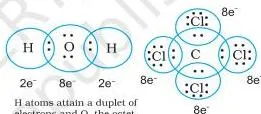
The octet rule says atoms combine by transferring or sharing valence electrons so that each ends up with an octet in its valence shell, matching a noble gas (p 102–103). Hydrogen is the exception: it works with a duplet.
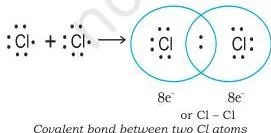
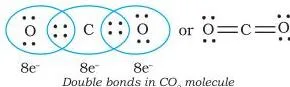
Sharing one electron pair makes a single covalent bond; two pairs make a double bond, as in CO₂ and ethene; three pairs make a triple bond, as in N₂ and ethyne (p 103).
Worked example — Lewis structure of HCN. Follow the method the chapter gives (p 104–105):
- Count valence electrons: \(4\ \text{(C)} + 5\ \text{(N)} + 1\ \text{(H)} = 10\). For an anion, add one electron per negative charge; for a cation, subtract one per positive charge (p 104).
- Place the least electronegative atom central: carbon, so the skeleton is H–C–N (p 104).
- Join the atoms with single bonds: H–C and C–N use \(2 + 2 = 4\) electrons; six remain (p 104).
- Complete the outer atoms: hydrogen already has its duplet; put the six remaining electrons as lone pairs on nitrogen. Carbon now has only four electrons around it — short of an octet (p 104–105).
- Make a multiple bond: convert a nitrogen lone pair into the C–N bond, giving \( \mathrm{H{-}C{\equiv}N{:}} \). Carbon has eight, nitrogen has eight (triple bond plus one lone pair), hydrogen has two (p 103–105).
Formal charge is electron bookkeeping. It assumes the atom in the molecule owns both electrons of a lone pair and one electron of every shared pair, and it is the difference between the valence electrons of the free atom and the electrons assigned to that atom in the Lewis structure (p 105):
\[ \text{Formal charge} = V – L – \frac{1}{2}S \]
Here \(V\) = valence electrons of the free atom, \(L\) = lone-pair electrons and \(S\) = shared (bonding) electrons. Formal charges are not real charge separation — they help you pick the lowest-energy structure, which is the one with the smallest formal charges (p 105).
Worked example — formal charge in CO₂. Carbon: \(V = 4\), \(L = 0\), \(S = 8\), so \( \text{FC} = 4 – 0 – \tfrac{1}{2}(8) = 0 \). Each oxygen: \(V = 6\), \(L = 4\), \(S = 4\), so \( \text{FC} = 6 – 4 – \tfrac{1}{2}(4) = 0 \). Every atom carries zero formal charge — the most favourable arrangement. (The chapter itself runs this same calculation on ozone, p 105; CO₂ is a fresh example.)
The octet rule is useful but not universal. It applies mainly to the second-period elements and breaks down in three ways (p 105–106):
- Incomplete octet — central atoms with fewer than four valence electrons stay short: LiCl, BeH₂, BCl₃, BF₃ and AlCl₃ (p 105–106).
- Odd-electron molecules — NO and NO₂ carry an unpaired electron, so at least one atom cannot complete an octet (p 106).
- Expanded octet — from the third period, d orbitals take part in bonding, so central atoms exceed eight electrons: PF₅, SF₆, H₂SO₄ (p 106).
The octet theory also cannot explain the shapes of molecules, says nothing about their relative stability or energy, and is embarrassed by noble-gas compounds such as XeF₂ and KrF₂ (p 106–107).
Ionic bonds and why lattice enthalpy matters
Removing an electron costs energy, so electron transfer alone looks like a bad deal. Lattice enthalpy is the chapter’s explanation of why the deal still closes: the crystal formation pays for the expensive steps.
In the Kössel picture, an electrovalent (ionic) bond forms by transfer of electrons, giving ions with noble-gas configurations that attract each other electrostatically (p 102, 107). Whether it happens depends on two things: how easily the ions form from neutral atoms, and how the ions arrange into a solid lattice (p 107).
The easiest ionic bonds form between metals with low ionisation enthalpy and non-metals whose electron gain enthalpy is strongly negative (p 107). The ammonium ion, NH₄⁺, is the famous exception — a cation built from two non-metals (p 107). Ionisation is always endothermic; electron gain may be exothermic or endothermic depending on the element (p 107).
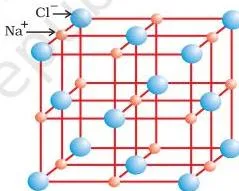
The rock-salt figure shows the payoff. Sodium and chloride ions lock into an ordered three-dimensional array held by coulombic interactions, and the energy released in building that array is the lattice enthalpy — the energy required to completely separate one mole of a solid ionic compound into its gaseous constituent ions (p 107–108). For NaCl that value is 788 kJ mol⁻¹ (p 107).
The book’s own numbers for sodium chloride make the point (p 107): ionisation of Na costs +495.8 kJ mol⁻¹, electron gain of Cl releases only −348.7 kJ mol⁻¹, and the two together leave +147.1 kJ mol⁻¹. Lattice formation at −788 kJ mol⁻¹ more than repays that deficit, so the overall process releases energy and the solid forms.
Worked example with a fresh set of numbers. Take a hypothetical salt MX with ionisation enthalpy +640 kJ mol⁻¹, electron gain enthalpy −360 kJ mol⁻¹ and lattice enthalpy of formation −980 kJ mol⁻¹. Add the three steps:
\[ (+640) + (-360) + (-980) = -700\ \text{kJ mol}^{-1} \]
The sum is negative, so forming one mole of solid MX lowers the energy of the system — the solid is stable even though the first two steps absorbed energy.
The lesson is the chapter’s own: the stability of an ionic compound is judged by its lattice enthalpy, not simply by achieving an octet around each ion in the gas phase (p 107).
Bond parameters: length, angle, enthalpy and order
These four measurable quantities describe any bond. Bond order is the one that organises the others: higher order means a stronger and shorter bond.

Bond length is the equilibrium distance between the nuclei of two bonded atoms (p 108). In a covalent bond each atom contributes its covalent radius — half the distance between two similar atoms joined by a covalent bond — so the bond length is \(R = r_A + r_B\) (p 108).
The figure contrasts this with the van der Waals radius, half the distance between similar atoms in separate molecules of a solid: the nonbonded size of the atom, always larger (p 108). Some book values: H–H 74 pm, F–F 144 pm, O=O 121 pm, N≡N 109 pm (p 109).
Bond angle is the angle between the orbitals that contain the bonding electron pairs around the central atom (p 108–109). It decides molecular shape; water’s H–O–H angle of 104.5° is the signature example (p 108–109, 123).
Bond enthalpy is the energy required to break one mole of bonds of a particular type between two atoms in the gaseous state, in kJ mol⁻¹ (p 109).
The chapter’s values: H–H 435.8, O=O 498, N≡N 946.0 and H–Cl 431.0 kJ mol⁻¹ (p 109) — triple bonds cost the most to break, so the larger the bond dissociation enthalpy, the stronger the bond (p 109).
In polyatomic molecules the two O–H bonds of water need different energies, 502 and 427 kJ mol⁻¹, because each bond feels a changed chemical environment. Chemists therefore use a mean bond enthalpy — the average, \((502 + 427)/2 = 464.5\ \text{kJ mol}^{-1}\) (p 109).
Bond order, in the Lewis description, is the number of bonds between two atoms in a molecule (p 110): H₂, O₂ and N₂ have bond orders 1, 2 and 3 respectively; CO (triple bond between C and O) also has order 3 (p 110).
Isoelectronic molecules and ions share the same order — F₂ and O₂²⁻ are both order 1, while N₂, CO and NO⁺ are all order 3 (p 110). The correlation that ties the parameters together: as bond order increases, bond enthalpy increases and bond length decreases (p 110).
Resonance: when one Lewis structure is not enough
Some molecules defeat a single Lewis structure: experiment gives bond lengths that sit between a single and a double bond. Resonance is the chapter’s way of writing those molecules accurately.
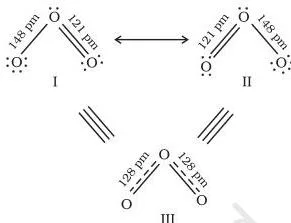
Ozone is the opening example (p 110). A normal O–O single bond is 148 pm and a normal O=O double bond is 121 pm, yet both oxygen–oxygen bonds of O₃ measure 128 pm — in between.
Each canonical form has one single and one double bond, so neither fits the measurement; the real molecule is the resonance hybrid, structure III, which averages the two (p 110).
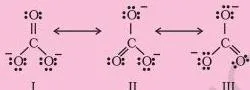
The carbonate ion works the same way: experiment shows all three C–O bonds of CO₃²⁻ are equivalent, so the ion is best described as a hybrid of three canonical forms, each putting the double bond on a different oxygen (p 111).

Carbon dioxide’s measured C–O bond length, 115 pm, lies between a normal C=O (121 pm) and C≡O (110 pm), so CO₂ is also best written as a hybrid of three canonical forms (p 110–111).
Two general results follow (p 111): resonance stabilises the molecule, because the hybrid is lower in energy than any single canonical form, and it averages the bond characteristics as a whole. The misconceptions matter just as much, and the book names them directly (p 111):
- The canonical forms have no real existence — they are paper structures only.
- The molecule does not spend part of its time in one canonical form and part in another.
- There is no equilibrium between canonical forms, as there is between keto and enol tautomers.
- The molecule has a single real structure — the resonance hybrid — which no single Lewis structure can depict.
Polarity and dipole moment: when bonds act as vectors
When two different atoms share a pair, the more electronegative atom pulls it closer and the bond becomes polar. The dipole moment puts a number on that pull — and because it is a vector, molecular shape can cancel it to zero.

A bond between identical atoms — H₂, O₂, Cl₂, N₂ or F₂ — is nonpolar: the shared pair sits exactly between the two nuclei. In a heteronuclear molecule like HF the pair displaces toward the more electronegative atom, giving a polar covalent bond (p 111).
The dipole moment measures that displacement: \(\mu = Q \times r\), the magnitude of the charge times the distance between the centres of positive and negative charge, expressed in Debye units, where \(1\ \text{D} = 3.33564 \times 10^{-30}\ \text{C m}\) (p 111–112).
The figure shows chemistry’s convention: a crossed arrow with the cross on the positive end and the arrowhead on the negative end — deliberately opposite to the physics direction of the dipole vector (p 111–112).
In polyatomic molecules the molecular dipole is the vector sum of the individual bond dipoles (p 112). Shape therefore decides everything: bent H₂O has a net dipole of 1.85 D \((6.17 \times 10^{-30}\ \text{C m})\), while linear BeF₂ and trigonal-planar BF₃ both cancel to zero because their equal bond dipoles point in directions that sum to nothing (p 112).
The chapter’s signature comparison is NH₃ against NF₃ (p 112). Both are pyramidal with one lone pair on nitrogen, and fluorine is more electronegative than nitrogen — yet NH₃ has 4.90 × 10⁻³⁰ C m (1.47 D) while NF₃ has only 0.80 × 10⁻³⁰ C m (0.23 D).
The reason is direction: in NH₃ the orbital dipole of the lone pair points the same way as the resultant of the N–H bond dipoles, so they add; in NF₃ the N–F bond dipoles point toward fluorine, opposite to the lone-pair orbital dipole, so they subtract. Electronegativity is real — but geometry controls the vector sum.
Finally, ionic bonds carry partial covalent character, and Fajans’ rules tell you when (p 112–113): more covalent character when the cation is small and the anion large; more when the charge on the cation is high; and more for transition-metal cations, whose electron configurations polarise the anion more strongly than noble-gas configurations do.
VSEPR: predicting molecular shapes from electron pairs
VSEPR is the fastest shape-prediction tool in the chapter: count the electron pairs around the central atom, space them as far apart as possible, then let lone pairs push harder than bond pairs. The theory predicts the geometry of a large number of p-block compounds accurately (p 113–114).
The postulates (p 113): the shape depends on the total number of valence-shell electron pairs; the pairs repel one another because their electron clouds are negatively charged; they occupy positions that minimise repulsion and maximise distance; a multiple bond is treated as a single super pair; and where resonance structures exist, the model applies to any of them (p 113).
The repulsion order is (p 113–114):
\[ \text{lone pair–lone pair} \gt \text{lone pair–bond pair} \gt \text{bond pair–bond pair} \]
Lone pairs win because they sit localised on the central atom, occupying more space than a pair shared between two nuclei (p 114). Memory aids: “lonely pairs push hardest” for the repulsion order, and for the ladder — 2 pairs make a line, 3 a triangle, 4 a tetrahedron, 5 a trigonal bipyramid, 6 an octahedron — try “Little Triangles Take Bigger Octaves”.
The geometry ladder for a central atom with no lone pairs runs (Table 4.6, p 114–115): two pairs → linear (BeCl₂, HgCl₂); three → trigonal planar (BF₃); four → tetrahedral (CH₄, NH₄⁺); five → trigonal bipyramidal (PCl₅); six → octahedral (SF₆). The ball-and-stick picture for all five is Fig 4.6, explained below.
When the central atom carries lone pairs, the electron-pair arrangement stays the same but the molecular shape loses a corner (Table 4.7, p 115–116): one lone pair on a tetrahedral base gives trigonal pyramidal (NH₃), two give bent (H₂O); on a trigonal-bipyramidal base, one lone pair gives see-saw (SF₄), two give T-shape (ClF₃); on an octahedral base, one gives square pyramidal (BrF₅), two give square planar (XeF₄).
Worked example — predict the shape and bond angle of PH₃. This is the full reasoning chain an answer should show:
- Count valence electrons: phosphorus has 5, each hydrogen has 1 — total 8 electrons, four pairs around phosphorus.
- Sort the pairs: three P–H bonding pairs and one lone pair → molecule type AB₃E.
- Name the electron-pair arrangement: four pairs → tetrahedral.
- Name the molecular shape: with one corner occupied by a lone pair, the shape is trigonal pyramidal (Table 4.7, p 115–116).
- Adjust the angle: lone pair–bond pair repulsion exceeds bond pair–bond pair repulsion, so the H–P–H angle compresses below the tetrahedral 109.5°. The chapter’s measured pattern for the same AB₃E case is NH₃ at 107° (p 116, 122–123).
Valence bond theory and hybridisation
VSEPR predicts shapes but does not explain them. Valence bond theory explains why a bond forms at all — orbital overlap — and hybridisation then fixes the one thing plain overlap cannot: methane’s 109.5° angle.
In VB theory (Heitler and London, developed by Pauling; p 117), the H₂ molecule forms because, as two hydrogen atoms approach, new attractive forces outweigh new repulsive forces until the system reaches minimum energy at 74 pm — the bond length — releasing 435.8 kJ mol⁻¹ as bond enthalpy (p 117–118; the energy curve is Fig 4.8, explained below).
Generalise this: a covalent bond forms when atomic orbitals overlap and pair their electrons, and the greater the overlap, the stronger the bond (p 118–119).
Then comes the problem. Carbon’s three p orbitals stand at 90° to one another, which would give H–C–H angles of 90° — but methane is exactly tetrahedral at 109.5° (p 119–120). Ammonia and water would also give 90° by pure s–p overlap, yet they measure 107° and 104.5° (p 120).
Hybridisation is Pauling’s fix: atomic orbitals of slightly different energies intermix to form a new set of equivalent hybrid orbitals of equal energy and shape (p 121). The number of hybrids equals the number of atomic orbitals mixed; hybrids form more stable bonds than pure orbitals; and their direction in space fixes the molecular geometry (p 121).
| Hybridisation | Orbitals mixed | Geometry | Bond angle | s character per hybrid | Examples |
|---|---|---|---|---|---|
| sp | one s + one p | linear | 180° | 50% | BeCl₂, carbon in ethyne |
| sp² | one s + two p | trigonal planar | 120° | one s among three hybrids | BCl₃, carbon in ethene |
| sp³ | one s + three p | tetrahedral | 109.5° | 25% | CH₄, NH₃, H₂O |
The s-character values and angles are the chapter’s (p 121–123): sp hybrids are 50% s and point 180° apart; sp³ hybrids are 25% s and point to the corners of a tetrahedron. The table is worth memorising because hybridisation questions are usually “name the hybridisation of the central atom” in disguise.
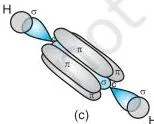
Sigma and pi bonds differ in how the overlap happens (p 120–121). A sigma (σ) bond forms by end-to-end, head-on overlap along the internuclear axis — s–s, s–p or p–p. A pi (π) bond forms by sidewise overlap of parallel orbitals, giving two saucer-shaped electron clouds above and below the molecular plane (p 120–121).
Because head-on overlap covers more area, σ bonds are stronger than π bonds (p 121). Every multiple bond is one σ plus the rest as π: double bond = 1σ + 1π; triple bond = 1σ + 2π (p 121, 123–124).
Counting sigma and pi in an original molecule — HCN. The H–C bond is a single σ. The C≡N triple bond is one σ and two π. Total: 2 sigma and 2 pi. This is the same counting the chapter applies to ethene and ethyne (p 123–124).
Ethene and ethyne show the pattern in real molecules (p 123–124): in ethene each carbon is sp², with an sp²–sp² σ bond between the carbons, four C–H σ bonds and one π bond from unhybridised p orbitals — the double bond is 1σ + 1π (Fig 4.15, explained below).
In ethyne each carbon is sp, with a C–C σ bond, two C–H σ bonds and two π bonds — the triple bond is 1σ + 2π (Fig 4.16, p 124).
Third-period elements add d orbitals to the mix. Phosphorus uses sp³d hybridisation in PCl₅, giving a trigonal bipyramid; sulphur uses sp³d² in SF₆, giving a regular octahedron (p 124–125). PCl₅’s five bonds are not identical: the two axial bonds are slightly longer and weaker than the three equatorial ones (p 125).
Molecular orbital theory: bonding as waves
MO theory changes the scale of the picture: instead of localised bonds between two atoms, the whole molecule gets its own set of orbitals, and electrons fill them just as they fill atomic orbitals.
The salient features (p 126): electrons in a molecule occupy molecular orbitals; an atomic orbital is monocentric while a molecular orbital is polycentric — influenced by two or more nuclei; the number of MOs formed equals the number of combining atomic orbitals; and MOs are filled according to the aufbau principle, obeying the Pauli exclusion principle and Hund’s rule (p 126).
Molecular orbitals are built by linear combination of atomic orbitals (LCAO) (p 127). Mathematically the combination is addition and subtraction of the atomic wave functions:
\[ \psi_{MO} = \psi_A \pm \psi_B \]
Addition gives the bonding orbital \(\sigma = \psi_A + \psi_B\); subtraction gives the antibonding orbital \(\sigma^* = \psi_A – \psi_B\) (p 127). Constructive interference concentrates electron density between the nuclei — that lowers energy and stabilises the molecule. Destructive interference puts a nodal plane, where electron density is zero, between the nuclei — that raises energy and destabilises (p 127).
Two atomic orbitals always produce exactly two molecular orbitals, and the total energy of the two MOs equals that of the two original atomic orbitals (p 127).
Combination is possible only under three conditions (p 128): the combining atomic orbitals must have the same or nearly the same energy; they must have the same symmetry about the molecular axis; and they must overlap to the maximum extent.
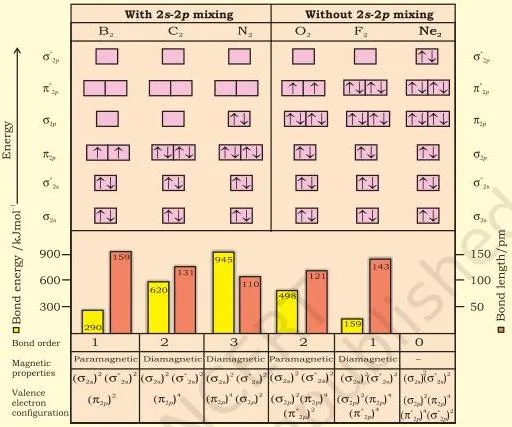
The occupancy chart for B₂ through Ne₂ (Fig 4.21, p 131) is the payoff diagram of the theory section: it shows how the MO electron configuration of each homonuclear diatomic molecule connects to its molecular properties. Read it alongside the energy-level diagram the section builds (p 128).
Hydrogen bonding
The chapter’s last bonding type: a hydrogen atom attached to an electronegative atom is also attracted to another electronegative atom nearby — a bridge that holds molecules or parts of a molecule together.
The cause is the same polarisation that makes an O–H or N–H bond polar in the first place: the hydrogen, bonded to an electronegative atom, is strongly attracted to the lone pair of a nearby electronegative atom such as nitrogen, oxygen or fluorine (p 132). The chapter separates the phenomenon into two types (p 132–133):
- Intermolecular hydrogen bonding — between the hydrogen of one molecule and an electronegative atom of a different molecule.
- Intramolecular hydrogen bonding — within the same molecule, when the two electronegative groups sit close enough.

o-Nitrophenol is the book’s example of the intramolecular type (p 132–133). The hydrogen of the O–H group, already bonded to one oxygen, is simultaneously attracted to an oxygen of the nitro group in the same molecule. In the figure, trace how that bridging hydrogen sits between the two oxygens, closing a ring within a single molecule.
Key figures in Chapter 4, explained


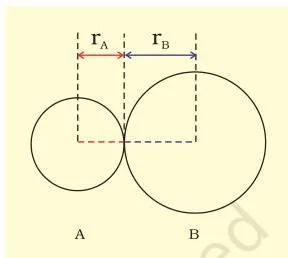

The chapter’s argument runs through its diagrams; these six repay the most careful reading. Each is shown with its NCERT caption and then read aloud: what to look at, and what it proves.
Fig 4.6: the shapes of molecules whose central atom has no lone pair
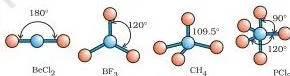
This is the base ladder that Tables 4.6 and 4.7 build from. Look at how the models space the identical atoms: two pairs give a 180° line, three a flat 120° triangle, four a 109.5° tetrahedron, five a trigonal bipyramid, six a 90° octahedron (p 114).
The moment a lone pair replaces a bond pair, this same framework distorts — which is the base for every bent, pyramidal, see-saw and T-shape that follows.
Fig 4.8: the H2 potential energy curve
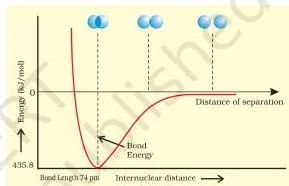
Read the curve left to right as two hydrogen atoms approach. Potential energy falls while attraction dominates, reaches a minimum at 74 pm — the bond length, the most stable state — and then climbs steeply as the nuclei begin to repel (p 118).
The depth of that well is the bond enthalpy, 435.8 kJ mol⁻¹: the energy released when the bond forms and required to dissociate the molecule back into atoms (p 117–118).
Fig 4.9: positive, negative and zero overlaps of s and p orbitals
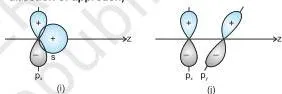
The plus and minus signs in this figure are the phase of the orbital wave function — not electrical charge. When the overlapping lobes carry the same phase, the overlap is positive and a bond can form; opposite phases give negative overlap; and the wrong orientation, p orbitals turned away from each other, gives zero overlap — no bond at all (p 119–120).
This is the geometric root of the sigma/pi distinction and, later, of why MO theory works the way it does.
Fig 4.15: sigma and pi bonds in ethene
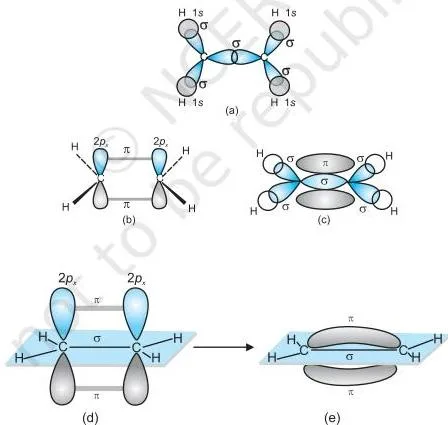
Trace the C=C unit: one sp²–sp² σ bond runs head-on along the C–C axis, the four C–H bonds are sp²–s σ bonds, and two unhybridised p orbitals, one on each carbon, overlap sidewise to make a single π cloud above and below the molecular plane (p 123–124).
The picture makes the chapter’s rule memorable: every double bond is one σ plus one π, and a triple bond, like ethyne’s, is one σ plus two π (p 124).
Fig 4.17: trigonal bipyramidal geometry of PCl5

Count the bond angles. Three equatorial P–Cl bonds lie in one plane at 120° to one another; two axial bonds stand above and below at 90° to that plane (p 125).
The axial bond pairs feel more repulsion from the equatorial pairs than the equatorial pairs feel from each other, so the axial bonds stretch — slightly longer and slightly weaker — which makes PCl₅ reactive (p 125). If a question asks you to compare the P–Cl bonds, this asymmetry is the answer.
Fig 4.19: bonding and antibonding molecular orbitals from LCAO
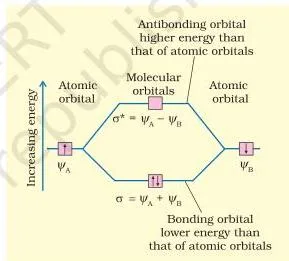
Two 1s orbitals, \(\psi_A\) and \(\psi_B\), combine in exactly two ways (p 127). Addition (same phase) concentrates electron density between the nuclei — the σ bonding orbital, lower in energy than either atomic orbital. Subtraction puts a nodal plane between the nuclei — σ*, higher in energy, which destabilises the molecule if occupied.
Two atomic orbitals in, two molecular orbitals out: the count is always conserved, and so is the total energy (p 127).
Definitions: the key terms of chemical bonding
A quick glossary for revision: every examinable term defined in plain words, with the printed page where NCERT states it. If a definition in your notes disagrees with this list, the book settles it.
| Term | Plain definition | NCERT page |
|---|---|---|
| Chemical bond | The attractive force holding constituents (atoms, ions) together in different chemical species. | p 101 |
| Valence electrons | Outer-shell electrons that take part in chemical combination. | p 101 |
| Lewis symbol | Notation showing an element’s valence electrons as dots around its symbol. | p 101 |
| Octet rule | Atoms combine by transferring or sharing valence electrons so that each attains a stable outer octet like a noble gas. | p 102–103 |
| Covalent bond | Bond formed by sharing of an electron pair between two atoms. | p 103 |
| Electrovalent (ionic) bond | Bond formed by electrostatic attraction between positive and negative ions produced by electron transfer. | p 102, 107 |
| Formal charge | Difference between the valence electrons of the free atom and the electrons assigned to it in the Lewis structure; \(\text{FC} = V – L – \tfrac{1}{2}S\). | p 105 |
| Lattice enthalpy | Energy required to completely separate one mole of a solid ionic compound into its gaseous constituent ions. | p 107–108 |
| Bond length | Equilibrium distance between the nuclei of two bonded atoms. | p 108 |
| Covalent radius | Half the distance between two similar atoms joined by a covalent bond; one atom’s contribution to a bond length. | p 108 |
| Van der Waals radius | Half the distance between similar atoms in separate molecules of a solid; the nonbonded size of an atom. | p 108 |
| Bond angle | Angle between the orbitals containing bonding electron pairs around the central atom. | p 108–109 |
| Bond enthalpy | Energy required to break one mole of bonds of a particular type between two atoms in the gaseous state. | p 109 |
| Mean bond enthalpy | Total bond dissociation enthalpy divided by the number of bonds broken, used for polyatomic molecules. | p 109 |
| Bond order | Number of bonds between two atoms in a molecule (Lewis description). | p 110 |
| Resonance hybrid | A single real structure, described accurately as a hybrid of canonical (resonance) structures when one Lewis structure fails. | p 110 |
| Dipole moment | Product of the magnitude of the charge and the distance between the centres of positive and negative charge; \(\mu = Q \times r\). | p 111–112 |
| VSEPR theory | Theory that predicts molecular shape from the repulsion between valence-shell electron pairs around the central atom. | p 113 |
| Sigma (σ) bond | Covalent bond formed by head-on overlap of orbitals along the internuclear axis. | p 120–121 |
| Pi (π) bond | Covalent bond formed by sidewise overlap of parallel orbitals, with electron density above and below the molecular plane. | p 120–121 |
| Hybridisation | Intermixing of orbitals of slightly different energies to form a new set of orbitals of equivalent energy and shape. | p 121 |
| Bonding molecular orbital | MO formed by constructive (additive) combination of atomic orbitals; lower in energy than the combining orbitals. | p 126–127 |
| Antibonding molecular orbital | MO formed by destructive (subtractive) combination; higher in energy, with a nodal plane between the nuclei. | p 126–127 |
| Hydrogen bond | Attraction in which a hydrogen atom bonded to an electronegative atom is also attracted to another electronegative atom nearby. | p 132 |
Common mistakes in chemical bonding and how to avoid them
Each entry below is a mistake the chapter itself warns against. Read the wrong belief first, then the correction, then the one-line check you can do in the exam.
| The wrong belief | The correction (with NCERT page) | Quick self-check |
|---|---|---|
| Resonance canonical forms are real structures the molecule flips between. | Canonical forms have no real existence; there is no equilibrium between them, and the molecule has one real structure — the resonance hybrid (p 111). | Are all equivalent bonds the same length? Then it is a hybrid, not any one form. |
| The dipole arrow points toward the positive end. | In chemistry the crossed arrow has its cross on the positive end and the arrowhead on the negative end — opposite to the physics vector (p 111–112). | Which atom pulls the electron pair closer? The arrowhead points at it. |
| A more electronegative atom always means a larger molecular dipole. | NF₃ has a smaller dipole (0.23 D) than NH₃ (1.47 D) because the lone-pair dipole opposes the N–F bond dipoles (p 112). | Check the direction of every bond dipole and the lone pair before comparing magnitudes. |
| The octet rule holds for phosphorus and sulphur compounds. | From the third period, d orbitals allow expanded octets: PF₅, SF₆, H₂SO₄ (p 105–106). Odd-electron molecules like NO, NO₂ also break the rule (p 106). | Count the electrons around the central atom: more than eight is allowed for period 3 and beyond. |
| VSEPR counts only bond pairs; water is quoted at 109.5°. | Lone pairs count too, and they compress angles: NH₃ is 107°, H₂O is 104.5° (p 113–116, 123). | Total electron pairs = bonded pairs + lone pairs; then apply lp–lp > lp–bp > bp–bp. |
| Higher bond order means a weaker, longer bond. | The trend is the opposite: with increasing bond order, bond enthalpy increases and bond length decreases (p 110). | Compare N₂ (order 3, 946 kJ mol⁻¹) with F₂ (order 1): triple bonds are hardest to break. |
| A pi bond is stronger than a sigma bond. | Sigma bonds are stronger because head-on overlap is greater than sidewise overlap (p 121). | Overlap extent decides strength — bigger overlap, stronger bond (p 118–119). |
| The five P–Cl bonds of PCl₅ are identical. | Axial bonds are longer and weaker than equatorial bonds because of greater repulsion at 90° (p 125). | Which bonds stand at 90° to the equatorial plane? Those are the axial ones — longer, weaker. |
How to answer chemical bonding questions
These are the question types the chapter’s own exercises train you for, each with a reliable method. The chapter’s exercises include items like the H₃PO₃ canonical-forms question and the CH₃COOH skeletal-structure problem (p 134), so practising the full step-by-step answer matters.
| Question type | Method |
|---|---|
| Draw a Lewis structure | Count valence electrons (add for anions, subtract for cations); put the least electronegative atom central; join with single bonds; complete octets of outer atoms; form multiple bonds if the central atom is short (p 104–105). |
| Predict molecular shape | Count all electron pairs; apply lp–lp > lp–bp > bp–bp; name the geometry from Tables 4.6 and 4.7 (p 113–116). |
| Explain a bond angle | State the ideal angle for the electron-pair arrangement, then account for lone-pair compression (p 116, 122–123). |
| Compare dipole moments | Treat bond dipoles as vectors and decide whether geometry cancels them; the NH₃ vs NF₃ contrast is the model case (p 111–112). |
| Explain resonance | Give the experimental bond-length evidence first, then introduce the hybrid idea (p 110–111). |
| Count sigma and pi bonds | Single bond = 1σ; double = 1σ + 1π; triple = 1σ + 2π; total them for the molecule (p 121, 123–124). |
| Name hybridisation | Count electron pairs around the central atom and match to sp, sp², sp³, sp³d or sp³d² (p 121–125). |
One honest caveat: textbook contents and the examinable syllabus are not always identical. Before the board exam, check the current official syllabus on the CBSE website. No page can responsibly promise which questions will appear.
Chemical Bonding and Molecular Structure Class 11: the chapter in ten points
A night-before recap — the whole chapter held in one screen, built from what the book itself stresses.
- The octet rule: atoms transfer or share valence electrons to reach a noble-gas octet, with three exception classes — incomplete, odd-electron and expanded (p 102–106).
- Two fundamental bond types: electrovalent (by transfer) and covalent (by sharing) (p 103, 107).
- Lattice enthalpy, not octet completion alone, is what stabilises ionic solids (p 107–108).
- Bond order organises the bond parameters: higher order means higher bond enthalpy and shorter bond length (p 110).
- Resonance hybrids average bond characteristics and are more stable than any canonical form (p 110–111).
- The dipole moment is a vector sum, and molecular shape can cancel bond dipoles to zero (p 111–112).
- VSEPR runs on the repulsion order lp–lp > lp–bp > bp–bp and the geometry ladder from linear to octahedral (p 113–116).
- Overlap theory: greater overlap means a stronger bond, and sigma bonds are stronger than pi bonds (p 118–121).
- Hybridisation fixes the 90° problem of pure p orbitals — sp, sp², sp³, and the d-orbital schemes sp³d and sp³d² (p 121–125).
- MO theory builds bonding and antibonding orbitals by LCAO, and hydrogen bonding closes the chapter (p 126–128, 132–133).
Related resources
This listing is maintained for the 2026-27 academic session using the NCERT textbook information available to us. NCERT remains the authority for confirming the latest edition.
Reference: NCERT Class 11 Chemistry textbook (Chemistry Part I), Chapter 4, official edition on ncert.nic.in.
Continue through the book and the site:
- NCERT Class 11 Chemistry Part I book page — every chapter of this textbook in one place.
- Previous chapter: Classification of Elements and Periodicity in Properties — Chapter 3 of Chemistry Part I.
- Next chapter: Thermodynamics — Chapter 5 of Chemistry Part I.
- Class 11 hub — the NCERT book directories for the whole class.
This page covers Chapter 4 of Chemistry Part I only; the chapters of Chemistry Part II are listed separately on the same book page. For revision help, the Class 11 Chemistry notes hub, the wider Class 11 notes collection and the main CBSE notes index hold worked help, including pages on Thermodynamics and Hydrocarbons.
Sources and data verification
- The figures and page references on this page describe the NCERT Class 11 Chemistry textbook, Chemistry Part I, Chapter 4 (Chemical Bonding and Molecular Structure), in its official PDF published by NCERT.
- This page covers that one chapter — not Chemistry Part II, and not the other chapters of Chemistry Part I.
- The listing is maintained for the current academic session using the NCERT information available to us.
- NCERT settles textbooks, editions and official PDFs; CBSE settles the curriculum, syllabus and examinations.
Frequently asked questions about chemical bonding
Quick answers to the questions students search for after reading this chapter, each citing the printed page where the chapter settles it.
Why is the dipole moment of NF₃ less than that of NH₃ even though fluorine is more electronegative than nitrogen?
Because the lone-pair orbital dipole opposes the N–F bond dipoles in NF₃ but aligns with the N–H dipoles in NH₃.
Both molecules are pyramidal with one lone pair on nitrogen; the resultant of the three N–F bond dipoles points toward fluorine, opposite to the lone-pair dipole, so they subtract and NF₃ ends at 0.80 × 10⁻³⁰ C m (0.23 D), while NH₃ reaches 4.90 × 10⁻³⁰ C m (1.47 D) (p 112).
Why are both oxygen–oxygen bonds in the ozone molecule the same length?
Because neither canonical form is real. Experiment gives both O–O bonds of O₃ as 128 pm, between a normal single bond (148 pm) and double bond (121 pm); only the resonance hybrid, which averages the two forms, matches the measurement (p 110).
Why is the bond angle in water smaller than the bond angle in ammonia?
Both molecules are sp³ with lone pairs, and lone pairs push harder than bond pairs. NH₃ has one lone pair, compressing the angle to 107°, while H₂O has two, compressing it further to 104.5° (p 116, 122–123).
How do I predict the shape of a molecule using VSEPR theory when the central atom has lone pairs?
Count all electron pairs — bonded and lone — find the arrangement they take at maximum distance, then remove the corners occupied by lone pairs and name what is left. PH₃, for example, has four pairs (AB₃E): tetrahedral arrangement, trigonal pyramidal shape, angle below 109.5° (p 113–116).
What is the difference between a sigma bond and a pi bond, and why is the sigma bond stronger?
A sigma bond forms by head-on overlap along the internuclear axis; a pi bond forms by sidewise overlap of parallel orbitals, giving electron density above and below the molecular plane. Sigma is stronger because head-on overlap is the greater overlap (p 120–121). A double bond is one sigma plus one pi, and a triple bond one sigma plus two pi (p 121, 123–124).
Why are the axial bonds of PCl₅ longer than its equatorial bonds?
Because axial bond pairs sit at 90° to the equatorial plane and suffer more repulsion from the three equatorial bond pairs than those pairs feel from each other at 120°. The extra repulsion stretches the axial bonds, making them longer and weaker — and it is why PCl₅ is reactive (p 125).
Explore Class 11 Chemistry Books
- Previous: Classification of Elements and Periodicity in Properties
- Next: Thermodynamics
Class 11 Chemistry on LearnCBSE:
Related chapters:
- Some Basic Concepts of Chemistry
- Structure of Atom
- Equilibrium