Redox Reactions Class 11 — that is Chapter 1 of the NCERT Chemistry Part II textbook, opening on textbook page 234 in the edition printed for the 2026-27 session. The official chapter PDF is on this page, and below it you will find a section-by-section map, plain-language explanations of every key idea, and the traps the chapter itself warns about.
Use the download link to get the file first, then come back here whenever a section does not click on first read — this page is written to be followed with the book open beside you.
Download the Redox Reactions Class 11 NCERT Chapter PDF
This is the same official file the printed textbook is set from — no reformatting, no third-party version, no login. Keep it open while you work through the notes below.
The NCERT Class 11 Chemistry Part II Redox Reactions chapter PDF is free to open or save, and every page number, figure and exercise referenced on this page comes from that file.
| What the chapter holds | Count | Where it is used |
|---|---|---|
| Printed pages | 21 | |
| Sections in the chapter | 9 | |
| Figures with NCERT captions | 7 | |
| Tables | 3 | |
| Worked examples | 9 | solved step by step in our NCERT Solutions |
| Exercise questions | 22 | answered in our NCERT Solutions |
| Official NCERT PDF | Download the chapter PDF | the chapter exactly as NCERT publishes it |
Chapter at a Glance: Redox Reactions Class 11
The chapter opens with the classical oxygen-based definition of oxidation and reduction, builds the oxidation number as a bookkeeping tool, and closes with electrode processes and the Daniell cell (NCERT, pp. 234–252).
What the NCERT Redox Reactions Chapter Covers, Section by Section
Use this map to jump straight to the section that is troubling you. Page numbers refer to the printed textbook.
| Section | Textbook pages | What it teaches |
|---|---|---|
| 7.1 Classical idea of oxidation and reduction | 235–237 | Oxidation as adding oxygen or an electronegative element or removing hydrogen or an electropositive element; reduction as the reverse |
| 7.2 Electron transfer and competitive electron transfer | 237–239 | Redox as electron loss and gain; the zinc–copper and copper–silver beaker experiments; the electron-releasing order Zn > Cu > Ag |
| 7.3 Oxidation number | 239–249 | The assignment rules, Stock notation, four reaction types, fractional oxidation numbers, both balancing methods, titrations, limitations of the concept |
| 7.4 Redox reactions and electrode processes | 249–252 | Redox couples, electrode potential, the standard hydrogen electrode, the Daniell cell |
| Summary and Exercises | 252 onward | The chapter’s closing summary and the end-of-chapter exercise set |
Key Concepts in This Chapter
The whole chapter is a study of electron movement. Because electrons cannot be seen, chemists invented the oxidation number — a bookkeeping number that tracks electrons on paper even in covalent compounds where no full electron transfer occurs (NCERT, p. 239).
The book deliberately teaches the same idea three times, each definition more general than the last (NCERT, pp. 235–241). Here is the same reaction, \( 2\text{Na} + \text{Cl}_2 \rightarrow 2\text{NaCl} \), viewed all three ways:
| Definition | Sodium | Chlorine | NCERT page |
|---|---|---|---|
| Classical | Oxidised — the electronegative element chlorine is added to it | Reduced — the electropositive element sodium is added to it | 236 |
| Electron transfer | Oxidised — each Na atom loses one electron | Reduced — each Cl atom gains one electron | 237 |
| Oxidation number | Oxidised — rises from 0 to +1 | Reduced — falls from 0 to −1 | 241 |
Oxidation Number Rules and the Stock Notation
Oxidation numbers are assigned by six fixed rules (NCERT, pp. 239–240). Work through them in order and you can number almost any compound:
- Free elements are zero. Each atom in \( \text{H}_2 \), \( \text{O}_2 \), \( \text{Cl}_2 \), \( \text{O}_3 \), \( \text{P}_4 \), \( \text{S}_8 \), Na, Mg or Al carries 0.
- Monatomic ions carry their charge. \( \text{Na}^+ \) is +1, \( \text{Cl}^- \) is −1. In compounds, alkali metals are always +1, alkaline earth metals +2, aluminium +3.
- Oxygen is −2 in most compounds. It is −1 in peroxides like \( \text{H}_2\text{O}_2 \), \( -\frac{1}{2} \) in superoxides like \( \text{KO}_2 \), and +2 in \( \text{OF}_2 \) — with fluorine, oxygen is positive.
- Hydrogen is +1 except in metal hydrides such as \( \text{LiH} \), \( \text{NaH} \) and \( \text{CaH}_2 \), where it is −1.
- Fluorine is always −1. The other halogens are −1 as halide ions, but take positive values when combined with oxygen in oxoacids and oxoanions.
- Sums. All oxidation numbers in a neutral compound add to zero; in a polyatomic ion they add to the ion’s charge. The three oxygens and one carbon of \( \text{CO}_3^{2-} \) must therefore add to −2.
When an element appears more than once in a formula — as in \( \text{Na}_2\text{S}_2\text{O}_3 \) or \( \text{Cr}_2\text{O}_7^{2-} \) — rule 6 gives the average oxidation number for that element. The section below explains what that average hides (NCERT, p. 240).
Stock notation writes the oxidation number as a Roman numeral after the metal, replacing the older -ous/-ic names: Au(I)Cl, Au(III)Cl\( _3 \), Sn(II)Cl\( _2 \), Sn(IV)Cl\( _4 \).
A change in the numeral means a change in oxidation state, so the notation shows at a glance which species is the oxidised or the reduced form — \( \text{Hg}_2\text{(I)Cl}_2 \) is the reduced partner of Hg(II)Cl\( _2 \) (NCERT, p. 241).
One more rule of thumb: the highest oxidation number of a representative element equals the group number for groups 1–2, and the group number minus 10 for groups 13–17. Across period 3 the maximum climbs from +1 (Na) to +7 (Cl) (NCERT, p. 240).
Worked check — the average oxidation number of sulphur in \( \text{S}_4\text{O}_6^{2-} \). Let that number be \( x \). Then:
\[ 4x + 6(-2) = -2 \Rightarrow 4x = 10 \Rightarrow x = +2.5 \]
An average of +2.5 is a warning flag, not a real charge — see below (NCERT, p. 245).
Why fractional oxidation numbers are averages. A fraction like +2.5 seems to break the rule that electrons are never shared or transferred in fractions — and it does, because the fraction is an average (NCERT, p. 245).
The structures tell the real story. In \( \text{C}_3\text{O}_2 \), two carbons are +2 and the middle carbon is 0, averaging \( \frac{4}{3} \). In \( \text{Br}_3\text{O}_8 \), the two terminal bromines are +6 and the middle one +4, averaging \( \frac{16}{3} \). In \( \text{S}_4\text{O}_6^{2-} \), the end sulphurs are +5 and the middle two are 0, averaging +2.5.
Mixed oxides such as \( \text{Fe}_3\text{O}_4 \), \( \text{Mn}_3\text{O}_4 \) and \( \text{Pb}_3\text{O}_4 \) behave the same way. Genuinely fractional oxidation numbers do exist — \( \text{O}_2^+ \) is \( +\frac{1}{2} \) and \( \text{O}_2^- \) is \( -\frac{1}{2} \) — but a fraction in a formula usually means: check the structure.
The Four Types of Redox Reactions
Classification is the skill this chapter drills hardest. The deciding test is always the same: which elements change oxidation number, and in which direction (NCERT, pp. 242–244). Work through this decision sequence:
- Assign oxidation numbers to every element on both sides. If nothing changes, the reaction is not redox at all — NCERT’s counterexample is \( \text{CaCO}_3 \rightarrow \text{CaO} + \text{CO}_2 \) (p. 242).
- Two substances forming one (A + B → C)? That is a combination reaction, provided at least one reactant is elemental — burning carbon or magnesium in dioxygen are the standard cases.
- One compound breaking into two or more components? That is a decomposition reaction if at least one product is elemental — \( 2\text{H}_2\text{O} \rightarrow 2\text{H}_2 + \text{O}_2 \) and \( 2\text{KClO}_3 \rightarrow 2\text{KCl} + 3\text{O}_2 \).
- One element replacing another in a compound (X + YZ → XZ + Y)? That is a displacement reaction — a metal displacing another metal, or a non-metal such as hydrogen or a halogen displacing another non-metal.
- Does one element end up at both a higher and a lower oxidation state than it started? That is disproportionation. The reacting element must sit at an intermediate state, so it needs at least three possible states (p. 244).
Halogens form their own displacement series: oxidising power falls from fluorine to iodine, so Cl\( _2 \) displaces Br\( ^- \) and I\( ^- \) (the laboratory’s ‘layer test’), Br\( _2 \) displaces I\( ^- \), and only electrolysis can oxidise F\( ^- \) to F\( _2 \) (NCERT, pp. 243–244).
Problem 7.6 on page 244 is the chapter’s ready-made classification check:
| Reaction | Type | Reason |
|---|---|---|
| \( \text{N}_2 + \text{O}_2 \rightarrow 2\text{NO} \) | Combination | Elemental nitrogen and oxygen combine into one product |
| \( 2\text{Pb(NO}_3)_2 \rightarrow 2\text{PbO} + 4\text{NO}_2 + \text{O}_2 \) | Decomposition | One compound breaks into three components; O\( _2 \) is elemental |
| \( \text{NaH} + \text{H}_2\text{O} \rightarrow \text{NaOH} + \text{H}_2 \) | Displacement | Hydride ion displaces the hydrogen of water |
| \( 2\text{NO}_2 + 2\text{OH}^- \rightarrow \text{NO}_2^- + \text{NO}_3^- + \text{H}_2\text{O} \) | Disproportionation | Nitrogen in +4 goes to +3 and +5 |
Balancing Redox Equations: Oxidation Number and Half Reaction Methods
Balancing is the main procedural skill in this chapter, and the step students most often rush: they balance atoms and forget charge. Both methods are electron bookkeeping — the oxidation number method works on the whole equation, the half reaction method separates oxidation and reduction first (NCERT, p. 246).
The oxidation number method (pp. 246–247):
- Write the correct formula for every reactant and product.
- Assign oxidation numbers and identify which atoms change.
- Calculate the increase and decrease per atom and per whole molecule or ion, then multiply by the smallest factors that make total increase equal total decrease. If you find two things reduced and nothing oxidised, a formula or an oxidation number is wrong — the book flags this check on p. 246.
- Balance ionic charge: add H\( ^+ \) in acidic solution or OH\( ^- \) in basic solution.
- Balance hydrogen by adding H\( _2 \)O, then confirm the oxygen atoms match.
The half reaction method (pp. 247–249):
- Write the skeletal ionic equation.
- Split it into an oxidation half reaction and a reduction half reaction.
- Balance atoms other than O and H in each half.
- Balance O with H\( _2 \)O, then H with H\( ^+ \). In a basic medium, balance as if acidic, then add one OH\( ^- \) to both sides for every H\( ^+ \) and combine them into H\( _2 \)O.
- Balance charge with electrons, then equalise the electrons in the two halves by multiplying.
- Add the halves and cancel electrons.
- Verify atoms and charge on both sides. This last check is the one students skip, and it is the one that catches every error.
Worked Example: Balancing Permanganate with Hydrogen Sulphide
Balance this reaction — which does not appear among the chapter’s solved problems — by the half reaction method: permanganate ion oxidises hydrogen sulphide in acidic medium to give Mn\( ^{2+} \) and elemental sulphur.
Step 1 — skeletal equation:
\[ \mathrm{MnO}_4^- + \mathrm{H}_2\mathrm{S} \rightarrow \mathrm{Mn}^{2+} + \mathrm{S} \]
Step 2 — split into half reactions.
S goes −2 → 0 (oxidation); Mn goes +7 → +2 (reduction).
Balance the reduction half: add 4 H\( _2 \)O to the right for oxygen, 8 H\( ^+ \) to the left for hydrogen, then 5 e\( ^- \) to the left for charge.
\[ \text{Reduction: } \mathrm{MnO}_4^- + 8\mathrm{H}^+ + 5\mathrm{e}^- \rightarrow \mathrm{Mn}^{2+} + 4\mathrm{H}_2\mathrm{O} \]
Step 3 — balance the oxidation half.
Two H\( ^+ \) and two electrons leave hydrogen sulphide.
\[ \text{Oxidation: } \mathrm{H}_2\mathrm{S} \rightarrow \mathrm{S} + 2\mathrm{H}^+ + 2\mathrm{e}^- \]
Step 4 — equalise electrons.
Reduction takes 5 e\( ^- \), oxidation gives 2 e\( ^- \); the common multiple is 10, so multiply reduction by 2 and oxidation by 5.
\[ 2\mathrm{MnO}_4^- + 16\mathrm{H}^+ + 10\mathrm{e}^- \rightarrow 2\mathrm{Mn}^{2+} + 8\mathrm{H}_2\mathrm{O} \]
\[ 5\mathrm{H}_2\mathrm{S} \rightarrow 5\mathrm{S} + 10\mathrm{H}^+ + 10\mathrm{e}^- \]
Step 5 — add the halves and cancel the 10 H\( ^+ \) that appear on both sides.
\[ 2\mathrm{MnO}_4^- + 6\mathrm{H}^+ + 5\mathrm{H}_2\mathrm{S} \rightarrow 2\mathrm{Mn}^{2+} + 5\mathrm{S} + 8\mathrm{H}_2\mathrm{O} \]
Step 6 — verify atoms and charge.
Mn 2 = 2; S 5 = 5; H 16 = 16; O 8 = 8.
Charge: left \( -2 + 6 = +4 \); right \( 2 \times (+2) = +4 \).
Final answer: \( 2\mathrm{MnO}_4^- + 5\mathrm{H}_2\mathrm{S} + 6\mathrm{H}^+ \rightarrow 2\mathrm{Mn}^{2+} + 5\mathrm{S} + 8\mathrm{H}_2\mathrm{O} \)
The oxidation number method reaches the same coefficients faster: Mn drops 5 and S rises 2, so the common multiple 10 fixes 2 permanganate against 5 hydrogen sulphide; charge then fixes the 6 H\( ^+ \) (NCERT, p. 246, where the method is laid out).
Redox Titrations and Their Indicators
A titration needs a visible signal at the equivalence point — the point where oxidant and reductant are present in exactly the right mole ratio. NCERT shows three ways to get that signal (p. 249):
| Indicator strategy | How the end point is seen | When it is used |
|---|---|---|
| Self-indicator | Permanganate ion is intensely coloured; the first lasting pink tinge appears at MnO\( _4^- \) as low as \( 10^{-6} \ \text{mol L}^{-1} \) | With reductants such as Fe\( ^{2+} \) or oxalate, \( \text{C}_2\text{O}_4^{2-} \) |
| Post-equivalence indicator | Dichromate is not a self-indicator; diphenylamine is oxidised just after the equivalence point and turns intense blue | With dichromate as the oxidant |
| Iodine–starch | Iodine gives an intense blue with starch; the colour vanishes as thiosulphate consumes the iodine | With oxidants such as Cu\( ^{2+} \) that liberate I\( _2 \) from iodide |
The iodine method rests on two reactions (p. 249):
\[ 2\mathrm{Cu}^{2+}(\mathrm{aq}) + 4\mathrm{I}^-(\mathrm{aq}) \rightarrow \mathrm{Cu}_2\mathrm{I}_2(\mathrm{s}) + \mathrm{I}_2(\mathrm{aq}) \quad (7.59) \]
\[ \mathrm{I}_2(\mathrm{aq}) + 2\mathrm{S}_2\mathrm{O}_3^{2-}(\mathrm{aq}) \rightarrow 2\mathrm{I}^-(\mathrm{aq}) + \mathrm{S}_4\mathrm{O}_6^{2-}(\mathrm{aq}) \quad (7.60) \]
Iodine is almost insoluble in water, so the titration is run in KI solution, where iodine dissolves as KI\( _3 \). Starch is added after the iodine is liberated; the blue colour appears, then disappears the moment thiosulphate has consumed the iodine — that disappearance is the end point (NCERT, p. 249).
Electrode Processes and the Daniell Cell
The chapter closes by making the same electron transfer you saw in a beaker flow through a wire. That flow of electrons is electrical energy (NCERT, pp. 249–250).
A redox couple is the pair — oxidised form and reduced form — taking part in a half reaction, written with a slash or line between them, oxidised form first: Zn\( ^{2+} \)/Zn and Cu\( ^{2+} \)/Cu (p. 250).
In the Daniell cell, zinc sulphate with a zinc rod and copper sulphate with a copper rod sit in separate beakers. A salt bridge — a U-tube of KCl or ammonium nitrate set in jelly — connects the solutions without mixing them, and a wire with a switch and ammeter connects the rods (p. 250).
With the switch on, zinc is oxidised at the anode and its electrons travel through the wire to the cathode, where Cu\( ^{2+} \) is reduced to copper. Ions carry the current through the salt bridge, and the conventional current direction is opposite to electron flow. With the switch off, nothing happens (p. 250).
The driving force is the electrode potential — the potential of each electrode. At unit concentration, 1 atm gas pressure and 298 K it becomes the standard electrode potential E°, and by convention the hydrogen electrode is set to 0.00 V. A negative E° means the couple is a stronger reducing agent than H\( ^+ \)/H\( _2 \); a positive E° means a weaker one (NCERT, pp. 250–251).
The standard potentials in Table 7.1 (p. 251) match the experiments earlier in the chapter: Zn\( ^{2+} \)/Zn sits at −0.76 V, Cu\( ^{2+} \)/Cu at +0.34 V and Ag\( ^+ \)/Ag at +0.80 V — exactly why zinc releases electrons to copper and copper to silver. Electrode chemistry returns properly in Class XII.
Reading the Chapter’s Figures
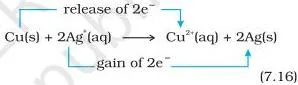
Five diagrams carry most of the visual ideas in the chapter. Each is reproduced below with an explanation of what to look at.
The Zinc–Copper Reaction as Two Half Reactions
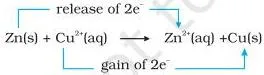
This is the chapter’s one-picture summary of electron transfer. The overall change \( \text{Zn} + \text{Cu}^{2+} \rightarrow \text{Zn}^{2+} + \text{Cu} \) (eq. 7.15) splits into a zinc half that releases two electrons — oxidation — and a copper half that collects them — reduction (NCERT, p. 238). Half reactions are exactly what the balancing methods later in the chapter work with.
Fig. 7.1 — Zinc Displaces Copper from Copper Nitrate

Leave the zinc strip in the copper nitrate solution for about an hour and you see red-brown copper coating the zinc while the blue of Cu\( ^{2+} \) fades — the dissolved copper is being replaced by colourless Zn\( ^{2+} \) (NCERT, p. 238). To confirm the Zn\( ^{2+} \), the book passes H\( _2 \)S through the solution made alkaline with ammonia and sees white zinc sulphide.
This beaker reaction is reaction (7.15), and later it becomes the heart of the Daniell cell.

Fig. 7.2 — Copper Displaces Silver from Silver Nitrate

Here copper is oxidised to blue Cu\( ^{2+} \) while Ag\( ^+ \) is reduced to silver metal, and the equilibrium again greatly favours the products (NCERT, p. 239). Put the two beaker experiments together and you get the electron-releasing order Zn > Cu > Ag — the seed of the electrochemical series your Class XII syllabus grows from.
The Structural Reality Behind Fractional Oxidation Numbers
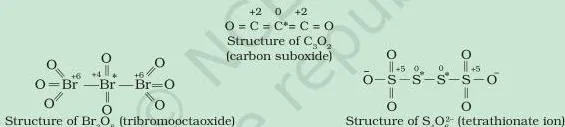
The asterisked atom in each structure is the one that breaks the average.
In \( \text{C}_3\text{O}_2 \) it is the central carbon at 0 against two terminal carbons at +2; in \( \text{Br}_3\text{O}_8 \) it is the middle bromine at +4 against two terminal bromines at +6; in \( \text{S}_4\text{O}_6^{2-} \) it is the pair of middle sulphurs at 0 against the two end sulphurs at +5 (NCERT, p. 245).
The average is exactly what the oxidation number rules produce — and exactly why a fraction in a formula means ‘check the structure’.
Fig. 7.3 — The Daniell Cell

Read the cell left to right: zinc dissolves at the anode as Zn\( ^{2+} \), its electrons travel through the external wire — past the ammeter — to the copper cathode, where Cu\( ^{2+} \) picks them up and plates out as copper.
The salt bridge closes the circuit by letting ions migrate between the two solutions, and the arrow shows the conventional current moving opposite to the electrons (NCERT, p. 250).
If the switch in the diagram is off, no reaction occurs and no current flows; turn it on and the beaker chemistry of Fig. 7.1 happens again, just at a distance (NCERT, p. 250).
Definitions You Need to Remember
One-line definitions you can scan in the last hour before an exam. Page numbers point to where each term is defined in the book.
| Term | Plain definition | NCERT page |
|---|---|---|
| Oxidation (classical) | Adding oxygen or an electronegative element, or removing hydrogen or an electropositive element | 236 |
| Reduction (classical) | Removing oxygen or an electronegative element, or adding hydrogen or an electropositive element | 236 |
| Oxidation (electron transfer) | Loss of electron(s) by a species | 237 |
| Reduction (electron transfer) | Gain of electron(s) by a species | 237 |
| Oxidant (oxidising agent) | Acceptor of electrons; a reagent that raises another element’s oxidation number | 237, 241 |
| Reductant (reducing agent) | Donor of electrons; a reagent that lowers another element’s oxidation number | 237, 241 |
| Oxidation number / oxidation state | The charge an atom would carry if every bonding pair belonged to the more electronegative atom, assigned by fixed rules | 239–240 |
| Stock notation | The oxidation number written as a Roman numeral after the metal, e.g. Sn(II)Cl\( _2 \) and Sn(IV)Cl\( _4 \) | 241 |
| Redox couple | The oxidised and reduced forms of a substance in a half reaction, written with a slash, e.g. Cu\( ^{2+} \)/Cu | 250 |
| Electrode potential | The potential associated with one electrode of a cell | 250 |
| Standard electrode potential (E°) | Electrode potential at unit concentration, 1 atm gas pressure and 298 K; hydrogen electrode set at 0.00 V | 250 |
| Disproportionation | One element in an intermediate oxidation state simultaneously oxidised and reduced | 244 |
Common Mistakes in Redox Reactions and How to Avoid Them
These are the traps NCERT itself flags — peroxides, hydrides, the calcium carbonate counterexample, and three subtle cases. Read them before you do the exercises, and again while checking your answers.
| Mistake | Correct rule | How to check your answer |
|---|---|---|
| ‘Oxygen is always −2.’ | Peroxides: −1 (\( \text{H}_2\text{O}_2 \), \( \text{Na}_2\text{O}_2 \)). Superoxides: \( -\frac{1}{2} \) (\( \text{KO}_2 \)). With fluorine: +2 in \( \text{OF}_2 \). | Look for an O–O bond, or oxygen bonded to fluorine. If you force −2 on a peroxide, hydrogen would have to be +2 each to sum to zero — impossible (NCERT, p. 240). |
| ‘Hydrogen is always +1.’ | In metal hydrides H is −1: LiH, NaH, CaH\( _2 \). | Sodium is always +1, so in NaH hydrogen must be −1 to make the sum zero (p. 240). |
| ‘Every decomposition is a redox reaction.’ | No change in oxidation number means no redox: \( \text{CaCO}_3 \rightarrow \text{CaO} + \text{CO}_2 \) leaves Ca +2, C +4 and O −2 untouched. | Assign numbers to every element on both sides; if none change, it is not redox (p. 242). |
| ‘Fluorine can disproportionate like the other halogens.’ | It cannot — fluorine has no positive oxidation state, and disproportionation needs an intermediate state plus higher and lower ones. | Check whether the element can exist in at least three oxidation states. For fluorine the answer is no (p. 244). |
| ‘A fractional oxidation number is a real oxidation state.’ | Fractions are averages over different atoms: S in \( \text{S}_4\text{O}_6^{2-} \) averages +2.5 but is really +5, 0, 0, +5. | Consider the structure — terminal atoms carry the high values, middle atoms the low ones (p. 245). |
| ‘Pb\( _3 \)O\( _4 \) reacts the same way with every acid.’ | Pb\( _3 \)O\( _4 \) is a mixture of 2 mol PbO and 1 mol PbO\( _2 \). PbO\( _2 \) (Pb +4) oxidises Cl\( ^- \) of HCl to Cl\( _2 \); against HNO\( _3 \), itself an oxidant, only the basic PbO reacts. | Ask whether the acid is an oxidant before predicting the products (p. 246). |
| ‘ClO\( _4^- \) can disproportionate.’ | No — chlorine is already at its highest state, +7, so there is no higher state to go to. | Find the element’s oxidation number; if it is the maximum, oxidation — and so disproportionation — is impossible (p. 244). |
How to Revise This Chapter Using the Book’s Own Objectives
NCERT opens the chapter with a list of what you should be able to do after studying it. That list is a ready-made revision checklist (p. 234):
- Identify redox reactions — reactions in which oxidation and reduction happen simultaneously.
- Define oxidation, reduction, oxidant and reductant from memory, in all three ways the chapter teaches.
- Explain the electron transfer mechanism of a redox reaction.
- Use oxidation numbers to identify the oxidant and reductant in any reaction.
- Classify reactions into combination, decomposition, displacement and disproportionation.
- Arrange reductants and oxidants in a comparative order.
- Balance equations by both the oxidation number method and the half reaction method.
- Explain redox in terms of electrode processes.
Map the exercises to the skills they test, and drill your weak spots:
| Exercises | Skill they test |
|---|---|
| 7.1–7.2 | Assigning oxidation numbers, including compounds the book asks you to rationalise (KI\( _3 \), H\( _2 \)S\( _4 \)O\( _6 \), Fe\( _3 \)O\( _4 \)) |
| 7.3–7.5 | Proving a reaction is redox; identifying the oxidant and reductant |
| 7.6–7.7 | Building formulas from Stock notation; listing species across an element’s oxidation state range |
| 7.8–7.17 | Reasoning about why species act as oxidants or reductants |
| 7.18–7.19 | Balancing by the ion-electron method and by the oxidation number method |
| 7.20–7.24 | Disproportionation — its conditions and its limits |
| 7.25 | Redox stoichiometry with a limiting reagent (the Ostwald process problem) |
| 7.26–7.30 | Standard electrode potentials: feasibility, electrolysis products, galvanic cell setup |
Textbook contents and the examinable syllabus are not always identical — check the current official CBSE syllabus for Class 11 Chemistry before exam season.
Chapter Summary in Plain Words
Redox reactions are reactions in which oxidation and reduction occur simultaneously — no oxidation without a matching reduction (NCERT, p. 252). The chapter teaches you three ways to see this: the classical oxygen/hydrogen view, the electron transfer view, and the oxidation number view, each more general than the last.
Oxidation numbers follow one fixed set of rules; two balancing methods are on offer; and reactions sort into four classes — combination, decomposition, displacement and disproportionation. The chapter closes by introducing redox couples, electrode potentials and the Daniell cell, the bridge to the cell chemistry you will meet in Class XII (NCERT, p. 252).
Do not file this chapter under ‘laboratory only’. The opening pages point out that fuels, batteries, corrosion, electrochemical extraction of metals and even discussions of the ‘ozone hole’ are all redox phenomena (NCERT, p. 234).
Related NCERT Class 11 Chemistry Resources
Redox Reactions is the opening chapter of Chemistry Part II, so it steps straight on from the bonding and structure ideas of Part I. If you need the background before you continue:
- Class 11 Chemistry notes — chapter-by-chapter help for the rest of the syllabus.
- Structure of Atom — the chapter where the electron, the central actor of redox, is introduced.
- Class 11 study hub — all Class 11 subjects in one place.
- CBSE notes home — the main index of study material on this site.
Sources and Data Verification
This page describes Chapter 1, Redox Reactions, of the NCERT Class 11 Chemistry Part II textbook. Page numbers and figure references come from the NCERT edition published on ncert.nic.in, in which the chapter opens on page 234.
The page is maintained for the current academic session using the NCERT files available to us. NCERT settles textbook editions, contents and official PDFs; CBSE settles the curriculum, syllabus and examinations. Textbook contents and the examinable syllabus are not always identical.
Frequently Asked Questions About Redox Reactions Class 11
What is the difference between oxidation number and oxidation state?
For this chapter, none — NCERT uses the two terms interchangeably: the oxidation number denotes the oxidation state of an element in a compound (p. 240). Both names refer to the same assigned number.
The number is a bookkeeping convention — an assumed complete transfer of each bonding pair to the more electronegative atom — not a real charge. The exception is a monatomic ion, where the oxidation number equals the actual ionic charge.
How can I tell whether a given reaction is a redox reaction?
Assign oxidation numbers to every element on both sides. If any element’s oxidation number changes, it is a redox reaction — the book’s own definition on p. 241.
If no number changes, it is not redox: \( \text{CaCO}_3 \rightarrow \text{CaO} + \text{CO}_2 \) leaves everything untouched (p. 242). The element whose number rises is oxidised — it is the reductant; the one whose number falls is reduced — it is the oxidant.
Why does fluorine not show disproportionation reactions?
Because fluorine, the most electronegative element, can never take a positive oxidation state (p. 240). Disproportionation needs an intermediate state plus a higher and a lower one — impossible when no higher state exists (p. 244).
That is why fluorine with alkali gives F\( ^- \) and OF\( _2 \) rather than hypochlorite-type products, and why no chemical oxidant can turn F\( ^- \) into F\( _2 \) — only electrolysis can (p. 244).
Why can the oxidation number of an element be a fraction?
Usually because the fraction is an average, not a real state — electrons are never shared or transferred in fractions (p. 245). In \( \text{S}_4\text{O}_6^{2-} \), sulphur averages +2.5 but the actual values are +5, 0, 0 and +5.
The same story holds for \( \text{C}_3\text{O}_2 \) (two +2 carbons and one 0, average \( \frac{4}{3} \)) and \( \text{Br}_3\text{O}_8 \) (two +6 bromines and one +4, average \( \frac{16}{3} \)). Genuine fractional values do exist for simple ions — \( \text{O}_2^+ \) is \( +\frac{1}{2} \) and \( \text{O}_2^- \) is \( -\frac{1}{2} \) (p. 245).
When should I use the oxidation number method instead of the half reaction method?
Both methods give the same balanced equation, and NCERT leaves the choice to you (p. 246). The oxidation number method is quicker for simple equations: spot the changes, equalise increase and decrease, then fix charge and hydrogen.
The half reaction method is the safer tool for ionic reactions in water, especially in acid or base, because electrons and the medium are handled explicitly — and it is the method the later exercises (7.18–7.19) are built on. Its final atom-and-charge check catches errors the fast method can hide.
How do standard electrode potentials help predict whether a reaction is feasible?
E° measures the relative tendency of the two members of a redox couple to stay in their oxidised or reduced form. By convention the hydrogen electrode is 0.00 V; a couple with negative E° is a stronger reducing agent than H\( ^+ \)/H\( _2 \), a positive E° a weaker one (p. 251).
So the more negative couple supplies the electrons: Zn\( ^{2+} \)/Zn at −0.76 V reduces Cu\( ^{2+} \)/Cu at +0.34 V — exactly the beaker experiment of section 7.2.1 (p. 238). Exercise 7.26 asks you to apply Table 7.1’s values to such predictions.
Reference: NCERT Class 11 Chemistry Part II textbook, chapter 1, official edition on ncert.nic.in.
Explore Class 11 Chemistry Books
- Previous: Equilibrium
- Next: Organic Chemistry – Some Basic Principles and Techniques
Class 11 Chemistry on LearnCBSE:
Related chapters:
- Some Basic Concepts of Chemistry
- Structure of Atom
- Classification of Elements and Periodicity in Properties