
This page covers the formulas you need for the Straight Lines chapter in Class 11 Maths: slope of a line, angle between two lines, conditions for parallel and perpendicular lines, the various forms of the equation of a line (point-slope, two-point, slope-intercept, intercept, and general form), and the distance from a point to a line (including the distance between two parallel lines).
Each formula is grouped by topic, with the meaning of every symbol, when to use it, and original worked examples.
For the detailed explanations and derivations of these formulas, visit the Class 11 Maths Formulas page.
Formulas at a Glance
| Purpose (what you are finding) | Formula |
|---|---|
| Slope from two points | \( m = \dfrac{y_2 – y_1}{x_2 – x_1},\ x_1 \neq x_2 \) |
| Slope from inclination | \( m = \tan \theta,\ \theta \neq 90^\circ \) |
| Parallel lines condition | \( m_1 = m_2 \) |
| Perpendicular lines condition | \( m_1 m_2 = -1 \) |
| Acute angle between two lines | \( \tan \theta = \left| \dfrac{m_2 – m_1}{1 + m_1 m_2} \right|,\ 1 + m_1 m_2 \neq 0 \) |
| Point-slope form | \( y – y_0 = m (x – x_0) \) |
| Two-point form | \( y – y_1 = \dfrac{y_2 – y_1}{x_2 – x_1} (x – x_1) \) |
| Slope-intercept form (y-intercept c) | \( y = mx + c \) |
| Slope-intercept form (x-intercept d) | \( y = m (x – d) \) |
| Intercept form | \( \dfrac{x}{a} + \dfrac{y}{b} = 1 \) |
| General (linear) equation | \( Ax + By + C = 0,\ A,B \text{ not both }0 \) |
| Distance from point to line | \( d = \dfrac{|Ax_1 + By_1 + C|}{\sqrt{A^2 + B^2}} \) |
| Distance between parallel lines (general form) | \( d = \dfrac{|C_1 – C_2|}{\sqrt{A^2 + B^2}} \) |
| Distance between parallel lines (slope-intercept form) | \( d = \dfrac{|c_1 – c_2|}{\sqrt{1 + m^2}} \) |
All Formulas, Grouped by Topic
Slope of a Line
If a line passes through points \( (x_1, y_1) \) and \( (x_2, y_2) \), its slope is
\[ m = \frac{y_2 – y_1}{x_2 – x_1},\quad x_1 \neq x_2. \]
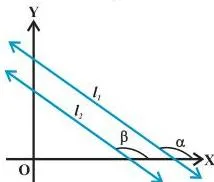
If the line makes an angle \( \theta \) with the positive direction of the x-axis (measured anticlockwise), then
\[ m = \tan \theta,\quad \theta \neq 90^\circ. \]
The slope of a horizontal line is 0; the slope of a vertical line is not defined.
Angle Between Two Lines
Let \( L_1 \) and \( L_2 \) have slopes \( m_1 \) and \( m_2 \). The acute angle \( \theta \) between them is given by
\[ \tan \theta = \left| \frac{m_2 – m_1}{1 + m_1 m_2} \right|,\quad 1 + m_1 m_2 \neq 0. \]
If the expression inside the absolute value is positive, \( \theta \) is acute; if negative, the obtuse angle is \( 180^\circ – \theta \).
Conditions for Parallel and Perpendicular Lines
- Parallel: \( m_1 = m_2 \) (non‑vertical lines).
- Perpendicular: \( m_1 m_2 = -1 \), i.e., \( m_2 = -\dfrac{1}{m_1} \).
Various Forms of the Equation of a Line
Point-slope form: Line with slope \( m \) through a fixed point \( (x_0, y_0) \):
\[ y – y_0 = m(x – x_0). \]
Two-point form: Line through \( (x_1, y_1) \) and \( (x_2, y_2) \):
\[ y – y_1 = \frac{y_2 – y_1}{x_2 – x_1} (x – x_1). \]
Slope-intercept form: Slope \( m \) and y-intercept \( c \):
\[ y = mx + c. \]
If the x-intercept is \( d \), the equation is
\[ y = m(x – d). \]
Intercept form: x-intercept \( a \) and y-intercept \( b \):
\[ \frac{x}{a} + \frac{y}{b} = 1. \]
General (linear) equation: \( Ax + By + C = 0 \), where \( A \) and \( B \) are not both zero. Any of the above forms can be converted to this form.
Distance of a Point from a Line
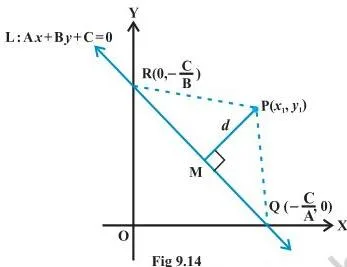
Perpendicular distance of point \( (x_1, y_1) \) from line \( Ax + By + C = 0 \):
\[ d = \frac{|Ax_1 + By_1 + C|}{\sqrt{A^2 + B^2}}. \]
Distance Between Two Parallel Lines
For lines \( y = mx + c_1 \) and \( y = mx + c_2 \):
\[ d = \frac{|c_1 – c_2|}{\sqrt{1 + m^2}}. \]
For lines \( Ax + By + C_1 = 0 \) and \( Ax + By + C_2 = 0 \):
\[ d = \frac{|C_1 – C_2|}{\sqrt{A^2 + B^2}}. \]
What Each Symbol Means
| Symbol | Meaning | Nature / Unit |
|---|---|---|
| \( m, m_1, m_2 \) | slope (gradient) of a line | dimensionless ratio |
| \( \theta \) | inclination of a line (angle with positive x-axis) | degrees or radians |
| \( (x_1, y_1), (x_2, y_2) \) | coordinates of points on the line | length units (e.g., cm) |
| \( (x_0, y_0) \) | fixed point on the line | length units |
| \( c \) | y-intercept (distance from origin to intersection with y-axis) | length units |
| \( d \) | x-intercept | length units |
| \( a \) | x-intercept in intercept form | length units |
| \( b \) | y-intercept in intercept form | length units |
| \( A, B, C, C_1, C_2 \) | constants in the general equation \( Ax+By+C=0 \) | depends on the line; \( A,B \) not both zero |
| \( d \) | perpendicular distance | length units |
When to Use Each Formula
| Formula | When to use it | Condition |
|---|---|---|
| \( m = \frac{y_2 – y_1}{x_2 – x_1} \) | Given two points on a line, find its slope. | \( x_1 \neq x_2 \) (line not vertical) |
| \( m = \tan \theta \) | Given the inclination, find the slope. | \( \theta \neq 90^\circ \) |
| \( m_1 = m_2 \) | Check if two non‑vertical lines are parallel. | Both lines non‑vertical |
| \( m_1 m_2 = -1 \) | Check if two non‑vertical lines are perpendicular. | Both lines non‑vertical |
| \( \tan \theta = \left|\frac{m_2 – m_1}{1+m_1 m_2}\right| \) | Find the acute angle between two intersecting lines from their slopes. | \( 1 + m_1 m_2 \neq 0 \) |
| \( y – y_0 = m(x – x_0) \) | Write the equation of a line when you know its slope and one point on it. | Line non‑vertical |
| \( y – y_1 = \frac{y_2 – y_1}{x_2 – x_1}(x – x_1) \) | Write the equation of a line through two given points. | \( x_1 \neq x_2 \) |
| \( y = mx + c \) | Write the equation of a line when you know its slope and y-intercept. | Line non‑vertical |
| \( \frac{x}{a} + \frac{y}{b} = 1 \) | Write the equation of a line knowing its intercepts on the axes. | \( a \neq 0,\ b \neq 0 \) |
| \( d = \frac{|Ax_1+By_1+C|}{\sqrt{A^2+B^2}} \) | Find the perpendicular distance of a point from a line. | Line in general form |
| \( d = \frac{|C_1 – C_2|}{\sqrt{A^2+B^2}} \) | Find the distance between two parallel lines given in general form. | Lines are parallel (same \( A,B \)) |
Worked Examples
Example 1: Using the point‑slope form
Find the equation of the line passing through \( (2, -3) \) with slope \( \frac{5}{2} \).
- Step 1: Identify the fixed point \( (x_0, y_0) = (2, -3) \) and slope \( m = \frac{5}{2} \).
- Step 2: Use the point‑slope formula \( y – y_0 = m(x – x_0) \).
\[ y – (-3) = \frac{5}{2} (x – 2) \]
Step 3: Simplify.
\[ y + 3 = \frac{5}{2}x – 5 \]
\[ y = \frac{5}{2}x – 8 \quad \text{or} \quad 5x – 2y – 16 = 0. \]
Final answer: \( y = \frac{5}{2}x – 8 \) (or \( 5x – 2y – 16 = 0 \)).
Example 2: Finding the distance from a point to a line
Find the perpendicular distance of the point \( (4, -1) \) from the line \( 2x – 3y + 5 = 0 \).
Step 1: Write the line in general form: \( A=2,\ B=-3,\ C=5 \).
The point is \( (x_1, y_1) = (4, -1) \).
Step 2: Use the distance formula \( d = \dfrac{|Ax_1 + By_1 + C|}{\sqrt{A^2+B^2}} \).
\[ d = \frac{|2(4) + (-3)(-1) + 5|}{\sqrt{2^2 + (-3)^2}} = \frac{|8 + 3 + 5|}{\sqrt{4 + 9}} = \frac{|16|}{\sqrt{13}}. \]
Final answer: \( \dfrac{16}{\sqrt{13}} \) units.
Example 3: Distance between two parallel lines
Find the distance between the parallel lines \( 3x + 4y – 8 = 0 \) and \( 3x + 4y + 12 = 0 \).
- Step 1: Identify \( A=3,\ B=4,\ C_1 = -8,\ C_2 = 12 \).
- Step 2: Use the formula \( d = \dfrac{|C_1 – C_2|}{\sqrt{A^2+B^2}} \).
\[ d = \frac{|-8 – 12|}{\sqrt{3^2 + 4^2}} = \frac{|-20|}{\sqrt{9+16}} = \frac{20}{5} = 4. \]
Final answer: 4 units.
Common Mistakes to Avoid
| Mistake | Correct Rule | How to Check Your Answer |
|---|---|---|
| Using the slope formula without checking \( x_1 \neq x_2 \). | If \( x_1 = x_2 \), the line is vertical and slope is undefined. | If the two points have the same x-coordinate, do not write a slope; the equation is \( x = \text{constant} \). |
| Forgetting the absolute value when calculating the acute angle between two lines. | Always use \( \tan \theta = \left|\frac{m_2 – m_1}{1+m_1 m_2}\right| \). | If the value inside is negative, the absolute value gives the acute angle; the obtuse angle is \( 180^\circ – \theta \). |
| Taking the reciprocal of the slope for perpendicular lines incorrectly. | If \( m_1 m_2 = -1 \), then \( m_2 = -\frac{1}{m_1} \). | Multiply your two slopes: the product must be exactly \( -1 \). |
| Confusing intercept form \( \frac{x}{a} + \frac{y}{b} = 1 \) with slope‑intercept form. | In intercept form, a and b are the intercepts, not the slope. | Rewrite the equation in slope‑intercept form: \( y = -\frac{b}{a}x + b \). Then the slope is \( -b/a \). |
| Using the distance formula for parallel lines without first writing them in the same form (both in general form with same A, B). | Convert both lines to \( Ax+By+C_1=0 \) and \( Ax+By+C_2=0 \), then use \( d = |C_1-C_2|/\sqrt{A^2+B^2} \). | Check that the coefficients of x and y are identical in both equations. |
Frequently Asked Questions
What is the slope of a line parallel to the y-axis?
The slope of a vertical line (parallel to the y-axis) is not defined. Its equation is \( x = k \).
How do I decide which form of the line equation to use?
Use this quick guide: if you have a point and a slope → point‑slope; if you have two points → two‑point; if you have slope and one intercept → slope‑intercept; if you have both intercepts → intercept form; otherwise, use the general form \( Ax+By+C=0 \).
Can the distance between two parallel lines be negative?
No. Distance is always non‑negative. The formula uses absolute values, so the result is always \( \ge 0 \).
Why do I get two possible slopes when using the angle formula?
The formula \( \tan \theta = \left|\frac{m_2 – m_1}{1+m_1 m_2}\right| \) gives the acute angle. When you solve for \( m_2 \), you must consider both the positive and negative cases of the absolute value: \( \frac{m_2 – m_1}{1+m_1 m_2} = \pm \tan \theta \).
This yields two possible lines (one making an acute angle \( \theta \) and the other making an obtuse angle \( 180^\circ – \theta \)).
Practice these formulas with the NCERT textbook; you can check the NCERT Solutions for Straight Lines here.
Reference: NCERT Class 11 Mathematics textbook, chapter Straight Lines (Rationalised NCERT).
Explore Class 11 Maths Formulas
More for this chapter:
Class 11 Maths on LearnCBSE:
Related chapters:
Official source: download the NCERT textbook free from ncert.nic.in.