
This sheet covers the probability class 11 formulas from NCERT Chapter 14 — the set forms of events, the axioms of probability, the equally-likely-outcomes rule, the addition rule for ‘A or B’, the complement rule for ‘not A’, and the three-event extension. Every formula is grouped by the textbook sub-topic it comes from.
Below each formula you will find the meaning of every symbol, a when-to-use line, and worked examples with original numbers. For the detailed explanations and derivations, browse the Class 11 Maths Formulas hub.
Formulas at a Glance
| Purpose | Formula |
|---|---|
| Probability of an event (equally likely outcomes) | \( P(A) = \frac{n(A)}{n(S)} \) |
| Probability of any event (axiomatic range) | \( 0 \leq P(E) \leq 1 \) |
| Probability of the sure event | \( P(S) = 1 \) |
| Probability of the impossible event | \( P(\phi) = 0 \) |
| Sum of probabilities of all outcomes | \( \sum_{i=1}^{n} P(\omega_i) = 1 \) |
| Probability of an event from its outcomes | \( P(A) = \sum_{\omega_i \in A} P(\omega_i) \) |
| Addition rule for ‘A or B’ (any two events) | \( P(A \cup B) = P(A) + P(B) – P(A \cap B) \) |
| Addition rule when A and B are mutually exclusive | \( P(A \cup B) = P(A) + P(B) \) |
| Complement rule for ‘not A’ | \( P(A’) = 1 – P(A) \) |
| Addition rule for three events | \( P(A \cup B \cup C) = P(A) + P(B) + P(C) – P(A \cap B) – P(A \cap C) – P(B \cap C) + P(A \cap B \cap C) \) |
All Formulas, Grouped by Topic
Events and Their Set Forms
An event is any subset \( E \) of the sample space \( S \) (NCERT, p. 290). The set forms below are the building blocks of every probability calculation in this chapter.
| Event | Set form |
|---|---|
| Impossible event | \( \phi \) |
| Sure event | \( S \) |
| Complementary event ‘not A’ | \( A’ = S – A \) |
| Event ‘A or B’ | \( A \cup B \) |
| Event ‘A and B’ | \( A \cap B \) |
| Event ‘A but not B’ | \( A – B = A \cap B’ \) |
| Mutually exclusive events | \( A \cap B = \phi \) |
| Exhaustive events | \( E_1 \cup E_2 \cup \dots \cup E_n = S \) |
Events \( E_1, E_2, \dots, E_n \) are mutually exclusive and exhaustive when they are pairwise disjoint and together cover the whole sample space (NCERT, p. 293):
\[ E_i \cap E_j = \phi \text{ for } i \neq j, \quad \text{and} \quad \bigcup_{i=1}^{n} E_i = S \]
Axioms of Probability
Probability \( P \) is a real-valued function on the power set of \( S \) with range \( [0, 1] \). It satisfies three axioms (NCERT, p. 296):
\[ P(E) \geq 0 \quad \text{for every event } E \]
\[ P(S) = 1 \]
\[ P(E \cup F) = P(E) + P(F) \quad \text{when } E \cap F = \phi \]
Because the range is \( [0, 1] \), every event satisfies \( 0 \leq P(E) \leq 1 \). Two results follow directly from the axioms:
\[ P(\phi) = 0 \]
For a sample space \( S = \{\omega_1, \omega_2, \dots, \omega_n\} \), the axioms give (NCERT, p. 296):
\[ 0 \leq P(\omega_i) \leq 1 \quad \text{for each } \omega_i \in S \]
\[ P(\omega_1) + P(\omega_2) + \dots + P(\omega_n) = 1 \]
\[ P(A) = \sum_{\omega_i \in A} P(\omega_i) \]
Probability of an Event with Equally Likely Outcomes
When every outcome of \( S \) has the same chance, all \( n \) outcomes share the total probability 1 equally, so each outcome gets probability \( \frac{1}{n} \), where \( n = n(S) \). For an event \( E \) with \( m = n(E) \) favourable outcomes (NCERT, p. 299):
\[ P(E) = \frac{m}{n} = \frac{\text{Number of outcomes favourable to } E}{\text{Total possible outcomes}} \]
\[ P(E) = \frac{n(E)}{n(S)} \]
Probability of ‘A or B’
For any two events \( A \) and \( B \) (NCERT, p. 300):
\[ P(A \cup B) = P(A) + P(B) – P(A \cap B) \]
The Venn diagram below shows why the overlap must be subtracted once: the region \( A \cap B \) is counted in both \( P(A) \) and \( P(B) \), so adding the two probabilities counts it twice.
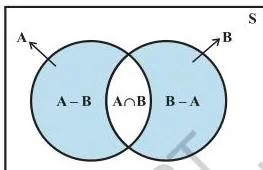
If \( A \) and \( B \) are mutually exclusive, then \( A \cap B = \phi \), so \( P(A \cap B) = 0 \) and the rule simplifies to:
\[ P(A \cup B) = P(A) + P(B) \]
For three events \( A, B, C \) (NCERT, p. 309):
\[ P(A \cup B \cup C) = P(A) + P(B) + P(C) – P(A \cap B) – P(A \cap C) – P(B \cap C) + P(A \cap B \cap C) \]
Probability of ‘not A’
Since \( A \) and \( A’ \) are mutually exclusive and exhaustive, \( P(A) + P(A’) = P(S) = 1 \), so (NCERT, p. 302):
\[ P(A’) = 1 – P(A) \]
What Each Symbol Means
Every symbol used in this chapter’s formulas, with its meaning and nature.
| Symbol | What it means | Unit / nature |
|---|---|---|
| \( S \) | Sample space: the set of all possible outcomes of the experiment | Set |
| \( \omega_i \) | A single outcome (sample point) of the experiment | Element of \( S \) |
| \( E, F, A, B, C \) | Events: subsets of the sample space | Set |
| \( \phi \) | Empty set; the impossible event | Set |
| \( n(S) \) | Number of outcomes in the sample space | Count |
| \( n(E) \) | Number of outcomes favourable to event \( E \) | Count |
| \( P(E) \) | Probability of event \( E \) | Dimensionless number, \( 0 \leq P(E) \leq 1 \) |
| \( P(\omega_i) \) | Probability assigned to the single outcome \( \omega_i \) | Dimensionless number |
| \( A’ \) | Complement of \( A \); the event ‘not A’ | Set |
| \( A \cup B \) | Union of \( A \) and \( B \); the event ‘A or B’ | Set |
| \( A \cap B \) | Intersection of \( A \) and \( B \); the event ‘A and B’ | Set |
| \( A – B \) | Difference; the event ‘A but not B’ | Set |
| \( \sum \) | Summation over the listed outcomes | Operation |
When to Use Each Formula
Reach for each formula in the situation described below.
| Formula | Use it when… |
|---|---|
| \( P(E) = \frac{n(E)}{n(S)} \) | Every outcome is equally likely (fair coin, fair die, random draw). Count the favourable outcomes and the total outcomes, then divide. |
| \( P(A) = \sum_{\omega_i \in A} P(\omega_i) \) | Outcomes are not equally likely but their individual probabilities are given. Add the probabilities of the outcomes inside \( A \). |
| \( P(A \cup B) = P(A) + P(B) – P(A \cap B) \) | You need ‘A or B’ and the two events can happen together. This general form is always safe. |
| \( P(A \cup B) = P(A) + P(B) \) | Only when \( A \) and \( B \) cannot occur together; otherwise the general rule above applies. |
| \( P(A’) = 1 – P(A) \) | The question asks for ‘not A’, or the complement is easier to count than the event itself — for example ‘at least one’ as \( 1 – P(\text{none}) \). |
| \( P(A \cup B \cup C) = P(A) + P(B) + P(C) – P(A \cap B) – P(A \cap C) – P(B \cap C) + P(A \cap B \cap C) \) | You need ‘A or B or C’. Add the three single probabilities, subtract the three pairwise overlaps, then add back the triple overlap. |
| Axioms \( 0 \leq P(E) \leq 1 \), \( P(S) = 1 \) | Checking whether a given assignment of probabilities to outcomes is valid. Each probability must lie in \( [0, 1] \) and the sum over all outcomes must be 1. |
Worked Examples
The three examples below use original numbers. Each shows the formula being selected, the substitution, and the final probability.
Example 1: Probability of an event with equally likely outcomes
Problem: A bag contains 6 red, 5 blue and 4 green marbles of the same size.
One marble is drawn at random.
Find the probability that it is (i) blue, (ii) not blue.
Step 1: Total marbles \( = 6 + 5 + 4 = 15 \), so \( n(S) = 15 \).
Each marble is equally likely to be drawn.
Step 2: Select \( P(E) = \frac{n(E)}{n(S)} \).
For blue, \( n(B) = 5 \):
\[ P(B) = \frac{5}{15} = \frac{1}{3} \]
Step 3: For ‘not blue’, select the complement rule \( P(A’) = 1 – P(A) \):
\[ P(\text{not blue}) = 1 – \frac{1}{3} = \frac{2}{3} \]
Final answer: \( P(\text{blue}) = \frac{1}{3} \) and \( P(\text{not blue}) = \frac{2}{3} \).
Example 2: Working backwards with the addition rule
Problem: For two events \( A \) and \( B \), \( P(A) = 0.55 \), \( P(B) = 0.45 \) and \( P(A \cup B) = 0.75 \).
Find \( P(A \cap B) \).
Are \( A \) and \( B \) mutually exclusive?
- Step 1: Select the addition rule \( P(A \cup B) = P(A) + P(B) – P(A \cap B) \).
- Step 2: Rearrange to isolate the intersection:
\[ P(A \cap B) = P(A) + P(B) – P(A \cup B) = 0.55 + 0.45 – 0.75 = 0.25 \]
Step 3: Mutually exclusive events have \( P(A \cap B) = 0 \).
Here \( P(A \cap B) = 0.25 \neq 0 \), so \( A \) and \( B \) are not mutually exclusive.
Final answer: \( P(A \cap B) = 0.25 \); the events are not mutually exclusive.
Example 3: Addition rule for mutually exclusive events
Problem: A die is rolled once.
Find the probability of getting a number less than 3 or greater than 4.
Step 1: The sample space is \( S = \{1, 2, 3, 4, 5, 6\} \), so \( n(S) = 6 \).
Let \( A = \{1, 2\} \) (less than 3) and \( B = \{5, 6\} \) (greater than 4).
Step 2: \( A \cap B = \phi \), so the events are mutually exclusive.
Select \( P(A \cup B) = P(A) + P(B) \).
\[ P(A) = \frac{2}{6} = \frac{1}{3}, \quad P(B) = \frac{2}{6} = \frac{1}{3} \]
\[ P(A \cup B) = \frac{1}{3} + \frac{1}{3} = \frac{2}{3} \]
Final answer: \( P(\text{less than 3 or greater than 4}) = \frac{2}{3} \).
For more chapter-wise formula sheets, see the main Maths Formulas index.
Common Mistakes to Avoid
These are the errors students most often make while applying this chapter’s formulas.
| Mistake | Correct rule | How to check your answer |
|---|---|---|
| Adding \( P(A) + P(B) \) for overlapping events and forgetting \( P(A \cap B) \) | The general rule always holds: \( P(A \cup B) = P(A) + P(B) – P(A \cap B) \). Subtract the overlap even when it looks small. | If your answer exceeds 1, the overlap was missed. On a die, P(even) + P(prime) = 6/6, but P(even or prime) = 5/6 because 2 is counted twice. |
| Using \( \frac{n(E)}{n(S)} \) when outcomes are not equally likely | The formula needs equally likely outcomes; otherwise add the given outcome probabilities: \( P(A) = \sum_{\omega_i \in A} P(\omega_i) \). | Ask: does every outcome have the same chance? A biased coin cannot be treated as \( \frac{1}{2} \) per outcome. |
| Writing \( P(A’) = P(A) – 1 \) | The complement rule is \( P(A’) = 1 – P(A) \). | \( P(A’) \) must lie between 0 and 1. If \( P(A) = 0.7 \), then \( P(A’) = 0.3 \). |
| Confusing \( A – B \) with \( B – A \) | \( A – B = A \cap B’ \): the outcomes in \( A \) that are not in \( B \). | With \( A = \{1, 2, 3\} \) and \( B = \{3, 4\} \), \( A – B = \{1, 2\} \), not \( \{4\} \). |
| Treating ‘at least one’ as ‘exactly one’ | ‘At least one’ includes every outcome except ‘none’, so use \( 1 – P(\text{none}) \). | For two coin tosses, at least one head \( = \frac{3}{4} \), exactly one head \( = \frac{1}{2} \). |
Frequently Asked Questions
What is the difference between mutually exclusive and exhaustive events?
Mutually exclusive means the events cannot occur together: \( A \cap B = \phi \). Exhaustive means at least one of them must occur: their union is the whole sample space. The two ideas are independent — events can be mutually exclusive without being exhaustive (for example, \( \{1, 2\} \) and \( \{3, 4\} \) on a die), and exhaustive without being mutually exclusive.
When can I use the shorter addition rule without subtracting anything?
Only when \( A \) and \( B \) are mutually exclusive, so \( A \cap B = \phi \). If the events share even one outcome, you must subtract \( P(A \cap B) \). Always check for common outcomes before using the shorter form.
Why is the probability of ‘not A’ equal to 1 minus P(A)?
Because \( A \) and \( A’ \) are mutually exclusive and together cover the whole sample space: \( A \cup A’ = S \). The axioms give \( P(A) + P(A’) = P(S) = 1 \), so \( P(A’) = 1 – P(A) \). This is why ‘at least one’ problems are usually solved as \( 1 – P(\text{none}) \).
What does ‘equally likely outcomes’ mean, and why does it matter?
It means every outcome of the sample space has the same probability. For \( n \) outcomes, each gets probability \( \frac{1}{n} \), which is what makes \( P(E) = \frac{n(E)}{n(S)} \) valid. When outcomes are not equally likely (a biased coin, for instance), you must add the individual outcome probabilities instead.
All formulas above follow the Rationalised NCERT Class 11 Mathematics textbook. You can verify them in the official PDF at ncert.nic.in.
Reference: NCERT Class 11 Mathematics textbook (Rationalised NCERT), chapter Probability.
Explore Class 11 Maths Formulas
More for this chapter:
Class 11 Maths on LearnCBSE:
Related chapters: