
Take any three consecutive square numbers — 1, 4, 9, say. Add the smallest and largest, then subtract twice the middle: \((1 + 9) – (2 \times 4) = 2\). Try 25, 36, 49: \((25 + 49) – (2 \times 36) = 2\) again. It always comes out 2, and this chapter’s algebra explains why.
These exploring algebraic identities class 9 notes put every identity, the geometric picture behind it, and the factorisation workflow on one page — the fastest way to revise Chapter 4 before a test. You get all 11 identities in a table, worked examples with original numbers, the errors that cost marks, and a one-page recap at the end.
Chapter 4 at a glance: exploring algebraic identities class 9 notes
The chapter works on one idea in four directions:
- Proving identities — verifying that an identity holds for all numbers, by geometry, by substitution, and by the distributive property.
- Visualising — area models (squares and rectangles) and algebra tiles show why each identity is true.
- Using them — squaring numbers like \(62^2\), finding products like \(19 \times 21\), and factorising expressions.
- Simplifying — turning rational algebraic expressions into simpler equivalent fractions (NCERT, p. 91).
These build directly on the linear polynomials and patterns you met earlier, so it helps to have your notes on The World of Numbers handy. The one-page recap at the bottom of this page is the fastest full review.
What makes an algebraic identity different from an equation
An algebraic identity is an equation that is true for all values of the variables in it. An ordinary equation is true only for some values (NCERT, p. 71).
The textbook’s contrast makes this concrete:
- \(x^2 – 1 = 24\) is true only for \(x = 5\) or \(x = -5\). It is an equation.
- \((x + y)^2 = x^2 + 2xy + y^2\) is true for every pair of numbers \(x\) and \(y\). It is an identity.
Why the difference matters: because an identity holds everywhere, you may replace one side with the other in any calculation, and you can check it with any convenient numbers. That is exactly what lets you square a big number like 62 by writing it as \((60 + 2)^2\).
The thinking point on p. 71 asks whether \((a + b)^2\) is always bigger than \(a^2 + b^2\). For \(a = 10, b = 2\): \((10 + 2)^2 = 144\) and \(10^2 + 2^2 = 104\). The term \(2ab\) decides which side wins — since \(144 = 104 + 2ab\), the comparison depends on the sign of \(2ab\).
Definitions you need before the formulas
These six terms carry the whole chapter. Learn the meaning, then the example fixes it in memory.
| Term | Meaning | Example from the chapter |
|---|---|---|
| Identity | An equation true for all values of its variables | \((x + y)^2 = x^2 + 2xy + y^2\) (p. 71) |
| Equation | A statement true only for some values of the variable | \(x^2 – 1 = 24\), true only for \(x = 5, -5\) |
| Distributive property | \(a(b + c) = ab + ac\); the engine behind every expansion | \((a + b)^2 = (a + b)(a + b) = a(a + b) + b(a + b)\) (p. 71) |
| Factorisation | Writing an expression as a product of simpler factors | \(x^2 + 4x + 4 = (x + 2)^2\) (p. 73) |
| Perfect square trinomial | A three-term expression of the form \(a^2 \pm 2ab + b^2\) | \(36x^2 + 12x + 1 = (6x + 1)^2\) (p. 73) |
| Rational algebraic expression | A fraction whose numerator and denominator are polynomials | \(\frac{x^2 – 7x + 12}{5x^2 + 5x – 100}\) (p. 87) |
Notice that factorisation is the reverse of expansion: where \((x + 2)^2\) expands to \(x^2 + 4x + 4\), factorisation recovers the \((x + 2)^2\).
All chapter identities in one table
These eleven identities, from the chapter summary on p. 91, are the chapter. The third column links each to its fastest exam use — this is the table to memorise the night before. Every formula here can be checked against the official NCERT Class 9 Mathematics textbook PDF.
| Identity | Fastest problem type |
|---|---|
| \((x + y)^2 = x^2 + 2xy + y^2\) | Squaring a sum; expanding any two-term square |
| \((x – y)^2 = x^2 – 2xy + y^2\) | Squaring a difference, e.g. \(29^2 = (30 – 1)^2\) |
| \((x + y + z)^2 = x^2 + y^2 + z^2 + 2xy + 2yz + 2zx\) | Squaring three-term expressions |
| \((x + y)(x – y) = x^2 – y^2\) | Products like \(19 \times 21\); factorising a difference of squares |
| \((x + a)(x + b) = x^2 + (a + b)x + ab\) | Expanding or factorising quadratics with leading term \(x^2\) |
| \((ax + b)(cx + d) = acx^2 + (ad + bc)x + bd\) | Expanding products of two linear binomials |
| \(x^3 – y^3 = (x – y)(x^2 + xy + y^2)\) | Factorising a difference of cubes |
| \(x^3 + y^3 = (x + y)(x^2 – xy + y^2)\) | Factorising a sum of cubes |
| \((x + y)^3 = x^3 + 3x^2y + 3xy^2 + y^3\) | Cube of a sum; cube problems |
| \((x – y)^3 = x^3 – 3x^2y + 3xy^2 – y^3\) | Cube of a difference; alternating signs |
| \(x^3 + y^3 + z^3 – 3xyz = (x + y + z)(x^2 + y^2 + z^2 – xy – xz – yz)\) | Three-variable problems, e.g. finding a sum of cubes (Example 15) |
Two quick ways to tell the signs apart: the two-term squares each carry a single \(2ab\) term, and minus signs appear only where the bracket has a minus. The cube identities get their own section below.
Seeing \((a + b)^2\) and \((a – b)^2\) as areas
Build a square of side \(a + b\). Its area is \((a + b)^2\). Partition it into a square of side \(a\), a square of side \(b\), and two rectangles each of dimensions \(a \times b\) — areas \(a^2\), \(b^2\), and \(ab\) twice. Adding them gives the identity (NCERT, p. 70).
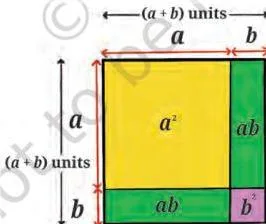
The mistake autopsy: why the \(2ab\) is there. Students write \((a + b)^2 = a^2 + b^2\) because they think “squaring each term.” What they miss is the two rectangles. The square of side \(a + b\) contains not only the corner squares \(a^2\) and \(b^2\), but also two rectangles of area \(ab\) each — that is the \(2ab\).
Leave it out and you have counted only the two opposite corners of the square. Check with \(a = 1, b = 1\): LHS \((1 + 1)^2 = 4\), RHS \(1 + 2 + 1 = 4\), but \(a^2 + b^2 = 2 \neq 4\).
The identity is not limited to lengths. It works for negatives — \(a = -2, b = -3\) gives \((-5)^2 = 25\) and \(4 + 12 + 9 = 25\) — and for rationals — \(a = -\frac{2}{3}, b = \frac{3}{4}\) gives \(\left(\frac{1}{12}\right)^2 = \frac{1}{144}\) both ways (NCERT, p. 71). The distributive property gives the general proof:
\[ (a + b)^2 = (a + b)(a + b) = a(a + b) + b(a + b) = a^2 + 2ab + b^2. \]
For \((a – b)^2\), draw a square of side \(a\) and split off a strip of width \(b\). The remaining square has side \(a – b\), and removing two rectangles from \(a^2\) leaves \((a – b)^2 = a^2 – 2ab + b^2\) (NCERT, p. 74).
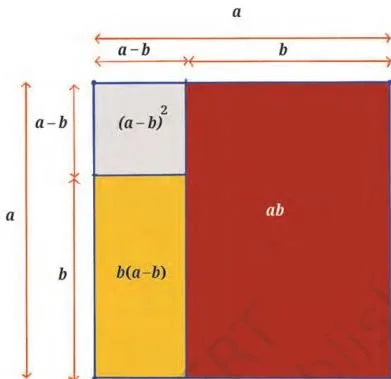
This also solves the opening puzzle. Any three consecutive numbers are \(n – 1, n, n + 1\). Their squares add as \((n – 1)^2 + (n + 1)^2 = 2n^2 + 2\), so after subtracting \(2n^2\) the answer is always 2 (NCERT, p. 74). That surprising constant 2 is exactly the kind of number pattern explored in the chapter I’m Up and Down and Round and Round.
Three more identities: \((a + b + c)^2\), \(a^2 – b^2\), and Śhrīdharāchārya’s square trick
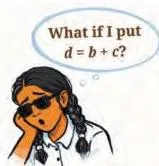
To square a sum of three terms, substitute \(d = b + c\) into \((a + d)^2\). Expanding gives (NCERT, p. 76):
\[ (a + b + c)^2 = a^2 + b^2 + c^2 + 2ab + 2bc + 2ca. \]
The geometry mirrors the two-term case: a square of side \(a + b + c\) splits into three squares and six rectangles whose areas exactly match the six terms on the right.
Next, the difference of squares from Grade 8: \(a^2 – b^2 = (a + b)(a – b)\). The chapter rewrites it as \(a^2 = (a + b)(a – b) + b^2\) and justifies it by areas in Fig. 4.5 (NCERT, p. 78).
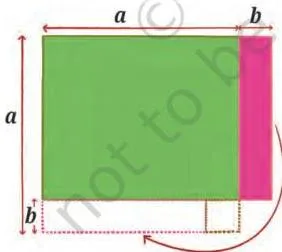
This form is Śhrīdharāchārya’s square trick, proposed in 750 CE to compute squares quickly (NCERT, p. 78). The textbook’s example: \(55^2 = (55 + 5)(55 – 5) + 5^2 = 60 \times 50 + 25 = 3025\). The idea is to turn one awkward multiplication into two easy ones. The worked-examples section below applies the same trick with fresh numbers.
Factorising with identities: perfect squares and splitting the middle term
Factorising is expansion in reverse — you recover the brackets from the expanded form. Use this decision checklist in this exact order (built from Examples 5–12, NCERT pp. 73–82):
- Common factor first. If all terms share one, take it out. Example 7 pulls 2 out of \(50p^2 + 60pq + 18q^2\) to get \(2(25p^2 + 30pq + 9q^2) = 2(5p + 3q)^2\) (NCERT, p. 73).
- Perfect square trinomial? Check whether the expression matches \(a^2 \pm 2ab + b^2\). \(9x^2 + 30x + 25 = (3x)^2 + 2(3x)(5) + 5^2 = (3x + 5)^2\).
- Difference of squares? Two terms, one minus: \(x^2 – y^2 = (x + y)(x – y)\).
- Otherwise split the middle term. For \(x^2 + 7x + 12\), find \(a, b\) with \(a + b = 7\) and \(ab = 12\); here 3 and 4, so \(x^2 + 7x + 12 = (x + 3)(x + 4)\) (NCERT, p. 81).
The sign of the \(x\)-coefficient decides the signs of \(a\) and \(b\). For \(x^2 – 5x + 6\), we need \(a + b = -5\) and \(ab = 6\), which forces both to be negative: \((x – 2)(x – 3)\) (NCERT, p. 82).
Algebra tiles: turning factors into rectangles
Algebra tiles make factorisation visible. One \(x^2\)-tile, seven \(x\)-tiles, and twelve unit tiles arrange into a rectangle of sides \(x + 3\) and \(x + 4\), showing directly that \(x^2 + 7x + 12 = (x + 3)(x + 4)\) (NCERT, p. 79).
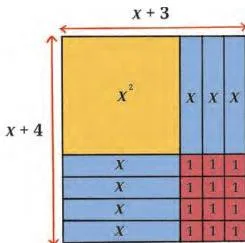
The key move is splitting the middle term: the \(7x\) in \(x^2 + 7x + 12\) is written as \(3x + 4x\), matching the three \(x\)-tiles on one side and four on the other. The same idea extends to \((px + a)(qx + b) = pq\,x^2 + (pb + qa)x + ab\) (NCERT, p. 80).
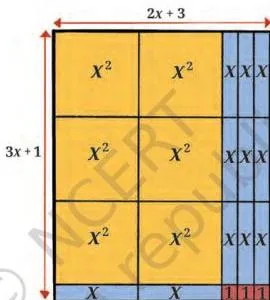
Tiles build intuition; for the exam, the identities and the middle-term split are what you actually write.
Cube identities and the \(x^3 + y^3 + z^3 – 3xyz\) formula
Building on \((a + b)^2\), multiply once more by \((a + b)\):
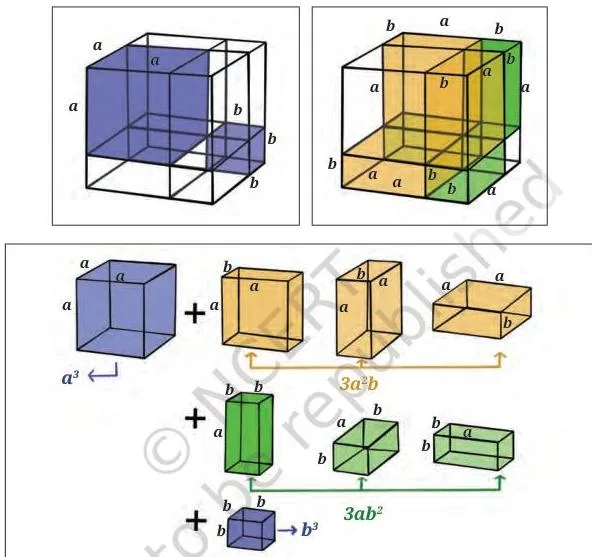
\[ (a + b)^3 = (a + b)(a^2 + 2ab + b^2) = a^3 + 3a^2b + 3ab^2 + b^3. \]
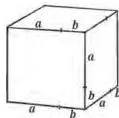
The cube picture: a cube of edge \(a + b\) splits into two smaller cubes of volumes \(a^3\) and \(b^3\), plus six cuboids — three of volume \(a^2b\) and three of volume \(ab^2\) (NCERT, p. 84).
Replacing \(b\) by \(-b\) gives the difference version (NCERT, p. 84):
\[ (a – b)^3 = a^3 – 3a^2b + 3ab^2 – b^3. \]
Memory trick for cube signs. In \((a – b)^3\) the signs alternate: \(+\), \(-\), \(+\), \(-\) — like a zigzag wave. So the first term is \(+a^3\), and the last term picks up the minus: \(-b^3\). In \((a + b)^3\) every term is positive. Test any doubt instantly with \(a = 1, b = 1\): \((1 – 1)^3 = 0\) and \(1 – 3 + 3 – 1 = 0\) — if your signs give anything else, you wrote them wrong.
Multiplying \((x – y)(x^2 + xy + y^2)\) gives the difference of cubes, and \((x + y)(x^2 – xy + y^2)\) the sum of cubes (NCERT, p. 85):
\[ x^3 – y^3 = (x – y)(x^2 + xy + y^2), \qquad x^3 + y^3 = (x + y)(x^2 – xy + y^2). \]
The pattern continues — \(x^2 – y^2\) and \(x^3 – y^3\) both carry the factor \(x – y\), and \(x^4 – y^4 = (x^2 – y^2)(x^2 + y^2)\) shows the factor survives to higher powers (NCERT, p. 86). This is why, whenever \(x = y\), the whole expression \(x^n – y^n\) vanishes.
Finally, multiplying the three factors exhaustively gives the three-variable identity (NCERT, p. 86):
\[ x^3 + y^3 + z^3 – 3xyz = (x + y + z)(x^2 + y^2 + z^2 – xy – xz – yz). \]
It is the tool for problems that give you \(x + y + z\), \(xyz\), and \(x^2 + y^2 + z^2\) and ask for \(x^3 + y^3 + z^3\) — exactly the situation in Example 15 (NCERT, p. 86).
Simplifying rational expressions by factorising
A rational algebraic expression is a fraction whose top and bottom are polynomials. Identities let you simplify it: factor both parts, then cancel a whole factor that appears in each. The textbook works \(\frac{x^2 – 7x + 12}{5x^2 + 5x – 100}\), assuming the denominator is non-zero (NCERT, p. 87):
\[ \frac{x^2 – 7x + 12}{5x^2 + 5x – 100} = \frac{(x – 3)(x – 4)}{5(x – 4)(x + 5)} = \frac{x – 3}{5(x + 5)}. \]
Watch the steps: the numerator factors as \((x – 3)(x – 4)\) because \(-3 + (-4) = -7\) and \((-3)(-4) = 12\); the denominator first sheds a common factor 5, then \(x^2 + x – 20\) splits as \((x – 4)(x + 5)\).
The cancellation rule: factor first, then cancel whole factors — never individual terms. And the edge case that costs full marks: cancelling \(x – 4\) is legal only because it is not zero, which is guaranteed by the assumption that the denominator is non-zero (NCERT, p. 87). Drop that restriction and the cancellation is invalid at the excluded value.
Worked examples: four original problems solved step by step
Each example names its identity first — writing that line before substituting is what makes the working gradeable.
Squaring 62 with \((a + b)^2\)
- Step 1: Write \(62 = 60 + 2\) and name the identity \((a + b)^2 = a^2 + 2ab + b^2\).
- Step 2: Substitute \(a = 60, b = 2\):
\[ 62^2 = (60 + 2)^2 = 60^2 + 2(60)(2) + 2^2 = 3600 + 240 + 4 = 3844. \]
Final answer: \(62^2 = 3844\).
Factorising \(4x^2 + 20x + 25\) and simplifying a fraction
Step 1: Match against \(a^2 + 2ab + b^2\).
Here \(4x^2 = (2x)^2\), \(25 = 5^2\), and the middle term \(20x = 2(2x)(5)\) fits perfectly.
- Step 1: Hence \(4x^2 + 20x + 25 = (2x + 5)^2\).
- Step 2: Use the factorisation to simplify \(\frac{4x^2 + 20x + 25}{2x + 5}\):
\[ \frac{(2x + 5)^2}{2x + 5} = 2x + 5, \quad \text{provided } 2x + 5 \neq 0. \]
Final answer: \(4x^2 + 20x + 25 = (2x + 5)^2\), and the fraction simplifies to \(2x + 5\) for \(x \neq -\frac{5}{2}\).
Computing \(19 \times 21\) with the difference of squares
- Step 1: Notice \(19 = 20 – 1\) and \(21 = 20 + 1\), so the product is \((20 – 1)(20 + 1)\).
- Step 2: Apply \((x + y)(x – y) = x^2 – y^2\) with \(x = 20, y = 1\):
\[ 19 \times 21 = 20^2 – 1^2 = 400 – 1 = 399. \]
Final answer: \(19 \times 21 = 399\).
Simplifying \(\frac{x^2 + 6x + 8}{x^2 – 4}\)
Step 1: Factor the numerator.
Need \(a + b = 6\) and \(ab = 8\); the pair is 2 and 4, so \(x^2 + 6x + 8 = (x + 2)(x + 4)\).
- Step 1: Factor the denominator by the difference of squares: \(x^2 – 4 = (x + 2)(x – 2)\).
- Step 2: Cancel the common factor \(x + 2\) (non-zero by the denominator assumption):
\[ \frac{x^2 + 6x + 8}{x^2 – 4} = \frac{(x + 2)(x + 4)}{(x + 2)(x – 2)} = \frac{x + 4}{x – 2}. \]
Final answer: \(\frac{x + 4}{x – 2}\), valid for \(x \neq \pm 2\).
Common mistakes and the corrections
These are the errors the chapter reliably produces. Each row is written the way students actually write it — memorise the correction.
| Mistake | Correct rule | How to check your answer |
|---|---|---|
| \((a + b)^2 = a^2 + b^2\) | \((a + b)^2 = a^2 + 2ab + b^2\) — the two rectangles of area \(ab\) are missing | Multiply \((a + b)(a + b)\) literally once, or test \(a = 1, b = 1\) |
| \((a – b)^3 = a^3 – 3a^2b + 3ab^2 + b^3\) | \((a – b)^3 = a^3 – 3a^2b + 3ab^2 – b^3\) — signs alternate | Substitute \(a = 1, b = 1\): LHS \((0)^3 = 0\); RHS \(1 – 3 + 3 – 1 = 0\) |
| Splitting a middle term with wrong signs, e.g. \(x^2 – 5x + 6 = (x + 2)(x + 3)\) | For \(x^2 – 5x + 6\), \(a + b = -5\), \(ab = 6\) forces both negative: \((x – 2)(x – 3)\) | Expand your brackets back and compare with the original |
| Cancelling terms instead of factors, e.g. \(\frac{x + 4}{x + 2} = \frac{4}{2}\) | Factor first, then cancel whole factors only | Try \(x = 2\) in both forms; original and answer must agree |
| Dropping the non-zero denominator restriction | State the excluded values whenever you cancel | Plug the excluded value into the original fraction; it must be undefined |
The first two rows are the chapter’s greatest mark-killers. The fix is never to skip the \(2ab\) — it comes from the two rectangles in the area model — and to remember that a minus in the bracket makes the cube terms alternate.
Exam notes: where the marks sit
These are observed patterns in how the chapter’s work is marked, not predictions. The step that earns the mark in each type of question:
- Square a number: write the identity line first — e.g. \((a + b)^2 = a^2 + 2ab + b^2\) — then substitute. The identity line is the mark; the arithmetic follows from it (NCERT, p. 72).
- Factorise a quadratic: show the middle-term split explicitly. \(x^2 + 11x + 30 = x^2 + 5x + 6x + 30\) shows the method; jumping straight to \((x + 5)(x + 6)\) hides it (NCERT, p. 82).
- Simplify a rational expression: state that the denominator is non-zero before cancelling, and write the excluded values in the answer (NCERT, p. 87).
- Read the summary (NCERT, p. 91): the chapter’s own summary lists exactly what is examinable — identities true for all values, visualising with geometry and tiles, factorising, simplifying calculations, and simplifying rational expressions.
For the rest of the Class 9 programme, keep our Class 9 Mathematics notes open alongside this page, and browse all Class 9 notes or the full CBSE notes library for other subjects.
Revision recap: the chapter on one page
Night-before version. Everything essential, nothing extra.
The 11 identities (p. 91) — condensed:
| Square and product identities | Cube identities |
|---|---|
| \((x + y)^2 = x^2 + 2xy + y^2\) | \((x + y)^3 = x^3 + 3x^2y + 3xy^2 + y^3\) |
| \((x – y)^2 = x^2 – 2xy + y^2\) | \((x – y)^3 = x^3 – 3x^2y + 3xy^2 – y^3\) |
| \((x + y + z)^2 = x^2 + y^2 + z^2 + 2xy + 2yz + 2zx\) | \(x^3 – y^3 = (x – y)(x^2 + xy + y^2)\) |
| \((x + y)(x – y) = x^2 – y^2\) | \(x^3 + y^3 = (x + y)(x^2 – xy + y^2)\) |
| \((x + a)(x + b) = x^2 + (a + b)x + ab\) | \(x^3 + y^3 + z^3 – 3xyz = (x + y + z)(x^2 + y^2 + z^2 – xy – xz – yz)\) |
| \((ax + b)(cx + d) = acx^2 + (ad + bc)x + bd\) |
Factorisation flow (use in order):
- Pull out any common factor.
- Match a perfect square trinomial \(a^2 \pm 2ab + b^2\).
- Match the difference of squares \(x^2 – y^2\).
- Split the middle term: find \(a, b\) with \(a + b =\) coefficient of \(x\), \(ab =\) constant term.
Rational expression steps: factor numerator, factor denominator, cancel whole common factors, state the non-zero restriction.
Frequently asked questions about algebraic identities
What is the difference between an equation and an algebraic identity?
An identity is an equation that is true for all values of its variables, while an ordinary equation is true only for some. \(x^2 – 1 = 24\) holds only for \(x = 5, -5\), so it is an equation; \((x + y)^2 = x^2 + 2xy + y^2\) holds for every \(x\) and \(y\), so it is an identity (NCERT, p. 71).
How do I choose which identity to use for squaring a number?
Break the number into a round base and a small correction. \(62^2\) uses \((60 + 2)^2\); \(29^2 = (30 – 1)^2\) uses the difference version; \(119^2 = (100 + 10 + 9)^2\) uses the three-term identity. Pick the split that makes the middle term easy to compute in your head (NCERT, p. 74, 76).
Why is \((a + b)^2\) not equal to \(a^2 + b^2\)?
Because the square of side \(a + b\) contains two rectangles of area \(ab\) in addition to the squares \(a^2\) and \(b^2\). Squaring a sum means multiplying \((a + b)(a + b)\), and the cross terms \(ab + ba\) cannot be ignored (NCERT, p. 70–71).
How do I simplify a rational algebraic expression using identities?
Factor the numerator and the denominator with the identities, then cancel the whole factors that appear in both. For example, factor \(x^2 + 6x + 8\) as \((x + 2)(x + 4)\) and \(x^2 – 4\) as \((x + 2)(x – 2)\), then cancel \(x + 2\). Always state that the denominator is non-zero (NCERT, p. 87).
When can I cancel a common factor in the numerator and denominator?
Only when the factor is not zero. In \(\frac{(x – 4)(x – 3)}{5(x – 4)(x + 5)}\) you may cancel \(x – 4\) precisely because the denominator is assumed non-zero; at \(x = 4\) the original fraction is undefined (NCERT, p. 87).
What was Śhrīdharāchārya’s method for finding squares?
He proposed, in 750 CE, computing squares as \(a^2 = (a + b)(a – b) + b^2\). For \(55^2\), take \(b = 5\): \((55 + 5)(55 – 5) + 5^2 = 60 \times 50 + 25 = 3025\). It turns one large multiplication into two easy ones (NCERT, p. 78).
Reference: NCERT Class 9 Mathematics textbook, chapter Exploring Algebraic Identities.
Explore Class 9 Mathematics Notes
Class 9 Mathematics on LearnCBSE:
Related chapters: