The World of Numbers Class 9 notes on this page condense NCERT Mathematics Chapter 3 (Ganita Manjari) into one revision sweep — every number family from N to R, Brahmagupta’s rules, the root-2 proof, decimal conversions, and worked examples with fresh numbers you have not memorised.
Use the jump links below to reach any section, then finish with the formulas bank and key-terms table ten minutes before the test. For the rest of the year’s work, see the Class 9 Mathematics notes hub and the full Class 9 notes collection.
What This Chapter Covers: From Tally Bones to the Real Number Line
Numbers grew in stages over thousands of years. Humanity started by counting with notches on bone, added zero and negatives in ancient India, invented fractions to measure and divide, then met irrational lengths like \(\sqrt{2}\) that no fraction can express. Uniting rationals and irrationals gives the real number line.
| Set | Symbol | What it includes | Example | Decimal signature |
|---|---|---|---|---|
| Natural numbers | \(N\) | Counting numbers \(\{1, 2, 3, \dots\}\) | 7, 20 | Terminating |
| Integers | \(Z\) | Naturals, zero, negatives | −12, 0, 9 | Terminating |
| Rational numbers | \(Q\) | All fractions \(p/q\), \(q \neq 0\) | \(\frac{3}{8}, -\frac{5}{11}\) | Terminating or repeating |
| Irrational numbers | \(I\) | Not expressible as \(p/q\) | \(\sqrt{2},\ \pi\) | Never terminate, never repeat |
| Real numbers | \(R\) | \(Q \cup I\) — the whole line | \(\sqrt{2},\ -3.5,\ \pi\) | Every decimal that exists |
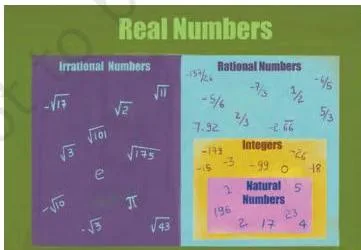
Read the table as a nesting chain (NCERT, p. 64): every natural is an integer, every integer is rational, and the irrationals sit outside the rationals. Together \(Q\) and \(I\) fill the entire real line.
The First Numbers: Tally Bones and One-to-One Correspondence
Before symbols existed, humans counted by matching. A herder watching cattle kept one pebble in a pot for each animal that left and removed one for each that returned (NCERT, p. 42). An empty pot at day’s end meant the herd was safe.
This matching of one object to another is one-to-one correspondence, and it is how the natural numbers \(N = \{1, 2, 3, \dots\}\) were born.

The oldest physical evidence of counting is carved into bone.
- Lebombo bone (~35,000 years old) — 29 deliberate, uniformly sized notches, likely a lunar phase or calendar counter.
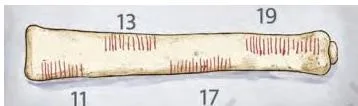
- Ishango bone (about 20,000 BCE) — three columns of notches; one column groups 11, 13, 17 and 19, the primes between 10 and 20, and another shows doubling.
India’s contribution was naming very large numbers. The Vedas named powers of 10 up to \(10^{12}\) (parārdha), the Lalitavistara went up to \(10^{53}\) (tallakṣaṇa), and the Rigveda used powers of 10 explicitly (NCERT, p. 43). This habit set the stage for the place-value system and, ultimately, for zero.
Zero: When Nothing Became a Number
The Babylonians and Mayans used placeholders to mark an empty column, but they never treated “nothing” as a number you could add or multiply. That leap came from Indian philosophy. Śhūnyatā — emptiness — was a revered meditative goal, so “nothingness” was welcome as a concept (NCERT, p. 44). The word śhūnya means zero.
The Bakhshālī Manuscript (early centuries CE) shows a bold dot, the bindu, used as the symbol for zero. But a mark becomes a number only when it has rules.
Brahmagupta supplied those rules in the Brāhmasphuṭasiddhānta (628 CE). He defined zero as \(a – a = 0\) and laid down its arithmetic (NCERT, p. 45):
| Rule | Meaning |
|---|---|
| \(a + 0 = a\) | Adding zero changes nothing |
| \(a – 0 = a\) | Subtracting zero changes nothing |
| \(a \times 0 = 0\) | Multiplying by zero collapses everything to zero |
The deep idea: a symbol is only a number once it obeys arithmetic. That is what made śhūnya the first true zero.
Integers: Fortunes, Debts and the Sign Rules
Brahmagupta grounded negative numbers in commerce. He called positive numbers dhana (fortunes) and negative numbers ṛiṇa (debts), then extended the number line to the left of zero. Integers \(Z\) — from the German Zahlen, meaning numbers — combine the naturals, their negatives and zero (NCERT, p. 46).

His five sign rules still govern arithmetic today. Here they are with fresh amounts:
| Rule | Example | Money gloss |
|---|---|---|
| fortune + fortune = fortune | \(8 + 3 = 11\) | Two profits add up |
| debt + debt = debt | \((-7) + (-2) = -9\) | Owing ₹7, then borrowing ₹2 more, means owing ₹9 |
| fortune − zero, debt − zero | \(9 – 0 = 9\), \(-6 – 0 = -6\) | Subtracting nothing changes the state |
| debt × fortune = debt | \((-3) \times 5 = -15\) | Five debts of ₹3 total ₹15 owed |
| debt × debt = fortune | \((-4) \times (-6) = 24\) | Four debts of ₹6 removed leave you ₹24 better off |
Why \((-) \times (-) = (+)\): multiplying by a negative is the removal of a debt. If four debts of ₹3 each are cancelled, you are ₹12 richer, so \((-3) \times (-4) = +12\) (NCERT, p. 47).
Modern link: a negative bank balance or UPI overdraft is a living ṛiṇa. When your account shows −₹2,500 and the bank waives that overdraft, the cancellation of a −(−2500) debt puts ₹2,500 back in your favour — the same ancient rule at work.
Rational Numbers: Definition and the Laws of Arithmetic
A rational number is any number that can be written as \(\frac{p}{q}\), where \(p\) and \(q\) are integers and \(q \neq 0\) (NCERT, p. 48).
Why \(q \neq 0\): division by zero has no meaning, because no number multiplied by 0 can give a non-zero result. So \(p/0\) answers no real question.
Rationals have no unique form. The fractions \(-\frac{2}{7} = -\frac{4}{14} = -\frac{6}{21}\) are equivalent rational numbers — all the same value. By convention we use the simplest form, where \(p\) and \(q\) are co-prime (no common factor except 1). So \(\frac{1}{2}\) stands for the whole class \(\{ \frac{1}{2}, \frac{2}{4}, \frac{3}{6}, \dots \}\) (NCERT, p. 48).
| Law | Formula | Condition |
|---|---|---|
| Equality | \(\frac{a}{b} = \frac{c}{d}\) iff \(ad = bc\) | — |
| Addition (same denominator) | \(\frac{a}{b} + \frac{c}{b} = \frac{a+c}{b}\) | — |
| Subtraction (same denominator) | \(\frac{a}{b} – \frac{c}{b} = \frac{a-c}{b}\) | — |
| Multiplication | \(\frac{a}{b} \times \frac{c}{d} = \frac{ac}{bd}\) | \(b \neq 0,\ d \neq 0\) |
| Division | \(\frac{a}{b} \div \frac{c}{d} = \frac{ad}{bc}\) | \(b, d, c \neq 0\) |
| Distributive | \(p(q + r) = pq + pr\) | — |
(NCERT, pp. 48–49). Rationals are closed under \(+, -, \times\), and under \(\div\) as long as you never divide by zero. Division by a fraction means “multiply by its reciprocal” — that swap is exactly why \(c \neq 0\) is required.
The Number Line: Placing Fractions, Absolute Value and Density
To place \(\frac{p}{q}\) on the number line, follow the method (NCERT, p. 51):
- Divide the unit interval (the gap between two consecutive integers) into \(q\) equal parts.
- Move \(p\) parts to the right of 0 for a positive number, or to the left for a negative one.
So \(\frac{3}{4}\) splits 0 to 1 into four parts and steps three right (Fig. 3.5), while \(\frac{8}{5}\) and \(-\frac{7}{4}\) follow the same idea (Fig. 3.7). Unlike integers, fractions may lie between two integers — see how \(\frac{1}{2}\) sits midway between 0 and 1 and \(-\frac{3}{4}\) lies between −1 and 0.


Absolute value \(|x|\) is the distance of \(x\) from 0 on the number line; it is always non-negative, so \(|x| \geq 0\) (NCERT, p. 52). For any two numbers \(a\) and \(b\), the distance between them is \(|a – b|\). Fig. 3.8 shows the distance between −4 and 3 is \(|-4 – 3| = 7\).
Density: rationals are dense. Between any two rationals \(a\) and \(b\), the average \(\frac{a+b}{2}\) always lies strictly between them (NCERT, p. 53). Average again and you keep finding new numbers, so infinitely many rationals exist between any two. That tempts us to think rationals fill the line — but they do not.
Irrational Numbers: The Root-2 Proof and Its Construction
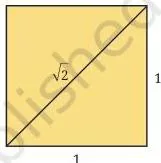
Around 800 BCE, Baudhāyana studied a unit square while writing rules for fire-altar geometry. By the Baudhāyana–Pythagoras theorem, \(1^2 + 1^2 = d^2\), so the diagonal is \(\sqrt{2}\) (NCERT, p. 54). No fraction could match that length.
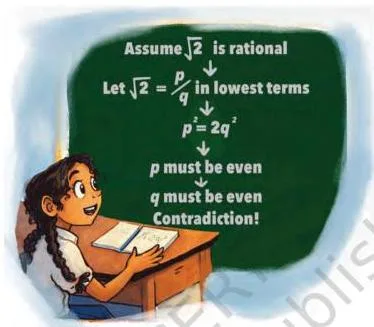
An irrational number cannot be written as \(p/q\). The first proof that \(\sqrt{2}\) is irrational is due to Hippasus, a member of the Pythagorean school (c. 400 BCE). He used proof by contradiction: assume the opposite, follow flawless logic, and show the assumption collapses (NCERT, pp. 54–55).
- Assume \(\sqrt{2} = \frac{p}{q}\) in lowest terms, so \(p\) and \(q\) are co-prime.
- Square both sides: \(2 = \frac{p^2}{q^2}\).
- Rearrange: \(2q^2 = p^2\).
- \(p^2\) is twice an integer, so \(p^2\) is even. A square is even only when the number itself is even, so \(p = 2k\).
- Substitute \(p = 2k\): \(2q^2 = (2k)^2 = 4k^2\).
- Divide by 2: \(q^2 = 2k^2\), so \(q^2\) is even and \(q\) is even.
- Both \(p\) and \(q\) are even, sharing the factor 2.
- That contradicts the co-prime assumption in Step 1. The assumption must be false — \(\sqrt{2}\) is irrational.
The same approach proves \(\sqrt{3}, \sqrt{5}, \sqrt{7}\) and, in general, \(\sqrt{n}\) irrational whenever \(n\) is not a perfect square.
Constructing \(\sqrt{2}\) on the number line (NCERT, pp. 56–57):
- Mark \(OA = 1\) on the line and draw a perpendicular at A.
- Mark \(AB = 1\) on that perpendicular and join O to B. Then \(OB = \sqrt{2}\) because \(1^2 + 1^2 = OB^2\).
- With O as centre and OB as radius, draw an arc that cuts the number line at P. Since \(OP = \sqrt{2}\), P represents \(\sqrt{2}\).
Figure Walkthrough: 9/4, the Root-2 Construction and the Square Root Spiral
Three diagrams recur in tests. Learn to read each one.
Fig. 3.6 — locating 9/4. Since \(\frac{9}{4} = 2\frac{1}{4}\), the point lies between 2 and 3. The figure splits the gap from 2 to 3 into four equal parts and steps one part past 2. It tests whether you know a fraction’s meaning: split the unit into \(q\) parts, then step \(p\) of them (NCERT, p. 52).

Fig. 3.11 — the \(\sqrt{2}\) construction. Trace the three construction steps: the unit segment OA, the perpendicular AB = 1, the hypotenuse OB = \(\sqrt{2}\), then the compass arc swinging from O until it meets the number line. Where the arc lands is the exact point P (NCERT, p. 57).
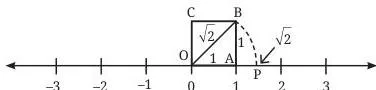
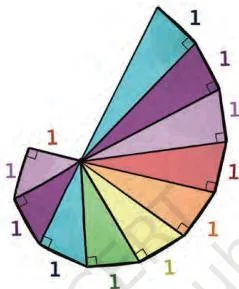
Fig. 3.14 — the square root spiral. Each new right triangle uses the previous hypotenuse as one leg and adds a unit leg, so the hypotenuses run \(\sqrt{1}, \sqrt{2}, \sqrt{3}, \sqrt{4}, \dots\). Every one of those lengths is a real number (NCERT, p. 67).
Pi, Madhava and the Infinite Series
Aryabhaṭa (499 CE) gave the excellent approximation \(\frac{3927}{1250} = 3.1416\) and honestly called it asanna — an approximation, not the exact value. Lambert proved that \(\pi\) is irrational in 1761 (NCERT, p. 57).
Because \(\pi\) is irrational, no single fraction can equal it. The first exact formula came in the 14th century from Mādhava of Sangamagrama, founder of the Kerala School of Mathematics:
\[ \pi = 4\left(1 – \frac{1}{3} + \frac{1}{5} – \frac{1}{7} + \dots \right) \]
An infinite sum means the value you approach as you add more and more terms — closer and closer to \(\pi\), yet never reached by any finite fraction.
Real Numbers and Decimal Expansions: Terminating, Repeating and Cyclic
Unite the rationals with the irrationals and you get the real numbers \(R\). The fastest way to classify a number is its decimal expansion (NCERT, p. 58).

Terminating and repeating decimals
Divide a numerator by its denominator and one of two things happens. The division either ends with remainder 0 — terminating, like \(\frac{3}{8} = 0.375\) — or it never ends and loops, like \(\frac{5}{11} = 0.4545\dots = 0.\overline{45}\).
Why repetition happens: divide by 7 and the only possible remainders are 1 through 6 (never 0, or it would stop). With only six possible remainders, one must re-appear, and once a remainder repeats the whole digit stream loops (NCERT, p. 58).
Prediction rule: for \(\frac{p}{q}\) in lowest terms, the decimal terminates exactly when the prime factors of \(q\) are only 2, only 5, or both — because then the denominator can be turned into a power of 10 (NCERT, pp. 59–60).
The 142857 cyclic number
\(\frac{1}{7} = 0.\overline{142857}\). The block 142857 is a cyclic number (NCERT, p. 62): its products by 1 through 6 are the same digits in rotation.
| Product | Result |
|---|---|
| 142857 × 1 | 142857 |
| 142857 × 2 | 285714 |
| 142857 × 3 | 428571 |
| 142857 × 4 | 571428 |
| 142857 × 5 | 714285 |
| 142857 × 6 | 857142 |
Two extras worth noticing: \(142857 \times 7 = 999999\), and multiplying by \(k\) and by \(7 – k\) gives complementary pairs that sum to 999999 — for instance \(285714 + 714285 = 999999\).
Irrational decimals and the 0.999… puzzle
Irrational decimals never end and never repeat: \(\sqrt{2} = 1.41421356\dots\), \(\pi = 3.14159265\dots\) (NCERT, p. 62).
Misconception autopsy — is 0.999… less than 1? Most students guess “a tiny bit less”. The algebra proves otherwise. Let \(x = 0.\overline{9}\). Then \(10x = 9.\overline{9}\). Subtracting gives \(10x – x = 9.\overline{9} – 0.\overline{9} = 9\), so \(9x = 9\) and \(x = 1\). Any terminating decimal has an alternative form with repeating 9s: \(1.000\dots = 0.999\dots\) and \(2.47000\dots = 2.46999\dots\) (NCERT, p. 63).
The “slightly less” instinct is wrong because a decimal is a limit, not a number that stops after so many 9s.
Beyond Real Numbers: A Glimpse of Root −1
Is there a square root of −1? A positive times a positive is positive, and a negative times a negative is also positive, so no real number can square to a negative (NCERT, pp. 65–66). To cope, mathematicians stepped off the number line and invented \(i = \sqrt{-1}\), the imaginary unit.
Imaginary numbers sound fictional but power modern electrical engineering, quantum mechanics and the technology inside your mobile phone. That journey belongs to a later year — for now, master the reals. This is a teaser, not exam content.
The World of Numbers Class 9 Notes: Key Terms at a Glance
| Term | Meaning | Example |
|---|---|---|
| Natural numbers | Counting numbers | 1, 2, 3 |
| Integers | Naturals, zero and negatives | −5, 0, 8 |
| Rational numbers | \(p/q\) with integers \(p, q\) and \(q \neq 0\) | \(\frac{3}{4}\) |
| Irrational numbers | Cannot be written as \(p/q\) | \(\sqrt{2},\ \pi\) |
| Real numbers | Rationals plus irrationals = whole line | \(\sqrt{2},\ -3.5\) |
| Co-prime | Two integers sharing no factor but 1 | 4 and 9 |
| Equivalent rational numbers | Same value, different fractions | \(\frac{1}{3} = \frac{2}{6}\) |
| Absolute value | Distance of a number from 0 | \(|-7| = 7\) |
| Terminating decimal | Division ends with remainder 0 | \(\frac{3}{8} = 0.375\) |
| Repeating decimal | Digits loop forever | \(\frac{5}{11} = 0.\overline{45}\) |
| Cyclic number | Block whose multiples rotate | 142857 |
| One-to-one correspondence | Matching one object to one symbol | a pebble per cow |
| Śhūnya | Sanskrit word for zero | \(a – a = 0\) |
Formulas and Rules Bank: The Complete Revision List
Everything in one place. The conditions are part of the formula — read them. Each rule can be checked against the printed chapter in the official NCERT Class 9 Mathematics textbook.
(a) Brahmagupta’s rules for zero and signs (NCERT, pp. 45–46)
| Rule | Meaning |
|---|---|
| \(a + 0 = a\) | Adding zero |
| \(a – 0 = a\) | Subtracting zero |
| \(a \times 0 = 0\) | Multiplying by zero |
| \(a – a = 0\) | Definition of zero |
| debt × fortune = debt | \((-) \times (+) = (-)\) |
| debt × debt = fortune | \((-) \times (-) = (+)\) |
(b) Laws of rational numbers (NCERT, pp. 48–53)
| Law | Formula | Condition |
|---|---|---|
| Equality | \(\frac{a}{b} = \frac{c}{d}\) iff \(ad = bc\) | — |
| Addition | \(\frac{a}{b} + \frac{c}{b} = \frac{a+c}{b}\) | same denominator |
| Subtraction | \(\frac{a}{b} – \frac{c}{b} = \frac{a-c}{b}\) | same denominator |
| Multiplication | \(\frac{a}{b} \times \frac{c}{d} = \frac{ac}{bd}\) | \(b, d \neq 0\) |
| Division | \(\frac{a}{b} \div \frac{c}{d} = \frac{ad}{bc}\) | \(b, d, c \neq 0\) |
| Distributive | \(p(q + r) = pq + pr\) | — |
| Absolute value | \(|x| \geq 0\) | always |
| Distance | \(|a – b|\) | between \(a\) and \(b\) |
| Density | \(\frac{a+b}{2}\) | lies between \(a\) and \(b\) |
(c) Decimal rules (NCERT, pp. 57–61)
| Situation | Rule |
|---|---|
| Terminating decimal | Prime factors of \(q\) (in lowest terms) are only 2, only 5, or both |
| Pure repeating | Multiply by \(10^n\), \(n\) = number of repeating digits, subtract, solve |
| General repeating | Multiply by \(10^m\) (non-repeating digits), then by \(10^n\) (repeating block), subtract, solve |
| Mādhava’s series | \(\pi = 4(1 – \frac{1}{3} + \frac{1}{5} – \frac{1}{7} + \dots)\) |
Worked Examples: Repeating Decimals to p/q, Step by Step
Four fresh examples. Watch the multiplier at every step — that is where the method marks live.
Worked Example 1: Pure repeating decimal
Method: In a pure repeating decimal the repeating block starts right after the point.
Multiply by \(10^n\) where \(n\) is the number of repeating digits, subtract, and solve.
Step 1: Convert \(1.\overline{27}\) (that is, 1.2727…) into \(\frac{p}{q}\).
Let \(x = 1.\overline{27}\).
Step 2: Two digits repeat, so multiply by \(10^2 = 100\): \(100x = 127.\overline{27}\).
\[ 100x – x = 127.\overline{27} – 1.\overline{27} = 126 \]
Step 3: Solve \(99x = 126\).
\[ x = \frac{126}{99} = \frac{14}{11} \]
Final answer: \(1.\overline{27} = \frac{14}{11}\).
Worked Example 2: General repeating decimal
Method: A general repeating decimal has non-repeating digits before the repeating block.
Multiply by \(10^m\) to clear the non-repeating part, then by \(10^n\) to shift one full repeating block, subtract, solve.
Step 1: Convert \(0.2\overline{3}\) (0.2333…) into \(\frac{p}{q}\).
Let \(x = 0.2\overline{3}\).
- Step 1: One non-repeating digit, so multiply by \(10^1 = 10\): \(10x = 2.\overline{3}\).
- Step 2: One repeating digit, so shift a full cycle with another 10: \(100x = 23.\overline{3}\).
\[ 100x – 10x = 23.\overline{3} – 2.\overline{3} = 21 \]
Step 4: Solve \(90x = 21\).
\[ x = \frac{21}{90} = \frac{7}{30} \]
Final answer: \(0.2\overline{3} = \frac{7}{30}\).
Worked Example 3: Density by averaging
Method: The average \(\frac{a+b}{2}\) of two rationals always lies between them, so averaging repeatedly generates new rationals.
Step 1: One rational between \(\frac{3}{5}\) and \(\frac{4}{5}\):
\[ \frac{\frac{3}{5}+\frac{4}{5}}{2} = \frac{\frac{7}{5}}{2} = \frac{7}{10} \]
Step 2: A second rational between \(\frac{3}{5}\) and \(\frac{7}{10}\):
\[ \frac{\frac{3}{5}+\frac{7}{10}}{2} = \frac{\frac{6}{10}+\frac{7}{10}}{2} = \frac{13}{20} \]
Final answer: \(\frac{7}{10}\) and \(\frac{13}{20}\) both lie between \(\frac{3}{5}\) and \(\frac{4}{5}\).
Worked Example 4: Predicting termination without division
Method: In lowest terms, \(\frac{p}{q}\) terminates only when the prime factors of \(q\) are 2, 5, or both.
Step 1: \(\frac{7}{25}\): \(25 = 5^2\), factors only 5 → terminating.
\[ \frac{7}{25} = \frac{28}{100} = 0.28 \]
Step 2: \(\frac{5}{6}\): \(6 = 2 \times 3\), the factor 3 is present → repeating.
\[ \frac{5}{6} = 0.8333\ldots = 0.8\overline{3} \]
Final answer: \(\frac{7}{25}\) terminates as 0.28; \(\frac{5}{6}\) repeats as \(0.8\overline{3}\).
Common Mistakes to Avoid in This Chapter
| Students write … | Correct is … | Because … |
|---|---|---|
| “Zero is nothing, not a number” | Zero is a number with rules, \(a + 0 = a\) | Brahmagupta defined it via \(a – a = 0\), so it obeys arithmetic |
| \((-3) \times (-4) = -12\) | +12 | The product of two debts is a fortune |
| \(q\) can be 0 in \(p/q\) | \(q \neq 0\) always | Division by zero is undefined — no number times 0 gives a non-zero result |
| Skipping the co-prime condition in the √2 proof | State that \(p\) and \(q\) are co-prime first | The contradiction is that both turn out even — that exploits the simplest form |
| Converting a general repeating decimal with one multiplication | Multiply by \(10^m\) then by \(10^n\) | One shift does not line up the repeating blocks needed for subtraction |
| “0.999… is a little less than 1” | Exactly 1 | After \(10x – x = 9\), you get \(9x = 9\), so \(x = 1\) |
| “142857 × 7 is another rotation” | It is 999999 | Multiplying by 7 wraps the full cycle and completes it to \(10^6 – 1\) |
| “22/7 equals π” | 22/7 is an approximation; π is irrational | A rational fraction can never equal an irrational number |
Exam Notes: How This Chapter Is Asked
These are observed patterns with an examiner’s mindset — each point names the step that earns the mark.
- One-mark definition: writing “\(p/q\) with \(q \neq 0\)” is the whole answer for a rational number.
- Decimal-to-p/q conversion: the step “let \(x = …\)” followed by the subtraction (99x or 90x) carries the method marks — write the multiplier explicitly.
- The √2 proof: naming the co-prime assumption is the mark-carrying assumption; without it the contradiction does not follow.
- “Find n rational numbers between a and b”: the average method is the accepted working; apply it repeatedly.
- Termination questions: prime-factorising \(q\) in lowest terms is the required step — long division is not expected.
- Closure: closure under \(+, -, \times\), and under \(\div\) except by zero, is a favoured true-or-false trap.
Revision Summary: The Whole Chapter in One View
The containment chain is the chapter’s skeleton: \(N \subset Z \subset Q\), with the irrationals sitting outside \(Q\), and \(R = Q \cup I\) (NCERT, pp. 64, 67). Remember the order with the mnemonic “Naughty Zebras Quite Ignore Rules” — N, Z, Q, I, R.
Before the exam you should be able to:
- define each number family with a correct example
- apply Brahmagupta’s six rules for zero and signs
- locate a fraction on the number line by splitting the unit into \(q\) parts
- use \(|a – b|\) for distance and \(|x| \geq 0\)
- find rational numbers between any two given rationals by averaging
- reproduce the √2 proof with the co-prime assumption
- predict terminating decimals from the prime factors of the denominator
- convert pure and general repeating decimals to \(p/q\)
- explain why 0.999… equals 1
Every hypotenuse \(\sqrt{n}\) in the square root spiral from the figure walkthrough is a real number — that is the chapter’s whole point. For the full Ganita Manjari Class 9 book, visit the NCERT official portal, and for related algebra chapters built on these number laws, see Introduction to Linear Polynomials and Exploring Algebraic Identities. Browse all CBSE Notes.
Frequently Asked Questions
Why can q never be 0 in the rational number p/q?
Division by zero is undefined: no number multiplied by 0 can give a non-zero result, so \(p/0\) answers no real question. That is why \(q \neq 0\) is part of the definition.
Why does a negative times a negative give a positive?
Because multiplying by a negative removes a debt. Removing a debt makes you richer, so the product of two debts is a fortune: \((-) \times (-) = (+)\).
Is 0.999… exactly equal to 1?
Yes, exactly. Let \(x = 0.\overline{9}\); then \(10x = 9.\overline{9}\), so \(10x – x = 9\) and \(x = 1\). Any terminating decimal has an alternative form with repeating 9s.
How do you find rational numbers between any two rational numbers?
Take their average: \(\frac{a+b}{2}\) always lies strictly between \(a\) and \(b\). Average again to get more, so you can produce as many rationals as asked.
How do you locate the square root of 2 on a number line without measuring it?
Mark \(OA = 1\), draw a perpendicular \(AB = 1\), join \(O\) to \(B\) so \(OB = \sqrt{2}\), then swing an arc of radius \(OB\) to cut the number line at \(P\). No measuring is needed.
Is 22/7 equal to pi?
No. Pi is irrational, so no fraction can equal it exactly; 22/7 is a convenient rational approximation, never the exact value.
Reference: NCERT Class 9 Mathematics textbook, chapter The World of Numbers.
Explore Class 9 Mathematics Notes
- Class 9 Maths Notes
- Class 9 CBSE Notes
- CBSE Notes for Classes 1 to 12
- Previous: Introduction to Linear Polynomials
- Next: Exploring Algebraic Identities
Related chapters:
- Orienting Yourself: The Use of Coordinates notes
- I'm Up and Down, and Round and Round notes
- Measuring Space: Perimeter and Area notes