
These im up and down and round and round class 9 notes compress the whole circles chapter — ‘I’m Up and Down, and Round and Round’ from the NCERT Ganita Manjari Grade 9 textbook (Chapter 5) — into one revision screen.
Everything you need before a test or the boards is here: circle definitions, all twelve theorems on chords, arcs and cyclic quadrilaterals, the chord-length formula, four step-by-step solved examples and the mistakes examiners see most often.
Revise in two passes. First scan the chapter map below to see how the eight sections of the book fit together, and tick off each theorem as you can state it and prove it. Then go section by section, finishing with the worked examples and the one-page recap.
Every result here comes straight from the textbook, which you can check on the official NCERT textbook portal.
Chapter Map: Twelve Theorems at a Glance
Study the chapter in this order, because each idea builds on the one before it (the book’s own summary is on NCERT, p. 117):
- Circle vocabulary — what a circle, chord, diameter and arc are.
- Symmetry — why every diameter is a mirror line and a circle looks the same when rotated.
- How many circles — through two points, through three collinear points, through three non-collinear points.
- Chord theorems 2–8 — angles, perpendiculars and distances from the centre.
- Arc-angle theorem 9 and its 90° corollary.
- Concyclicity and cyclic quadrilaterals — theorems 10–12.
The twelve theorems — tick each off as you master it:
- Exactly one circle passes through any three non-collinear points.
- Equal chords subtend equal angles at the centre.
- Chords that subtend equal angles at the centre are equal in length.
- The line from the centre to the midpoint of a chord is perpendicular to the chord.
- The perpendicular from the centre to a chord bisects the chord.
- Equal chords lie at the same distance from the centre.
- Chords at the same distance from the centre are equal in length.
- Of two unequal chords, the longer one lies closer to the centre.
- An arc subtends double the angle at the centre that it subtends at any point on the circle outside the arc.
- If a segment AB subtends equal angles at two points C and D on the same side of AB, all four points lie on a circle.
- Opposite angles of a cyclic quadrilateral add to 180°.
- If two opposite angles of a quadrilateral add to 180°, the quadrilateral is cyclic.
Circle Vocabulary: Definitions You Cannot Skip
The book assumes every shape here lives on a flat, two-dimensional plane (NCERT, p. 94). The load-bearing idea is the locus definition of a circle, so start there.
Fresh analogy — the tracking device. Picture a wildlife collar with a fixed-range radio beacon. The beacon is planted at one fixed spot (the centre); the collar pings whenever it sits exactly one fixed distance away (the radius). If you marked every place from which the collar pings, the dots would trace a circle.
The set of all such possible points is the locus — a circle is precisely the locus of points at a fixed distance from a fixed point (NCERT, p. 94).
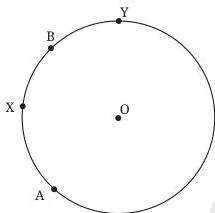
The diagram above labels the two arcs of a circle. Master every term in the table:
| Term | Meaning | Example |
|---|---|---|
| Circle | The set of all points in a plane equidistant from a given point | Rim of a wheel |
| Locus | The set of all points satisfying a given condition | Circle = locus of points at fixed distance from a fixed point |
| Centre | The fixed point from which every point of the circle is equidistant | Point A in the textbook figure |
| Radius | Distance from the centre to any point on the circle | Length AB |
| Chord | A line segment joining two points on the circle | Segment BC |
| Diameter | A chord that passes through the centre | Longest possible chord |
| Arc | A connected portion of the circle | Curved part between A and B |
| End points | The two points on the circle that define an arc | A and B |
| Minor arc | The smaller of the two arcs between the end points | Arc AXB |
| Major arc | The larger of the two arcs between the end points | Arc AYB |
| Angle subtended | The angle formed at a point by lines drawn to the ends of an arc or chord | \(\angle AOB\) |
| Concyclic | Points that lie on the same circle | Vertices of a cyclic quadrilateral |
| Cyclic quadrilateral | A quadrilateral whose vertices all lie on one circle | Quadrilateral ABCD inscribed in a circle |
Symmetry: Folding and Rotating a Circle
Two symmetry facts carry this section (NCERT, p. 95):
- Reflection symmetry across every diameter — fold a paper circle so its boundaries overlap and the crease is a diameter, a line of reflection symmetry.
- Complete rotational symmetry — rotate a circle about its centre by any angle and it looks identical, like a rotating wheel.
Method: locating the centre of a circular paper. Fold the circle so the boundaries overlap — that crease is a diameter. Open it, then fold again along a different overlap to get a second diameter. Where the two creases cross is the centre. This is exactly the folding trick used in the activities at NCERT, p. 103.
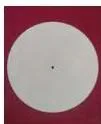
That single fold idea is behind a lot of the chapter: a perpendicular crease bisects a chord, and two such creases pin down the centre.
How Many Circles? Two Points, Three Points and the Circumcentre
Through two points: infinitely many. For any circle through A and B, the centre O must satisfy OA = OB, so O lies on the perpendicular bisector of AB (NCERT, p. 95). The small circle with midpoint of AB as centre has AB as diameter, so its radius is half of AB.
There is no largest circle — the centre can slide arbitrarily far along the bisector.
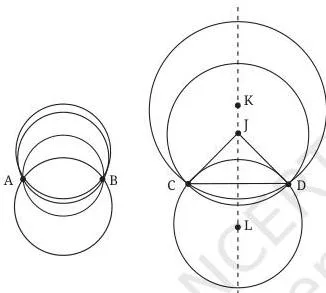
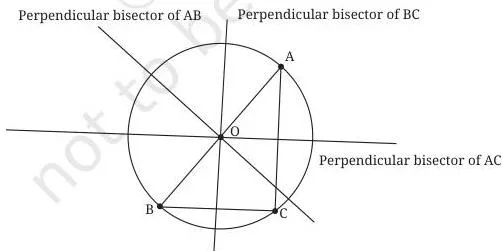
Through three points: if A, B, C are collinear, no circle passes through them (the perpendicular bisectors of AB and BC are parallel and never meet). If they are non-collinear, Theorem 1 gives a unique circle (NCERT, p. 97). The reasoning: OA = OB puts O on the perpendicular bisector of AB, and OA = OC puts O on the perpendicular bisector of AC.
Those two bisectors meet in exactly one point, so one circle exists and only one.
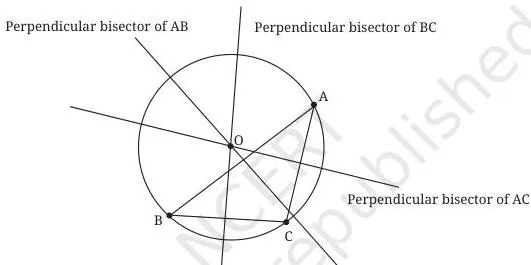
This circle is the circumcircle, its centre is the circumcentre; the circle circumscribes the triangle and the triangle is inscribed in the circle (NCERT, p. 97). Where does the circumcentre sit? It depends on the triangle:
- Acute triangle — circumcentre inside the triangle.
- Right triangle — circumcentre at the midpoint of the hypotenuse.
- Obtuse triangle — circumcentre outside the triangle (NCERT, p. 98).
Memory device — just breathe, A-I-R. Acute = Inside; Right = on the hypotenuse midpoint; Obtuse = Outside. “Where is the circumcentre? A-in, R-hypotenuse-midpoint, O-out.”
Chord Theorems: Angles, Perpendiculars and Distances from the Centre
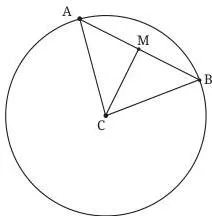
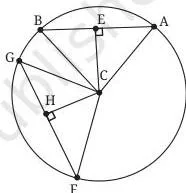
Theorems 2–8 come in matched pairs — each result has a converse. The proofs all lean on triangle congruence (SSS, SAS or RHS) inside triangles joining the centre to the chord ends (NCERT, pp. 100–105). The two figures below picture Theorems 4 and 7.
| Pair | Result (statement) | Converse |
|---|---|---|
| T2 / T3 | Equal chords subtend equal angles at the centre | Chords subtending equal angles at the centre are equal |
| T4 / T5 | Line from centre to midpoint of a chord is perpendicular to it | Perpendicular from the centre bisects the chord |
| T6 / T7 | Equal chords are equidistant from the centre | Chords at equal distance from the centre are equal in length |
| T8 | The longer of two chords lies closer to the centre | — (single statement, no converse) |
Theorem 8 has two clean edges (NCERT, p. 105): the chord nearest the centre contains the centre, so its distance is zero — that chord is the diameter, the greatest chord. Push a chord away from the centre and at some point it shrinks to a single point of length zero, at distance equal to the radius.
The chord-length formula (NCERT, p. 106): for radius \(r\) and perpendicular distance \(d\) from the centre,
\[ L = 2\sqrt{r^2 – d^2}. \]
It works because the perpendicular from the centre bisects the chord (T5), building a right triangle with hypotenuse \(r\), one leg \(d\) and the other leg half the chord.
The same squares appear when you square algebraic expressions, so brush up on our class 9 exploring algebraic identities notes.
The Arc Rule: Double at the Centre, and the 90° Corollary
An arc is a connected portion of the circle between two end points; the smaller piece is the minor arc, the larger the major arc. The central angle is measured by sweeping from one radius to the other along the arc (NCERT, p. 107).
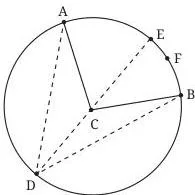
Theorem 9 (NCERT, p. 108): the angle subtended by an arc at the centre is double the angle it subtends at any point on the circle outside the arc. The proof idea in plain words: join the outside point D to the centre C and extend the line to meet the circle.
Triangle DCB is isosceles (CB = CD are radii), and the exterior angle theorem doubles the base angle; the same move on triangle ADC, and the two pieces add up.
A beautiful consequence (NCERT, p. 110): no matter which point D you pick outside the arc, the subtended angle is the same — all angles in the same segment are equal. This is the fact that separates the circle from every other shape.
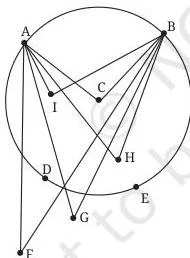
Corollary (NCERT, p. 110): the angle subtended by a diameter at any point on the circle is \(90^\circ\). The one-line reason: the diameter’s arc is a straight line, so its central angle is \(180^\circ\), and Theorem 9 halves it to \(90^\circ\).
Practical application — squaring a corner without a protractor. To mark a right angle on a field (a garden bed corner or a pitch line), peg out a diameter AB with a rope of length \(2r\), then take any point P on the circle traced by a stick held at distance \(r\) from the centre.
Because AB is a diameter, \(\angle APB = 90^\circ\) — a guaranteed right angle.
Four Points on One Circle: Cyclicity and Cyclic Quadrilaterals
Now the chapter answers its own opening question — when do four points share one circle? — as Theorems 10–12 (NCERT, pp. 112–114).
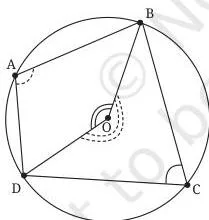
- Theorem 10. If segment AB subtends equal angles at two points C and D on the same side of AB, then A, B, C, D are concyclic. Proof idea: draw the circle through A, B, C; if D were inside or outside, an exterior-angle contradiction arises, so D must lie on the circle.
- Cyclic quadrilateral. A quadrilateral whose vertices are concyclic is called cyclic (NCERT, p. 112).
- Theorem 11. The sum of two opposite angles of a cyclic quadrilateral is \(180^\circ\). Why: each angle equals half the central angle of the opposite arc; together the two arcs make a full \(360^\circ\), so half of it is \(180^\circ\).
- Theorem 12 (converse test). If two opposite angles of a quadrilateral add to \(180^\circ\), the quadrilateral is cyclic.
One useful side-result from the end-of-chapter exercises: the rectangle is the only parallelogram that can be inscribed in a circle (NCERT, p. 116).
Worked Examples: Solved Step by Step
Four problems with fresh numbers so you can follow the full method before touching the exercises.
Example 1: Chord length from radius and perpendicular distance
- Step 1: Name the rule — chord length \(L = 2\sqrt{r^2 – d^2}\) (radius \(r\), distance \(d\)).
- Step 2: Read off \(r = 10\ \text{cm}\), \(d = 6\ \text{cm}\).
- Step 3: Half-chord first: \(\sqrt{10^2 – 6^2} = \sqrt{100 – 36} = \sqrt{64} = 8\ \text{cm}\).
- Step 4: Double it for the full chord: \(2 \times 8 = 16\ \text{cm}\).
Final answer: the chord is \(16\ \text{cm}\) long.
Example 2: Finding the radius backwards
- Step 1: The perpendicular from the centre bisects the chord (T5), so the half-chord is \(24 \div 2 = 12\ \text{cm}\).
- Step 2: The radius is the hypotenuse of a right triangle with legs \(12\ \text{cm}\) and \(5\ \text{cm}\) (the distance).
By the Baudhāyana–Pythagoras theorem, \(r^2 = 12^2 + 5^2 = 144 + 25 = 169\).
Step 3: \(r = \sqrt{169} = 13\ \text{cm}\).
Final answer: the radius is \(13\ \text{cm}\).
Example 3: The arc rule in action
- Step 1: Name the rule — Theorem 9: angle at centre = 2 × angle at any point on the circle outside the arc.
- Step 2: The central angle is \(70^\circ\).
- Step 3: Halve it: \(70^\circ \div 2 = 35^\circ\).
Final answer: the arc subtends \(35^\circ\) at any point on the circle outside the arc.
Example 4: Opposite angles of a cyclic quadrilateral
- Step 1: Name the rule — Theorem 11: opposite angles of a cyclic quadrilateral add to \(180^\circ\).
- Step 2: Take opposite pair A and C: \(3x + (x + 40) = 180\).
\[ 4x + 40 = 180 \Rightarrow 4x = 140 \Rightarrow x = 35. \]
- Step 1: Back-substitute: \(\angle A = 3 \times 35 = 105^\circ\), \(\angle C = 35 + 40 = 75^\circ\).
- Step 2: Check the other pair: \(80^\circ + 100^\circ = 180^\circ\).
Final answer: \(x = 35\); \(\angle A = 105^\circ\), \(\angle C = 75^\circ\).
Common Mistakes: What Students Write and What Is Correct
A quick correction table for the most-tested ideas in this chapter:
| Mistake | Correct rule | How to check your answer |
|---|---|---|
| Writing \(L = \sqrt{r^2 – d^2}\) | \(L = 2\sqrt{r^2 – d^2}\) — the root alone gives only half the chord | For \(r = 5\), \(d = 3\), you should get \(L = 8\) (not 4); a full chord spans the circle twice |
| “The longer chord is farther from the centre” | The longer chord is closer; the diameter (longest) has distance zero | Sketch two chords — the one hugging the centre spans more of the circle |
| Applying the double-angle rule to any chord | It applies only to the arc not containing your chosen point | Ask which arc your point lies outside before halving the central angle |
| “A diameter is not a chord” | A diameter is a chord — the longest one, because it passes through the centre | It joins two points of the circle, so it fits the chord definition |
| “The circumcentre is always inside the triangle” | Acute → inside; right → midpoint of the hypotenuse; obtuse → outside | Test on an obtuse triangle — the circumcentre lands outside it |
| “Every quadrilateral is cyclic” | Only when a pair of opposite angles sums to \(180^\circ\) | Add both pairs of opposite angles; if neither reaches \(180^\circ\), no single circle passes through all four vertices |
Exam Notes: How Marks Are Won
Board-style questions on this chapter keep returning to a few setups — the pattern is visible across the end-of-chapter exercises (NCERT, pp. 115–116):
- Chord length from radius and distance appears several times (Q1, Q3, Q4, Q9) — you get two of {radius, distance, chord length} and find the third with \(2\sqrt{r^2 – d^2}\).
- Angle in a semicircle equals 90° is tested directly (Q6, Q24).
- Cyclic quadrilateral opposite angles come both as direct sums (Q7) and as setup equations (Q8: \(\angle P = (2x + 10)^\circ\), \(\angle R = (3x – 20)^\circ\)).
The steps that earn the marks: draw and label the figure first, name the theorem you are invoking, and show the congruence (SSS, SAS or RHS) explicitly — never jump to “solving, we get”. The usual trick answer to watch for: the diameter is the longest chord and its distance from the centre is zero.
Some questions even ask for the area of a cyclic quadrilateral (Q10), so refresh your area formulas in our class 9 measuring space, perimeter and area notes. For official syllabus and exam details, check the CBSE website.
One-Page Revision Recap: im up and down and round and round class 9 notes
The night-before sheet — every result in one table:
| Result | One-line memory |
|---|---|
| Unique circle through 3 non-collinear points | Two perpendicular bisectors meet once → the circumcircle |
| Equal chords ↔ equal central angles (T2/T3) | SSS one way, SAS the other |
| Centre-to-midpoint ↔ perpendicular (T4/T5) | The isosceles triangle splits into two right triangles |
| Equal chords ↔ equal distance (T6/T7) | Rotation: the circle looks the same, so chords behave the same |
| Longer chord closer to the centre (T8) | Baudhāyana–Pythagoras on the two right triangles |
| Angle at centre = 2 × angle at a point (T9) | Isosceles triangles + exterior angle theorem |
| Angle in a semicircle = 90° | Straight angle 180° halved |
| All angles in the same segment are equal | Every outside point sees the same arc, hence the same angle |
| Equal angles on the same side → concyclic (T10) | Fourth point can be neither inside nor outside |
| Cyclic quadrilateral: opposite angles sum to 180° (T11/T12) | Two arcs together give 360°; each angle holds half its arc |
| Chord length \(L = 2\sqrt{r^2 – d^2}\) | Right triangle: hypotenuse \(r\), one leg \(d\), other leg half the chord |
| Circumcentre position | A-in, R-hypotenuse midpoint, O-out |
For the rest of the syllabus, browse the class 9 mathematics notes, the wider class 9 notes hub, or the full CBSE notes library.
Reference: NCERT Class 9 Mathematics textbook, chapter ‘I’m Up and Down, and Round and Round’.
Frequently Asked Questions
How many circles pass through two given points, and where are their centres?
Infinitely many. Their centres all lie on the perpendicular bisector of the segment joining the two points (NCERT, p. 95). The smallest circle has the segment as its diameter, so its radius is half the segment; there is no largest circle.
Why is the angle in a semicircle exactly 90 degrees?
Because the diameter’s arc is a straight line, so its central angle is \(180^\circ\). Theorem 9 halves it, giving \(90^\circ\) at any point on the circle (NCERT, p. 110).
How do I use the chord length formula \(2\sqrt{r^2 – d^2}\)?
Let \(r\) be the radius and \(d\) the perpendicular distance from the centre to the chord. The perpendicular bisects the chord (T5), making a right triangle whose hypotenuse is \(r\) and whose other leg is \(d\). Half the chord is \(\sqrt{r^2 – d^2}\), so the full chord is double that (NCERT, p. 106). Example: \(r = 10\) cm, \(d = 6\) cm gives \(2\sqrt{64} = 16\) cm.
When do four points lie on the same circle?
When a segment AB subtends equal angles at two other points C and D on the same side of AB (Theorem 10). For a quadrilateral, the test is simpler: if a pair of opposite angles adds to \(180^\circ\), the vertices are concyclic (Theorem 12, NCERT, p. 114).
Where does the circumcentre lie for an acute, obtuse and right triangle?
Acute triangle — inside. Right triangle — at the midpoint of the hypotenuse. Obtuse triangle — outside (NCERT, p. 98). Remember A-I-R: Acute In, Right hyphen-midpoint, Obtuse Out.
Is the diameter really the longest chord of a circle?
Yes. The diameter contains the centre, so its distance from the centre is zero — the smallest possible distance — and the closer a chord is to the centre, the longer it is (Theorem 8, NCERT, p. 105).
Explore Class 9 Mathematics Notes
Class 9 Mathematics on LearnCBSE:
Related chapters: