Chemical Reactions and Equations Class 10 Chapter 1 Notes – Learncbse.net
These chemical reactions and equations class 10 notes cover everything the first chapter of NCERT Class 10 Science expects you to recall in one sitting: what counts as a chemical reaction, how to write and balance an equation, and the five reaction types the exercises test again and again. A chemical reaction is a process in which the chemical identity of a substance changes — new substances with new properties are formed, and the original substances no longer exist in their old form (NCERT, p. 1). Milk turning sour, an iron nail rusting in humid air, and grapes fermenting are everyday chemical reactions, not physical changes.
How do you know a chemical reaction has actually happened, rather than just a physical change like melting ice? NCERT’s Activities 1.1 to 1.3 (burning magnesium, mixing lead nitrate with potassium iodide, and dropping zinc into dilute acid) point to four observable signs (NCERT, p. 2):
- Change of state (a solid ribbon burning into a powder)
- Change of colour (a colourless solution turning into a coloured precipitate)
- Evolution of a gas (bubbles forming around zinc granules)
- Change in temperature (the reaction flask feeling warm or cold to the touch)
If you’re revising this chapter along with related topics, it helps to keep the Class 10 Science notes index open, since acids, bases, metals, and this chapter share several reactions.
Word Equations, Skeletal Equations and Balanced Equations: The Difference
Writing out “magnesium burns in oxygen to form magnesium oxide” every time is slow. A word equation shortens this to \( \text{Magnesium} + \text{Oxygen} \rightarrow \text{Magnesium oxide} \) (NCERT, p. 2). The substances on the left are reactants; the new substance on the right is the product. By convention, reactants sit on the left-hand side (LHS), products on the right-hand side (RHS), and the arrow points from reactants to products — it shows the direction the change happens in, not an equals sign.
Replacing words with chemical formulae gives \( \text{Mg} + \text{O}_2 \rightarrow \text{MgO} \) (NCERT, p. 3). Count the atoms on each side and you’ll find they don’t match — one oxygen atom’s worth is missing from the right. An equation in this raw, formula-only state is called a skeletal equation. It is scientifically incomplete because it disagrees with the law of conservation of mass you studied in Class 9: mass (and therefore the number of atoms of each element) can neither be created nor destroyed in a chemical reaction (NCERT, p. 3). A skeletal equation only becomes a true balanced chemical equation once the atom count matches on both sides.
How to Balance a Chemical Equation: The Hit-and-Trial Method, Step by Step
NCERT balances \( \text{Fe} + \text{H}_2\text{O} \rightarrow \text{Fe}_3\text{O}_4 + \text{H}_2 \) using a method called hit-and-trial, because you adjust whole-number coefficients by trial until both sides agree (NCERT, pp. 3-5). Here is the procedure in a form you can apply to any unseen equation in the exam:
Step 1: Box every formula so you remember you may never touch what is inside the box — only the number written in front of it.
Step 2: List how many atoms of each element sit on the LHS and how many on the RHS.
Step 3: Start with the compound that has the most atoms of one element (in \( Fe_3O_4 \), oxygen appears four times) — this element is usually easiest to lock in first.
Step 4: Multiply the whole formula (never a subscript) by a coefficient until that element balances, then move to the next unbalanced element.
Step 5: Repeat element by element until every count matches. Fewer than three cycles is usually enough for board-level equations.
Step 6: Recount every element on both sides as a final check.
Step 7: Add state symbols where the question asks for them: \( (s) \) solid, \( (l) \) liquid, \( (g) \) gas, \( (aq) \) dissolved in water. Reaction conditions such as heat, pressure, or a catalyst are written above or below the arrow, for example \( \xrightarrow{\text{Heat}} \) (NCERT, p. 5).
The one rule that decides half the marks in this topic: you may change a coefficient in front of a formula, but you must never change a subscript inside it. Changing \( H_2O \) to \( H_2O_4 \) does not balance oxygen — it invents a compound that doesn’t exist, which is why examiners specifically penalise this slip.
Five Types of Chemical Reactions Asked in Class 10 Exams
Revise all five reaction types together before drilling into each one separately — that is what this table is for.
| Reaction type | General pattern | NCERT example | Key identifying clue |
|---|---|---|---|
| Combination | \( A + B \rightarrow AB \) | \( CaO(s) + H_2O(l) \rightarrow Ca(OH)_2(aq) \) (NCERT, p. 6) | Two or more reactants join into one single product |
| Decomposition | \( AB \rightarrow A + B \) | \( CaCO_3(s) \xrightarrow{\text{Heat}} CaO(s) + CO_2(g) \) (NCERT, p. 8) | One reactant breaks apart into two or more simpler products |
| Displacement | \( A + BC \rightarrow AC + B \) | \( Fe(s) + CuSO_4(aq) \rightarrow FeSO_4(aq) + Cu(s) \) (NCERT, p. 10) | A more reactive element pushes a less reactive one out of its compound |
| Double displacement | \( AB + CD \rightarrow AD + CB \) | \( Na_2SO_4(aq) + BaCl_2(aq) \rightarrow BaSO_4(s) + 2NaCl(aq) \) (NCERT, p. 11) | Ions swap partners between two compounds; often gives an insoluble precipitate |
| Oxidation-reduction (redox) | One species gains oxygen/loses hydrogen while the other loses oxygen/gains hydrogen, in the same reaction | \( CuO + H_2 \xrightarrow{\text{Heat}} Cu + H_2O \) (NCERT, p. 12) | Look for oxygen or hydrogen moving from one reactant to the other, not just being added or removed once |
Combination Reactions: Quick Lime, Burning Coal and Formation of Water
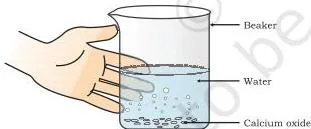
When calcium oxide (quick lime) is mixed with water, the beaker becomes noticeably warm to the touch (Activity 1.4). The reaction \( CaO(s) + H_2O(l) \rightarrow Ca(OH)_2(aq) \) releases heat as it proceeds, which is why it is called an exothermic reaction — a reaction that gives out heat along with the product (NCERT, p. 7). Burning coal, \( C(s) + O_2(g) \rightarrow CO_2(g) \), and the formation of water from hydrogen and oxygen are further combination reactions that are also exothermic.
A detail examiners like to ask about: a freshly whitewashed wall looks dull, not shiny. The slaked lime coating reacts slowly with carbon dioxide in the air, \( Ca(OH)_2(aq) + CO_2(g) \rightarrow CaCO_3(s) + H_2O(l) \), and this thin layer of calcium carbonate — the same compound marble is made of — only forms after two to three days, giving the wall its shine (NCERT, p. 7). Students who answer “because it dries” without naming \( CaCO_3 \) usually lose the mark.
Decomposition Reactions: Thermal, Electrolytic and Photolytic
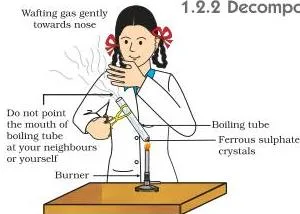
A decomposition reaction is the reverse idea of combination: one reactant splits into two or more products. All three forms below need energy put in, which is why decomposition reactions are called endothermic — energy is absorbed, not released (NCERT, p. 9).
- Thermal decomposition (energy supplied as heat): heating green ferrous sulphate crystals gives ferric oxide, sulphur dioxide, and sulphur trioxide, with a visible colour change and the smell of burning sulphur, \( 2FeSO_4(s) \xrightarrow{\text{Heat}} Fe_2O_3(s) + SO_2(g) + SO_3(g) \) (NCERT, p. 8). Limestone breaking down to quick lime, \( CaCO_3(s) \xrightarrow{\text{Heat}} CaO(s) + CO_2(g) \), is the industrial version used in cement manufacture.
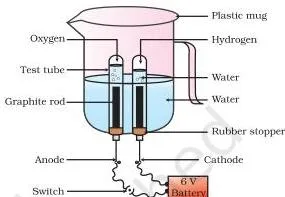
- Electrolytic decomposition (energy supplied as electricity): passing current through acidified water splits it into hydrogen and oxygen gas at the two electrodes. NCERT’s Activity 1.7 asks you to compare the volume of gas collected in each test tube — the volume ratio is exactly \( 2:1 \), hydrogen to oxygen, which is a frequently asked one-mark answer (NCERT, p. 9).
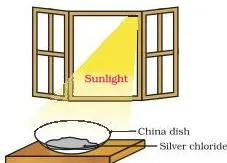
- Photolytic decomposition (energy supplied as light): white silver chloride turns grey when kept in sunlight because it splits into silver metal and chlorine gas, \( 2AgCl(s) \xrightarrow{\text{Sunlight}} 2Ag(s) + Cl_2(g) \); silver bromide behaves the same way. This reaction is the basis of black-and-white photography (NCERT, p. 9).
Displacement and Double Displacement Reactions: How to Tell Them Apart
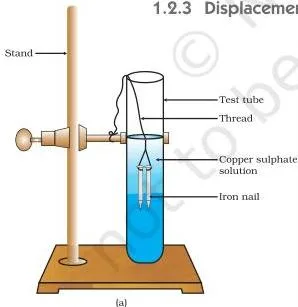
In a displacement reaction, one element takes the place of another element inside a compound. When iron nails sit in copper sulphate solution, the blue colour fades and the nails turn brownish, because \( Fe(s) + CuSO_4(aq) \rightarrow FeSO_4(aq) + Cu(s) \) — iron is more reactive than copper, so it displaces copper out of the sulphate (NCERT, p. 10).
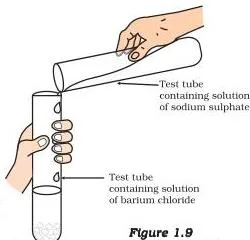
In a double displacement reaction, two compounds exchange ions with each other rather than one element replacing another. Mixing sodium sulphate and barium chloride solutions gives \( Na_2SO_4(aq) + BaCl_2(aq) \rightarrow BaSO_4(s) + 2NaCl(aq) \); the insoluble white solid that settles out is called a precipitate (NCERT, p. 11).
Here is the edge case that Class 10 exercises specifically test (Q13, Q15): every precipitation reaction is a double displacement reaction, but the reverse is not automatically true. If a question like \( NaOH(aq) + HCl(aq) \rightarrow NaCl(aq) + H_2O(l) \) exchanges ions but every product stays dissolved, it is still a double displacement reaction even though nothing precipitates out. Only call a reaction “precipitation” when a visible insoluble solid actually forms.
Oxidation, Reduction and Redox Reactions
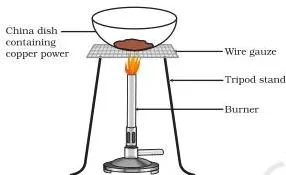
At Class 10 level, oxidation and reduction are defined only through the gain or loss of oxygen and hydrogen — not through electron transfer, which comes later. The rule, stated both ways (NCERT, p. 12):
- Oxidation: gain of oxygen, or loss of hydrogen.
- Reduction: loss of oxygen, or gain of hydrogen.
When heated copper powder is exposed to hydrogen gas, \( CuO + H_2 \xrightarrow{\text{Heat}} Cu + H_2O \): copper(II) oxide loses oxygen (it is reduced) while hydrogen gains oxygen (it is oxidised), in the same step. Because one substance is oxidised while another is reduced at the same time, this is called a redox reaction (NCERT, p. 12).
This oxygen-gain idea explains two everyday problems. Corrosion is what happens when a metal reacts with moisture, acids, or gases around it and loses its surface — rusting of iron, and the tarnishing of silver or copper, are examples (NCERT, p. 13); you can read more about how reactive metals resist or invite corrosion in the Metals and Non-metals notes. Rancidity is the oxidation of fats and oils in food, which changes their smell and taste; this is why food packets are flushed with nitrogen gas and antioxidants are added — both steps keep oxygen away from the fat (NCERT, p. 13).
Key Terms From Chapter 1 You Should Be Able to Define in One Line
| Term | One-line definition |
|---|---|
| Chemical equation | The symbolic, shorthand representation of a chemical reaction using formulae of reactants and products (NCERT, p. 2) |
| Balanced equation | An equation in which the number of atoms of each element is equal on both sides (NCERT, p. 3) |
| Exothermic reaction | A reaction in which heat is released along with the products (NCERT, p. 7) |
| Endothermic reaction | A reaction in which energy is absorbed from the surroundings (NCERT, p. 9) |
| Combination reaction | Two or more substances combine to form a single new substance (NCERT, p. 6) |
| Decomposition reaction | A single substance breaks down into two or more simpler substances (NCERT, p. 8) |
| Displacement reaction | A more reactive element removes a less reactive element from its compound (NCERT, p. 10) |
| Double displacement reaction | Two compounds exchange ions to form two new compounds (NCERT, p. 11) |
| Precipitate | An insoluble solid formed and separated out during a reaction in solution (NCERT, p. 11) |
| Oxidation | Gain of oxygen or loss of hydrogen by a substance (NCERT, p. 12) |
| Reduction | Loss of oxygen or gain of hydrogen by a substance (NCERT, p. 12) |
| Corrosion | Slow attack on a metal’s surface by moisture, acids or gases in its surroundings (NCERT, p. 13) |
| Rancidity | Oxidation of fats and oils in food, causing a change in smell and taste (NCERT, p. 13) |
Worked Example: Balance This Equation and Name the Reaction Type
Question 1: Balance \( Al + O_2 \rightarrow Al_2O_3 \) and identify the reaction type
Step 1: Box the formulae: \( \boxed{Al} + \boxed{O_2} \rightarrow \boxed{Al_2O_3} \).
Step 2: Count atoms on each side before balancing.
| Element | Atoms in reactants (LHS) | Atoms in products (RHS) |
|---|---|---|
| \(Al\) | 1 | 2 |
| \(O\) | 2 | 3 |
Step 3: \( Al_2O_3 \) has the most atoms of one element (three oxygens), so balance oxygen first. The lowest common multiple of 2 and 3 is 6, so multiply \( O_2 \) by 3 and \( Al_2O_3 \) by 2.
\[ Al + 3O_2 \rightarrow 2Al_2O_3 \]
Step 4: Aluminium is now unbalanced: \( 2Al_2O_3 \) needs 4 aluminium atoms, so put a coefficient of 4 in front of \( Al \).
\[ 4Al + 3O_2 \rightarrow 2Al_2O_3 \]
Step 5: Recheck the atom count: \(Al: 4 = 4\), \(O: 6 = 6\). Both sides match.
Step 6: Add state symbols. Aluminium and its oxide are solids; oxygen is a gas.
\[ 4Al(s) + 3O_2(g) \rightarrow 2Al_2O_3(s) \]
Final answer: \( 4Al(s) + 3O_2(g) \rightarrow 2Al_2O_3(s) \) — a combination reaction, since two reactants join to give a single product; like magnesium, aluminium burns to release heat, so it is also exothermic.
Question 2: Balance \( AgNO_3 + NaCl \rightarrow AgCl + NaNO_3 \) and identify the reaction type
Step 1: Box the formulae: \( \boxed{AgNO_3} + \boxed{NaCl} \rightarrow \boxed{AgCl} + \boxed{NaNO_3} \).
Step 2: Count atoms on each side.
| Element | Atoms in reactants (LHS) | Atoms in products (RHS) |
|---|---|---|
| \(Ag\) | 1 | 1 |
| \(N\) | 1 | 1 |
| \(O\) | 3 | 3 |
| \(Na\) | 1 | 1 |
| \(Cl\) | 1 | 1 |
Step 3: Every element already matches 1:1:1:1:1, so no coefficients are needed.
Step 4: Add state symbols. Silver nitrate, sodium chloride, and sodium nitrate stay dissolved; silver chloride is the insoluble solid that separates out.
\[ AgNO_3(aq) + NaCl(aq) \rightarrow AgCl(s) + NaNO_3(aq) \]
Final answer: Already balanced as written. This is a double displacement reaction (the \(Ag^+\) and \(Na^+\) ions swap partners), and since a visible white precipitate of \(AgCl\) forms, it is also a precipitation reaction. Note that this same \(AgCl\) turns grey if left in sunlight, decomposing photolytically into silver and chlorine — the same reaction covered under decomposition above.
Mistakes Students Make in This Chapter — And the Fix
| Mistake | Correct rule | How to check your answer |
|---|---|---|
| Changing a subscript (e.g. writing \(H_2O_4\) instead of \(4H_2O\)) to balance an equation | Only coefficients in front of a formula may change; subscripts inside a formula are fixed once the compound is fixed | Read the formula back and ask: is this still the same real compound named in the question? If not, undo it |
| Leaving out state symbols when the question says “with state symbols” | Add \((s)\), \((l)\), \((g)\), \((aq)\) after every formula whenever the question explicitly asks for them | Reread the question line; if it names “state symbols”, scan your final equation for four missing brackets |
| Calling every double displacement reaction a “precipitation reaction” | A double displacement reaction is only a precipitation reaction if an insoluble solid actually separates out | Check the product list: if every product carries \((aq)\), it is double displacement but not precipitation |
| Tracking oxidation or reduction in only one reactant at a time | In a redox reaction, one reactant gains oxygen/hydrogen while the other loses it, in the same equation — both must be identified together | Write “oxidised:” and “reduced:” against both reactants before answering; one blank means the answer is incomplete |
| Formula slips under exam pressure, e.g. writing \(Fe_3O_2\) instead of \(Fe_2O_3\) | Valencies fix the subscripts before any balancing starts; iron(III) oxide is always \(Fe_2O_3\) | Cross-check the formula against the compound’s valency (or against the copy given in the question) before you touch coefficients |
How CBSE Tests This Chapter: Question Types to Expect
| Question style | Example from NCERT exercises | What to practise |
|---|---|---|
| MCQ identifying which species is oxidised/reduced, or naming the reaction type | Exercise Q1 (oxidation-reduction in \(2PbO + C \rightarrow 2Pb + CO_2\)), Q2 (reaction type of \(Fe_2O_3 + 2Al \rightarrow Al_2O_3 + 2Fe\)) | Practise scanning an already-balanced equation for oxygen movement and reactivity clues, without needing to balance it yourself |
| “Balance the equation” short answer | Exercise Q5, Q6, Q7 (translating word statements into equations, then balancing them) | Practise the full hit-and-trial procedure on unseen word statements, not just equations already given in symbol form |
| Combined “balance and identify reaction type” question | Exercise Q8 | This is the most common way the chapter is tested. Balancing correctly earns nothing if you misname the reaction type, and vice versa — both steps must be right for full marks on that question |
| Definition / explain-with-example questions | Exercise Q9 (exothermic/endothermic), Q13 (displacement vs double displacement), Q15 (precipitation), Q16 (oxidation and reduction), Q20 (corrosion and rancidity) | Give the one-line definition first, then attach one NCERT-style example equation — examiners award marks separately for the definition and for the example |
NCERT Diagrams in This Chapter and What Each One Proves
A quick visual pass over the chapter’s figures, matched to the reaction each one demonstrates:
- Figure 1.1 (magnesium burning with a dazzling white flame, p. 1): proves a combination reaction — magnesium plus oxygen gives a single product, magnesium oxide — and shows the reaction is exothermic since the flame itself is visible heat and light.
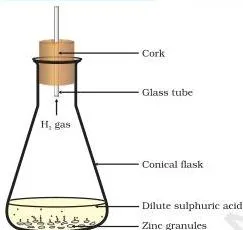
- Figure 1.2 (zinc granules with dilute acid, shown below): shows a displacement reaction; hydrogen gas bubbles off, and the classic test is a burning matchstick giving a pop sound at the mouth of the test tube.
- Figure 1.4 and Figure 1.5 (heating ferrous sulphate, and heating lead nitrate, p. 8): both are thermal decompositions — ferrous sulphate changes colour and releases the smell of burning sulphur; lead nitrate gives off visible brown fumes of nitrogen dioxide.
- Figure 1.6 (electrolysis of water, shown above): proves electrolytic decomposition, with the 2:1 hydrogen-to-oxygen volume ratio as the key measurable fact.
- Figure 1.7 (silver chloride greying in sunlight, shown above): proves photolytic decomposition — light alone, without heat or electricity, breaks the compound apart.
- Figure 1.8(a) and 1.8(b) (iron nails in copper sulphate, before and after, p. 10-11): the fading blue colour of the solution and the brownish coating on the nail are direct visual proof that \(Cu^{2+}\) ions are being replaced by \(Fe^{2+}\) ions — this is the displacement reaction in action.
If you want to see these diagrams in their original textbook layout, the NCERT Class 10 Science textbook, chapter 1 is available as a free download from the official NCERT website, which is useful for checking any figure or exercise wording against the source.
One-Page Recap: Equations and Reaction Types Before the Exam
| Concept | What to remember |
|---|---|
| Balancing rule | Adjust coefficients until atom counts of every element match on both sides; never touch a subscript |
| Exothermic vs endothermic | Exothermic releases heat (combination reactions, respiration); endothermic absorbs energy (all decomposition reactions) |
| Combination | \(CaO + H_2O \rightarrow Ca(OH)_2\) — two or more reactants, one product |
| Decomposition | \(CaCO_3 \rightarrow CaO + CO_2\) — one reactant, two or more products; can be thermal, electrolytic, or photolytic |
| Displacement | \(Fe + CuSO_4 \rightarrow FeSO_4 + Cu\) — a more reactive element replaces a less reactive one |
| Double displacement | \(Na_2SO_4 + BaCl_2 \rightarrow BaSO_4 + 2NaCl\) — ions exchange partners; precipitation only if a solid forms |
| Oxidation / reduction | Gain of oxygen or loss of hydrogen = oxidation; loss of oxygen or gain of hydrogen = reduction; both happen together in a redox reaction |
| Corrosion and rancidity | Corrosion attacks metal surfaces (rusting, tarnishing); rancidity is the oxidation of fats/oils in food, slowed by antioxidants and nitrogen flushing |
Frequently Asked Questions on Chemical Reactions and Equations
What is the difference between a skeletal equation and a balanced chemical equation?
A skeletal equation only shows the correct formulae of reactants and products with an arrow between them — the atom counts on each side may not match. A balanced chemical equation has coefficients adjusted so the number of atoms of every element is identical on both sides, which is required by the law of conservation of mass.
Why is respiration classified as an exothermic reaction in this chapter?
During respiration, glucose combines with oxygen in body cells and breaks down to release carbon dioxide, water, and energy: \( C_6H_{12}O_6(aq) + 6O_2(aq) \rightarrow 6CO_2(aq) + 6H_2O(l) + \text{energy} \). Because energy is given out as part of the reaction, it fits the definition of an exothermic reaction.
Why does the volume of gas collected during electrolysis of water differ at the two electrodes?
Water, \(H_2O\), contains twice as many hydrogen atoms as oxygen atoms. When electrolysed, this ratio carries through to the gases produced, so the volume of hydrogen collected is twice the volume of oxygen — a \(2:1\) ratio.
Is every double displacement reaction also a precipitation reaction?
No. A double displacement reaction only becomes a precipitation reaction when the exchange of ions produces an insoluble solid that separates out of the solution. If all the products remain dissolved, the ion exchange has still happened, but there is nothing to call a precipitate.
Why does an iron nail turn brownish when dipped in copper sulphate solution?
Iron is more reactive than copper, so it displaces copper from copper sulphate: \( Fe(s) + CuSO_4(aq) \rightarrow FeSO_4(aq) + Cu(s) \). The brownish coating on the nail is metallic copper being deposited, and the blue colour of the solution fades as copper sulphate is used up.
Why are oil and fat containing food items flushed with nitrogen gas?
Fats and oils turn rancid when they are oxidised by exposure to air, which changes their smell and taste. Flushing the packet with nitrogen gas keeps oxygen away from the food, which slows down this oxidation and keeps the food edible for longer.
For the next chapter in this sequence, revise how these same combination, displacement, and double displacement patterns show up with acids and bases in the Acids, Bases and Salts notes, or browse all subjects for this grade on the Class 10 hub page.
Reference: NCERT Class 10 Science textbook, chapter Chemical Reactions and Equations.
Explore Class 10 Science Notes
More for this chapter:
- Chemical Reactions and Equations Important Questions
- Chemical Reactions and Equations Previous Year Questions
Related chapters: