
Mechanical properties of fluids class 11 — this page covers Chapter 9 of the NCERT Class 11 Physics Part II textbook, the chapter on pressure, Pascal’s law, Bernoulli’s principle, viscosity and surface tension. The official chapter PDF is right below, and under it a complete walkthrough of what the chapter teaches, with NCERT page numbers so you can follow along in your own book.
Official NCERT Chapter PDFs
| What the chapter holds | Count | Where it is used |
|---|---|---|
| Printed pages | 22 | |
| Sections in the chapter | 18 | |
| Figures with NCERT captions | 23 | |
| Tables | 4 | |
| Exercise questions | 16 | answered in our NCERT Solutions |
| Official NCERT PDF | Download the chapter PDF | the chapter exactly as NCERT publishes it |
The page follows the NCERT Physics Part II textbook, 2026-27 reprint edition.
Working from the official PDF keeps every figure and exercise number exactly as NCERT printed them, so the page references below will line up with your copy of the book.
Open the official NCERT Class 11 Physics Mechanical Properties of Fluids chapter PDF to work from the chapter exactly as published — the full text, all its figures, worked examples and every exercise question, starting at page 179 of Physics Part II.
Mechanical Properties of Fluids Class 11 at a Glance
The table below lists how much this chapter holds — its sections, figures, worked examples and exercise questions — so you know what you are working with before you start.
The chapter is organised as six teaching sections, each building on the last:
- 9.1 Introduction — what fluids are and how they differ from solids
- 9.2 Pressure — Pascal’s law, pressure with depth, atmospheric and gauge pressure, hydraulic machines
- 9.3 Streamline flow — steady flow, streamlines, the equation of continuity
- 9.4 Bernoulli’s principle — speed of efflux (Torricelli’s law) and dynamic lift
- 9.5 Viscosity — internal friction between layers, the coefficient of viscosity, Stokes’ law
- 9.6 Surface tension — surface energy, angle of contact, drops and bubbles, capillary rise
The chapter closes with a Summary, Points to Ponder (the hardest conceptual points, worth reading twice), exercises and additional exercises. Every figure in the chapter appears in the gallery below; each one is explained where it matters in the walkthrough that follows.
Why Fluids Behave Differently From Solids
Every idea in this chapter — pressure acting normal to a surface, viscosity, surface tension — follows from one fact: a fluid cannot hold its shape. Get this contrast clear first.
Fluids are liquids and gases. The defining property is that they can flow, and therefore they have no shape of their own — a fluid takes the shape of its container (NCERT p. 179).
- Solids keep a fixed shape and a fixed volume; liquids keep a fixed volume but take the container’s shape; gases have neither.
- Solids and liquids are hard to compress; gases compress easily. That is why a liquid’s density is treated as constant while a gas’s density varies with pressure.
- Shear stress — a force that tries to slide one layer over another — changes a solid’s shape at fixed volume. A fluid offers almost no resistance: its shape changes under a very small shear stress.
The chapter states the contrast bluntly: the shearing stress of fluids is about a million times smaller than that of solids (NCERT p. 179). So a fluid at rest cannot sustain any force parallel to a surface — if it could, it would flow. That single fact is why the next section insists that fluid pressure acts only perpendicular to surfaces.
Pressure: What It Really Is, and Why It Is a Scalar
Pressure is the chapter’s first working tool, and it reappears in every later section. The whole trick is knowing what the F in F/A really means.
The figure below is the starting observation. A fluid at rest pushes on any surface — a submerged object, a container wall — only normal (perpendicular) to that surface.
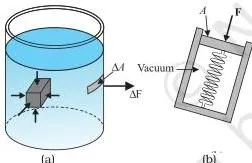
Why must it be normal? If the fluid exerted a force parallel to the surface, the object would push back with an equal parallel force (Newton’s third law), and that force would make the fluid flow. But the fluid is at rest, so no parallel force can exist (NCERT p. 181).
The average pressure is the normal force per unit area:
\[ P_{av} = \frac{F}{A} \quad (9.1) \]
Making the piston area arbitrarily small gives the limiting definition \( P = \lim_{\Delta A \to 0} \frac{\Delta F}{\Delta A} \) (Eq. 9.2). In both, \(F\) is only the normal component of the force.
Pressure is a scalar — this is the chapter’s first conceptual trap. NCERT’s Points to Ponder (p. 198) warns that defining pressure as “force per unit area” misleads you into thinking it is a vector.
The force in the numerator is the component normal to the area, and no direction can be assigned to pressure itself: whichever way you tilt the area, the fluid pushes normal to it.
Units matter here. The SI unit is the pascal (Pa = N m\(^{-2}\)), dimensions [ML\(^{-1}\)T\(^{-2}\)]. Atmospheric pressure at sea level is \(1\ \text{atm} = 1.013 \times 10^{5}\ \text{Pa}\). Density is \( \rho = m/V \) (Eq. 9.3), SI unit kg m\(^{-3}\); water at 4 °C has density \(1.0 \times 10^{3}\ \text{kg m}^{-3}\), and relative density is \( \rho/\rho_{water} \), a dimensionless number (NCERT p. 181).
A quick check that pressure is really about area: a 60 kg student standing on one heel of area 1 cm\(^{2}\) exerts \(F = 600\ \text{N}\) on \(A = 10^{-4}\ \text{m}^{2}\), so \(P = 600/10^{-4} = 6 \times 10^{6}\ \text{Pa}\) — about 60 times ordinary atmospheric pressure. That is exactly the physics behind the chapter’s Exercise 9.5.
Pascal’s Law and the Hydraulic Machines That Use It
Pascal’s law is why a small force can lift a car. It says a fluid transmits pressure — it never creates it.
The law comes in two forms. First: in a fluid at rest, the pressure is the same at all points that are at the same height (NCERT p. 182). The tiny right-angled prism in Fig. 9.2 proves it.
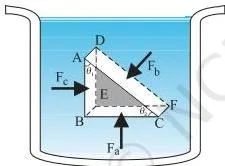
The prism is in equilibrium, so the three forces on its faces balance; geometry connects the three face areas. Dividing force by area gives \(P_a = P_b = P_c\) (Eq. 9.4) — pressure is the same in all directions (NCERT p. 182).
If pressure differed across any horizontal plane, the fluid would flow from high to low pressure; since it does not flow, the pressure must be equal everywhere on that plane.
The second form is the one machines use: whenever external pressure is applied to any part of a fluid in a closed vessel, it is transmitted undiminished, equally in all directions (NCERT p. 185). Fig. 9.6(a) shows the proof — pushing the piston makes the liquid rise to the same level in all three tubes.
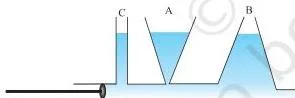
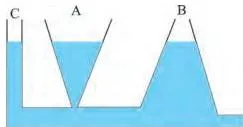
The hydrostatic paradox (Fig. 9.4) follows from pressure depending on depth alone, not on shape: three vessels of different shapes hold different amounts of water, yet fill to the same height, because the bottom pressure is identical under each vessel (NCERT p. 183).
In a hydraulic lift (Fig. 9.6b), a small piston of area \(A_1\) pushes with force \(F_1\); the pressure \(F_1/A_1\) reaches a larger piston of area \(A_2\), which feels \(F_2 = F_1 A_2/A_1\). The ratio \(A_2/A_1\) is the mechanical advantage (NCERT p. 185).
Because liquids are incompressible, the volume pushed in on one side equals the volume moved out on the other: \(L_1 A_1 = L_2 A_2\) (NCERT p. 186). Hydraulic brakes work on the same principle — one press of the pedal sends equal pressure to all four wheels.
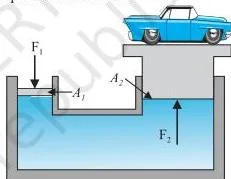
Worked example (original numbers).
A hydraulic lift has piston radii \(r_1 = 2.0\ \text{cm}\) and \(r_2 = 10\ \text{cm}\).
A force \(F_1 = 40\ \text{N}\) is applied to the small piston; it moves down by \(L_1 = 5.0\ \text{cm}\).
Find the force \(F_2\) and how far the large piston moves.
Step 1: Convert radii to metres: \(2.0\ \text{cm} = 2.0 \times 10^{-2}\ \text{m}\), \(10\ \text{cm} = 10 \times 10^{-2}\ \text{m}\).
Since \(A = \pi r^2\), the area ratio is \[ \frac{A_2}{A_1} = \frac{r_2^2}{r_1^2} = \frac{(10)^2}{(2)^2} = 25 \]
- Step 2: Apply Pascal’s law: pressure is transmitted undiminished, so \[ F_2 = F_1 \frac{A_2}{A_1} = 40\ \text{N} \times 25 = 1000\ \text{N} \]
- Step 3: The liquid is incompressible, so volume is conserved: \(L_1 A_1 = L_2 A_2\).
\[ L_2 = L_1 \frac{A_1}{A_2} = 5.0\ \text{cm} \times \frac{1}{25} = 0.20\ \text{cm} \]
Final answer: The large piston supports 1000 N — 25 times the applied force — but moves only 0.20 cm. Force is multiplied, distance is not.
Pressure With Depth, Barometers and Gauge Pressure
A liquid’s pressure is not uniform — it grows with depth because every layer must support the weight of the liquid above it.
Take a vertical cylinder of fluid, base area \(A\), height \(h\) (Fig. 9.3). Pressure at the top pushes down with \(P_1 A\); pressure at the bottom pushes up with \(P_2 A\). The difference balances the cylinder’s weight \(mg = \rho h A g\).
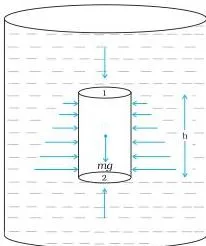
\[ (P_2 – P_1)A = mg = \rho h A g \quad \Rightarrow \quad P_2 – P_1 = \rho g h \quad (9.6) \]
Notice what dropped out: the area \(A\). The pressure difference depends only on the vertical distance \(h\), the density \(\rho\) and gravity \(g\) — never on the shape or width of the container (NCERT p. 182-183).
If the top surface is open to the atmosphere, \(P_1 = P_a\), and the pressure at depth \(h\) is \[ P = P_a + \rho g h \quad (9.7) \]
The excess \(P – P_a = \rho g h\) is called the gauge pressure at that point (NCERT p. 183).
Worked check (original numbers).
Pressure on a swimmer at 5 m depth in a pool, with \( \rho = 1000\ \text{kg m}^{-3} \) and \(g = 10\ \text{m s}^{-2}\):
\[ P = 1.013 \times 10^{5} + \rho g h = 1.013 \times 10^{5} + 1000 \times 10 \times 5 = 1.513 \times 10^{5}\ \text{Pa} \approx 1.5\ \text{atm} \]
Conclusion: just 5 m of water adds half an atmosphere. NCERT Example 9.2 (p. 183) shows the same doubling effect at 10 m.
The mercury barometer (Fig. 9.5a) measures atmospheric pressure directly. Torricelli filled a long tube with mercury and inverted it in a trough; the column stands at about 76 cm at sea level because the atmosphere’s push balances the column’s weight:
\[ P_a = \rho g h \quad (9.8) \]
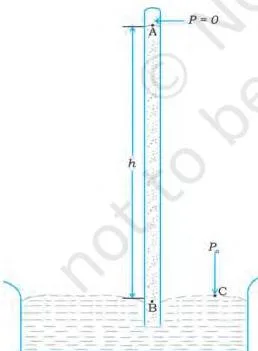
Two units follow from this experiment: 1 mm of mercury = 1 torr = 133 Pa, and 1 bar = 10\(^{5}\) Pa, used in meteorology (NCERT p. 184).
The open-tube manometer (Fig. 9.5b) measures gauge pressure: one arm is open to the atmosphere, the other is connected to the system, and the height difference \(h\) between the two liquid columns gives \(P – P_a = \rho g h\) (NCERT p. 184). Tyre gauges and the sphygmomanometer (blood pressure gauge) all read gauge pressure (NCERT p. 199).
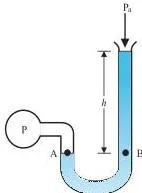
One caution from Points to Ponder (NCERT p. 199): \(P = P_s + \rho g h\) assumes an incompressible fluid — fine for liquids, wrong for gases, whose density changes with pressure. NCERT’s Example 9.3 shows the consequence: if air had constant density, the atmosphere would end at only about 8 km.
Streamline Flow and the Equation of Continuity
Moving fluids are complicated, so the chapter starts with the simplest motion — steady flow — and derives its first conservation law: mass is conserved.
Flow is steady if, at any fixed point, every passing particle has the same velocity as the one before it. The velocity can change from point to point in space, but not with time at a given point (NCERT p. 186).
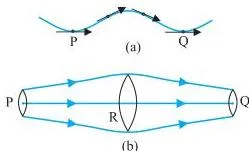
A streamline is the path of a fluid particle in steady flow — a curve whose tangent at every point is the direction of the fluid velocity there (Fig. 9.7). Two streamlines can never cross: at a crossing, a single particle would have two possible velocities.
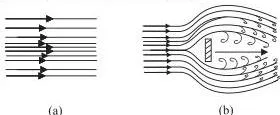
Beyond a limiting value — the critical speed — steady flow loses its smoothness and becomes turbulent: swirling, unsteady motion like the “white water” rapids formed when a fast stream hits rocks. Fig. 9.8 contrasts smooth laminar flow with a jet of air striking a flat plate and scattering (NCERT p. 187).
The equation of continuity is mass conservation. In a small time \(\Delta t\), the mass crossing any cross-section is \(\rho A v \Delta t\); since mass is neither created nor lost, this quantity is the same at every section (Eq. 9.9). For an incompressible liquid, \(\rho\) cancels and \[ A v = \text{constant} \quad (9.11) \]
The product \(Av\) is the volume flux, or flow rate, and it stays constant along the pipe (NCERT p. 187). Practical result: where a pipe narrows, the liquid must speed up — think of water rushing out of a squeezed hose.
That is why Exercise 9.15 asks you to spot the flow figure that violates continuity, and why the spray pump of Exercise 9.16 ejects liquid so fast through its fine holes.
Bernoulli’s Principle: Energy Conservation Along a Streamline
Bernoulli’s equation is the chapter’s second conservation law — energy, instead of mass. It links pressure, speed and height along a streamline, and it explains more everyday phenomena than any other formula in Class 11.
Take an incompressible, non-viscous fluid flowing steadily through a pipe that changes cross-section and height (Fig. 9.9). In time \(\Delta t\), a volume \(\Delta V\) enters at one end and the same volume leaves at the other.
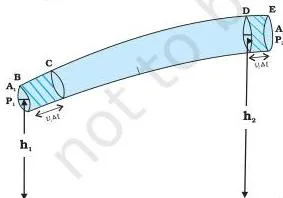
The pressure at the entry does work \(P_1 \Delta V\) on the fluid; the pressure at the exit does work \(-P_2 \Delta V\) against it. The net work \((P_1 – P_2)\Delta V\) goes into kinetic energy \( \frac{1}{2} \rho \Delta V (v_2^2 – v_1^2) \) and gravitational potential energy \( \rho g \Delta V (h_2 – h_1) \).
This is the work–energy theorem applied to the fluid (NCERT p. 188).
\[ (P_1 – P_2)\Delta V = \frac{1}{2} \rho \Delta V (v_2^2 – v_1^2) + \rho g \Delta V (h_2 – h_1) \]
Dividing by \(\Delta V\) and rearranging gives Bernoulli’s equation:
\[ P_1 + \frac{1}{2} \rho v_1^2 + \rho g h_1 = P_2 + \frac{1}{2} \rho v_2^2 + \rho g h_2 \quad (9.12) \]
\[ P + \frac{1}{2} \rho v^2 + \rho g h = \text{constant} \quad (9.13) \]
In words (NCERT p. 188): as you move along a streamline, the sum of the pressure, the kinetic energy per unit volume \( \frac{1}{2} \rho v^2 \) and the potential energy per unit volume \( \rho g h \) stays constant.
The equation is valid only when three conditions hold: the fluid is non-viscous (no internal friction), incompressible, and the flow is steady. The book is blunt about the first one — no real fluid has zero viscosity, so the equation is an approximation for real liquids (NCERT p. 188).
Self-check that you have the signs right: set \(v = 0\) everywhere (fluid at rest). Bernoulli collapses to \(P_1 – P_2 = \rho g (h_2 – h_1)\), which is exactly the hydrostatic equation, Eq. 9.6 (NCERT p. 188). If your version of Bernoulli does not reduce to \(P = P_a + \rho g h\) at rest, you have written it wrong.
And it fails fast: in a river rapid the flow is turbulent, non-steady and dragged by its own viscosity, so Bernoulli cannot describe it — that is the point of Exercise 9.11.
Torricelli’s Law and Dynamic Lift: Bernoulli in Action
These two applications show Bernoulli doing real work: the speed at which liquid leaves a tank, and the lift that makes aeroplanes fly and cricket balls swing.
Consider a tank with a small hole at depth \(h\) below the open surface (Fig. 9.10). The hole is so small that the surface falls almost imperceptibly, so the top velocity can be taken as zero.
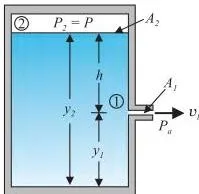
Applying Bernoulli between the surface and the hole, with atmospheric pressure at the hole, gives the speed of efflux:
\[ v_1 = \sqrt{2gh} \quad (9.15) \]
This is exactly the speed of a freely falling body, and it is Torricelli’s law (NCERT p. 189). If the tank is sealed and pressurised to \(P\), the formula gains a term:
\[ v_1 = \sqrt{2gh + \frac{2(P – P_a)}{\rho}} \quad (9.14) \]
When \(P\) is large, the pressure term dominates — that is the idea behind rocket propulsion (NCERT p. 189).
Dynamic lift is the force a body feels by virtue of its motion through a fluid (NCERT p. 190). Fig. 9.11 shows the three cases at once.
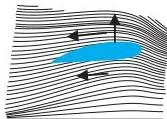
- Ball without spin: the streamlines are symmetric above and below, so the air speeds — and pressures — are equal, and there is no lift.
- Ball with spin: the spinning ball drags air along with it. Relative to the ball, the air above moves faster and the air below slower; the streamlines crowd above. Faster flow means lower pressure, so there is a net upward force — the Magnus effect.
- Aerofoil: the curved upper surface crowds the streamlines above the wing, making the air there faster and the pressure lower, so the wing is pushed upward (NCERT p. 190). NCERT’s worked example shows the air above the wing needs to be only about 8% faster than the air below to support a fully loaded Boeing.
This is why you blow over a paper, not under it (Exercise 9.4a): the fast air above the paper gives lower pressure there, and the higher atmospheric pressure underneath pushes the paper up. And a spinning cricket ball deviates from its parabolic path (Exercise 9.4e) for exactly the same reason — the Magnus effect.
Viscosity and Stokes’ Law
Real fluids resist flow. That internal friction is viscosity, and it decides how fast a sphere falls through a liquid, why honey pours slowly, and why Bernoulli’s equation is never exact.
Picture a liquid between two parallel plates (Fig. 9.12a). The bottom layer sticks to the fixed plate and is at rest; the top layer moves with the moving plate at speed \(v\).
Velocities increase uniformly from bottom to top, so the liquid shears — the layers slide over one another like the pages of a book under a horizontal push (NCERT p. 191).
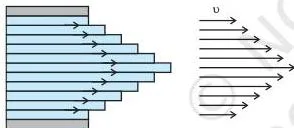
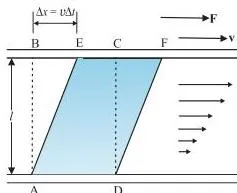
Unlike a solid, a flowing fluid keeps straining, so experiments show the shear stress is proportional to the velocity gradient \(v/l\), not to the strain itself. The coefficient of viscosity \(\eta\) is defined as \[ \eta = \frac{F/A}{v/l} = \frac{Fl}{vA} \quad (9.16) \]
The SI unit is the poiseuille (Pl), equal to N s m\(^{-2}\) or Pa s; dimensions are [ML\(^{-1}\)T\(^{-1}\)] (NCERT p. 191). Table 9.2 in the chapter gives the magnitudes — glycerine is hundreds of times more viscous than water, while air is about sixty times less viscous than water at 20 °C.
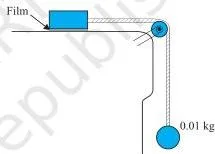
Fig. 9.13 shows the classic measurement: a block dragged at constant speed over a thin film of liquid by a falling mass. At constant speed, the tension equals the viscous drag, and \(\eta\) follows from Eq. 9.16 (NCERT p. 191).
Temperature behaviour is a favourite exam point: for liquids, \(\eta\) falls as temperature rises (molecules become more mobile); for gases, \(\eta\) rises (faster random motion transfers momentum between layers) (NCERT p. 191, p. 199).
A body falling through a fluid drags a layer of fluid with it and so feels a retarding force. Stokes’ law gives this drag for a sphere of radius \(a\) moving at speed \(v\):
\[ F = 6\pi \eta a v \quad (9.17) \]
A raindrop accelerates under gravity until the upward viscous drag plus buoyancy balances its weight; then the net force is zero and it falls at constant terminal velocity:
\[ 6\pi \eta a v_t = \frac{4\pi}{3} a^3 (\rho – \sigma) g \quad \Rightarrow \quad v_t = \frac{2a^2(\rho – \sigma)g}{9\eta} \quad (9.18) \]
where \(\rho\) is the density of the sphere and \(\sigma\) that of the fluid. Terminal velocity scales with the square of the radius (big drops fall faster) and inversely with \(\eta\) (thick fluids stop things quickly) (NCERT p. 193).
Worked example (original numbers).
A small glass sphere of radius \(a = 1.5\ \text{mm}\) and density \(\rho = 2.5 \times 10^{3}\ \text{kg m}^{-3}\) falls through glycerine of density \(\sigma = 1.3 \times 10^{3}\ \text{kg m}^{-3}\) and viscosity \(\eta = 0.83\ \text{Pa s}\).
Find its terminal velocity.
Take \(g = 9.8\ \text{m s}^{-2}\).
- Step 1: Convert the radius to metres: \(a = 1.5\ \text{mm} = 1.5 \times 10^{-3}\ \text{m}\).
- Step 2: Find the density difference: \( \rho – \sigma = (2.5 – 1.3) \times 10^{3} = 1.2 \times 10^{3}\ \text{kg m}^{-3} \).
- Step 3: Substitute into Eq. 9.18:
\[ v_t = \frac{2 \times (1.5 \times 10^{-3})^2 \times 1.2 \times 10^{3} \times 9.8}{9 \times 0.83} \]
\[ v_t = \frac{2 \times 2.25 \times 10^{-6} \times 1.2 \times 10^{3} \times 9.8}{7.47} = \frac{5.29 \times 10^{-2}}{7.47} \]
\[ v_t = 7.1 \times 10^{-3}\ \text{m s}^{-1} \]
Final answer: The sphere falls at about \(7.1 \times 10^{-3}\ \text{m s}^{-1}\) — roughly 0.71 cm per second — a slow, constant speed set by the balance of weight, buoyancy and viscous drag.
Surface Tension: Surface Energy, Drops, Bubbles and Capillary Rise
A liquid surface behaves like a stretched elastic skin. Surface tension explains why drops are round, why bubbles need extra pressure inside, and why water climbs a thin tube.
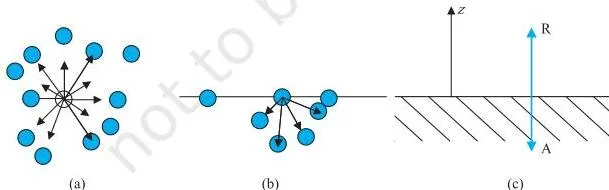
The molecule picture (Fig. 9.14): a molecule deep inside a liquid is surrounded by neighbours and has the lowest possible energy; a molecule at the surface has neighbours on only one side, so it carries extra energy. Nature minimises energy, so a liquid shrinks its surface to the smallest area the surroundings allow (NCERT p. 193-194).
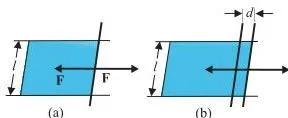
That extra energy is measured by the film experiment (Fig. 9.15). A soap film on a wire frame has a movable bar; pulling the bar out by distance \(d\) creates extra area \(2ld\) — the factor 2 because a film has two surfaces. The work \(Fd\) turns into surface energy, giving \[ S = \frac{Fd}{2ld} = \frac{F}{2l} \quad (9.20) \]
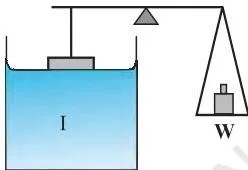
Surface tension \(S\) is thus the force per unit length, or equivalently the surface energy per unit area, of the interface; its unit is N m\(^{-1}\) (NCERT p. 194). Fig. 9.16 shows a direct measurement: a flat glass plate is pulled free from a liquid surface, and the extra weight needed gives \[ S_{la} = \frac{mg}{2l} \quad (9.21) \]
The angle of contact \(\theta\) is the angle between the tangent to the liquid surface at the point of contact and the solid surface, measured inside the liquid (NCERT p. 195). It decides wetting, as Fig. 9.17 shows:
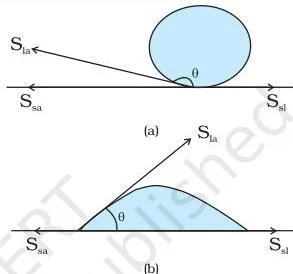
- Acute \(\theta\) — water on clean glass or plastic — the liquid wets the surface and spreads out.
- Obtuse \(\theta\) — water on a lotus leaf or a waxy surface, and mercury on almost anything — the liquid does not wet and beads into drops (NCERT p. 195).
- Soaps and detergents are wetting agents: they make \(\theta\) small so liquids penetrate; waterproofing agents do the opposite, making \(\theta\) large.
The three interfacial tensions balance at the line of contact (NCERT p. 195):
\[ S_{la} \cos \theta + S_{sl} = S_{sa} \quad (9.22) \]
Drops and bubbles (Fig. 9.18): a sphere has the least area for a given volume, so small drops are spherical if gravity can be neglected. But a curved surface also needs a pressure difference to exist.
Expanding a drop of radius \(r\) by \(\Delta r\) costs surface energy \(8\pi r \Delta r S\), and the pressure difference \((P_1 – P_0)\) supplies work \((P_1 – P_0)4\pi r^2 \Delta r\) (Eqs. 9.23-9.24). Equating the two gives
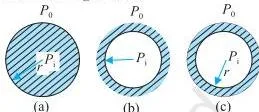
\[ (P_1 – P_0) = \frac{2S_{la}}{r} \quad \text{(drop or cavity: one interface)} \quad (9.25) \]
\[ (P_1 – P_0) = \frac{4S_{la}}{r} \quad \text{(soap bubble: two interfaces)} \quad (9.26) \]
The factor of two is THE classic trap: a soap bubble is a film with two liquid-air surfaces (inside and outside), so it needs twice the excess pressure of a drop of the same radius (NCERT p. 196). An air bubble inside a liquid has only one surface, so it uses \(2S/r\) — NCERT Example 9.10 makes this explicit.
In every case, the concave (inside) side is at the higher pressure.
Capillary rise (Fig. 9.19): a narrow tube dipped in water develops a concave meniscus, the pressure just below it is less than atmospheric, and the outside pressure pushes the water up until the column’s weight balances the pressure difference:
\[ h = \frac{2S \cos \theta}{\rho g a} \quad (9.29) \]
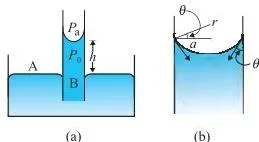
For water on glass, \(\theta\) is acute, \(\cos \theta\) is positive, and the water rises — 2.98 cm for a tube of radius 0.05 cm, the chapter’s own number (NCERT p. 197). For mercury, \(\theta\) is obtuse, \(\cos \theta\) is negative, and the “rise” is negative — the mercury is depressed below the outside surface. Surface tension, like viscosity, falls with temperature (NCERT p. 194).
The Chapter’s Summary and Points to Ponder, Explained
NCERT closes the chapter with a Summary (p. 197-198) and Points to Ponder (p. 198-199). Condensed into one revision sheet:
| Idea | One-line revision statement |
|---|---|
| Fluids | Liquids and gases flow; a fluid’s shape is governed by its container. |
| Pressure | \(P = F/A\) with \(F\) the normal force; a scalar; 1 atm = \(1.01 \times 10^{5}\) Pa, 1 bar = \(10^{5}\) Pa, 1 torr = 133 Pa. |
| Pascal’s law | Same pressure at all points at the same height; enclosed-fluid pressure is transmitted undiminished. |
| Depth | \(P = P_s + \rho g h\); gauge pressure = \(\rho g h\); holds for incompressible liquids. |
| Continuity | \(Av = \text{constant}\) — conservation of mass in steady flow. |
| Bernoulli | \(P + \frac{1}{2} \rho v^2 + \rho g h = \text{constant}\) — energy conservation; needs non-viscous, incompressible, steady flow. |
| Viscosity | \(\eta = (F/A)/(v/l)\); units Pa s; liquids \(\eta\) falls, gases \(\eta\) rises with temperature. |
| Stokes’ law | \(F = 6\pi \eta a v\); terminal velocity \(v_t = 2a^2(\rho – \sigma)g/(9\eta)\). |
| Surface tension | Force per unit length, or surface energy per unit area; N m\(^{-1}\); falls with temperature. |
The Points to Ponder are the places students usually slip. The ones worth memorising:
- Pressure exists at every point in a fluid, not just on walls or submerged solids — a fluid element is in equilibrium because pressures on all its faces balance (NCERT p. 198).
- Gauge pressure is the difference between actual and atmospheric pressure; most measuring devices (tyre gauge, sphygmomanometer) read gauge (NCERT p. 199).
- \(P = P_s + \rho g h\) assumes the fluid is incompressible — strictly a statement about liquids (NCERT p. 199).
- Streamlines cannot intersect in steady flow — one particle, one velocity (NCERT p. 199).
- Bernoulli fails under viscous drag — the energy lost to friction becomes heat, and the pressure is lower than Eq. 9.12 predicts (NCERT p. 199).
- Surface energy is an interfacial property — it needs two substances, at least one of them a fluid (NCERT p. 199).
Common Mistakes Students Make in This Chapter
Each of these errors has a page in the textbook behind it. Name the mistake before it costs you a mark:
| Mistake | Correct rule | How to check your answer |
|---|---|---|
| Treating pressure as a vector because it is force/area | Pressure is scalar; the force in \(F/A\) is the normal component only (NCERT p. 198) | Does pressure itself point anywhere? It pushes normal to any surface, whatever its orientation. |
| Using \(2S/r\) for a soap bubble | A bubble has two surfaces: excess pressure \(4S/r\); a drop or cavity uses \(2S/r\) (NCERT p. 196) | Count the liquid-gas interfaces before choosing the factor. |
| Applying Bernoulli to any flow | Valid only for steady, non-viscous, incompressible flow (NCERT p. 188) | Is the flow turbulent or viscous? A river rapid fails all three conditions. |
| Mixing gauge and absolute pressure | Gauge = \(P – P_a\); a gauge reading of 2 atm means absolute pressure is about 3 atm (NCERT p. 183-184) | Decide which pressure you are using and stay consistent — Exercise 9.12 tests exactly this. |
| Using \(P = P_s + \rho g h\) for gases | The formula assumes constant density; gases compress (NCERT p. 199) | Is the fluid a liquid? For a gas, treat \(\rho\) as variable. |
| Expecting mercury to rise in a capillary | \(\cos \theta\) is negative for mercury (obtuse contact angle), so the level falls (NCERT p. 197) | Check the sign of \(\cos \theta\) before calculating \(h\). |
How to Use This Chapter for Exams
This chapter produces two kinds of questions: “explain why” items that test whether you can think in physics words, and numericals that test the formulas. The table below maps each exercise in the set to the concept it tests, so you can target your weakest areas.
| Exercise | Concept it tests | Type |
|---|---|---|
| 9.1 | Pressure at depth, atmospheric pressure, pressure as a scalar | Explain why |
| 9.2 | Angle of contact, wetting, surface tension independent of area, spherical drops | Explain why |
| 9.3 | Temperature behaviour of \(S\) and \(\eta\); shear strain vs strain rate; continuity; turbulence | Fill in the blanks |
| 9.4 | Bernoulli applications: blowing over paper, water taps, syringe flow, efflux thrust, spinning ball | Explain why |
| 9.5 | Pressure from a single heel — area is what matters | Numerical |
| 9.6 | Height of a liquid column equal to 1 atm (barometer idea) | Numerical |
| 9.7 | Pressure at ocean depth vs the stress a structure can bear | Numerical + reasoning |
| 9.8 | Hydraulic lift: maximum pressure on the small piston | Numerical |
| 9.9 | U-tube: specific gravity of spirit from column heights | Numerical |
| 9.10 | U-tube: mercury level difference after more liquid is added | Numerical |
| 9.11 | Validity of Bernoulli for a river rapid | Explain |
| 9.12 | Gauge vs absolute pressure in Bernoulli’s equation | Explain |
| 9.13 | Viscous flow through a tube: pressure difference; checking that flow is laminar | Numerical |
| 9.14 | Wind tunnel: lift on a wing from the speed difference | Numerical |
| 9.15 | Equation of continuity: which flow figure is incorrect | Figure reasoning |
| 9.16 | Spray pump: ejection speed through fine holes | Numerical |
Notice the pattern: the chapter’s signature question is “explain why” — Q9.1, 9.2, 9.4, and the reasoning items 9.11 and 9.12. A full answer names the principle first (Pascal’s law, Bernoulli’s principle, continuity), then connects it to the situation in one or two sentences. The numericals are short: write the equation, substitute with units, and state the answer with its unit.
The additional exercises (Q9.17 onward) extend the same ideas — soap films and surface tension, a mercury drop, a soap bubble — so they are excellent extra practice for the surface-tension formulas above.
One honest caveat: textbook contents and the examinable syllabus are not always identical — check the current official syllabus for what is examinable this session, since NCERT’s chapter list and CBSE’s syllabus are set by different authorities.
Related Chapters in This Book and Sources
This chapter leans on ideas from earlier chapters — the work–energy theorem behind Bernoulli’s equation, and the contrast between how solids and fluids respond to shear, which is the subject of the previous chapter, Mechanical Properties of Solids. The energy and vector tools Bernoulli uses also connect with Motion in a Plane.
For revision covering both NCERT books, the Class 11 Physics notes hub collects the chapters; the Class 11 hub holds the other subjects, and the CBSE notes library covers every class. The official chapter PDF linked at the top of this page is hosted on ncert.nic.in and is the authoritative source for the text and figures.
Sources and data verification
- The page describes the NCERT Class 11 Physics Part II textbook (English medium), Chapter 9, Mechanical Properties of Fluids, Reprint 2026-27 edition, and its official chapter PDF on ncert.nic.in.
- It covers Chapter 9 of that book only — not the other chapters of Physics Part II, and not Class 11 Physics Part I.
- The academic session this page is maintained for is stated in the introduction above.
- NCERT settles textbook editions, chapter contents and the official PDFs; CBSE settles the curriculum, syllabus and examinations.
Reference: NCERT Class 11 Physics textbook, chapter 9 (Mechanical Properties of Fluids), official edition on ncert.nic.in.
Frequently Asked Questions
Why is pressure a scalar quantity even though it is defined as force per unit area?
Because the “force” in \(F/A\) is not the full force vector — it is the magnitude of the component normal to the area. A fluid at rest pushes perpendicular to any surface you choose, so the direction is fixed by the surface, not by anything intrinsic to the fluid.
NCERT’s Points to Ponder (p. 198) says the phrase “force per unit area” is what gives the false impression that pressure is a vector; no direction can be assigned to pressure.
Why is the excess pressure inside a soap bubble 4S/r but only 2S/r inside a liquid drop?
Count the interfaces. A liquid drop has one liquid-air surface, so the energy cost of expanding it gives excess pressure \(2S/r\) (Eq. 9.25). A soap bubble is a film with two surfaces — an inside one and an outside one — so the energy cost doubles and the excess pressure is \(4S/r\) (Eq. 9.26) (NCERT p. 196).
An air bubble inside a liquid has just one surface and uses \(2S/r\), as NCERT Example 9.10 points out.
When does Bernoulli’s equation stop being valid?
Whenever any of its three conditions fails: the fluid is viscous (energy is lost to internal friction), compressible, or the flow is not steady — turbulent or changing with time. For real liquids it is a good approximation when the flow is low-viscosity, incompressible and steady.
A river rapid fails all three conditions (Exercise 9.11), and Points to Ponder (p. 199) reminds you that with viscous drag the pressure along the flow is lower than Bernoulli predicts.
Does liquid pressure depend on the shape of the container?
No. Pressure at depth \(h\) in a liquid open to the atmosphere is \(P = P_a + \rho g h\) — the container’s shape and the amount of liquid never enter.
The hydrostatic paradox (Fig. 9.4) makes the point: three differently shaped vessels hold different amounts of water, yet fill to the same height, because the bottom pressure is the same under each (NCERT p. 183).
Why does water rise in a capillary tube while mercury falls in the same tube?
The capillary rise formula is \(h = 2S\cos\theta/(\rho g a)\), and the sign of \(\cos\theta\) decides everything. Water on glass has an acute angle of contact, so \(\cos\theta\) is positive and \(h\) is positive — the water rises.
Mercury on glass has an obtuse angle of contact, so \(\cos\theta\) is negative and \(h\) is negative — the level is depressed below the outside surface (NCERT p. 197).
Explore Class 11 Physics Books
- Previous: Mechanical Properties of Solids
- Next: Thermal Properties of Matter
Class 11 Physics on LearnCBSE:
Related chapters:
- Units and Measurement
- Motion in a Straight Line
- Motion in a Plane