
Our Environment Class 10 notes are built around one idea: living things and their surroundings do not exist separately, they run as one connected system. NCERT calls this system an ecosystem — all the organisms in an area (biotic components) interacting with non-living factors like temperature, soil and rainfall (abiotic components) (NCERT, p. 1).
Chapter 13 is one of the shortest chapters in the Class 10 Science book, but it is heavily tested. CBSE regularly draws MCQs and 2-3 mark questions straight from three areas: how food chains move energy, why the ozone layer matters, and how to tell biodegradable waste from non-biodegradable waste.
If you get these three ideas solid, most of the chapter’s marks are within reach.
What This Chapter Covers and Why It Matters for Boards
An ecosystem is not just a list of plants and animals. It is the set of interactions between them and their physical environment (NCERT, p. 1). A garden, a forest, a pond and even a fish tank all qualify — some occur naturally, others are built by people.
This chapter builds on that idea in three stages: first it explains how organisms are connected through food chains and food webs, then it shows how energy and harmful chemicals move through those chains, and finally it looks at two environmental problems caused by human activity — ozone depletion and waste disposal (NCERT, p. 5).
Keep that three-part structure in mind; it maps almost exactly onto how the exam paper is usually set.
Ecosystem, Biotic and Abiotic Components: The Garden and Aquarium Examples
Every ecosystem has two kinds of components. Biotic components are the living organisms — plants, animals, microorganisms and humans. Abiotic components are the physical factors that shape how those organisms live: temperature, rainfall, wind, soil and minerals (NCERT, p. 1). A garden is a good example.
Grasses, flowering plants, insects, frogs and birds all interact with each other, and their growth depends on sunlight, soil quality and water. A garden or a crop field is a human-made (artificial) ecosystem, while a forest or a pond is natural (NCERT, p. 1).
Within any ecosystem, organisms fall into three functional groups based on how they get their food (NCERT, p. 1):
- Producers — green plants and some bacteria that make their own food through photosynthesis, using sunlight and chlorophyll.
- Consumers — organisms that depend on producers, directly or indirectly, for food.
- Decomposers — bacteria and fungi that break down dead organisms and waste into simple substances that go back into the soil.
Consumers are further split into four types. A herbivore eats only plants — a deer grazing on grass. A carnivore eats other animals — a lion hunting the deer. An omnivore eats both — a crow picking at grain and also at insects. A parasite feeds on a living host without killing it immediately — a tick drawing blood from a dog.
(These examples are original; use your own when answering, not the textbook’s.)
NCERT’s Activity 13.1 asks why an aquarium needs periodic cleaning while a pond does not. Here is the reasoning: a pond has a large volume of water, a natural soil-and-sediment bed, and an established community of decomposers that keeps pace with the amount of waste produced.
An aquarium is a small, closed volume of water with a limited decomposer population, so waste (uneaten food, fish excreta, dead plant matter) builds up faster than it can be broken down — hence it needs manual cleaning. This is really a question about decomposer capacity, not just water volume.
Food Chains, Food Webs and Trophic Levels Explained Step by Step
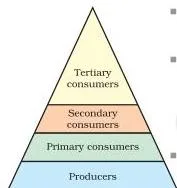
A food chain is the sequence of organisms feeding on one another, one after another, in a straight line. Each step in this sequence is a trophic level (NCERT, p. 3). NCERT fixes four trophic levels:
- Trophic level 1 — producers (autotrophs) that capture solar energy.
- Trophic level 2 — herbivores, also called primary consumers.
- Trophic level 3 — small carnivores, called secondary consumers.
- Trophic level 4 — larger carnivores, called tertiary consumers (NCERT, p. 3).
Here is an original four-step example, different from the textbook’s grass-goat-human chain: algae (trophic level 1, producer) → tadpole (trophic level 2, herbivore, eats algae) → heron (trophic level 3, carnivore, eats the tadpole) → crocodile (trophic level 4, carnivore, eats the heron). Notice each organism occupies exactly one trophic level in this particular chain.
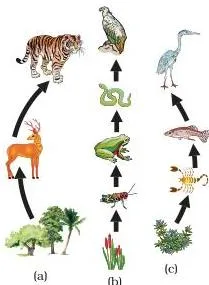
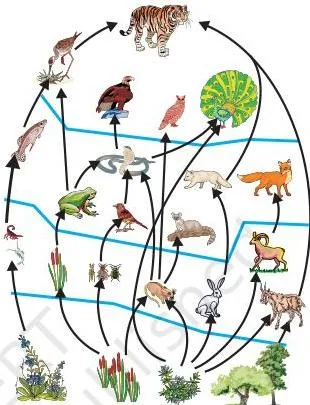
In real ecosystems, an organism is rarely eaten by only one predator, and it rarely eats only one kind of food. So instead of a single straight line, the real picture is a set of interconnected food chains branching in many directions — this is a food web (NCERT, p. 4).
In one line: a food chain is a single linear sequence of who-eats-whom; a food web is many food chains linked together into a network.
Energy Flow in an Ecosystem: The 10% Rule and Why Chains Stay Short
Producers capture only about 1% of the sunlight energy falling on their leaves and convert it into food energy (NCERT, p. 3). When a herbivore eats a plant, most of that energy is lost — as heat, in digestion, in daily activity.
On average, only about 10% of the food eaten at one trophic level becomes body mass available to the next level (NCERT, p. 3). This is why it is called the 10% rule, and why food chains rarely go beyond four trophic levels: past that point, so little usable energy is left that it cannot support a viable population.
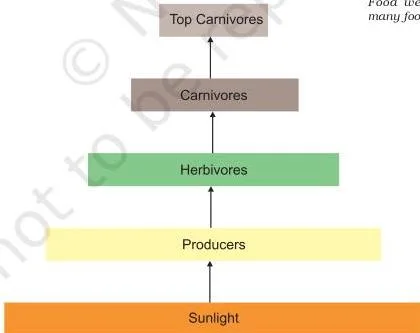
Two facts come directly out of this diagram, and examiners like asking for both by name: energy flow in an ecosystem is unidirectional — once energy passes from producers to herbivores, it never flows back to producers — and the amount of energy available keeps decreasing at every successive trophic level (NCERT, p. 4).
This is also why producers always have the largest population in an ecosystem: they are the only entry point for energy, so more of them are needed to support fewer organisms above them.
Worked Example: Tracking Energy Loss Across Four Trophic Levels
The numbers below are original — they do not appear in the NCERT text — but they apply the same 10% transfer rule described on page 3.
Problem: If producers in a grassland fix 50,000 kJ of solar energy, how much energy reaches primary, secondary and tertiary consumers?
- Step 1: Energy available to producers (trophic level 1) is given as \( 50{,}000\ \text{kJ} \).
- Step 2: Only about 10% of this passes on to primary consumers (trophic level 2), since roughly 90% is lost as heat, in digestion, and in the producer’s own life processes.
\[ \text{Energy to primary consumers} = 50{,}000 \times \frac{10}{100} = 5{,}000\ \text{kJ} \]
Step 3: Apply the same 10% transfer from primary consumers to secondary consumers (trophic level 3).
\[ \text{Energy to secondary consumers} = 5{,}000 \times \frac{10}{100} = 500\ \text{kJ} \]
Step 4: Apply the 10% transfer once more from secondary consumers to tertiary consumers (trophic level 4).
\[ \text{Energy to tertiary consumers} = 500 \times \frac{10}{100} = 50\ \text{kJ} \]
Step 5: Check what a fifth trophic level would receive: \( 50 \times \frac{10}{100} = 5\ \text{kJ} \).
This is why a fifth trophic level is almost never viable — 5 kJ cannot support a stable population of predators after their own metabolic needs are met.
Final answer: Primary consumers get \( 5{,}000\ \text{kJ} \), secondary consumers get \( 500\ \text{kJ} \), and tertiary consumers get \( 50\ \text{kJ} \) — each step losing about 90% of the energy received at the previous level.
Biological Magnification: How Pesticides Travel Up the Food Chain
Pesticides sprayed on crops do not stay on the surface of the plant forever. They get washed into the soil or into water bodies, and from there they are absorbed by plants along with water and minerals, or taken up by aquatic organisms (NCERT, p. 4).
Because these chemicals do not degrade easily, they accumulate at each trophic level rather than being broken down. Since humans usually sit at the top of a food chain — eating plants, animals or both — the highest concentration of these chemicals builds up in the human body. This progressive build-up at higher trophic levels is called biological magnification (NCERT, p. 4).
This is also why wheat, rice, vegetables, fruits and even meat can contain pesticide residues that washing does not fully remove (NCERT, p. 5), connected to Activity 13.3 on pesticide levels in ready-made food. The reason is simple: once a pesticide has been absorbed into plant tissue or an animal’s fat, it is inside the organism, not just sitting on its surface.
Rinsing with water removes surface residue, but it cannot pull out a chemical that has already been taken up internally. This is a specific, testable reason — not a vague safety warning — and it is worth stating exactly this way in an exam answer.
Ozone Layer: Formation, Function and the CFC Problem
Oxygen that we breathe is \( O_2 \) — two atoms of oxygen bonded together. Ozone is a different molecule, \( O_3 \), made of three oxygen atoms, and at ground level it is a poison (NCERT, p. 5).
But high in the atmosphere, ozone performs a essential job: it shields the earth’s surface from ultraviolet (UV) radiation from the sun, radiation known to cause skin cancer in humans (NCERT, p. 5).
Ozone forms when high-energy UV radiation splits some \( O_2 \) molecules into free oxygen atoms, which then combine with more \( O_2 \) to form \( O_3 \) (NCERT, p. 6):
\[ O_2 \xrightarrow{\text{UV}} O + O \]
\[ O + O_2 \rightarrow O_3 \]
The amount of atmospheric ozone began dropping sharply in the 1980s, and this has been linked to chlorofluorocarbons (CFCs), synthetic chemicals used in refrigerants and fire extinguishers (NCERT, p. 6).
A fact students often forget: in 1987, the United Nations Environment Programme (UNEP) got countries to agree to freeze CFC production at 1986 levels, and it is now compulsory for manufacturers to make CFC-free refrigerators worldwide (NCERT, p. 6).
If a question asks what steps have been taken against ozone depletion, this 1987 agreement is the specific fact to name — a generic answer like “countries banned harmful chemicals” will not earn full marks. Students who want to read the original chapter can check the NCERT Class 10 Science textbook, Chapter 13 PDF, which carries the full text this page is based on.
Biodegradable vs Non-Biodegradable Waste: Classifying Correctly
A substance is biodegradable if it can be broken down by biological processes — mainly by the enzymes of bacteria and fungi. A substance is non-biodegradable if it cannot be broken down this way and instead persists in the environment for long periods (NCERT, p. 6).
The reason some things resist decomposition comes down to enzyme specificity: enzymes are built to act on particular chemical structures, so a bacterium’s enzymes that break down cellulose or protein cannot act on the synthetic structure of plastic (NCERT, p. 6).
NCERT’s Activity 13.5 tests this directly — bury a mix of kitchen waste, paper, cloth and plastic in soil and check what has changed after a few weeks.
| Item | Biodegradable? | Reason |
|---|---|---|
| Grass | Yes | Plant (cellulose) material — decomposer enzymes can break it down. |
| Leather | Yes | Animal-derived organic material, broken down over time by microbial action. |
| Paper | Yes | Made from plant cellulose fibres, so the same decomposer enzymes act on it. |
| Plastic (conventional) | No | Synthetic polymer with no natural enzyme matching its structure; only physical processes like heat and pressure act on it (NCERT, p. 6). |
| Glass | No | Inorganic material — no biological enzyme system acts on it at all. |
| Kulhad (clay cup) | No, but low-impact | Clay is inorganic and is not decomposed biologically, but it returns to soil-like material without releasing toxic residue, unlike plastic. |
Managing Waste: From Disposable Cups to E-Waste
NCERT uses the disposable-cup story to show that every alternative has a trade-off. Trains once served tea in reusable plastic glasses, which had to be returned. Disposable cups replaced them for hygiene, but no one accounted for the impact of disposing millions of cups daily. Clay kulhads were tried next, but making them at scale meant scraping away fertile top-soil.
Disposable paper cups came after that (NCERT, p. 8) — a reasonable next step, though it still uses forest resources and requires proper collection to avoid littering.
The same chapter flags e-waste as a modern concern (Activity 13.9): electronic items contain hazardous materials that need careful handling when disposed of, and improper disposal or recycling can affect soil and water quality (NCERT, p. 9).
This is a common source of HOTS (higher-order thinking) questions because it connects a familiar chapter to a current, real-world problem — expect it phrased as “suggest one way to reduce e-waste’s environmental impact” rather than a definition question.
Key Terms You Must Define Correctly in Exams
| Term | Working definition for exams |
|---|---|
| Ecosystem | All the living organisms of an area interacting with each other and with the non-living (physical) factors of that area (NCERT, p. 1). |
| Trophic level | A feeding step or position in a food chain — producers occupy the first, herbivores the second, and so on (NCERT, p. 3). |
| Food web | A network formed when many interconnected food chains are linked together, since one organism can be eaten by more than one predator (NCERT, p. 4). |
| Biological magnification | The progressive build-up of non-degradable chemicals at each higher trophic level, reaching the highest concentration at the top of the food chain (NCERT, p. 4). |
| Ozone | A molecule made of three oxygen atoms \((O_3)\), poisonous at ground level but essential in the upper atmosphere for absorbing harmful UV radiation (NCERT, p. 5). |
| Biodegradable | A substance that can be broken down into simpler substances by the action of bacteria and other decomposers (NCERT, p. 6). |
| Non-biodegradable | A substance that cannot be broken down by biological processes and persists in the environment (NCERT, p. 6). |
| Decomposer | Bacteria and fungi that break down the dead remains and waste of organisms into simple substances that re-enter the soil (NCERT, p. 1). |
Mistakes Students Repeatedly Make in This Chapter
| Mistake | Correct rule | How to check your answer |
|---|---|---|
| Treating a food chain and a food web as the same thing | A food chain is one straight sequence of who-eats-whom; a food web is many such chains linked together into a network (NCERT, p. 4). | If more than one arrow leads into or out of an organism in your diagram, you have drawn a web, not a chain. |
| Saying decomposers only matter at the producer level | Decomposers act on the dead remains and waste of organisms from every trophic level, not just plants — this is what NCERT exercise Q4/Q5 expect you to reason through (NCERT, p. 1, p. 10). | Ask yourself: whose dead matter is being broken down? If your answer only mentions plants, you have missed the point. |
| Writing that ozone \((O_3)\) and oxygen \((O_2)\) are the same gas | Oxygen \((O_2)\) is needed for respiration; ozone \((O_3)\) is a different, poisonous molecule that shields the earth from UV radiation in the upper atmosphere (NCERT, p. 5). | Count the oxygen atoms in the formula — two means \(O_2\), three means ozone. |
| Assuming every plastic is non-biodegradable in every case | Conventional plastics resist decomposition, but Activity 13.6 points to newer biodegradable plastic types now being developed (NCERT, p. 7). | Check if the question says “plastic” generally or specifies a newer biodegradable type before answering. |
| Quoting the 10% rule as an exact, fixed law | 10% is stated as an average figure for how much energy passes to the next trophic level, not a value that holds in every single case (NCERT, p. 3). | Use words like “on average” or “approximately 10%” in your answer instead of stating it as a fixed law. |
How CBSE Tests This Chapter: Question Pattern to Watch
The NCERT exercise set for this chapter (page 9-10) has a clear pattern that boards reuse closely:
| Question numbers | Format | What a full-marks answer needs |
|---|---|---|
| Q1-Q3 | MCQ-style classification (biodegradable items, food-chain sequence, environment-friendly practices) | Correctly identify the option and, if asked to justify, state the classifying rule in one line — for example, why grass, flowers and leather are all biodegradable. |
| Q4-Q5 | Reasoning on trophic levels | Distinguish the effect of removing producers from removing a middle consumer, not just say “the ecosystem is disturbed.” |
| Q6 | Definition plus application (biological magnification) | Define the term and state that magnification is greatest at the highest trophic level. |
| Q7-Q8 | Short answer on waste problems | Name specific problems — for example, non-biodegradable waste clogging soil/drains, or biodegradable waste still causing odour and disease if left unmanaged. |
| Q9 | 3-mark question, recurring in boards, on ozone | State the UV-shielding function of ozone, mention CFCs as the cause of depletion, and name the 1987 UNEP agreement as the corrective step. |
This mapping is specific to this chapter’s exercise set, not a generic exam tip — Q1 through Q3 are the ones most often lifted directly into MCQ banks because their options test a single classification rule.
Answering ‘What Happens If You Remove a Trophic Level’ Correctly
NCERT exercise Q4 and Q5 ask what happens if all organisms at one trophic level are killed, and whether this effect is the same at every level. A one-line answer here loses marks. The honest answer has two distinct parts:
- Removing producers collapses the entire food chain above them, because producers are the only entry point for energy into the system — every consumer level ultimately depends on that first capture of solar energy (NCERT, p. 3).
- Removing a middle consumer (say, the herbivores in a chain) does not collapse the chain, but it creates an imbalance: the producers below that level may grow unchecked from lack of grazing, while the carnivores above that level lose their food source and their population falls.
The common student assumption is that only removing a top predator matters. That is not correct — no trophic level can be removed without some consequence to the ecosystem, because every level is linked to the ones above and below it through the flow of energy and matter.
The specific consequence differs by level: total collapse for producers, an imbalance in population numbers for consumers.
Quick Recap Table: Chapter 13 at a Glance
| Concept | One-line fact |
|---|---|
| Ecosystem types | Natural (forest, pond) vs human-made (garden, aquarium, crop field) (NCERT, p. 1). |
| Trophic level order | Producers → primary consumers → secondary consumers → tertiary consumers (NCERT, p. 3). |
| Energy transfer | About 10% of energy passes to the next trophic level; most is lost as heat (NCERT, p. 3). |
| Energy flow direction | One-way (unidirectional); never flows back to a previous trophic level (NCERT, p. 4). |
| Biological magnification | Non-degradable chemicals build up most at the top of the food chain (NCERT, p. 4). |
| Ozone formation | \( O_2 \xrightarrow{UV} O + O \), then \( O + O_2 \rightarrow O_3 \) (NCERT, p. 6). |
| Waste categories | Biodegradable (broken down by decomposers) vs non-biodegradable (persists in environment) (NCERT, p. 6). |
Frequently Asked Questions on Our Environment (Class 10)
Why do food chains usually have only three or four trophic levels?
Because energy is lost at every step — only about 10% of the food eaten at one level becomes available to the next, so by the fourth or fifth level there is too little energy left to support a stable population (NCERT, p. 3).
What is the difference between a food chain and a food web?
A food chain is a single, linear sequence showing who eats whom. A food web is what you get when many such food chains interconnect, because most organisms are eaten by more than one predator and eat more than one kind of food (NCERT, p. 4).
How does biological magnification affect human beings specifically?
Humans usually occupy the highest trophic level in a food chain, so non-degradable chemicals like pesticide residues that have accumulated at every lower level reach their highest concentration in the human body (NCERT, p. 4).
Why are CFCs harmful to the ozone layer even though they seem inert on the ground?
CFCs are stable at ground level, which is exactly why they persist long enough to drift up into the upper atmosphere, where they contribute to breaking down the ozone layer that shields the earth from UV radiation (NCERT, p. 6).
Are all plastics non-biodegradable, or do exceptions exist now?
Conventional plastics are non-biodegradable because no natural enzyme matches their structure, but NCERT’s Activity 13.6 points out that newer biodegradable plastic types are being developed, so the answer depends on the specific plastic being asked about (NCERT, p. 7).
What happens to an ecosystem if all decomposers are removed?
Dead organisms and waste would no longer be broken down into simple substances, so nutrients would not return to the soil for producers to reuse, disrupting the entire cycle that supports plant growth and, in turn, every trophic level above it (NCERT, p. 1).
For more Class 10 Science chapter notes, visit the CBSE Class 10 Science notes section, browse all Class 10 study material on the site, or revise another physics chapter through the Magnetic Effects of Electric Current notes.
Reference: NCERT Class 10 Science textbook, chapter Our Environment.
Explore Class 10 Science Notes
Class 10 Science on LearnCBSE:
Related chapters: