Heredity Class 10 Notes: CBSE Science Chapter 8 – Learncbse.net
These heredity class 10 notes begin with the same puzzle the NCERT chapter opens with: why does a field of sugarcane look almost identical plant to plant, while a group of human beings — or dogs, or pigeons — never looks that uniform? Sugarcane is usually propagated asexually, from cuttings, so each new plant is a near-copy of its parent. Humans and most animals reproduce sexually, and sexual reproduction mixes genetic material from two parents in every generation, which multiplies the differences between individuals (NCERT, p. 1). This chapter explains how that variation is created, how it is passed on according to fixed rules, and how it decides something as basic as whether a baby is a boy or a girl.
Why Offspring Resemble Parents But Are Never Identical
Reproduction always produces something similar to the parent — a pea plant produces pea plants, not sunflowers — but never an exact copy. Even asexual reproduction introduces small variations, because DNA copying is not perfect. Sexual reproduction increases this variation sharply, since the offspring’s genetic material is a mix of two different individuals rather than a copy of one (NCERT, p. 1). This is why the sugarcane field looks uniform (asexual propagation, minimal mixing) while a crowd of people shows wide differences in height, skin tone, and facial features (sexual reproduction, maximum mixing). Keep this contrast in mind — it is the reason the rest of the chapter exists.
What Chapter 8 Covers: From Variation to Sex Determination
Heredity is a short chapter — about six textbook pages — but it is concept-heavy, and CBSE tends to test it through reasoning questions rather than long numerical problems. For quick revision, think of it as four connected ideas, in this order:
- Accumulation of variation: how small differences build up generation after generation, and why sexual reproduction creates more of them than asexual reproduction (p. 1).
- Mendel’s cross experiments: the monohybrid cross (one trait) and the dihybrid cross (two traits), which gave us the rules of dominant and recessive inheritance (pp. 2–4).
- Gene-to-trait mechanism: how a gene, sitting on a chromosome, controls an enzyme, which controls a hormone, which finally decides a visible trait (p. 4).
- Sex determination: how the X and Y chromosomes decide whether a human baby will be male or female (p. 5).
If you are short on time, prioritise the monohybrid and dihybrid cross logic and the X/Y sex-determination mechanism — these are the two ideas the NCERT exercises return to most often.
How Variation Builds Up Across Generations
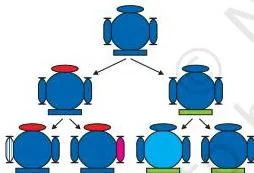
Figure 8.1 in the textbook shows one organism giving rise to two individuals in the next generation, each of which then produces two more. By the third row, the four individuals are all different from one another — some differences were inherited from a parent, others appeared fresh in that generation (NCERT, p. 1). In asexual reproduction, such as a bacterium dividing into two, the offspring are almost identical, with only tiny differences from small errors in DNA copying. Sexual reproduction generates far more diversity because it combines DNA from two separate parents. This matters for survival: not every variant does equally well in a given environment. A heat-tolerant bacterium, for instance, survives a heat wave better than others in its population — variation is the raw material that environmental selection later acts on, which is the seed idea for the evolution chapter that follows this one.
Mendel’s Pea Experiments: How the Monohybrid Cross Works
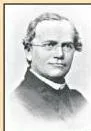
Gregor Mendel studied at the University of Vienna and later grew pea plants at his monastery. What set him apart from earlier researchers was that he actually counted how many offspring in each generation showed each trait, instead of just describing them (NCERT, p. 3).
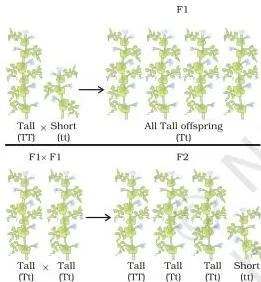
His classic experiment: cross a tall pea plant with a short one. Every single F1 (first-generation) plant turned out tall — none were of medium height. This told Mendel that inheritance is not a blending process; one full trait wins out, not an average of the two (NCERT, p. 3). The real test came next. He let the F1 tall plants self-pollinate to produce the F2 generation. This time, about one-quarter of the F2 plants were short. Since shortness reappeared after skipping a generation, the F1 plants must have been carrying the factor for shortness all along — it just wasn’t expressed.
Mendel explained this by proposing that every plant carries two copies of the factor (now called a gene) for each trait — one from each parent. If the two copies differ, only one of them is expressed. A trait that shows up even with one copy present (like ‘T’ for tallness) is called a dominant trait; a trait that shows up only when both copies match (like ‘t’ for shortness in ‘tt’) is a recessive trait (NCERT, p. 3). So TT and Tt plants both look tall; only tt looks short.
Dihybrid Cross: Why Traits Are Inherited Independently
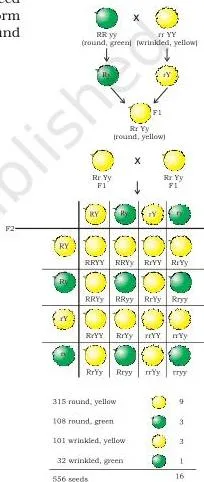
Mendel then asked what happens if you track two traits at once. He crossed a tall pea plant with round seeds against a short plant with wrinkled seeds. All F1 plants were tall with round seeds — both tallness and round seeds are dominant traits (NCERT, p. 3).
The interesting part appeared when these F1 plants self-pollinated to give F2. Most F2 plants matched one of the two original parent combinations (tall-round or short-wrinkled), but some showed brand-new combinations that neither parent had — tall plants with wrinkled seeds, and short plants with round seeds (NCERT, p. 4). New combinations could only appear if the gene for plant height and the gene for seed shape can separate and recombine independently of each other. This is the principle of independent assortment: unrelated traits are inherited separately, not as a fixed package.
From Genes to Traits: The DNA-Enzyme-Hormone Link
A gene is a section of DNA that carries the information to make one particular protein (NCERT, p. 4). Take plant height as an example. Plants grow taller under the influence of a growth hormone, and the amount of that hormone made depends on how efficiently a particular enzyme works. An efficient version of the enzyme produces more hormone, so the plant grows tall. If the gene for that enzyme is altered so the enzyme works less efficiently, less hormone is made and the plant stays short. In short: gene → enzyme → hormone level → visible trait.
For both parents to influence a trait equally, each must contribute one full copy of the relevant gene, meaning every pea plant carries two copies of every gene — one from each parent. But if all genes existed on a single continuous DNA thread, traits like plant height and seed shape would always travel together, and the new combinations seen in the dihybrid cross (as discussed in the reproduction chapter on DNA copying) could never appear. The NCERT explanation is that a gene set exists as several separate, independent pieces called chromosomes, not one long strand. Each germ cell (sperm or egg) picks up just one chromosome from each pair, and this pairing restores the full set when two germ cells combine at fertilisation (NCERT, p. 4). Because different chromosomes assort independently during germ-cell formation, unlinked traits like height and seed shape can recombine freely — which is exactly what the dihybrid cross showed.
Sex Determination in Humans: The X and Y Story
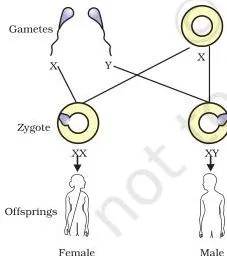
Humans have 23 pairs of chromosomes. Twenty-two of these pairs are identical in shape between men and women. The 23rd pair, the sex chromosomes, is different: women carry two X chromosomes (XX), while men carry one normal-sized X and one shorter Y chromosome (XY) (NCERT, p. 5).
Every child receives one X chromosome from the mother, since that is all she has to give. What decides the child’s sex is which chromosome the child receives from the father. A sperm carrying an X chromosome produces a girl (XX); a sperm carrying a Y chromosome produces a boy (XY). Since a man produces roughly equal numbers of X-bearing and Y-bearing sperm, each pregnancy has a theoretical 1:1 chance of either outcome (NCERT, p. 5).
This directly corrects a common belief: it is not the mother’s genes that decide a baby’s sex — biologically, she can only pass on an X chromosome. The determining event is entirely on the father’s side, in which type of sperm fertilises the egg.
Not every species uses this method. In some reptiles, the temperature at which the eggs are kept decides whether the hatchlings develop as male or female — an environmental trigger, not a genetic one. In snails, an individual can change its sex during its lifetime, showing that sex is not fixed by genes in every organism (NCERT, p. 5). Humans are firmly in the genetically-determined category.
Key Terms You Must Know: Gene, Allele, Dominant, Recessive and More
| Term | What it means |
|---|---|
| Gene | A section of DNA that carries the code for making one protein; the basic unit of inheritance (p. 4). |
| Dominant trait | A trait that is expressed even when only one copy of its gene is present, e.g. tallness (‘T’) in Mendel’s pea plants (p. 3). |
| Recessive trait | A trait expressed only when both copies of the gene match, e.g. shortness (‘tt’) (p. 3). |
| F1 generation | The first-generation offspring of a cross between two parent plants/organisms (p. 3). |
| F2 generation | The offspring produced when F1 individuals self-pollinate or are crossed with each other (p. 3). |
| Homozygous / heterozygous | Homozygous means both gene copies are identical (TT or tt); heterozygous means the two copies differ (Tt). |
| Chromosome | An independent, separate piece of DNA carrying a set of genes; humans have 23 pairs (p. 4–5). |
| Sex chromosome | The chromosome pair that differs between the sexes — XX in women, XY in men (p. 5). |
| Germ cell | A reproductive cell (egg or sperm) carrying only one chromosome from each pair (p. 4). |
Mendelian Ratios to Remember for Exams
| Cross type | Ratio | What it describes |
|---|---|---|
| Monohybrid cross — F2 phenotypic ratio | \(3:1\) | Tall : short (dominant trait shown by 3 parts, recessive by 1 part) (p. 3). |
| Monohybrid cross — F2 genotypic ratio | \(1:2:1\) | TT : Tt : tt (pure dominant : hybrid : pure recessive) (p. 3). |
| Dihybrid cross — F2 phenotypic ratio | \(9:3:3:1\) | Both dominant : one dominant-one recessive (two combinations) : both recessive (p. 4). |
| Sex ratio per pregnancy (humans) | \(1:1\) | Theoretical chance of a girl versus a boy, since half the sperm carry X and half carry Y (p. 5). |
These ratios hold for large numbers of offspring, the way Mendel counted hundreds of pea plants. In a single small family or a small batch of seedlings, the actual numbers can differ quite a bit from the ratio — that is chance at work on a small sample, not a failure of the rule.
Solved Problems: Monohybrid Cross, Dihybrid Cross and Sex Ratio
Problem 1: Monohybrid cross — purple pod versus green pod
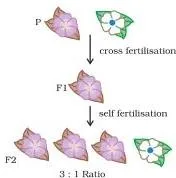
Step 1: A cross between a purebred purple-podded pea plant and a purebred green-podded pea plant gives an F1 generation that is entirely purple-podded, so purple pod colour is the dominant trait and green is recessive.
Step 2: When these F1 plants self-pollinate, the F2 generation of 640 plants follows the phenotypic ratio \(3:1\) (purple : green).
\[ \text{Purple-podded} = \frac{3}{4} \times 640 = 480 \]
\[ \text{Green-podded} = \frac{1}{4} \times 640 = 160 \]
Step 3: Using the genotypic ratio \(1:2:1\) (PP : Pp : pp) on the same 640 plants:
\[ PP = \frac{1}{4} \times 640 = 160, \quad Pp = \frac{2}{4} \times 640 = 320, \quad pp = \frac{1}{4} \times 640 = 160 \]
Final answer: 480 purple-podded plants (160 PP + 320 Pp) and 160 green-podded plants (160 pp).
Problem 2: Dihybrid cross — smooth red seeds versus wrinkled white seeds
Step 1: A plant with smooth, red seeds is crossed with one that has wrinkled, white seeds. The F1 plants are all smooth and red, showing that smoothness and red colour are the dominant traits.
Step 2: The F1 plants self-pollinate to give 320 F2 plants, which split in the \(9:3:3:1\) ratio across four seed types. Since \(9+3+3+1 = 16\), each ‘part’ equals:
\[ \frac{320}{16} = 20 \text{ plants per part} \]
\[ \text{Smooth, red} = 9 \times 20 = 180, \quad \text{Smooth, white} = 3 \times 20 = 60 \]
\[ \text{Wrinkled, red} = 3 \times 20 = 60, \quad \text{Wrinkled, white} = 1 \times 20 = 20 \]
Step 3: Smooth-red (180) and wrinkled-white (20) match the original parents, so they are the parental combinations. Smooth-white (60) and wrinkled-red (60) are new combinations, produced because the seed-shape gene and seed-colour gene assort independently.
Final answer: 180 smooth-red, 60 smooth-white, 60 wrinkled-red, 20 wrinkled-white; the middle two categories are the new combinations.
Problem 3: Sex ratio in a family of four children
Step 1: Each pregnancy has an independent, theoretical chance of \(1:1\) for a girl versus a boy, because the father makes roughly equal numbers of X-bearing and Y-bearing sperm.
Step 2: Over 4 children, the theoretical expectation is 2 girls and 2 boys.
Step 3: In reality, each birth is an independent event, like a coin toss. A family could easily have 4 girls, or 3 boys and 1 girl, purely by chance — the \(1:1\) ratio is only expected to show up reliably over a very large number of births, not in one family of four.
Final answer: Theoretical expectation is 2 girls and 2 boys, but small families can deviate from this because each child’s sex is decided independently.
Where Students Lose Marks in This Chapter
| Mistake | Correct rule | How to check your answer |
|---|---|---|
| Assuming a dominant trait is ‘stronger’ or more common in a population | Dominance describes how a gene is expressed when paired with a different copy — it has no link to how frequent the trait is in a population, as the trait-A/trait-B question on page 2 tests directly. | Ask: does this trait appear in a cross even with a single copy present? If yes, it’s dominant, regardless of how many individuals show it. |
| Expecting F1 offspring to show a blend of parental traits (e.g. medium height) | Mendel’s F1 plants showed only one full parental trait, never an average — inheritance is not blending (p. 3). | Check the F1 phenotype against both parents; it should match one parent completely, not sit in between. |
| Confusing genotype with phenotype in a Punnett square | Genotype is the gene combination (TT, Tt, tt); phenotype is the visible trait (tall or short). TT and Tt share a phenotype but differ in genotype. | Before writing an answer, label each square as genotype first, then work out phenotype separately. |
| Believing the mother’s chromosomes decide the child’s sex | The mother always contributes an X chromosome; it is the father’s X or Y sperm that decides whether the child is a girl or a boy (p. 5). | Trace the sex chromosome pair back to the father’s gamete, not the mother’s, before answering. |
| Applying \(3:1\) or \(9:3:3:1\) ratios to a small litter and expecting an exact match | These ratios are statistical averages seen over large numbers of offspring, not guarantees for every small cross. | If the sample size given in a question is small, state that deviation from the exact ratio is expected by chance. |
How CBSE Tests Heredity: Question Patterns to Watch
NCERT’s own end-of-chapter question on blood groups is a good model for how CBSE frames this topic: a man with blood group A marries a woman with blood group O, and their daughter has blood group O. The question asks whether this single cross is enough to tell you which trait, A or O, is dominant. It is not — one cross cannot establish dominance, because you would need to see the pattern repeat across many offspring, or compare it against a cross where the same trait combination is tested in reverse, before drawing a conclusion (NCERT, p. 6). CBSE frequently reuses this exact reasoning style with other trait pairs — eye colour, coat colour in dogs — asking students to say whether the given data is ‘enough’ to conclude dominance, and to explain why or why not. Full marks require the reasoning, not just a yes/no answer.
The other recurring format is a genotype-identification MCQ: for example, working out that a tall, violet-flowered parent producing tall and short progeny (all violet) must be heterozygous for height but homozygous dominant for flower colour, written as Tt WW. A third format uses assertion-style or short-answer questions on sex determination, testing whether students correctly identify that the father’s X or Y sperm — not the mother’s genes — decides a child’s sex. Across all three formats, these are typically 2–3 mark reasoning questions, not numericals, so practise writing the full explanation rather than jumping straight to a final answer.
Heredity Chapter 8: Quick Recap Before the Exam
- Variation accumulates more in sexual reproduction than in asexual reproduction, because sexual reproduction mixes DNA from two parents (p. 1).
- Mendel used pea plants and, unlike earlier researchers, counted the number of offspring showing each trait across generations (p. 3).
- F1 offspring show only the dominant trait; F2 offspring split \(3:1\) between dominant and recessive phenotypes (p. 3).
- Two unrelated traits are inherited independently, giving a \(9:3:3:1\) ratio in F2 of a dihybrid cross (p. 4).
- Genes are DNA segments that code for proteins/enzymes, which in turn control hormone levels and visible traits (p. 4).
- Each germ cell carries one chromosome from every pair, which is why unlinked traits can recombine freely (p. 4).
- In humans, women are XX and men are XY; the father’s sperm (X or Y) decides the child’s sex, giving a theoretical \(1:1\) sex ratio (p. 5).
Heredity Class 10: Questions Students Keep Asking
Why did all the F1 plants in Mendel’s cross come out tall and not medium height?
Because inheritance does not blend two traits into an average. Each F1 plant carries one gene copy for tallness and one for shortness, but tallness is dominant, so it alone is expressed. The shortness gene is present but hidden until it meets another copy of itself in the next generation (NCERT, p. 3).
What is the difference between genotype TT, Tt and tt in a monohybrid cross?
TT and tt are homozygous — both gene copies are the same (both dominant or both recessive). Tt is heterozygous, with one dominant and one recessive copy. Phenotypically, TT and Tt both look tall; only tt looks short (NCERT, p. 3).
If a trait is recessive, does that mean it will disappear from a population over generations?
No. A recessive trait can stay hidden in heterozygous individuals (Tt) for generations and reappear whenever two carriers happen to have offspring together. Dominance and recessiveness describe how a trait is expressed, not how common or rare it becomes over time.
How can one cross like blood group A x blood group O tell us which trait is dominant?
A single cross cannot tell us that on its own. In the NCERT example, a father with blood group A and mother with blood group O have a daughter with blood group O — this shows O can appear in offspring, but one instance is not enough evidence to call A or O dominant. You would need to examine the pattern across many such crosses (NCERT, p. 6).
Why do human males have an X and a Y chromosome instead of two X chromosomes?
Because the sex chromosome pair is the one pair in humans that is not always matched. Women inherit an X from each parent, giving XX. Men inherit an X from their mother (the only kind she has) and a Y from their father, giving XY. This mismatch in the male pair is exactly what allows sex to be determined genetically (NCERT, p. 5).
Is the 9:3:3:1 ratio always seen exactly in real dihybrid crosses?
Not exactly, especially with a small number of offspring. The ratio \(9:3:3:1\) is a statistical expectation that shows up reliably only over large sample sizes, similar to how a coin only approaches a 50-50 split after many tosses, not after four or five.
For the original chapter text and diagrams, you can also check the NCERT Class 10 Science textbook, Chapter 8 on the official NCERT website. For the chapter that these heredity class 10 notes build on — how organisms pass on DNA in the first place — revisit the How Do Organisms Reproduce notes, and browse more chapters on the Class 10 Science notes hub.
Reference: NCERT Class 10 Science textbook, chapter Heredity.
Explore Class 10 Science Notes
Related chapters: