Electricity Class 10 Notes: Ohm’s Law, Resistance, Power
These electricity class 10 notes cover Chapter 11 of the NCERT Science textbook — how electric charge flows in a circuit, what decides the size of the current, Ohm’s law, resistance combinations, and the heating and power effects of current. The chapter explains what constitutes electric current, how it is measured, and how it produces heat and does work (NCERT, p. 1). Every definition, formula and solved example below follows the order the NCERT builds the chapter in, so you can revise it exactly as it will be tested.
What Chapter 11 Electricity Actually Tests
Electricity is a numerical-heavy chapter. Board papers pull questions from three zones: direct formula application (current, resistance, power), reasoning-based “explain why” questions (fuse wire, alloy heating coils, tungsten filaments), and diagram-based questions that test correct use of circuit symbols. A student who only memorises formulas without understanding why Ohm’s law needs constant temperature, or why a parallel circuit is preferred at home, loses marks even on questions they technically know. This page works through the chapter in the same sequence NCERT uses, so each idea builds on the one before it.
Chapter Map: From Charge Flow to Household Wiring
The chapter has a logical build: electric current and circuit → potential difference → Ohm’s law → resistance and resistivity → series and parallel combinations → heating effect → electric power and the kilowatt hour. Each idea depends on the one before it — you cannot state Ohm’s law without first knowing what current and potential difference are, and you cannot work out heat and power without Ohm’s law. Revise in this order rather than jumping straight to formulas; it is the fastest way to avoid silly mistakes in numericals.
If you are revising the full syllabus, keep the Class 10 Science notes page open alongside this chapter — Electricity connects directly into the next chapter on Magnetic Effects of Electric Current, which reuses the same current and circuit ideas.
Electric Current and Circuit: Charge in Motion
When electric charge flows through a conductor, we say there is an electric current in it. A continuous, closed path along which current flows is called an electric circuit; break the path anywhere (open a switch) and the current stops (NCERT, p. 1). Current is defined as the rate of flow of charge:
\[ I = \frac{Q}{t} \]
Here \( Q \) is the charge (in coulombs) crossing a section of the conductor in time \( t \) (in seconds). The SI unit of current is the ampere (A); \( 1\ \text{A} = 1\ \text{C/s} \) (NCERT, p. 2). In a metallic wire, electrons carry the charge, but current direction is conventionally taken opposite to the direction electrons actually move — this convention was fixed before electrons were discovered, when current was assumed to be a flow of positive charge (NCERT, p. 1). This single fact is a favourite in MCQs: current direction and electron-flow direction are always opposite in a conductor.
An ammeter measures current and must always be connected in series in the circuit whose current you want to read (NCERT, p. 2). If a student asks why current is not simply “how fast electrons move” — current depends on both how much charge moves and how fast; the same current can occur in a thin wire with fast-moving electrons or a thick wire with slow-moving electrons, because current counts total charge per second, not individual electron speed.
Potential Difference: Why Charge Moves at All
Charges do not flow on their own inside a wire, just as water does not flow through a horizontal pipe unless one end is at a higher level than the other. A cell creates this “electrical pressure difference” — called potential difference — between its terminals using the chemical energy stored inside it (NCERT, p. 3). Potential difference is the work done to move a unit charge between two points:
\[ V = \frac{W}{Q} \]
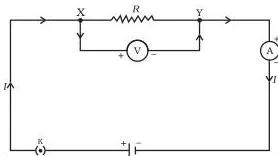
The SI unit is the volt (V); \( 1\ \text{V} = 1\ \text{J/C} \) — one volt means 1 joule of work is needed to move 1 coulomb of charge between the two points (NCERT, p. 3). A voltmeter measures this and is always connected in parallel across the two points, never in series (NCERT, p. 4). If the potential difference across a closed circuit is zero, no current flows even if the circuit path is complete — a circuit needs both a closed path AND a driving potential difference; one without the other gives no current.
Circuit Diagram Symbols You Must Recognise
NCERT Table 11.1 lists the standard symbols used to draw circuit diagrams (NCERT, p. 4). CBSE diagram-based questions are marked strictly on correct symbol use — a wrongly drawn ammeter placement (in parallel instead of series) or a voltmeter drawn in series costs marks even if the rest of the diagram is right.
| Component | What it represents | Placement rule to remember |
|---|---|---|
| Cell | Single source of potential difference | Longer line is the positive terminal |
| Battery | Combination of cells | Same polarity convention as a cell |
| Plug key / switch (open) | Breaks the circuit | Gap shown in the line |
| Plug key / switch (closed) | Completes the circuit | No gap in the line |
| Wire joint | Two wires electrically connected | Shown with a dot at the junction |
| Wires crossing without joining | Wires that cross on paper but carry no shared current | Shown as a small hump, no dot |
| Electric bulb | Resistive load that also gives light | Drawn as a circle with a cross |
| Resistor \( (R) \) | Fixed resistance | Zig-zag line |
| Rheostat | Variable resistance | Zig-zag line with an arrow across it |
| Ammeter | Measures current | Always in series |
| Voltmeter | Measures potential difference | Always in parallel |
Ohm’s Law and the V-I Graph
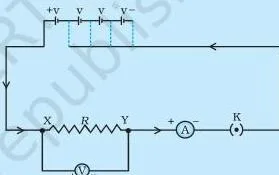
Ohm’s law states that the potential difference across a metallic conductor is directly proportional to the current through it, provided its temperature remains the same (NCERT, p. 5). That condition is the part most students drop while writing the law in exams, and CBSE examiners deduct a mark for it. Mathematically:
\[ V \propto I \quad \Rightarrow \quad \frac{V}{I} = \text{constant} = R \quad \Rightarrow \quad V = IR \]
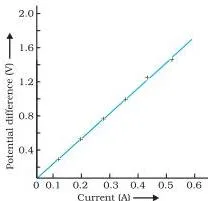
The constant \( R \) is the resistance of the conductor, measured in ohm \( (\Omega) \). One ohm is the resistance of a conductor across which 1 V produces a current of 1 A (NCERT, p. 5). Plotting V against I for a nichrome wire gives a straight line through the origin — this straight-line, origin-passing graph is the visual proof that V and I are directly proportional (NCERT, p. 6). If a graph question shows a curve instead of a straight line, the component is not obeying Ohm’s law (temperature is changing, as in a bulb filament).
From \( V = IR \), current \( I = V/R \): current is inversely proportional to resistance, so doubling resistance halves the current for the same voltage (NCERT, p. 6). A rheostat is a variable resistance used to change current in a circuit without changing the source voltage — it is placed in series and works exactly on this inverse relationship.
What Decides a Wire’s Resistance: Length, Area, Material
Resistance of a uniform conductor depends on three things: it is directly proportional to length \( l \), inversely proportional to cross-sectional area \( A \), and depends on the material (NCERT, p. 7-8). Combining these:
\[ R = \rho \frac{l}{A} \]
where \( \rho \) (rho) is resistivity, a property of the material alone, independent of the wire’s length or thickness. Its SI unit is \( \Omega\,\text{m} \). Metals and alloys have low resistivity, roughly \( 10^{-8} \) to \( 10^{-6}\ \Omega\,\text{m} \), which makes them good conductors; insulators have resistivity as high as \( 10^{10} \) to \( 10^{17}\ \Omega\,\text{m} \) (NCERT, p. 8). NCERT explicitly says you do not need to memorise the exact resistivity values — you only need them to solve a numerical when they are given in the question (NCERT, p. 8).
Alloys such as nichrome, manganin and constantan usually have higher resistivity than the pure metals that make them up, and they do not oxidise easily even at high temperatures. That is exactly why heating devices like electric irons and toasters use nichrome coils instead of copper: copper would oxidise (burn out) quickly at the temperatures needed for heating, while nichrome survives repeated heating cycles (NCERT, p. 8). Tungsten, with a very high melting point, is used for bulb filaments for the same reason — it must glow white-hot without melting.
Resistors in Series vs Parallel: The Rules and the Difference
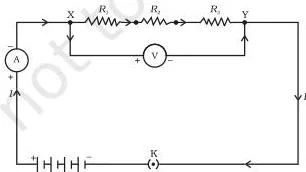
In series, resistors are joined end to end so the same current \( I \) flows through each one, while the potential difference splits across them: \( V = V_1 + V_2 + V_3 \) (NCERT, p. 12-13). Applying Ohm’s law to each resistor and adding gives the series rule:
\[ R_s = R_1 + R_2 + R_3 \]
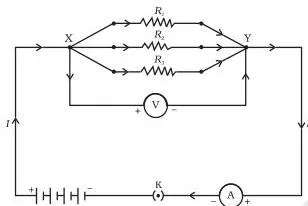
In parallel, resistors share the same two end points, so the potential difference \( V \) across each one is the same, while the current splits: \( I = I_1 + I_2 + I_3 \) (NCERT, p. 15-16). This gives the parallel rule:
\[ \frac{1}{R_p} = \frac{1}{R_1} + \frac{1}{R_2} + \frac{1}{R_3} \]
| Feature | Series combination | Parallel combination |
|---|---|---|
| Current | Same current through every resistor | Current divides; each branch gets a different current |
| Potential difference | Divides across resistors, adds up to the source V | Same across every resistor, equal to the source V |
| Equivalent resistance | \( R_s = R_1+R_2+R_3 \), always greater than the largest individual resistor | \( 1/R_p \) is a sum of reciprocals; \( R_p \) is always smaller than the smallest individual resistor |
| Effect of one component failing | Whole circuit breaks — no other component works | Other components keep working normally |
This last row is why household wiring uses parallel connections, not series (NCERT, p. 17). If a bulb, fan, and iron were wired in series, all three would need the same current, which is impossible since they are designed for very different currents, and if any one device switched off or failed the entire house would lose power. In parallel, each appliance gets the full mains voltage independently and can be switched on or off without affecting the others.
Heating Effect of Current and Joule’s Law
When a resistor carries current, the source keeps supplying energy to move the charge, and in a purely resistive circuit this energy is entirely converted to heat (NCERT, p. 18). The power delivered by the source is \( P = VI \), so the heat produced in time \( t \) is:
\[ H = VIt \]
Using Ohm’s law \( (V = IR) \) to substitute for V gives Joule’s law of heating:
\[ H = I^2 R t \]
This tells you heat is directly proportional to the square of the current, directly proportional to resistance, and directly proportional to time (NCERT, p. 19). Because \( H \propto I^2 \), doubling the current quadruples the heat produced in the same resistor over the same time — this is why overcurrent is dangerous and why fuses matter.
A common exam question asks why the connecting cord of an electric heater stays cool while the heating coil glows red. The same current \( I \) flows through both the cord and the coil since they are in series, but the cord is usually thick copper wire with very low resistance, while the coil is thin nichrome wire with high resistance. Since \( H = I^2 R t \) and \( I \) and \( t \) are identical for both, the heat produced is proportional only to \( R \) — the cord’s low resistance means it generates very little heat, while the coil’s high resistance generates a lot (NCERT, p. 20).
A fuse uses this same principle protectively: it is a wire of a metal or alloy with a set melting point, placed in series with the circuit. If current exceeds a rated value, \( I^2Rt \) heating melts the fuse wire and breaks the circuit before the wiring or appliance is damaged (NCERT, p. 20). Domestic fuses are rated 1 A, 2 A, 3 A, 5 A, 10 A and so on. A 1 kW iron on a 220 V line draws \( 1000/220 = 4.54\ \text{A} \), so a 5 A fuse — the next rating above the running current — is the correct choice (NCERT, p. 20).
Electric Power, Energy and the Electricity Bill
Electric power is the rate at which electrical energy is consumed:
\[ P = VI = I^2R = \frac{V^2}{R} \]
The SI unit is the watt (W); 1 W is the power used when 1 A flows at a potential difference of 1 V (NCERT, p. 21). Since watt is a small unit for everyday electricity use, bills are measured in kilowatt hour (kWh), commonly called a “unit”:
\[ 1\ \text{kWh} = 1000\ \text{W} \times 3600\ \text{s} = 3.6 \times 10^{6}\ \text{J} \]
NCERT specifically corrects a common misunderstanding: electrons are not consumed or used up in a circuit. What you pay the electricity supplier for is the energy spent moving those electrons through your appliances, not the electrons themselves (NCERT, p. 21).
To find an electricity bill from a rated wattage and hours of use, follow three steps: first, find the total energy consumed in watt-hour by multiplying power (W) by time (hours); second, convert that to kilowatt-hour by dividing by 1000; third, multiply the kWh figure by the rate charged per unit. This three-step method is applied with real numbers in the worked example below.
Definitions You Must State Correctly in Exams
| Term | Definition | SI unit |
|---|---|---|
| Electric current | Rate of flow of electric charge through a cross-section of a conductor | ampere (A) |
| Potential difference | Work done to move a unit charge between two points in a circuit | volt (V) |
| Resistance | Property of a conductor that opposes the flow of charge through it | ohm \( (\Omega) \) |
| Resistivity | Resistance of a unit length of a material with unit cross-sectional area; a fixed property of the material | \( \Omega\,\text{m} \) |
| Ohm’s law | Potential difference across a conductor is directly proportional to current through it, at constant temperature | — |
| Series combination | Resistors joined end to end so the same current flows through each one | — |
| Parallel combination | Resistors joined between the same two points so each carries part of the total current at the same potential difference | — |
| Electric power | Rate at which electrical energy is consumed or dissipated in a circuit | watt (W) |
| Kilowatt hour | Commercial unit of electrical energy; energy used at the rate of 1 kW for 1 hour | kWh (\(3.6\times10^{6}\ \text{J}\)) |
Formula Sheet for Chapter 11
| Formula | Meaning | SI unit |
|---|---|---|
| \( I = Q/t \) | Current from charge and time | A |
| \( V = W/Q \) | Potential difference from work and charge | V |
| \( V = IR \) | Ohm’s law | V |
| \( R = \rho l/A \) | Resistance from resistivity, length, area | \( \Omega \) |
| \( R_s = R_1+R_2+R_3 \) | Equivalent resistance in series | \( \Omega \) |
| \( 1/R_p = 1/R_1+1/R_2+1/R_3 \) | Equivalent resistance in parallel | \( \Omega \) |
| \( H = VIt = I^2Rt \) | Heat produced (Joule’s law) | J |
| \( P = VI = I^2R = V^2/R \) | Electric power | W |
| \( 1\ \text{kWh} = 3.6\times10^{6}\ \text{J} \) | Commercial unit of energy | kWh |
Solved Numericals: Current, Resistance and Combinations (New Values)
Example 1: Charge from a steady current
Step 1: A wire carries a current \( I = 2\ \text{A} \) for \( t = 5\ \text{min} = 300\ \text{s} \). Use \( Q = It \).
\[ Q = 2\ \text{A} \times 300\ \text{s} = 600\ \text{C} \]
Final answer: 600 coulombs of charge flow through the wire.
Example 2: Work done moving charge through a potential difference
Step 1: A charge \( Q = 5\ \text{C} \) moves through a potential difference \( V = 10\ \text{V} \). Use \( W = VQ \).
\[ W = 10\ \text{V} \times 5\ \text{C} = 50\ \text{J} \]
Final answer: 50 joules of work are done.
Example 3: Resistance of a copper wire from resistivity
Step 1: Length \( l = 2\ \text{m} \), diameter \( d = 0.6\ \text{mm} = 6\times10^{-4}\ \text{m} \), resistivity \( \rho = 1.62\times10^{-8}\ \Omega\,\text{m} \) (copper). Find the area first: \( A = \pi d^2/4 \).
\[ A = \frac{\pi (6\times10^{-4})^2}{4} = 2.83\times10^{-7}\ \text{m}^2 \]
Step 2: Apply \( R = \rho l/A \).
\[ R = \frac{1.62\times10^{-8}\times 2}{2.83\times10^{-7}} \approx 0.115\ \Omega \]
Final answer: The wire’s resistance is approximately \( 0.115\ \Omega \).
Example 4: Three resistors in series
Step 1: Resistors of \( 6\ \Omega \), \( 9\ \Omega \) and \( 15\ \Omega \) are in series with a 15 V battery. Add resistances: \( R_s = 6+9+15 = 30\ \Omega \).
Step 2: Find current using Ohm’s law on the whole circuit: \( I = V/R_s \).
\[ I = \frac{15\ \text{V}}{30\ \Omega} = 0.5\ \text{A} \]
Step 3: This same current flows through each resistor (series rule). Find the pd across each: \( V_1 = IR_1 \), \( V_2 = IR_2 \), \( V_3 = IR_3 \).
\[ V_1 = 0.5\times6 = 3\ \text{V}, \quad V_2 = 0.5\times9 = 4.5\ \text{V}, \quad V_3 = 0.5\times15 = 7.5\ \text{V} \]
Final answer: Current \( = 0.5\ \text{A} \); pd across the resistors is 3 V, 4.5 V and 7.5 V respectively (these add up to 15 V, confirming the series rule).
Example 5: Three resistors in parallel
Step 1: Resistors of \( 15\ \Omega \), \( 30\ \Omega \) and \( 10\ \Omega \) are connected in parallel across a 30 V source. Find the equivalent resistance using \( 1/R_p = 1/R_1+1/R_2+1/R_3 \).
\[ \frac{1}{R_p} = \frac{1}{15}+\frac{1}{30}+\frac{1}{10} = \frac{2+1+3}{30} = \frac{6}{30} = \frac{1}{5} \quad \Rightarrow \quad R_p = 5\ \Omega \]
Step 2: The pd across each resistor is the full 30 V (parallel rule). Find the branch currents using \( I = V/R \).
\[ I_1 = \frac{30}{15} = 2\ \text{A}, \quad I_2 = \frac{30}{30} = 1\ \text{A}, \quad I_3 = \frac{30}{10} = 3\ \text{A} \]
Step 3: Total current \( I = I_1+I_2+I_3 = 6\ \text{A} \). Check using \( I = V/R_p = 30/5 = 6\ \text{A} \) — matches.
Final answer: Equivalent resistance \( = 5\ \Omega \); total current drawn from the source \( = 6\ \text{A} \).
Solved Numericals: Heating Effect, Power and Electricity Cost (New Values)
Example 6: Electricity bill for a geyser
Step 1: A geyser rated 2000 W is used 2 hours a day for 15 days. Find the total energy in watt-hour: energy \( = \) power \( \times \) time.
\[ \text{Energy} = 2000\ \text{W} \times 2\ \text{h/day} \times 15\ \text{days} = 60000\ \text{Wh} \]
Step 2: Convert to kilowatt-hour by dividing by 1000.
\[ 60000\ \text{Wh} = 60\ \text{kWh} \]
Step 3: Multiply by the rate, Rs 5 per unit (1 kWh = 1 unit).
\[ \text{Cost} = 60\ \text{kWh} \times \text{Rs } 5 = \text{Rs } 300 \]
Final answer: The geyser consumes 60 kWh (units) over 15 days, and the cost is Rs 300.
Example 7: Heat produced by Joule heating
Step 1: A resistor of \( R = 5\ \Omega \) carries \( I = 3\ \text{A} \) for \( t = 40\ \text{s} \). Apply \( H = I^2Rt \) directly since current is already given (no need to find V first).
\[ H = 3^2 \times 5 \times 40 = 9 \times 5 \times 40 = 1800\ \text{J} \]
Final answer: 1800 joules of heat are produced.
Example 8: Power and resistance of a bulb
Step 1: A bulb draws \( I = 0.25\ \text{A} \) from a \( V = 220\ \text{V} \) line. Find power using \( P = VI \).
\[ P = 220 \times 0.25 = 55\ \text{W} \]
Step 2: Find resistance using \( R = V/I \).
\[ R = \frac{220}{0.25} = 880\ \Omega \]
Final answer: The bulb’s power is 55 W and its resistance is \( 880\ \Omega \).
Reading the Chapter’s Circuit Diagrams
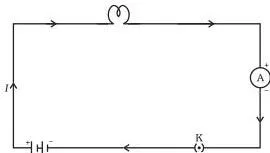
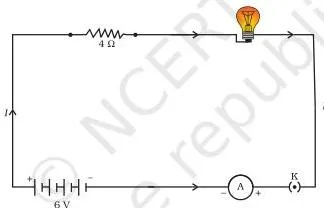
In Figure 11.1, the cell provides the potential difference, the bulb is the resistive load, the ammeter (always in series) reads the circuit current, and the plug key opens or closes the path (NCERT, p. 2). When you redraw this diagram, keep current flowing from the positive terminal of the cell, through the external circuit, back to the negative terminal — that is the conventional direction examiners expect.
Mixed series-parallel diagrams, like the arrangement of five resistors in Example 11.9 of the textbook, are simplified in two stages: first replace each parallel group of resistors with its single equivalent resistance using \( 1/R_p = \Sigma(1/R) \), then add these equivalent values in series using \( R_s = \Sigma R \) (NCERT, p. 17). Doing this in stages, rather than trying to combine everything in one step, is the safest way to avoid arithmetic slips in a mixed-combination question.
Mistakes That Cost Marks in This Chapter
| Mistake | Correct rule | How to check your answer |
|---|---|---|
| Connecting the ammeter in parallel or the voltmeter in series | Ammeter always in series (measures the current actually flowing); voltmeter always in parallel (measures pd without diverting current) | Trace the circuit path — current must pass through the ammeter; the voltmeter should sit on a side branch across two points |
| Stating Ohm’s law without the constant-temperature condition | \( V \propto I \) holds only if temperature stays the same; resistance itself changes with temperature | Re-read your written statement — it must include “provided temperature remains constant” |
| Adding resistances directly for a parallel combination | Use \( 1/R_p = 1/R_1+1/R_2+1/R_3 \), not \( R_p = R_1+R_2+R_3 \) | \( R_p \) must come out smaller than the smallest individual resistor — if your answer is larger, you added instead of using reciprocals |
| Using \( H = VIt \) when only current and resistance are given | Find \( V = IR \) first if V is not given directly, or use \( H = I^2Rt \) straightaway | Check which quantities the question actually gives before picking a formula |
| Assuming resistance halves when a wire’s diameter is doubled | \( R \propto 1/A \propto 1/d^2 \); doubling the diameter makes area 4 times larger, so resistance drops to one-fourth, not one-half | Recompute \( A = \pi d^2/4 \) with the new diameter and substitute into \( R = \rho l/A \) rather than guessing the ratio |
How CBSE Sets Questions From This Chapter
CBSE routinely pairs a numerical (series/parallel resistance or power calculation) with a reasoning “explain why” question from the same chapter in one paper — questions like why tungsten is used for filaments, why heating devices use an alloy rather than a pure metal, and why series arrangement is unsuitable for domestic wiring appear directly as Exercise Question 18(a)-(c) in the textbook (NCERT, p. 24). A full-marks answer to a reasoning question must state the property involved (high melting point, high resistivity, resistance to oxidation, or independence of appliances) AND connect it to the specific device asked about — a vague answer without the device-specific link loses marks.
Diagram-drawing questions, such as Exercise Question 1 on page 15 asking you to draw a series circuit with a battery, three resistors and a plug key, are marked on correct symbol use from Table 11.1 — a wrong ammeter or voltmeter placement is marked wrong even if the resistor values used in any follow-up calculation are correct.
Ratio-based questions are also common: Exercise Question 1 on page 23 asks about a wire cut into five equal parts and reconnected in parallel, testing whether you understand how \( R \) changes with length and how parallel combination changes equivalent resistance together — practise the underlying ratio logic (how \( R \) scales with \( l \) and how \( R_p \) scales with the number of equal parallel branches), not just the plug-in formula, since MCQs often rearrange the same idea with new numbers.
Quick Recap Before the Exam
- Conventional current direction is opposite to the direction electrons actually flow.
- Potential difference is measured in volts; it is the driving cause of current, maintained by a cell’s chemical energy.
- Resistance depends on length, area of cross-section, and the material of the conductor — captured in \( R = \rho l/A \).
- Ohm’s law holds only when temperature stays constant; a straight V-I line through the origin is its graphical signature.
- Series: same current, pd adds, equivalent resistance is the sum and is always larger than any one resistor.
- Parallel: same pd, current adds, equivalent resistance is found from reciprocals and is always smaller than the smallest resistor.
- Joule’s law: \( H = I^2Rt \) — heat depends on the square of current, on resistance, and on time.
- Electric power: \( P = VI = I^2R = V^2/R \), measured in watts; energy is billed in kilowatt hour.
- \( 1\ \text{kWh} = 3.6\times10^{6}\ \text{J} \) — you pay for energy consumed, not for electrons used up.
Frequently Asked Questions on Electricity Class 10
Why must an ammeter be connected in series and a voltmeter in parallel in a circuit?
An ammeter must carry the actual circuit current to measure it, so it is placed in series, directly in the current’s path (NCERT, p. 2). A voltmeter measures the potential difference between two points without disturbing the current, so it is connected in parallel across those points (NCERT, p. 3-4). Placing them the wrong way round gives an incorrect reading and can damage the instrument.
Why is nichrome used for the heating element of an electric iron instead of copper wire?
Nichrome has much higher resistivity than copper, so a short length of it produces significant Joule heating (\( H = I^2Rt \)) at normal household currents. It also resists oxidation at high temperatures, unlike copper, which would burn out quickly if made to glow (NCERT, p. 8).
How do you find the equivalent resistance when resistors of different values are connected in parallel?
Add the reciprocals of each resistance and take the reciprocal of that sum: \( 1/R_p = 1/R_1 + 1/R_2 + 1/R_3 + \dots \) (NCERT, p. 16). The result is always smaller than the smallest individual resistor in the combination.
What is the difference between resistance and resistivity in this chapter?
Resistance \( (R) \) depends on the specific wire — its length, cross-sectional area, and material — and changes if you cut the wire or change its thickness. Resistivity \( (\rho) \) is a fixed property of the material itself, independent of the wire’s dimensions (NCERT, p. 7-8).
Why does the connecting cord of an electric heater stay cool while the coil glows red hot?
The cord and the coil carry the same current since they are in series, but the cord is thick, low-resistance copper wire while the coil is thin, high-resistance nichrome wire. Since \( H = I^2Rt \) and \( I \) and \( t \) are identical for both parts, the heat produced depends only on \( R \) — low resistance in the cord means very little heat, high resistance in the coil means a lot (NCERT, p. 20).
How is 1 kilowatt hour related to joules, and why is it used for electricity billing instead of the joule?
\( 1\ \text{kWh} = 3.6\times10^{6}\ \text{J} \) (NCERT, p. 21). The joule is far too small a unit to conveniently measure the energy a household uses over days or months, so the kilowatt hour — energy used at a rate of 1 kW for 1 hour — is used commercially as the billing unit, commonly called a “unit” of electricity.
For the original text of this chapter, the NCERT Class 10 Science textbook, Chapter 11 (Electricity), is available on the official NCERT site if you want to cross-check any activity or exercise question in full. You can also continue revision with the Class 10 CBSE resources hub or move to the Human Eye and Colourful World notes for the next physics chapter.
Reference: NCERT Class 10 Science textbook, chapter Electricity.
Explore Class 10 Science Notes
- Class 10 Science Notes
- Class 10 CBSE Notes
- CBSE Notes for Classes 1 to 12
- Previous: The Human Eye and the Colourful World
- Next: Magnetic Effects of Electric Current
Related chapters:
- Chemical Reactions and Equations notes
- Acids, Bases and Salts notes
- Metals and Non-metals notes