Life Processes Class 10 Notes: NCERT Chapter 5 – Learncbse.net
These life processes class 10 notes cover NCERT Chapter 5 (Life Processes) — nutrition, respiration, transportation and excretion in plants and humans, with the exact reasoning the chapter uses, the diagrams you need to label, and the numbers examiners like to test. Read it once for concepts, then use the tables and self-check list closer to the exam.
What Counts as a Life Process? Why Movement Alone Isn’t Enough
Most students answer “movement” when asked how we know something is alive. That’s not wrong, but it’s incomplete. A sleeping dog isn’t moving visibly, yet it’s alive. A plant that has stopped growing for the day is still alive. The chapter’s own argument is sharper: it is invisible, molecular-level movement that defines life, not movement you can see with your eyes (NCERT, p. 1).
Here’s the logic, step by step, because this is exactly what a “criteria for life” question expects:
- Living structures are organised — cells inside tissues, molecules inside cells.
- The environment constantly disturbs this order (heat, chemical reactions, wear).
- To stay alive, an organism must keep repairing and maintaining that order.
- Repair means moving molecules around — and that requires energy.
So the processes that keep this molecular repair going, even when the organism looks completely still, are called life processes (NCERT, p. 1). Viruses are the edge case worth remembering: outside a host cell they show no molecular movement at all, which is exactly why biologists still argue over whether viruses count as living (NCERT, p. 1).
The Four Life Processes and Why Multicellular Bodies Need Them
The chapter builds these four processes as a logical chain, not a random list:
- Nutrition — brings food (energy and raw material) into the body from outside.
- Respiration — breaks down that food, usually using oxygen, to release usable energy.
- Transportation — carries food and oxygen to cells, and carries waste away from them.
- Excretion — removes the harmful waste by-products from the body.
A single-celled organism like an amoeba has its entire surface in contact with the environment, so diffusion alone — molecules simply spreading from high to low concentration — is enough to bring in food and oxygen and push out waste (NCERT, p. 2). A human being cannot rely on diffusion because most of our cells are buried deep inside tissues, far from any exchange surface. If oxygen had to move purely by diffusion, it would reportedly take about three years to reach a molecule from our lungs to our toes (NCERT, p. 12) — which is why multicellular organisms evolve specialised organs and a transport system instead of leaving everything to chance diffusion (NCERT, p. 2–3).
Autotrophic Nutrition: Photosynthesis Step by Step
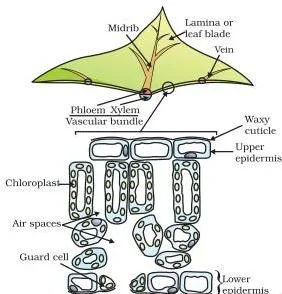
Autotrophs — green plants and some bacteria — make their own food from simple inorganic material: carbon dioxide and water, using sunlight and chlorophyll (NCERT, p. 3). This is photosynthesis, and the balanced equation is:
\[ 6CO_2 + 12H_2O \xrightarrow[\text{Sunlight}]{\text{Chlorophyll}} C_6H_{12}O_6 + 6O_2 + 6H_2O \]
Notice water appears on both sides — 12 molecules go in, 6 come back out. This detail is exactly what students drop when writing the equation from memory (see the mistakes table below).
Three events happen during photosynthesis (NCERT, p. 4):
- Chlorophyll absorbs light energy.
- That light energy splits water molecules into hydrogen and oxygen.
- Carbon dioxide is reduced to carbohydrates using the hydrogen released.
These steps don’t always happen in strict sequence. Desert plants take up \(CO_2\) at night (when losing less water through open stomata is safer) and store an intermediate compound, which is then used during the day when light energy is available (NCERT, p. 4) — a good example to quote in a “give an exception” question.
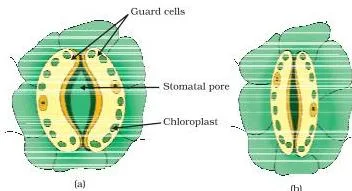
Gas exchange for photosynthesis mostly happens through stomata, tiny pores on the leaf surface. Guard cells around each pore control opening and closing: when water flows into guard cells, they swell and the pore opens; when they lose water and shrink, the pore closes (NCERT, p. 4). This matters because stomata also lose water as vapour, so the plant keeps them shut when it doesn’t need \(CO_2\).
Two classic activities prove the raw materials needed. Destarching a variegated leaf in the dark for three days, then testing with iodine after light exposure, shows starch (the product of photosynthesis) forms only in the green, chlorophyll-containing parts of the leaf (NCERT, p. 4) — that’s Activity 5.1. Placing potassium hydroxide (which absorbs \(CO_2\)) next to one potted plant and none next to a control plant, then testing both leaves for starch, shows the plant without \(CO_2\) makes little or no starch (NCERT, p. 5) — that’s Activity 5.2, and it’s the standard way examiners ask you to prove \(CO_2\) is essential for photosynthesis.
Heterotrophic Nutrition: Saprophytic, Holozoic and Parasitic Modes
Heterotrophs cannot make their own food, so they depend directly or indirectly on autotrophs (NCERT, p. 3). The chapter groups them by how food is obtained:
- Saprophytic — food is broken down outside the body, then absorbed. Example: bread mould, yeast, mushrooms (NCERT, p. 6).
- Holozoic — whole food is taken in and broken down inside the body. Example: Amoeba, Paramoecium, most animals (NCERT, p. 6).
- Parasitic — nutrition is drawn from a living host without killing it. Example: Cuscuta (amar-bel), ticks, lice, leeches, tapeworms (NCERT, p. 6).
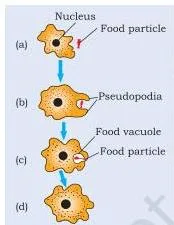
A distinction examiners like to test: Amoeba pushes out temporary finger-like extensions called pseudopodia that fuse around a food particle to form a food vacuole — it can do this from any point on its surface. Paramoecium, though also single-celled, has a fixed shape and a specific spot for taking in food; cilia covering its surface beat to sweep food toward that spot (NCERT, p. 6). One organism uses a temporary structure, the other a permanent, fixed feeding point — that contrast is worth writing out fully if asked to compare the two.
Human Digestive System: From Mouth to Anus, Organ by Organ
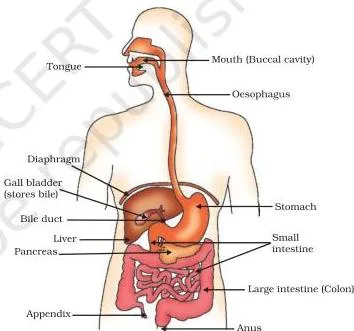
Food travels through one continuous tube, the alimentary canal, but each region is built to do a different job (NCERT, p. 6–8).
| Organ | Secretion | Enzyme(s) | Action |
|---|---|---|---|
| Mouth | Saliva (salivary glands) | Salivary amylase | Breaks starch into simple sugar; chewing and tongue movement mix food with saliva (NCERT, p. 7) |
| Stomach | Gastric juice | Pepsin (+ HCl, mucus) | HCl makes the medium acidic for pepsin to digest protein; mucus protects the stomach lining from the acid (NCERT, p. 7) |
| Liver | Bile (via bile duct into small intestine) | No enzyme; bile salts | Makes acidic food from the stomach alkaline for pancreatic enzymes; emulsifies fat globules into smaller ones, like soap on grease (NCERT, p. 7) |
| Pancreas | Pancreatic juice | Trypsin, lipase | Trypsin digests protein; lipase breaks down emulsified fat (NCERT, p. 7) |
| Small intestine wall | Intestinal juice | Various | Completes digestion — proteins to amino acids, carbohydrates to glucose, fats to fatty acids and glycerol; villi absorb the digested food into blood vessels (NCERT, p. 7) |
| Large intestine | — | — | Absorbs water from undigested waste before it leaves through the anus (NCERT, p. 7) |
One application point worth remembering: herbivores eat grass, which contains cellulose that is hard to digest, so they need a longer small intestine; carnivores digest meat more easily and have a shorter one (NCERT, p. 7). A practical, examinable fact from the chapter’s “More to Know” box is dental caries — bacteria acting on sugar stuck as plaque produce acid that softens tooth enamel, and this is exactly why brushing after eating removes plaque before acid forms (NCERT, p. 8).
Respiration: Glucose Breakdown, Aerobic vs Anaerobic Pathways
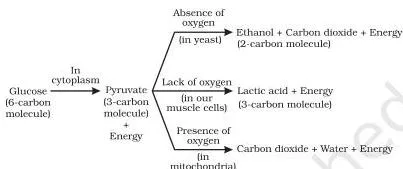
Every pathway starts the same way: glucose (a six-carbon molecule) is broken down into pyruvate (a three-carbon molecule) in the cytoplasm (NCERT, p. 9). What happens to pyruvate next depends on whether oxygen is available.
| Pathway | Where it happens | Products | Energy released | Example organism |
|---|---|---|---|---|
| Aerobic respiration | Mitochondria | \(CO_2\) + water | A lot greater | Humans, most animals and plants (NCERT, p. 9) |
| Anaerobic respiration (fermentation) | Cytoplasm | Ethanol + \(CO_2\) | Less | Yeast (NCERT, p. 9) |
| Anaerobic respiration (in muscle) | Cytoplasm | Lactic acid | Less | Human muscle cells during a shortage of oxygen — causes cramps (NCERT, p. 9) |
The energy released during respiration is used immediately to make ATP from ADP and inorganic phosphate:
\[ ADP + P \xrightarrow{\text{Energy}} ATP \]
When the terminal phosphate bond in ATP is broken using water, it releases \(30.5\ \text{kJ/mol}\) (NCERT, p. 10). Think of ATP the way the chapter does — like a battery that can power very different jobs: muscle contraction, protein synthesis, and conduction of nerve impulses (NCERT, p. 10). The battery doesn’t care what device it’s plugged into; ATP doesn’t care which cellular process is using its energy.
Breathing in Humans: Why Alveoli Are Built the Way They Are
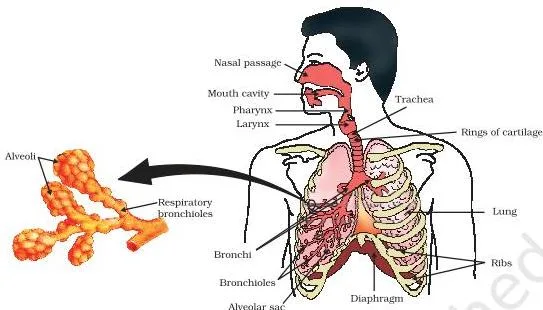
Air’s path: nostrils (filtered by fine hairs and mucus) → throat (held open by cartilage rings so it doesn’t collapse) → lungs, where the passage divides into smaller and smaller tubes ending in balloon-like alveoli (NCERT, p. 11–12). Breathing in lifts the ribs and flattens the diaphragm, enlarging the chest cavity and sucking air into the expanded alveoli (NCERT, p. 12).
Two numbers explain why this design exists, and connecting them is a strong exam-answer move. If spread out flat, the alveolar surface would cover about \(80\ \text{m}^2\) (NCERT, p. 12) — a huge area packed into a small chest, which maximises how much gas can be exchanged at once. But a large surface only helps if the gas can actually reach every cell fast enough. If oxygen moved through the body purely by diffusion, it’s estimated it would take about 3 years for one molecule to travel from the lungs to the toes (NCERT, p. 12). Diffusion is far too slow over long distances, which is exactly why the body needs haemoglobin — a respiratory pigment with a high affinity for oxygen, carried in red blood cells — and a full circulatory system to move oxygen quickly to distant tissues, instead of relying on diffusion alone (NCERT, p. 12).
A practical health note from the chapter: cilia lining the upper respiratory tract normally sweep out dust and germs, but smoking destroys these cilia, letting harmful particles reach the lungs and cause infection or cancer (NCERT, p. 12).
Human Circulatory System: Heart Chambers and Double Circulation
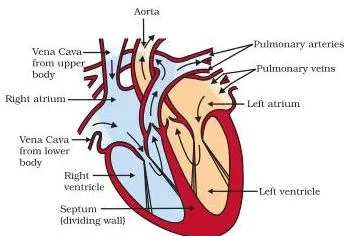
The heart has separate chambers specifically so oxygen-rich blood never mixes with carbon-dioxide-rich blood (NCERT, p. 14). Follow blood through one full cycle:
- Oxygen-rich blood from the lungs enters the left atrium, which relaxes to collect it.
- Left atrium contracts, left ventricle relaxes — blood moves into the left ventricle.
- Left ventricle contracts and pumps oxygenated blood to the whole body.
- Deoxygenated blood from the body enters the right atrium.
- Right atrium contracts, right ventricle relaxes — blood moves into the right ventricle.
- Right ventricle pumps this blood to the lungs for oxygenation (NCERT, p. 14).
Ventricles have thicker, more muscular walls than atria because they must pump blood out to distant organs, not just pass it to the next chamber (NCERT, p. 14). Valves stop blood flowing backward when chambers contract.
Because blood passes through the heart twice in one full circuit around the body (once to the lungs, once to the body), this is called double circulation (NCERT, p. 14–15). Birds and mammals need this complete separation because they constantly use energy to maintain body temperature, which demands an efficient, high-oxygen supply. Fish, by contrast, have only two heart chambers and blood passes through the heart just once per cycle — sufficient because their energy needs are lower (NCERT, p. 14–15).
Blood pressure is the force blood exerts on vessel walls. Systolic pressure (during ventricular contraction) is normally about \(120\ \text{mm Hg}\); diastolic pressure (during ventricular relaxation) is normally about \(80\ \text{mm Hg}\), measured with a sphygmomanometer (NCERT, p. 15). Hypertension, or high blood pressure, is caused by constriction of arterioles increasing resistance to blood flow, and can, in severe cases, rupture an artery (NCERT, p. 15).
Arteries, Veins, Capillaries and the Role of Platelets and Lymph
| Vessel | Wall | Valves | Function |
|---|---|---|---|
| Artery | Thick, elastic | No | Carries blood away from the heart under high pressure (NCERT, p. 15) |
| Vein | Thin | Yes | Carries blood back to the heart under low pressure; valves stop backflow (NCERT, p. 15) |
| Capillary | One cell thick | No | Site of exchange between blood and surrounding cells (NCERT, p. 15) |
Platelets circulate in blood and clot at injury sites, sealing leaks so the system doesn’t lose pressure or too much blood (NCERT, p. 15). Lymph (tissue fluid) forms when plasma, proteins and cells leak through capillary pores into the spaces between cells; it drains through lymphatic vessels back into larger veins, carrying absorbed fat from the intestine and returning excess fluid to the blood (NCERT, p. 16).
Transport in Plants: Xylem for Water, Phloem for Food
| Xylem | Phloem | |
|---|---|---|
| Carries | Water and minerals | Products of photosynthesis (food), amino acids |
| Direction | Roots to leaves (one-way, upward) | Both upward and downward, depending on plant need (NCERT, p. 17) |
| Driving force | Root pressure (at night) and transpiration pull (mainly by day) — a physical process (NCERT, p. 17) | Osmotic pressure created using ATP energy — an active process (NCERT, p. 17) |
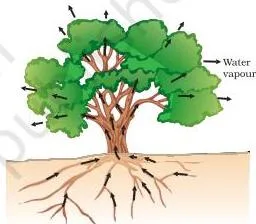
Root cells actively absorb ions from soil, creating a concentration difference that pulls water into the root, building up a column of water pushed upward — this is root pressure (NCERT, p. 16). But root pressure alone can’t lift water to the top of a tall tree. The bigger driving force is transpiration pull: water evaporating from leaf cells through stomata creates suction that pulls water up through the xylem from the roots (NCERT, p. 17). Activity 5.8 — comparing a potted plant against a plain stick, both covered with a plastic sheet in sunlight — is the classic demonstration that water loss (misting on the plastic) happens through the living plant, not the soil (NCERT, p. 17).
Phloem transport, called translocation, works differently: sugar is actively loaded into phloem tissue using ATP, raising the osmotic pressure there so water moves in; this pressure then pushes material toward tissues where pressure is lower, in whichever direction the plant currently needs it (NCERT, p. 17–18).
Excretion in Humans: How a Nephron Filters Blood
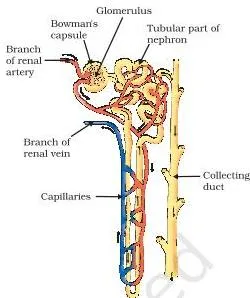
The human excretory system has a pair of kidneys, ureters, a urinary bladder and a urethra (NCERT, p. 18). Each kidney is packed with filtration units called nephrons. Each nephron has a cluster of thin-walled blood capillaries next to a cup-shaped Bowman’s capsule that collects the filtrate (NCERT, p. 18–19).
Filtration alone would throw away useful substances too, so the nephron does a second job: as filtrate flows along the tubule, glucose, amino acids, salts and most of the water are selectively reabsorbed back into blood (NCERT, p. 19). This is why urine formation is filtration plus reabsorption, not filtration alone — a distinction examiners test directly (see mistakes table). About \(180\ \text{L}\) of filtrate forms in a healthy adult’s kidneys daily, yet only \(1\)–\(2\ \text{L}\) is actually excreted as urine, because the rest is reabsorbed in the tubules (NCERT, p. 19).
An artificial kidney (haemodialysis) does only the filtration part. The patient’s blood passes through tubes with a semi-permeable lining, suspended in a tank of dialysing fluid that has the same osmotic pressure as blood but no nitrogenous waste. Waste diffuses out of the blood into the fluid, and the cleaned blood is pumped back — but there is no selective reabsorption step, unlike a real kidney (NCERT, p. 19).
Excretion in Plants: No Kidneys, Different Tricks
Plants don’t have dedicated excretory organs. Instead, they use several separate routes (NCERT, p. 20):
- Oxygen, itself a by-product of photosynthesis, diffuses out through stomata.
- \(CO_2\) is removed through stomata during respiration.
- Excess water is removed by transpiration.
- Some wastes are stored in cell vacuoles.
- Others are stored as resins and gums, especially in old xylem.
- Waste-laden leaves are shed off the plant.
- Some waste substances are excreted directly into the surrounding soil.
If a question asks about plant excretion, avoid describing kidney-like organs — the correct answer is this list of separate mechanisms.
Key Terms to Get Exactly Right
| Term | Meaning |
|---|---|
| Life processes | The maintenance functions — nutrition, respiration, transport, excretion — that keep an organism’s molecular structure repaired even when it shows no visible activity (NCERT, p. 1) |
| Nutrition | The process of taking in food from outside the body to supply energy and raw material (NCERT, p. 1) |
| Autotroph | An organism that makes its own food from \(CO_2\) and water using an external energy source (NCERT, p. 3) |
| Heterotroph | An organism that takes in complex food material already prepared by other organisms (NCERT, p. 3) |
| Respiration | The process of taking up oxygen and using it to break down food for cellular energy (NCERT, p. 1) |
| Aerobic respiration | Breakdown of pyruvate using oxygen in the mitochondria, producing \(CO_2\) and water and releasing more energy (NCERT, p. 9) |
| Anaerobic respiration | Breakdown of pyruvate without oxygen, in the cytoplasm, producing ethanol and \(CO_2\) (in yeast) or lactic acid (in muscle) (NCERT, p. 9) |
| Transpiration | Loss of water vapour from the aerial parts of a plant, which pulls water upward through the xylem (NCERT, p. 17) |
| Translocation | Movement of the products of photosynthesis and other substances through the phloem, using ATP energy (NCERT, p. 17) |
| Excretion | The biological removal of harmful metabolic waste products from the body (NCERT, p. 18) |
| Double circulation | Blood passing through the heart twice during each full circuit of the body — once on the way to the lungs, once on the way to the body (NCERT, p. 14–15) |
| Dialysis | Artificial removal of nitrogenous waste from blood by diffusion across a semi-permeable membrane, without the reabsorption step of a real kidney (NCERT, p. 19) |
Equations and Numbers This Chapter Expects You to Know
Photosynthesis:
\[ 6CO_2 + 12H_2O \xrightarrow[\text{Sunlight}]{\text{Chlorophyll}} C_6H_{12}O_6 + 6O_2 + 6H_2O \]
ATP formation:
\[ ADP + P \xrightarrow{\text{Energy}} ATP \]
| Quantity | Value | Where it’s used |
|---|---|---|
| Energy released on ATP hydrolysis | \(30.5\ \text{kJ/mol}\) | Powers muscle contraction, protein synthesis, nerve conduction (NCERT, p. 10) |
| Normal systolic blood pressure | \(120\ \text{mm Hg}\) | Benchmark for classifying blood pressure readings (NCERT, p. 15) |
| Normal diastolic blood pressure | \(80\ \text{mm Hg}\) | Benchmark for classifying blood pressure readings (NCERT, p. 15) |
| Daily filtrate formed by kidneys | ~\(180\ \text{L}\) | Shows how much filtration happens before reabsorption (NCERT, p. 19) |
| Daily urine excreted | ~\(1\)–\(2\ \text{L}\) | Shows how much of the filtrate is actually lost as waste (NCERT, p. 19) |
| Alveolar surface area (if spread flat) | ~\(80\ \text{m}^2\) | Explains why gas exchange in the lungs is efficient (NCERT, p. 12) |
Editor’s note: these three formula-type statements (the photosynthesis equation, the ATP equation, and the constants above) were flagged for OCR verification against the physical textbook page before this page is published.
Solved Problems: Applying the Concepts with New Numbers
Problem 1: Energy released from hydrolysis of 8 moles of ATP
Step 1: Recall that breaking the terminal phosphate bond in one mole of ATP releases \(30.5\ \text{kJ}\) of energy (NCERT, p. 10).
Step 2: For 8 moles, multiply the per-mole energy by the number of moles.
\[ \text{Total energy} = 8 \times 30.5\ \text{kJ/mol} \]
\[ = 244\ \text{kJ} \]
Final answer: Hydrolysing 8 moles of ATP releases \(244\ \text{kJ}\) of energy, which the cell can use for processes such as muscle contraction or protein synthesis.
Problem 2: Percentage of filtrate reabsorbed by the kidneys
Step 1: Suppose a person’s kidneys form \(170\ \text{L}\) of filtrate per day and pass out \(1.2\ \text{L}\) as urine per day (these numbers are chosen for practice and are not the textbook’s own \(180\ \text{L}\) figure).
Step 2: Find the volume reabsorbed by subtracting urine volume from filtrate volume.
\[ \text{Volume reabsorbed} = 170 – 1.2 = 168.8\ \text{L} \]
Step 3: Express this as a percentage of the total filtrate formed.
\[ \text{Percentage reabsorbed} = \frac{168.8}{170} \times 100 \approx 99.3\% \]
Final answer: About \(99.3\%\) of the filtrate is reabsorbed. This shows that the nephron’s tubule does far more work than simple filtration — nearly all the water, glucose, amino acids and salts filtered out are pulled straight back into the blood, and only the small remainder becomes urine (NCERT, p. 19).
Problem 3: Classifying a blood pressure reading
Step 1: Note the patient’s reading: \(138/88\ \text{mm Hg}\), where \(138\) is systolic and \(88\) is diastolic.
Step 2: Compare against the normal benchmark of \(120/80\ \text{mm Hg}\) (NCERT, p. 15).
Step 3: Systolic pressure is \(138\ \text{mm Hg}\) against a normal \(120\ \text{mm Hg}\) — raised by \(18\ \text{mm Hg}\). Diastolic pressure is \(88\ \text{mm Hg}\) against a normal \(80\ \text{mm Hg}\) — raised by \(8\ \text{mm Hg}\).
Final answer: Both values are above normal, with the systolic reading raised more in absolute terms. Persistently raised readings like this indicate the arterioles are offering more resistance to blood flow than normal, which the chapter identifies as the cause of hypertension (NCERT, p. 15) — worth flagging for a doctor’s check, though the chapter does not go into treatment.
Mistakes Students Repeatedly Make in This Chapter
| Mistake | Correct rule | How to check your answer |
|---|---|---|
| Writing photosynthesis as \(CO_2 + H_2O \rightarrow \text{glucose} + O_2\) without balancing water | Water appears on both sides: 12 molecules of water are used, 6 are released, along with 6 of \(O_2\) (NCERT, p. 4) | Count atoms of C, H and O on both sides — they must match exactly |
| Saying anaerobic respiration happens in the mitochondria | Glycolysis (glucose to pyruvate) happens in the cytoplasm for every pathway; only the oxygen-using step happens in mitochondria (NCERT, p. 9) | Ask: does this step need oxygen? If no, it’s in the cytoplasm |
| Claiming the four heart chambers mix oxygenated and deoxygenated blood | In humans, birds and mammals, the chambers keep the two blood types separate — that’s the whole point of having four chambers (NCERT, p. 14) | Trace the path: left side always carries oxygenated blood, right side always carries deoxygenated blood |
| Swapping xylem and phloem — saying xylem carries food or phloem carries water | Xylem carries water and minerals, one-way, upward; phloem carries food, in both directions, using ATP (NCERT, p. 16–17) | Remember: x for water is wrong to say aloud, but phloem = “food” (both start with a soft sound reminder), and phloem needs ATP while xylem does not |
| Describing urine formation as filtration only | Urine formation is filtration in Bowman’s capsule plus selective reabsorption of glucose, amino acids, salts and water along the tubule (NCERT, p. 19) | Check the numbers: \(180\ \text{L}\) filtered but only \(1\)-\(2\ \text{L}\) excreted proves reabsorption is happening |
How This Chapter Is Usually Tested in Class 10 Exams
The chapter’s own exercise (NCERT, p. 21) mixes four MCQs testing basic recall — which system the kidney belongs to, what xylem transports, the requirements for autotrophic nutrition, and where pyruvate breakdown to \(CO_2\) and water occurs — with longer descriptive questions. Look closely at the descriptive set: question 8 asks for a comparison of aerobic and anaerobic respiration, question 12 asks for differences between xylem and phloem transport, and question 13 asks you to compare the structure and functioning of alveoli and nephrons side by side. That pattern is a clear signal: this chapter is weighted toward comparison-style and diagram-based answers, not isolated definitions.
For a full-marks answer on a comparison question, state both sides in parallel — location, direction/mechanism, and outcome — rather than describing one system and then the other separately; examiners award marks for each point of contrast, not for describing either system in isolation. Since three separate figures (the human heart, the nephron, and the alveoli/lungs) appear across the exercise, practise labelling these three diagrams from memory — a labelled, correctly oriented diagram is often worth marks on its own, independent of the written answer.
Fast Revision: One Page Before the Exam
In the chapter’s own words, condensed (NCERT, p. 20):
- Movement — including invisible molecular movement — is treated as a sign of life.
- Maintaining life needs nutrition, respiration, transport and excretion working together.
- Autotrophic nutrition builds complex food from simple inorganic material using an outside energy source (sunlight).
- Heterotrophic nutrition takes in complex food already made by other organisms.
- In humans, food is broken down step by step along the alimentary canal and absorbed in the small intestine.
- Respiration breaks glucose down to release energy stored as ATP; aerobic respiration releases more energy than anaerobic.
- The circulatory system (heart, blood, blood vessels) transports oxygen, \(CO_2\), food and excretory products in humans.
- In plants, xylem and phloem together form the vascular tissue that transports water, minerals and food.
- Kidneys remove soluble nitrogenous waste through nephrons.
- Plants dispose of waste through vacuole storage, resins and gums, shedding leaves, and release into soil.
Self-check before the exam — can you:
- Write the balanced photosynthesis equation from memory, water included on both sides?
- Name three differences between arteries and veins without looking them up?
- Trace blood through all four heart chambers in the correct order?
- Explain, in one or two sentences, why diffusion alone can’t supply a human’s oxygen needs?
- List at least four separate ways a plant gets rid of waste, without mentioning kidneys?
For related revision material, see the Control and Coordination notes, which cover the nervous and hormonal systems that regulate many of the processes described here, and the How Do Organisms Reproduce notes for the next life process the syllabus covers. You can browse all chapters at the Class 10 Science notes hub, or check the full Class 10 subject list. If you also need the chemistry chapter that discusses carbon-based molecules referenced in nutrition, the Carbon and its Compounds notes are a useful companion. Students who want to check the original wording and figures can refer to the official NCERT Class 10 Science textbook, Chapter 5.
Frequently Asked Questions on Life Processes
Why can’t diffusion alone supply enough oxygen to a multicellular organism like a human?
Diffusion works well only over short distances, because it relies on molecules randomly spreading from high to low concentration. In a human, most cells are far from any exchange surface, and the textbook notes that oxygen moving purely by diffusion would take roughly three years to reach the toes from the lungs (NCERT, p. 12). That’s far too slow to keep tissues supplied, so the body uses haemoglobin and a circulatory system to move oxygen quickly instead.
What is the difference between aerobic and anaerobic respiration, and which organisms use each?
Aerobic respiration breaks pyruvate down in the mitochondria using oxygen, producing \(CO_2\) and water and releasing more energy; humans and most animals and plants use this pathway. Anaerobic respiration happens in the cytoplasm without oxygen, producing ethanol and \(CO_2\) in yeast (fermentation), or lactic acid in human muscle cells when oxygen runs short, which causes cramps (NCERT, p. 9).
Why do plants need a two-way transport system when animals mainly move blood one way through vessels?
Animals need a continuous, fast supply of oxygen and food to every cell, so blood is pumped in one direction around a closed loop by the heart. Plants have much lower energy needs and don’t move, so they can afford a slower system, but their transport needs go both ways: water moves upward from roots through xylem, while food made in leaves must be sent both up (to growing shoots) and down (to roots) through phloem, depending on where it’s currently needed (NCERT, p. 16–17).
How does an artificial kidney (dialysis) differ from a real kidney if both remove waste from blood?
Both use a filtration-like process, but a real kidney filters blood and then selectively reabsorbs useful substances like glucose, amino acids, salts and water back into the blood as filtrate passes along the nephron tubule. An artificial kidney only removes waste by diffusion across a semi-permeable membrane into dialysing fluid — there is no reabsorption step (NCERT, p. 19).
Why do human beings, birds and mammals need a four-chambered heart while fish manage with two chambers?
Birds and mammals constantly use energy to maintain a stable body temperature, which needs an efficient, high-oxygen blood supply — a four-chambered heart keeps oxygenated and deoxygenated blood fully separate to achieve this. Fish don’t regulate body temperature the same way, have lower energy needs, and manage with a two-chambered heart where blood passes through the heart only once per circuit (NCERT, p. 14–15).
What exactly happens to a starch molecule from the moment it enters the mouth to when it is absorbed?
In the mouth, salivary amylase in saliva starts breaking starch down into simple sugar as you chew. In the stomach, no enzyme acts on starch directly; it mainly waits while proteins are digested by pepsin. In the small intestine, pancreatic and intestinal juices complete the breakdown of any remaining starch into glucose, which is then absorbed into blood vessels through the villi lining the small intestine wall (NCERT, p. 7).
Reference: NCERT Class 10 Science textbook, chapter Life Processes.
Explore Class 10 Science Notes
Related chapters: