Control and Coordination Class 10 Notes (Chapter 6) – Learncbse.net
A cat chasing a mouse, a buffalo working its jaw over cud, a seedling pushing up through soil — these all involve movement, but not the same kind of movement. These control and coordination class 10 notes explain why living things need a way to sense a change around them and produce the correct response, and how two separate systems — nervous and hormonal — get this done in animals and plants. Control and coordination is the process by which an organism detects a stimulus in its surroundings and reacts through its nervous tissue and chemical messengers so that the response actually matches the situation (NCERT, p. 1).
Why Living Things Need Control and Coordination Systems
Not every movement works the same way. A germinating seed pushes through soil because its cells are growing and elongating — stop the growth, and the movement stops too. A cat sprinting after a mouse, or a buffalo chewing cud, involves no growth at all; it is muscle contraction responding to a signal. What connects both examples is that the movement is a reaction to something detected in the environment, and the reaction has to be appropriate — you whisper to a friend in class, you don’t shout. Matching a detected change to the right response, quickly and correctly, is what this chapter is built around (NCERT, p. 1). In animals this job is shared between the nervous system, which uses electrical impulses, and the hormonal or endocrine system, which uses chemical messengers travelling in the blood. Plants, which have neither nerves nor muscles, rely entirely on chemical signalling and directional growth.
Chapter 6 Snapshot: Nervous System vs Hormonal System
Before the details, it helps to see how the two control systems differ in medium, speed and reach. This comparison also gives you a ready-made answer structure for exam questions that ask you to contrast the two mechanisms.
| System | Medium | Speed | Reach | Example |
|---|---|---|---|---|
| Nervous system | Electrical impulse along neurons, chemical only at the synapse | Fast, almost instant | Limited — only cells connected by nerve fibres | Pulling a hand back from a hot object (reflex arc) |
| Hormonal system | Chemical messenger (hormone) diffusing through blood | Slower, builds up over seconds to minutes | Wide — can reach every cell in the body | Adrenaline preparing the whole body for a sudden scare |
NCERT Exercise Q11 on page 13 asks you to “compare and contrast nervous and hormonal mechanisms for control and coordination in animals.” A table like this one earns more marks than a paragraph, because it shows the examiner you understand the categories, not just the facts.
How a Nerve Impulse Travels from Receptor to Effector
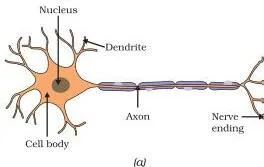
A neuron detects information at the tip of its dendrite. This sets off a chemical reaction that creates an electrical impulse, which then moves along a fixed path inside the cell (NCERT, p. 1). The pathway from stimulus to action looks like this:
- A receptor (often the tip of a dendrite in a sense organ) detects the stimulus — heat, sound, taste, and so on.
- The dendrite converts this detection into an electrical impulse.
- The impulse travels through the cell body of the neuron.
- It moves along the axon to the axon’s end.
- At the axon terminal, the impulse triggers the release of chemicals into the synapse — the small gap between this neuron and the next cell.
- These chemicals cross the gap and set off a fresh electrical impulse in the next neuron’s dendrite, or in a muscle/gland if that is the effector.
A synapse is not a physical joint — it is a gap (NCERT, p. 1). This matters because it answers the recurring doubt “what exactly crosses the synapse?”: it is a chemical, not the electrical impulse itself. The signal changes form three times on its journey — electrical inside the first neuron, chemical while crossing the gap, and electrical again once it starts a new impulse in the next cell. Figure 6.1 in the textbook labels the dendrite, cell body, axon and the neuromuscular junction where a neuron meets a muscle.
Reflex Arc: Why the Hand Pulls Back Before You Feel the Pain
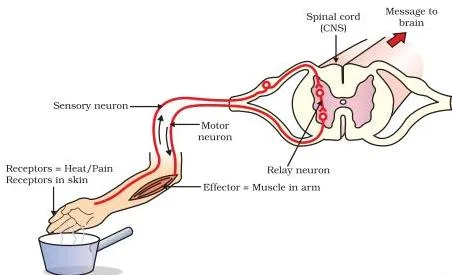
A reflex action is a quick, automatic response to a stimulus that does not wait for conscious thought (NCERT, p. 3). Touching a flame is exactly the kind of urgent situation where thinking would be too slow — thinking involves a large, complex network of neurons, and that takes time you don’t have when your fingers are near fire. The body’s shortcut is the reflex arc:
- Receptor detects the stimulus (heat on the skin).
- A sensory neuron carries the impulse toward the spinal cord.
- A relay neuron inside the spinal cord connects the sensory input directly to a motor pathway.
- A motor neuron carries the impulse out to the muscle.
- The effector muscle contracts and pulls the hand away.
The connection is made in the spinal cord, not the brain, because nerves from all over the body already pass through the spinal cord on their way to the brain — it is the first point where an input nerve and an output nerve can meet (NCERT, p. 3). The signal does travel on to the brain as well, which is why you register the pain a moment after your hand has already moved. This directly answers NCERT Q1 and Q5 on page 6: a reflex action is completed by the spinal cord without conscious involvement, while walking is a voluntary action planned and directed by the brain.
Human Brain: Fore-brain, Mid-brain and Hind-brain at Work
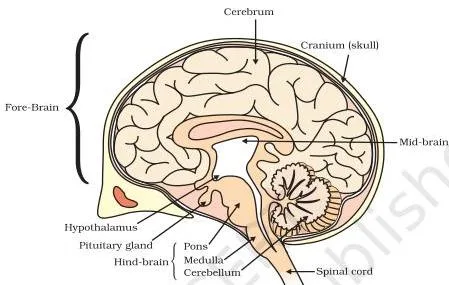
The brain and spinal cord together form the central nervous system, and the brain integrates information from every part of the body (NCERT, p. 4). It has three regions, and each has a distinct job.
| Region | Sub-part / area | Function |
|---|---|---|
| Fore-brain | Sensory areas | Receive impulses for hearing, smell, sight and other senses, each in a separate area |
| Fore-brain | Association areas | Interpret sensory information together with information already stored in the brain, and decide on a response |
| Fore-brain | Motor areas | Control the movement of voluntary muscles |
| Fore-brain | Hunger centre | Produces the sensation of feeling full or hungry, separate from any sense organ |
| Mid-brain and hind-brain (medulla) | Medulla | Controls involuntary actions such as blood pressure, salivation and vomiting |
| Hind-brain | Cerebellum | Maintains posture and balance, and gives precision to voluntary movements such as walking in a straight line or picking up a pencil |
Here is a short way to fix the three regions in memory that you won’t find printed in the textbook: Think — Balance — Background. The fore-brain thinks (senses, interprets, decides, moves voluntary muscles). The cerebellum balances (posture and precise movement). The medulla runs in the background (blood pressure, salivation, vomiting) whether or not you’re paying attention to it.
How the Brain and Spinal Cord Stay Protected
The brain sits inside a bony box (the skull) and is further cushioned by a fluid-filled covering inside that box. The spinal cord is protected by the vertebral column, the hard, bumpy structure you can feel running down the middle of your back (NCERT, p. 6). This directly explains NCERT Q7 on page 13: an injury to the spinal cord can disrupt both reflex responses and voluntary control in the parts of the body below the point of injury, because the nerve pathways carrying those signals pass through the cord itself.
Definitions You Must Get Right in This Chapter
- Neuron: the basic cell of the nervous system, built to detect a stimulus and carry it forward as an electrical impulse (NCERT, p. 1).
- Synapse: the small gap between two neurons (or between a neuron and a muscle/gland) that is crossed by chemicals released from the axon terminal (NCERT, p. 1).
- Reflex action: a fast, automatic response to a stimulus, completed through the spinal cord without waiting for a conscious decision (NCERT, p. 3).
- Nervous tissue: tissue made of neurons organised into a network, specialised to conduct information via electrical impulses (NCERT, p. 1).
- Tropism: a directional growth movement of a plant part, made in response to a stimulus such as light, gravity, water or a chemical (NCERT, p. 8).
- Phototropism: growth movement in response to light — shoots bend toward it, roots bend away from it (NCERT, p. 8).
- Geotropism: growth movement in response to gravity — roots grow downward, shoots grow upward (NCERT, p. 8).
- Hydrotropism: growth movement of a plant part toward or away from water (NCERT, p. 8).
- Chemotropism: growth movement in response to a chemical, such as a pollen tube growing toward an ovule (NCERT, p. 8).
- Hormone: a chemical messenger, made in one part of an organism, that travels to another part to produce an effect there (NCERT, p. 10).
- Endocrine gland: a gland that releases its hormone directly into the blood, without a duct, e.g. the adrenal gland or pancreas (NCERT, p. 10).
- Feedback mechanism: a control loop where the level of a hormone’s effect regulates how much more of that hormone gets released (NCERT, p. 11).
Signal Flow You Should Be Able to Draw: Reflex Arc and Hormone Feedback Loop
This chapter has no formulas to memorise, but two flow sequences turn up in almost every paper. Redraw both from memory as revision — diagram and flowchart-based questions on the neuron and the reflex arc are one of the most reliably repeated CBSE question types for this chapter, year after year.
1. Reflex arc pathway:
- Receptor detects stimulus
- Sensory neuron carries impulse toward spinal cord
- Relay neuron in the spinal cord connects sensory input to motor output
- Motor neuron carries impulse to effector
- Effector (muscle) produces the response
2. Hormone feedback loop (blood sugar example):
- Blood sugar level rises
- Rise detected by cells of the pancreas
- Pancreas releases more insulin
- Insulin brings blood sugar level down
- As blood sugar falls, insulin secretion is reduced (NCERT, p. 11)
Coordination in Plants: Two Kinds of Movement
Plants have neither nerves nor muscles, yet they clearly respond to touch, light and gravity (NCERT, p. 6). They do this using two very different kinds of movement.
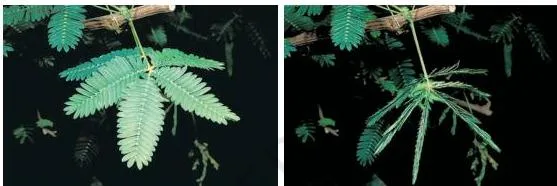
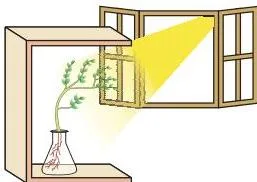
The leaves of the sensitive plant (chhui-mui) fold up almost immediately when touched. This movement does not involve any growth — it happens because cells change the amount of water inside them, swelling or shrinking, which changes their shape (NCERT, p. 7). Bending toward light, by contrast, is a growth-based movement. When light comes from one side, a hormone called auxin — made at the shoot tip — moves toward the shaded side and makes those cells grow longer than the cells on the lit side. Because one side grows more than the other, the shoot appears to bend toward the light (NCERT, p. 8).
Here is an exception worth remembering: a pea plant’s tendril curling around a support looks like a quick, animal-like response, but it isn’t. The side of the tendril touching the support grows more slowly than the side away from it, so the tendril curls around the object purely through unequal growth — the same growth-based mechanism as phototropism, not the turgor-based mechanism of the sensitive plant (NCERT, p. 7).
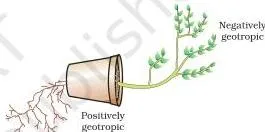
| Plant part | Response to light | Response to gravity |
|---|---|---|
| Shoot | Positive phototropism (grows toward light) | Negative geotropism (grows away from gravity, upward) |
| Root | Negative phototropism (grows away from light) | Positive geotropism (grows toward gravity, downward) |
Endocrine Glands and Their Hormones in Humans
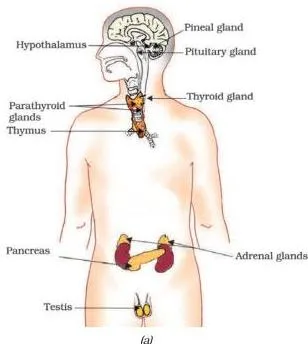
Hormones reach every cell through the blood, so they are the body’s way of coordinating changes that no single nerve pathway could reach on its own (NCERT, p. 10). The table below fills in every gland-hormone-function pairing you need for this chapter.
| Gland | Hormone | Main function |
|---|---|---|
| Pituitary | Growth hormone | Stimulates growth in all organs; deficiency in childhood causes dwarfism (NCERT, p. 10) |
| Thyroid | Thyroxin | Regulates carbohydrate, protein and fat metabolism; needs iodine for synthesis, and deficiency causes goitre (NCERT, p. 10) |
| Pancreas | Insulin | Regulates blood sugar level; low secretion allows sugar to rise, as seen in diabetes (NCERT, p. 10) |
| Testes | Testosterone | Brings about changes of puberty in males (NCERT, p. 10) |
| Ovaries | Oestrogen | Development of female sex organs, regulates the menstrual cycle (NCERT, p. 10) |
| Adrenal gland | Adrenaline | Prepares the body for sudden action — faster heartbeat, faster breathing, blood diverted to skeletal muscles (NCERT, p. 10) |
| Hypothalamus | Releasing hormones | Stimulates the pituitary gland to release its hormones (NCERT, p. 11) |
The adrenaline mechanism is worth learning as a sequence, because exam answers on it are marked step by step: adrenaline is released into the blood by the adrenal glands; it makes the heart beat faster, sending more oxygen to the muscles; small arteries supplying the digestive system and skin contract, so blood is diverted toward the skeletal muscles; and the diaphragm and rib muscles contract more, increasing the breathing rate (NCERT, p. 10).
Worked Examples: Applying Control and Coordination in New Situations
Example 1: Heart rate jump on seeing a stray dog
Step 1: Note the given values — resting heart rate is \(72\) beats per minute; on seeing a stray dog charging toward her, it rises to about \(118\) beats per minute within seconds.
Step 2: Identify the trigger — a sudden, threatening stimulus is exactly the kind of situation that calls for a whole-body preparation for fighting or fleeing, not a single localised muscle movement.
Step 3: Apply the hormonal mechanism — the adrenal glands release adrenaline into the blood the moment the threat is perceived. Adrenaline acts directly on the heart, increasing both the rate and force of its beating.
Step 4: Explain why this uses a hormone and not only nerves — a nerve impulse would reach only the muscles directly wired to it, but adrenaline travels through the entire bloodstream, so the heart, the breathing muscles and the blood vessels to the skin and gut are all adjusted together within seconds.
Conclusion: The rise from \(72\) to \(118\) beats per minute is the direct effect of adrenaline released by the adrenal gland, preparing the body’s muscles with a faster supply of oxygenated blood.
Example 2: Blood glucose after breakfast
Step 1: Note the given values — fasting blood glucose is \(90\ \text{mg/dL}\); after breakfast it rises to \(150\ \text{mg/dL}\).
Step 2: Identify the detecting organ — cells of the pancreas monitor the sugar level in the blood.
Step 3: Apply the feedback loop — the rise to \(150\ \text{mg/dL}\) is detected by the pancreas, which responds by releasing more insulin into the blood.
Step 4: Track the correction — insulin brings the glucose level back down toward the fasting value of \(90\ \text{mg/dL}\). As the level falls, the pancreas reduces its insulin output again, closing the loop.
Conclusion: The glucose level does not stay at \(150\ \text{mg/dL}\) because a feedback mechanism links insulin secretion to the sugar level itself — more sugar means more insulin, and once the sugar falls, insulin secretion falls too.
Example 3: Bean seedling bending toward one-sided light
Step 1: Note the setup — a potted bean seedling is kept in a box with light entering only from the left side; after four days the shoot tip has bent about \(30^\circ\) toward the opening.
Step 2: Identify the hormone involved — auxin, synthesised at the shoot tip, is responsible for this bending, the same hormone tested in Activity 6.2 on page 8.
Step 3: Apply the mechanism — because light enters only from the left, auxin accumulates more on the shaded, right-hand side of the shoot than on the lit, left-hand side.
Step 4: Connect auxin to growth — higher auxin concentration makes the cells on the right side elongate more than the cells on the left side. Unequal elongation over four days produces a visible bend toward the light.
Conclusion: The \(30^\circ\) bend toward the opening is a case of positive phototropism, caused by unequal distribution of auxin, not by any muscle-like movement of the shoot.
Common Mistakes Students Make in This Chapter
| Mistake | Correct rule | How to check your answer |
|---|---|---|
| Calling heartbeat or digestion a “reflex action” | These are involuntary actions controlled by the medulla, not a reflex arc — a reflex needs a specific sudden stimulus and a spinal-cord loop | Ask whether there is a distinct stimulus you can point to. If the action is continuous and background (like heartbeat), it is involuntary, not reflex |
| Saying the synapse is where two neurons physically touch | The synapse is a small gap; chemicals released from one neuron’s axon terminal cross it to trigger the next impulse | Re-check that your answer mentions “gap” and “chemical”, not “joint” or “connection point” |
| Mixing up the cerebellum with the cerebrum/fore-brain | Cerebellum (hind-brain) manages balance, posture and precision of voluntary movement; the fore-brain handles thinking and sensory interpretation | If the question is about balance or coordination of movement, the answer is cerebellum; if it’s about thinking or sensing, it’s fore-brain |
| Saying a shoot bends to light because it “moves” like an animal | Bending is unequal cell elongation caused by auxin distribution, not muscle contraction | Check your answer names auxin and describes unequal growth on the two sides, not “movement” |
| Writing “insulin controls blood sugar” without naming the gland or the direction of action | State that insulin is released by the pancreas and that it lowers blood sugar as part of a feedback loop | Count whether your sentence has three parts: gland, hormone, and effect — a 2 or 3 mark answer loses marks for missing any one |
How CBSE Tests This Chapter: Exam Notes
MCQs from this chapter commonly test the synapse gap and which option in a list is a plant hormone — these map directly to NCERT Exercise Q1 and Q2 on page 13. Diagram-based questions asking you to label a neuron or a reflex arc appear regularly, so practise redrawing Figure 6.1 and Figure 6.2 from memory rather than only reading them. “Compare and contrast” questions such as Exercise Q11 (page 13) are answered better as a table than as flowing paragraphs, because the examiner is checking whether you can separate medium, speed and reach cleanly.
For a short-answer question like “difference between reflex action and walking” (Q1, page 6), a full-marks answer should cover four points: the control centre involved (spinal cord for reflex, brain for walking), the speed of response (near-instant for reflex, slower and considered for walking), whether conscious thinking is involved (no for reflex, yes for walking) and one concrete example of each. Missing even one of these four usually costs a mark.
Quick Revision Summary: Control and Coordination in One Table
| Topic | One-line recap |
|---|---|
| Nervous tissue / neurons | Network of cells carrying electrical impulses via dendrite → cell body → axon → synapse |
| Reflex arc pathway | Receptor → sensory neuron → relay neuron in spinal cord → motor neuron → effector |
| Brain regions | Fore-brain thinks; cerebellum balances; medulla runs involuntary actions in the background |
| Protection of CNS | Skull box with fluid cushioning for the brain; vertebral column for the spinal cord |
| Plant movement types | Sensitive plant leaf-fold = non-growth, turgor-based; shoot bending, tendril curling = growth-based |
| Tropisms with direction | Shoot: positive phototropism, negative geotropism. Root: negative phototropism, positive geotropism |
| Plant hormones | Auxin and gibberellin promote stem growth; cytokinin promotes cell division; abscisic acid inhibits growth |
| Animal hormones and glands | Pituitary–growth hormone, thyroid–thyroxin, pancreas–insulin, testes–testosterone, ovaries–oestrogen, adrenal–adrenaline, hypothalamus–releasing hormones |
| Feedback mechanism | Rising hormone effect switches off further release; falling effect switches it back on |
For related revision, see the Life Processes chapter notes, which cover the digestive and circulatory systems referenced when adrenaline redirects blood flow, and the How Do Organisms Reproduce notes, which pick up on testosterone and oestrogen in the context of reproduction. You can browse all chapters at Class 10 Science notes, or go back to the full Class 10 subject list. Students who want to read the original chapter text can open the official NCERT Class 10 Science textbook, Chapter 6, which is the source this page is based on.
Frequently Asked Questions on Control and Coordination
What is the difference between a reflex action and a voluntary action like walking?
A reflex action is completed by a loop through the spinal cord without conscious thought, so it happens almost instantly. Walking is a voluntary action planned by the fore-brain, involving conscious decisions about direction and speed, so it is slower to initiate and can be changed mid-way.
Why does the pupil of the eye change size without us thinking about it?
Because it is controlled as a reflex action through a fast nerve pathway rather than through conscious decision-making. The change happens automatically to protect the eye from too much or too little light, which is exactly why we cannot control it just by trying to think about it.
Is the folding of leaves in a sensitive plant caused by growth?
No. The leaf-folding of the sensitive plant (chhui-mui) happens because cells change the amount of water inside them and change shape — no growth is involved. This is different from a shoot bending toward light, which does depend on unequal cell growth caused by auxin.
Which hormone deficiency causes dwarfism and which causes goitre?
A deficiency of growth hormone, secreted by the pituitary gland, during childhood causes dwarfism. A deficiency of iodine in the diet reduces thyroxin production by the thyroid gland and can cause goitre, seen as a swelling in the neck.
How is chemical coordination in plants different from hormonal coordination in animals?
In plants, chemical signals such as auxin diffuse from cell to cell with no specialised conducting tissue, and the response is usually a slow, directional growth movement. In animals, hormones are released by specific endocrine glands directly into the blood, which carries them to distant target organs, and the response can be a rapid, whole-body change like the effects of adrenaline.
Why can’t a person stop adrenaline from being released even if they try to stay calm?
Adrenaline release is triggered automatically by the adrenal glands in response to a perceived threat, in the same way that involuntary actions are controlled by the medulla rather than by conscious will. Since it does not go through the thinking part of the brain first, deciding to “stay calm” does not switch off the hormonal response.
Reference: NCERT Class 10 Science textbook, chapter Control and Coordination.
Explore Class 10 Science Notes
Related chapters: