Carbon and Its Compounds Class 10 Notes (CBSE) – Learncbse.net
These carbon and its compounds class 10 notes cover the whole of NCERT Chapter 4 — covalent bonding, the versatile nature of carbon, its chemical reactions, and the everyday chemistry of ethanol, ethanoic acid and soap. Carbon makes up only 0.02% of the earth’s crust and about 0.03% of the atmosphere as carbon dioxide, yet it forms more known compounds than every other element put together (NCERT, p. 1). A quick classroom exercise worth trying before you revise: list ten things you used since morning and sort them by material — you will find that almost everything in the ‘others’ column, from your notebook to your lunch, is a carbon compound. That single observation is the reason this chapter matters: understanding how carbon bonds explains why it ended up inside food, fuel, medicine, plastics and your own body.
If you also need a refresher on ionic bonding and metallic properties before comparing them with carbon’s covalent behaviour, revise Metals and Non-metals alongside this chapter — the contrast between ionic and covalent compounds is a recurring exam question.
Chapter Map: From Covalent Bonds to Soap Chemistry
NCERT organises this chapter into four blocks, numbered 4.1 to 4.4 in the textbook. Use the table below to see where you are weak before you start detailed revision.
| NCERT Section | Topic | What to focus on for exams |
|---|---|---|
| 4.1 | Covalent bonding | Electron dot structures, why carbon shares rather than transfers electrons |
| 4.2 | Versatile nature of carbon | Catenation, tetravalency, isomers, functional groups, homologous series, naming rules |
| 4.3 | Chemical properties | Combustion, oxidation, addition, substitution reactions with equations |
| 4.4 | Ethanol, ethanoic acid and soaps | Comparison reactions, esterification, saponification, micelle formation |
Covalent Bonding: How Carbon Completes Its Octet
Carbon has atomic number 6, so its electronic configuration is 2, 4 — four electrons in the outer shell. To reach a stable, noble-gas-like outer shell of eight electrons, carbon would need to either gain four electrons or lose four electrons. Neither works well: gaining four electrons to form \( C^{4-} \) would force a nucleus of only six protons to hold ten electrons, which is not stable, and losing four electrons to form \( C^{4+} \) would need a large amount of energy while leaving a tiny, highly charged ion (NCERT, p. 1). Since neither ion is workable, carbon instead shares its four valence electrons with other atoms. A shared pair of electrons between two atoms is called a covalent bond.
The number of electron pairs shared decides the type of bond: one shared pair is a single covalent bond, two shared pairs make a double bond, and three shared pairs make a triple bond. Hydrogen shares one electron each to form \( H_2 \) with a single bond; oxygen atoms share two electrons each to complete their octets, giving \( O_2 \) a double bond; nitrogen atoms share three electrons each, giving \( N_2 \) a triple bond (NCERT, p. 2). Methane, \( CH_4 \), is carbon’s simplest covalent compound: carbon shares one electron with each of four hydrogen atoms, and all five atoms end up with a complete outer shell.
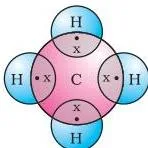
Why do covalent carbon compounds behave so differently from ionic compounds such as sodium chloride? Table 4.1 of the textbook gives the answer in numbers: carbon compounds have low melting and boiling points, unlike ionic compounds, which need far more energy to break their strong electrostatic lattice.
| Compound | Melting point (K) | Boiling point (K) |
|---|---|---|
| Acetic acid, \( CH_3COOH \) | 290 | 391 |
| Chloroform, \( CHCl_3 \) | 209 | 334 |
| Ethanol, \( CH_3CH_2OH \) | 156 | 351 |
| Methane, \( CH_4 \) | 90 | 111 |
Low melting and boiling points tell you that the forces holding covalent molecules together (weak intermolecular forces) are much weaker than the bonds inside the molecule. Because no ions are formed when electrons are shared, most carbon compounds are also poor conductors of electricity (NCERT, p. 1). This single idea — share, don’t transfer — is why carbon behaves so differently from the sodium and chlorine you studied in Metals and Non-metals.
Allotropes of Carbon: Diamond, Graphite and Fullerene Compared
Diamond and graphite are both pure carbon, yet one is the hardest natural substance and the other is soft and slippery. The difference is entirely in how the carbon atoms are linked, not in what they are made of (NCERT, p. 4).
| Allotrope | Bonding pattern | Key physical property |
|---|---|---|
| Diamond | Each carbon bonded to 4 other carbons in a rigid 3-D network | Extremely hard; does not conduct electricity |
| Graphite | Each carbon bonded to 3 others in a plane (one bond is a double bond); planes stack in layers | Soft, slippery, conducts electricity |
| Fullerene (C-60) | 60 carbon atoms arranged in a closed, football-shaped cage | Named after architect Buckminster Fuller, whose geodesic domes it resembles |
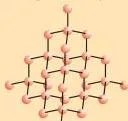
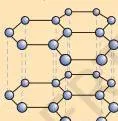
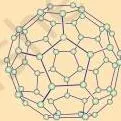
A frequently asked short-answer question is why diamond and graphite differ physically but not chemically. The answer: both are made of nothing but carbon atoms, so both burn to give carbon dioxide and undergo the same type of reactions — only the arrangement of bonds, and therefore the physical structure, is different.
Catenation and Tetravalency: The Two Reasons Carbon Forms So Many Compounds
If an exam question asks why carbon forms such a huge number of compounds, there are exactly two points to write, both grounded in the textbook (NCERT, p. 5):
1. Catenation. Carbon atoms can link to other carbon atoms to form long chains, branched chains or rings. The carbon-carbon bond is strong because carbon’s atomic size is small, so its nucleus holds the shared electron pair tightly. Silicon also shows catenation, but only up to chains of seven or eight atoms, and those silicon-hydrogen compounds are far more reactive and unstable than carbon’s equivalents. This is why silicon never rivals carbon for the sheer number of compounds it forms.
2. Tetravalency. Carbon has a valency of four, so it can bond with up to four other atoms — more carbon, or hydrogen, oxygen, nitrogen, sulphur, or halogens. Every different combination of these atoms produces a distinct compound with its own properties.
A fact worth remembering for one-mark or assertion-type questions: in 1828, Friedrich Wöhler prepared urea from ammonium cyanate in the laboratory. Before this, chemists believed organic (carbon) compounds could only be made by a living organism using some ‘vital force’. Wöhler’s synthesis disproved that idea, even though carbon compounds (except carbides, oxides of carbon, and carbonate/hydrogencarbonate salts) are still studied under the branch called organic chemistry (NCERT, p. 6).
Saturated and Unsaturated Hydrocarbons: Building Ethane, Ethene and Ethyne
NCERT builds hydrocarbon structures in two steps: first, link the carbon atoms together with a single bond skeleton; second, use hydrogen atoms to satisfy whatever valency is left over on each carbon (NCERT, p. 6). For ethane, \( C_2H_6 \), joining the two carbons with a single bond leaves three valencies on each carbon, so three hydrogen atoms attach to each carbon.
Sometimes hydrogen alone cannot satisfy every valency. For ethene, \( C_2H_4 \), after joining the carbons with one bond, one valency is left unsatisfied on each carbon — and since there is no extra hydrogen to spare, the two carbons must form a second bond between themselves, giving a double bond. Ethyne, \( C_2H_2 \), goes one step further and needs a triple bond between its two carbons to satisfy all valencies.
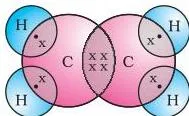
This gives a clean definition worth memorising: a compound with only single bonds between carbon atoms is called saturated (alkanes); a compound with one or more double or triple bonds between carbon atoms is unsaturated (alkenes and alkynes) (NCERT, p. 7). Saturated compounds are generally less reactive because their bonds are already ‘full’ — there is no extra bond waiting to be broken and used to add new atoms. Unsaturated compounds are more reactive because the double or triple bond can open up to accept additional atoms. This reactivity difference is exactly why the bromine water / alkaline potassium permanganate test can tell a saturated hydrocarbon apart from an unsaturated one — the coloured reagent gets decolourised only when it reacts with the extra bond.
Chains, Branches, Rings and Structural Isomers (Butane Example)
Carbon chains are not limited to straight lines. Table 4.2 of the textbook lists methane through hexane — one to six carbon atoms — each following the alkane formula \( C_nH_{2n+2} \): methane \( CH_4 \), ethane \( C_2H_6 \), propane \( C_3H_8 \), butane \( C_4H_{10} \), pentane \( C_5H_{12} \) and hexane \( C_6H_{14} \) (NCERT, p. 7).
Butane is a useful example because its four carbon atoms can be arranged in two different skeletons — one straight chain and one with a branch — and both skeletons, once filled with hydrogen, give the same molecular formula \( C_4H_{10} \). Compounds with an identical molecular formula but different structures are called structural isomers (NCERT, p. 7).
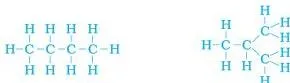
Carbon chains can also close into rings — cyclohexane, \( C_6H_{12} \), is one such ring compound — and rings can be unsaturated too, as in benzene, \( C_6H_6 \) (NCERT, p. 7). Hydrocarbons containing only carbon and hydrogen are divided into three classes: alkanes (all single bonds, saturated), alkenes (one or more C=C double bonds), and alkynes (one or more \( C\equiv C \) triple bonds).
Functional Groups and Heteroatoms: What Changes When Hydrogen Is Replaced
When an atom other than hydrogen or carbon replaces a hydrogen atom on a hydrocarbon chain, that atom is called a heteroatom. A specific heteroatom or group of atoms that gives a carbon compound its characteristic chemical behaviour, regardless of chain length, is called a functional group (NCERT, p. 8).
| Functional group | Heteroatom/group | Example |
|---|---|---|
| Halo (chloro/bromo) | \( -Cl, -Br \) | Chloromethane |
| Alcohol | \( -OH \) | Ethanol, \( C_2H_5OH \) |
| Aldehyde | \( -CHO \) | Ethanal, \( CH_3CHO \) |
| Ketone | \( -CO- \) | Propanone, \( CH_3COCH_3 \) |
| Carboxylic acid | \( -COOH \) | Ethanoic acid, \( CH_3COOH \) |
Because the functional group decides chemical behaviour no matter how long the carbon chain is, this idea leads directly into the homologous series concept below. A simple way to remember the order these suffixes appear in the NCERT naming table (Table 4.4) is the phrase ‘Old Aunty Owns Oranges’ — OL (alcohol), AL (aldehyde), ONE (ketone), OIC ACID (carboxylic acid). Say the four words in order and you get exactly the suffix sequence you need to recall when naming compounds.
Homologous Series: Same Functional Group, Growing Carbon Chain
A homologous series is a family of compounds that all carry the same functional group attached to carbon chains of increasing length, where every successive member differs from the one before it by a single \( -CH_2- \) unit (NCERT, p. 9). Because a \( CH_2 \) unit has a mass of \( 12 + 2(1) = 14\ u \), the molecular mass of successive members always increases by 14 u.
| Series | General formula | Example |
|---|---|---|
| Alkanes | \( C_nH_{2n+2} \) | Propane, \( C_3H_8 \) |
| Alkenes | \( C_nH_{2n} \) | Propene, \( C_3H_6 \) |
| Alkynes | \( C_nH_{2n-2} \) | Propyne, \( C_3H_4 \) |
Physical properties such as melting point, boiling point and solubility change gradually as molecular mass increases along a series, simply because bigger molecules need more energy to separate. Chemical properties, however, stay similar throughout the series because they are governed by the functional group, which does not change (NCERT, p. 10). This distinction — physical properties change, chemical properties don’t — is one of the most repeated two-mark definition answers in this chapter.
Naming Carbon Compounds: The Four-Step CBSE Method
NCERT gives a clear four-step method for naming any carbon compound (NCERT, p. 10):
Step 1: Count the number of carbon atoms in the longest chain and use the matching base name (three carbons = propane, four = butane, and so on).
Step 2: If a functional group is present, show it using the prefix or suffix listed for that group (see Table 4.4 in the textbook).
Step 3: If the suffix begins with a vowel, drop the final ‘e’ from the chain name before adding it — for example, propane minus ‘e’ plus ‘one’ gives propanone.
Step 4: If the chain is unsaturated, change the ending ‘ane’ to ‘ene’ (double bond) or ‘yne’ (triple bond).
Try this on a compound not used in the textbook: a five-carbon chain ending in a ketone group, \( CH_3-CO-CH_2-CH_2-CH_3 \). Step 1 counts five carbons, giving the base name pentane. Step 2 identifies the ketone functional group, which takes the suffix ‘-one’. Step 3 drops the final ‘e’ from ‘pentane’ and adds ‘one’, giving ‘pentanone’. Because the ketone group sits on the second carbon, the full name used in higher classes is pentan-2-one; at Class 10 level, stating ‘pentanone’ with the correct functional group identified is the expected answer.
Combustion, Oxidation, Addition and Substitution: Four Reactions to Remember
Board papers often ask you to identify which of these four reaction types is shown in a given equation, so know the defining condition for each (NCERT, p. 12–14).
Combustion: carbon and its compounds burn in oxygen to release carbon dioxide, water, heat and light.
\[ CH_4 + 2O_2 \rightarrow CO_2 + 2H_2O + \text{heat and light} \]
\[ C_2H_5OH + 3O_2 \rightarrow 2CO_2 + 3H_2O + \text{heat and light} \]
Saturated hydrocarbons burn with a clean blue flame; unsaturated hydrocarbons burn with a yellow, sooty flame because incomplete combustion leaves unburnt carbon as soot. Even a saturated fuel gives a sooty flame if the air supply is limited — which is exactly why a blackened cooking-vessel bottom means the air holes in the stove are blocked and fuel is being wasted (NCERT, p. 13).
Oxidation: an oxidising agent adds oxygen to a compound. Alkaline potassium permanganate or acidified potassium dichromate oxidise ethanol to ethanoic acid.
\[ CH_3CH_2OH \xrightarrow[\text{Heat}]{\text{Alkaline } KMnO_4} CH_3COOH \]
Addition: an unsaturated hydrocarbon adds hydrogen across its double or triple bond in the presence of a nickel or palladium catalyst, becoming saturated. This is the basis of vegetable-oil hydrogenation to make vanaspati (NCERT, p. 14).
Substitution: in sunlight, chlorine replaces hydrogen atoms on a saturated hydrocarbon one at a time.
\[ CH_4 + Cl_2 \xrightarrow{\text{Sunlight}} CH_3Cl + HCl \]
A useful one-mark fact: coal formed from buried plant remains and petroleum formed from buried marine organisms, both compressed over millions of years under heat and pressure — which is why they are called fossil fuels (NCERT, p. 13).
Ethanol and Ethanoic Acid: Properties and Reactions Side by Side
NCERT’s exercise question 7 asks students to differentiate ethanol and ethanoic acid using physical and chemical properties — this table gives you exactly that answer.
| Property/Test | Ethanol (\(C_2H_5OH\)) | Ethanoic acid (\(CH_3COOH\)) |
|---|---|---|
| Reaction with sodium metal | Liberates \(H_2\); gives sodium ethoxide | Liberates \(H_2\); gives sodium ethanoate |
| Reaction with NaOH (a base) | Does not neutralise NaOH the way an acid does | Neutralises NaOH to give a salt and water |
| Reaction with sodium carbonate/bicarbonate | No reaction; no gas evolved | Brisk effervescence of \(CO_2\) — a reliable identification test |
| Esterification with the other compound | Reacts with ethanoic acid + conc. \(H_2SO_4\) to form a sweet-smelling ester | Same reaction, viewed from the acid’s side |
The carbonate/bicarbonate test is the fastest way to tell the two apart in a practical or a written ‘how would you distinguish’ question: only the acid produces brisk \(CO_2\) gas, confirmed by lime water turning milky (NCERT, p. 17).
\[ CH_3COOH + NaHCO_3 \rightarrow CH_3COONa + H_2O + CO_2 \]
Esterification and its reverse, saponification, are easy to mix up. In esterification, an acid and an alcohol combine in the presence of concentrated sulphuric acid to form a sweet-smelling ester and water:
\[ CH_3COOH + C_2H_5OH \rightleftharpoons CH_3COOC_2H_5 + H_2O \]
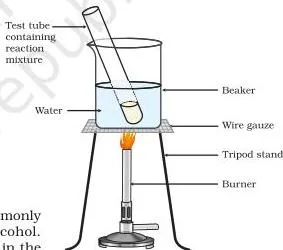
In saponification, that ester is treated with sodium hydroxide and breaks back down into an alcohol and the sodium salt of the acid — this is how soap is made (NCERT, p. 16).
\[ CH_3COOC_2H_5 + NaOH \rightarrow C_2H_5OH + CH_3COONa \]
Two safety facts worth remembering for reasoning-type questions: pure ethanoic acid (glacial acetic acid) freezes at 290 K, so it can solidify in cold winters, which is where its name comes from (NCERT, p. 16). Also, industrial ethanol is deliberately made undrinkable by adding methanol and a blue dye — this is called denatured alcohol. Methanol itself is dangerous even in small amounts because the liver oxidises it to methanal, which can damage the optic nerve and cause blindness (NCERT, p. 15).
Soaps, Detergents and Micelle Formation: Why Soap Fails in Hard Water
A soap molecule is the sodium or potassium salt of a long-chain carboxylic acid. It has two very different ends: a long hydrocarbon tail that dissolves in oil, and a charged \( -COO^- \) head that dissolves in water. When soap is added to water containing an oily stain, the hydrocarbon tails bury themselves inside the oil droplet while the ionic heads stay on the outside, facing the water. This forms a cluster called a micelle, which keeps the oil droplet suspended (emulsified) in water instead of separating out (NCERT, p. 17). Agitation — rubbing, beating or the tumbling action of a washing machine — is what physically pulls the loosened dirt away from the fabric so the micelles can carry it off.
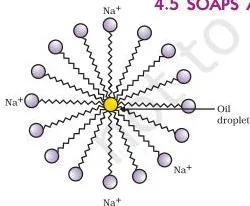
Hard water contains dissolved calcium and magnesium salts. These ions react with soap to form an insoluble curdy precipitate called scum, instead of forming micelles — this wastes soap and reduces foaming (NCERT, p. 19). Note the precise wording here: soap does not ‘remove’ or ‘kill’ the hardness of water; it simply reacts with the \( Ca^{2+} \)/\( Mg^{2+} \) ions and gets used up as scum. Detergents avoid this problem because they are sodium salts of sulphonic acids or ammonium salts with long hydrocarbon chains, and their charged ends do not form insoluble precipitates with calcium or magnesium ions — so detergents keep foaming even in hard water (NCERT, p. 19).
Worked Examples: Applying the Rules to New Structures
Example 1: Mass difference between pentane and heptane
Step 1: Write the molecular formulas. Pentane is \( C_5H_{12} \) and heptane is \( C_7H_{16} \), both from the alkane series \( C_nH_{2n+2} \).
Step 2: Find the difference in carbon atoms: \( 7 – 5 = 2 \), which means two \( -CH_2- \) units separate them (they are not neighbouring members of the series, but two homologous steps apart).
Step 3: Calculate the molecular mass of each. Using atomic masses \( C = 12\ u \) and \( H = 1\ u \):
\[ \text{Pentane: } 5(12) + 12(1) = 60 + 12 = 72\ u \]
\[ \text{Heptane: } 7(12) + 16(1) = 84 + 16 = 100\ u \]
Step 4: Find the mass difference: \( 100 – 72 = 28\ u \), which is exactly two \( CH_2 \) units (\( 2 \times 14\ u \)).
Final answer: Pentane and heptane differ by two \( CH_2 \) units and a mass of \( 28\ u \), confirming they belong to the same homologous series.
Example 2: How many structural isomers does pentane have?
Step 1: Fix the molecular formula \( C_5H_{12} \) and build every possible carbon skeleton using five carbons.
Step 2: Skeleton 1 — a straight chain of five carbons: n-pentane, \( CH_3-CH_2-CH_2-CH_2-CH_3 \).
Step 3: Skeleton 2 — a four-carbon chain with one methyl branch on the second carbon: isopentane (2-methylbutane), \( CH_3-CH(CH_3)-CH_2-CH_3 \).
Step 4: Skeleton 3 — a three-carbon chain with two methyl branches on the middle carbon: neopentane (2,2-dimethylpropane), \( C(CH_3)_4 \).
Step 5: Check that no further skeleton is possible without repeating one already drawn — five carbons can only be arranged in these three distinct ways.
Final answer: Pentane has 3 structural isomers — n-pentane, isopentane and neopentane — all with the same molecular formula \( C_5H_{12} \) but different carbon skeletons.
Example 3: Name the compound \( CH_3-CH_2-CH_2-CHO \)
Step 1: Count the carbon atoms in the chain, including the carbon of the \( -CHO \) group: there are four, so the base name is butane.
Step 2: Identify the functional group: \( -CHO \) is the aldehyde group, which takes the suffix ‘-al’.
Step 3: The suffix ‘-al’ begins with a vowel, so drop the final ‘e’ from ‘butane’ before adding it: butane − e + al.
Final answer: The compound is named butanal.
Example 4: Classify the reaction \( CH_3-CH=CH_2 + H_2 \xrightarrow{Ni} CH_3-CH_2-CH_3 \)
Step 1: Identify the starting material: propene, \( CH_3-CH=CH_2 \), is an unsaturated hydrocarbon with one carbon-carbon double bond.
Step 2: Identify what is added: a molecule of hydrogen, \( H_2 \), in the presence of a nickel catalyst.
Step 3: Check the product: propane, \( CH_3-CH_2-CH_3 \), has only single bonds — it is fully saturated.
Step 4: Since an unsaturated compound gained atoms across its double bond to become saturated, this matches the definition of addition, not substitution (no atom was replaced) or oxidation (no oxygen was added).
Final answer: This is an addition reaction — specifically, catalytic hydrogenation of propene to propane.
Common Mistakes Students Make in This Chapter
| Mistake | Correct rule | How to check your answer |
|---|---|---|
| Drawing an electron dot structure and showing only the bonding electron pairs | Every atom must show its lone pairs too — for example, oxygen, nitrogen and chlorine keep unshared electrons that are not part of any bond | Count total electrons around each atom; it should equal 8 (or 2 for hydrogen), including both bonding and non-bonding pairs |
| Deciding ‘saturated’ or ‘unsaturated’ by counting how many carbons are in the chain | Saturation depends only on bond type — single bonds throughout means saturated, any double or triple C–C bond means unsaturated | Look for a double (\(=\)) or triple (\(\equiv\)) bond between carbons in the structure, not chain length |
| Writing the general formula of alkenes as \( C_nH_{2n+2} \) (copying the alkane formula) | Alkenes follow \( C_nH_{2n} \); only alkanes follow \( C_nH_{2n+2} \) | Substitute a known alkene, like ethene (\(n=2\)): \( C_2H_4 \) fits \( C_nH_{2n} \), not \( C_nH_{2n+2} \) |
| Assuming ethanol reacts with sodium hydroxide the same way ethanoic acid does | Only ethanoic acid, being an acid, neutralises NaOH to form a salt and water; ethanol does not react with NaOH in this way | Recall the carbonate test — only the acid gives brisk \( CO_2 \) with sodium carbonate; ethanol shows no such reaction |
| Reversing esterification and saponification | Esterification: acid + alcohol \(\rightarrow\) ester + water. Saponification: ester + NaOH \(\rightarrow\) alcohol + soap (a salt of the acid) | Check which side has the ester: if it starts as a reactant and NaOH is present, it is saponification, not esterification |
Exam Notes: How This Chapter Is Usually Tested
The NCERT end-of-chapter exercise gives a clear pattern of what to expect. Questions 1 to 3 are MCQs — bond-counting in a molecule like ethane, identifying the functional group in a named compound such as butanone, and a reasoning question on why a vessel bottom blackens during cooking. Questions 4 and 5 test electron dot structures, including for molecules not explicitly worked out in the chapter, such as \( H_2S \) and \( F_2 \) — which is exactly why practising the method on unfamiliar molecules matters more than memorising the chapter’s own methane or ethane diagrams. Question 6 is a definition question on homologous series. Question 7 asks you to differentiate ethanol and ethanoic acid — use the comparison table above. Questions 8, 10 and 15 focus on soap and micelle chemistry — explain the hydrophobic tail/hydrophilic head structure and the scum reaction with hard water in your own words rather than a one-line answer. Question 12 asks about hydrogenation and its industrial use (making vanaspati from vegetable oil), and question 13 asks you to pick out which hydrocarbons from a mixed list can undergo addition reactions — check each formula for a double or triple bond before answering.
The pattern repeats every year with different molecules plugged into the same question type. A full-marks answer on electron dot structures must show every bonding pair as well as every lone pair, and a full-marks answer distinguishing ethanol from ethanoic acid must include at least the carbonate/bicarbonate test, since that is the one unambiguous chemical test the examiner is looking for.
Quick Revision Chart: Bonds, Formulas and Reactions in One Table
| Concept | One-line summary |
|---|---|
| Covalent bond types | Single (one shared pair, e.g. \(H_2\)), double (two pairs, e.g. \(O_2\)), triple (three pairs, e.g. \(N_2\)) |
| Catenation | Carbon-carbon bonds form long chains, branches and rings due to carbon’s small size and strong bonds |
| Tetravalency | Carbon bonds with up to 4 other atoms, giving countless combinations |
| General formulas | Alkane \(C_nH_{2n+2}\), alkene \(C_nH_{2n}\), alkyne \(C_nH_{2n-2}\) |
| Functional groups | Halo \(-Cl/-Br\), alcohol \(-OH\), aldehyde \(-CHO\), ketone \(-CO-\), carboxylic acid \(-COOH\) |
| Combustion | Compound + \(O_2 \rightarrow CO_2 + H_2O\) + heat and light |
| Oxidation | Ethanol + alkaline \(KMnO_4\)/acidified \(K_2Cr_2O_7\) \(\rightarrow\) ethanoic acid |
| Addition | Unsaturated hydrocarbon + \(H_2\) (Ni/Pd) \(\rightarrow\) saturated hydrocarbon |
| Substitution | \(CH_4 + Cl_2 \xrightarrow{\text{sunlight}} CH_3Cl + HCl\), one H replaced at a time |
| Ethanol vs ethanoic acid test | Only ethanoic acid gives brisk \(CO_2\) with sodium carbonate/bicarbonate |
| Soap vs detergent in hard water | Soap forms insoluble scum with \(Ca^{2+}/Mg^{2+}\); detergents keep foaming |
Frequently Asked Questions on Carbon and Its Compounds
Why does carbon form covalent bonds instead of ionic bonds like sodium chloride does?
Carbon has four electrons in its outer shell. Gaining four electrons to form \( C^{4-} \) would overload a nucleus of only six protons, and losing four electrons to form \( C^{4+} \) would need too much energy while leaving a highly charged, unstable ion. Sharing electrons with other atoms lets carbon complete its outer shell without either of these problems, which is why it always forms covalent bonds.
What is the difference between catenation in carbon compounds and catenation in silicon compounds?
Both carbon and silicon can bond to atoms of their own kind, but carbon-carbon bonds are far stronger because carbon’s atomic size is smaller, so its nucleus holds the shared electrons more tightly. This lets carbon form chains of unlimited length. Silicon’s chains with hydrogen are limited to about seven or eight atoms, and those compounds are much more reactive and less stable than carbon’s equivalents.
How do you name a compound like \( CH_3-CH_2-CH_2-COOH \) using the CBSE naming rules?
Count the carbons: there are four, including the carbon of the \(-COOH\) group, so the base name is butane. The functional group is carboxylic acid, which takes the suffix ‘-oic acid’. Since the suffix begins with a vowel, drop the final ‘e’ from ‘butane’ and add the suffix: butane − e + oic acid = butanoic acid.
Why is diamond extremely hard while graphite conducts electricity, even though both are pure carbon?
In diamond, every carbon atom is bonded to four other carbons in a rigid three-dimensional framework, which makes it very hard and prevents free electron movement, so it does not conduct electricity. In graphite, each carbon is bonded to only three others in flat hexagonal layers, and one bond per carbon is a double bond — this leaves loosely held electrons that can move and carry current, and the layers themselves can slide over each other, making graphite soft and slippery.
Why does soap form a scum with hard water while detergents keep foaming?
Hard water contains dissolved calcium and magnesium ions. These ions react with the fatty-acid part of soap to form an insoluble curdy precipitate called scum instead of dissolving to form cleaning micelles, so soap gets wasted and lathers poorly. Detergents are built from sulphonic acid or ammonium salts whose charged ends do not form such insoluble precipitates with calcium or magnesium ions, so they continue to foam and clean even in hard water.
What is the difference between an esterification reaction and a saponification reaction?
Esterification combines a carboxylic acid and an alcohol, usually with concentrated sulphuric acid as a catalyst, to produce a sweet-smelling ester and water: \( CH_3COOH + C_2H_5OH \rightleftharpoons CH_3COOC_2H_5 + H_2O \). Saponification is the reverse process using a base: an ester is treated with sodium hydroxide and splits back into an alcohol and the sodium salt of the acid (soap): \( CH_3COOC_2H_5 + NaOH \rightarrow C_2H_5OH + CH_3COONa \).
You can also read the official chapter on the NCERT website’s Class 10 Science textbook page for Chapter 4 if you want to check any structure or activity against the original PDF while revising. For a broader view of the syllabus and links to other chapters, visit the CBSE Class 10 Science notes hub, or go back to the full Class 10 subject list. Since carbon compounds form the chemical basis of every living cell, it also helps to revise Life Processes alongside this chapter to connect the chemistry to biology.
Reference: NCERT Class 10 Science textbook, chapter Carbon and its Compounds.
Explore Class 10 Science Notes
Related chapters: