Light Reflection and Refraction Class 10 Notes (Ch 9) – Learncbse.net
These light reflection and refraction class 10 notes walk through NCERT Chapter 9 in the order the textbook builds it: spherical mirrors first, then refraction, lenses, and the formulas that connect them. Use it to check definitions, re-derive the sign convention, and see two fresh worked numericals before you attempt the NCERT exercise on your own.
Why This Chapter Has Two Halves: Reflection and Refraction
Reflection is light bouncing back off a surface without entering it — this is what a mirror does. Refraction is light bending as it crosses the boundary between two transparent media, such as air and glass. Both halves of this chapter treat light as travelling in straight lines, called rays. NCERT flags in its ‘More to Know’ box that light also shows wave-like and particle-like behaviour (diffraction, quantum effects), but that discussion is kept for higher classes. For your Class 10 exam, you only need the ray picture — nothing about wave or quantum theory is tested here.
Concave and Convex Mirrors: Pole, Centre of Curvature and R = 2f
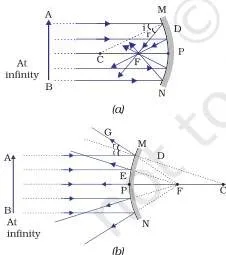
A concave mirror curves inward, toward the centre of the sphere it is cut from. A convex mirror curves outward. Four terms you must be able to label on a diagram:
- Pole (P): the centre point of the mirror’s reflecting surface — it lies ON the mirror.
- Centre of curvature (C): the centre of the sphere of which the mirror is a part. It lies in front of a concave mirror and behind a convex mirror — and it is NOT part of the mirror surface. This is a common one-mark trap: students often mark C as if it lies on the mirror.
- Principal axis: the straight line through P and C.
- Principal focus (F): the point on the principal axis where rays parallel to the axis converge (concave) or appear to diverge from (convex) after reflection.
The focus lies exactly midway between P and C, which gives the relation \( f = \frac{R}{2} \), or \( R = 2f \). This holds only for mirrors of small aperture (the mirror’s diameter is much smaller than its radius of curvature) — write this restriction if a question asks you to justify the formula.
Six Object Positions for a Concave Mirror — Reading Table 9.1 Correctly
A concave mirror gives six distinct outcomes depending on where you place the object relative to P, F and C. Learn the pattern rather than memorising six unrelated lines: as the object moves from infinity toward the mirror, the image moves from F toward infinity (behind the mirror), and it flips from real-diminished to real-enlarged to virtual-enlarged.
| Object position | Image position | Image size | Nature |
|---|---|---|---|
| At infinity | At F | Point-sized, highly diminished | Real, inverted |
| Beyond C | Between F and C | Diminished | Real, inverted |
| At C | At C | Same size | Real, inverted |
| Between C and F | Beyond C | Enlarged | Real, inverted |
| At F | At infinity | Highly enlarged | Image not formed on a screen |
| Between P and F | Behind the mirror | Enlarged | Virtual, erect |
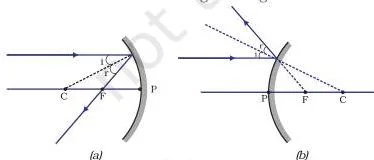
To draw any of these, board answers accept any two of the standard rays: a ray parallel to the principal axis reflects through F (or appears to come from F for a convex mirror); a ray through C strikes the mirror along the normal and reflects straight back along its own path. Examiners check which two rays you chose, not just the final image, so label them in your diagram.
Convex Mirror Images and Why Vehicles Use Them
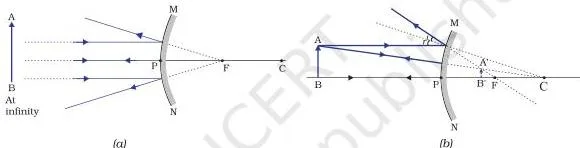
A convex mirror only ever gives two outcomes, both virtual and erect: a point-sized image at F when the object is at infinity, and a diminished image between P and F for any closer object. This single, unchanging behaviour is exactly why it is used as a rear-view mirror — the driver always sees an erect image, at any distance, and because the mirror curves outward it also covers a wider field of view than a plane mirror of the same size. Concave mirrors, by contrast, are used where you want a magnified image or a concentrated beam: shaving mirrors, dentists’ mirrors, torches and headlights (to produce a powerful parallel beam), and solar furnaces (to concentrate sunlight for heat).
New Cartesian Sign Convention: The Rules Students Get Wrong
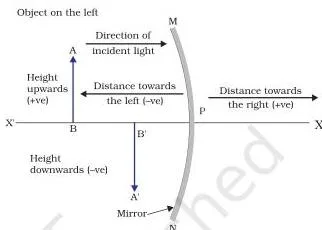
Almost every mark lost in mirror/lens numericals traces back to a sign mistake here, so read this slowly. The five rules:
- The object is always placed to the left of the mirror or lens; light travels left to right.
- All distances are measured from the pole (mirror) or optical centre (lens).
- Distances measured to the right of the pole/optical centre (direction of incident light) are positive; distances to the left are negative.
- Heights measured upward, above the principal axis, are positive.
- Heights measured downward, below the principal axis, are negative.
Quick check before you plug numbers into any formula:
- \( u \) (object distance) is always negative — the object sits to the left of the pole/optical centre.
- \( f \) is negative for a concave mirror and positive for a convex mirror.
- \( f \) is positive for a convex lens and negative for a concave lens.
If your final value of \( u \) comes out positive in a normal setup, stop and recheck your substitution — that is the sign of an error, not a valid answer.
Mirror Formula and Magnification — When to Use Which Sign
The mirror formula relates object distance \( u \), image distance \( v \), and focal length \( f \):
\[ \frac{1}{v} + \frac{1}{u} = \frac{1}{f} \]
Magnification compares image height \( h’ \) to object height \( h \):
\[ m = \frac{h’}{h} = -\frac{v}{u} \]
Here is the exam-checking trick: you don’t need a ray diagram to know whether an image is real or virtual — just look at the sign of \( m \). A negative \( m \) means the image is real and inverted; a positive \( m \) means it is virtual and erect. If your calculated \( m \) contradicts the nature of image you expect (say, you got a positive \( m \) for an object placed beyond C on a concave mirror), you have made a sign error somewhere and should recheck the substitution.
Refraction Through a Glass Slab: Why the Emergent Ray Is Shifted, Not Bent
When a ray enters a rectangular glass slab obliquely, it bends toward the normal at the first (air-to-glass) surface and bends away from the normal by an equal angle at the second (glass-to-air) surface. Because the bending at the two parallel faces is equal and opposite, the ray that emerges is parallel to the original incident ray. It is NOT bent overall — it is only displaced sideways. This sideways shift is called lateral displacement, and it is the reason print viewed through a thick glass slab looks raised but not tilted.
The two laws of refraction are:
- The incident ray, the refracted ray, and the normal at the point of incidence all lie in the same plane.
- Snell’s law: the ratio of the sine of the angle of incidence to the sine of the angle of refraction is constant for a given pair of media and a given colour of light.
\[ \frac{\sin i}{\sin r} = \text{constant} \]
NCERT states this law is valid only for angles of incidence between \( 0^\circ \) and \( 90^\circ \) (\( 0^\circ \lt i \lt 90^\circ \)). This is an edge case worth remembering if a question probes the limits of the law rather than just asking you to apply it.
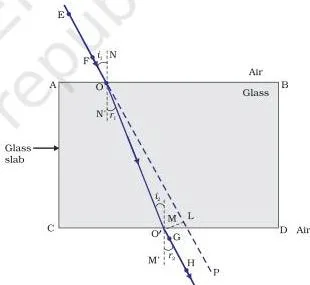
Refractive Index: Absolute vs Relative, and Reading Table 9.3
The refractive index of medium 2 with respect to medium 1, written \( n_{21} \), is the ratio of the speed of light in medium 1 to the speed of light in medium 2: \( n_{21} = \dfrac{v_1}{v_2} \). When medium 1 is air (or vacuum), this ratio is called the absolute refractive index of medium 2: \( n = \dfrac{c}{v} \), where \( c \) is the speed of light in air/vacuum \( (3 \times 10^{8}\ \text{m/s}) \) and \( v \) is its speed in that medium. You don’t need to memorise every value in NCERT’s Table 9.3, but a few are worth knowing: air \( \approx 1.00 \), water \( 1.33 \), kerosene \( 1.44 \), crown glass \( 1.52 \), diamond \( 2.42 \).
The gotcha here is important: optical density and mass density are not the same thing. Kerosene has a refractive index of \( 1.44 \), higher than water’s \( 1.33 \), so kerosene is optically denser than water — even though kerosene is less dense by mass and floats on water. A medium with a higher refractive index also has a lower speed of light passing through it, so among kerosene, turpentine \( (1.47) \) and water \( (1.33) \), light travels fastest in water and slowest in turpentine.
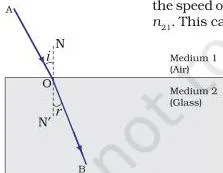
Convex and Concave Lenses: Optical Centre, Focus and the Two-Ray Rule
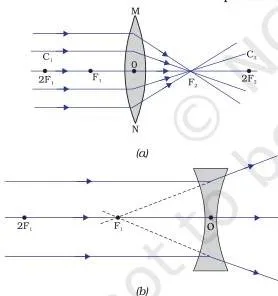
A lens is bound by at least one spherical surface. A convex lens is thicker in the middle and converges light rays to a real focus; a concave lens is thicker at the edges and diverges light rays, so their focus is virtual. The optical centre (O) is the mid-point of the lens through which a ray passes without changing direction. For ray diagrams, use any two of these three rays: a ray parallel to the principal axis (bends through the focus on the far side for a convex lens, or appears to come from the near-side focus for a concave lens); a ray through the focus (emerges parallel to the axis); and a ray through the optical centre (goes straight through, undeviated).
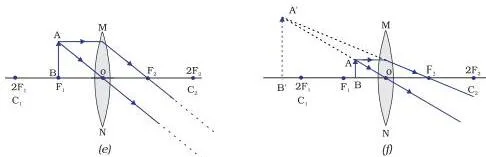
A convex lens gives six possible images, following the same pattern as a concave mirror but measured from 2F and F on both sides:
| Object position | Image position | Size | Nature |
|---|---|---|---|
| At infinity | At focus \(F_2\) | Point-sized | Real, inverted |
| Beyond \(2F_1\) | Between \(F_2\) and \(2F_2\) | Diminished | Real, inverted |
| At \(2F_1\) | At \(2F_2\) | Same size | Real, inverted |
| Between \(F_1\) and \(2F_1\) | Beyond \(2F_2\) | Enlarged | Real, inverted |
| At focus \(F_1\) | At infinity | Highly enlarged | Image not formed on a screen |
| Between \(F_1\) and O | Same side as object | Enlarged | Virtual, erect |
A concave lens is simpler and worth a full one-mark answer by itself: a concave lens always forms a virtual, erect, diminished image, wherever the object is placed. Only its size changes slightly as the object moves — it never becomes real or inverted, unlike a convex lens.
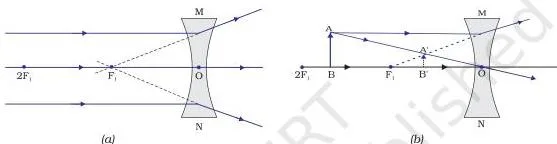
Lens Formula, Power of a Lens and Combining Lenses in Contact
The lens formula looks almost like the mirror formula, but the sign in the middle is different — this single difference is the most common formula-mixing mistake students make in this chapter:
\[ \frac{1}{v} – \frac{1}{u} = \frac{1}{f} \]
Compare this with the mirror formula, which uses a plus sign: \( \dfrac{1}{v} + \dfrac{1}{u} = \dfrac{1}{f} \). Magnification for a lens is \( m = \dfrac{h’}{h} = \dfrac{v}{u} \) — no minus sign here, unlike the mirror’s magnification formula.
Power of a lens tells you how strongly it converges or diverges light, and is the reciprocal of focal length in metres:
\[ P = \frac{1}{f} \]
The SI unit of power is the dioptre (D); \( 1\ D = 1\ \text{m}^{-1} \). A convex lens has positive power; a concave lens has negative power. When two or more thin lenses are placed in contact, their powers simply add:
\[ P = P_1 + P_2 + P_3 + \ldots \]
This additive rule is how opticians combine trial lenses of known power during an eye test instead of recalculating focal lengths each time.
Worked Numericals: Mirror and Lens Problems With Fresh Numbers
Example A: Concave mirror, f = 12 cm, object at u = 20 cm
Step 1: Apply the sign convention. For a concave mirror, \( f \) is negative and \( u \) is always negative: \( f = -12\ \text{cm} \), \( u = -20\ \text{cm} \).
Step 2: Use the mirror formula \( \dfrac{1}{v} + \dfrac{1}{u} = \dfrac{1}{f} \), so \( \dfrac{1}{v} = \dfrac{1}{f} – \dfrac{1}{u} \).
\[ \frac{1}{v} = \frac{1}{-12} – \frac{1}{-20} = -\frac{1}{12} + \frac{1}{20} = \frac{-5+3}{60} = -\frac{2}{60} = -\frac{1}{30} \]
Step 3: So \( v = -30\ \text{cm} \). The negative sign shows the image forms in front of the mirror, on the same side as the object — it is real.
Step 4: Find magnification using \( m = -\dfrac{v}{u} \).
\[ m = -\frac{(-30)}{(-20)} = -1.5 \]
Final answer: \( v = -30\ \text{cm} \), \( m = -1.5 \). The image is real, inverted, and enlarged \( 1.5 \times \) the object size, formed 30 cm in front of the mirror.
Example B: Convex lens, f = 20 cm, object at u = 30 cm
Step 1: Apply the sign convention. For a convex lens, \( f \) is positive; \( u \) is always negative: \( f = +20\ \text{cm} \), \( u = -30\ \text{cm} \).
Step 2: Use the lens formula \( \dfrac{1}{v} – \dfrac{1}{u} = \dfrac{1}{f} \), so \( \dfrac{1}{v} = \dfrac{1}{f} + \dfrac{1}{u} \).
\[ \frac{1}{v} = \frac{1}{20} + \frac{1}{-30} = \frac{3-2}{60} = \frac{1}{60} \]
Step 3: So \( v = +60\ \text{cm} \). The positive sign shows the image forms on the opposite side of the lens from the object — it is real.
Step 4: Find magnification using \( m = \dfrac{v}{u} \).
\[ m = \frac{60}{-30} = -2 \]
Final answer: \( v = +60\ \text{cm} \), \( m = -2 \). The image is real, inverted, and magnified \( 2 \times \) the object size, formed 60 cm on the far side of the lens.
Common Mistakes Students Make in Chapter 9
- Using a positive \( f \) for a concave mirror. Fix: \( f \) is negative for a concave mirror and positive for a convex mirror.
- Applying the mirror formula’s plus sign to a lens problem. Fix: the lens formula has a minus sign, \( \dfrac{1}{v} – \dfrac{1}{u} = \dfrac{1}{f} \); the mirror formula has a plus sign, \( \dfrac{1}{v} + \dfrac{1}{u} = \dfrac{1}{f} \).
- Forgetting that \( u \) is always negative. Fix: under the New Cartesian Sign Convention, the object is always placed to the left of the mirror/lens, so \( u \) always carries a negative sign — for both mirrors and lenses.
- Reading a refractive index as a statement about mass density. Fix: ‘refractive index of diamond is \( 2.42 \)’ means the speed of light in vacuum is \( 2.42 \) times its speed inside diamond — it says nothing about how heavy diamond is compared to another substance.
- Applying \( R = 2f \) to any spherical mirror without checking the aperture. Fix: this relation only holds for mirrors of small aperture, where the reflecting surface is a small part of the full sphere.
How CBSE Frames Questions From This Chapter
NCERT’s own end-of-chapter exercise for this chapter mixes question types, and CBSE papers follow the same mix: one-mark MCQs (roughly Q1–6) testing definitions and sign rules directly; short numericals with a required ray diagram (roughly Q7, 10, 11) worth 2–3 marks; conceptual reasoning questions (roughly Q8, 9, 13) that ask you to explain a choice of mirror or interpret a magnification value; and direct numericals (roughly Q12, 14–17) that test the mirror/lens formula and power calculations.
For any numerical that asks for ‘position, size and nature’ of the image, write three separate, clearly labelled conclusions — the value of \( v \), the magnification or relative size, and whether the image is real/virtual and erect/inverted. A correct numerical value for \( v \) with the nature of the image left unstated typically loses marks, even though the arithmetic is right.
Quick Recap: Mirror vs Lens Formula and Sign Rules
| Quantity | Mirror | Lens |
|---|---|---|
| Formula | \( \dfrac{1}{v} + \dfrac{1}{u} = \dfrac{1}{f} \) | \( \dfrac{1}{v} – \dfrac{1}{u} = \dfrac{1}{f} \) |
| Sign of \( f \) | Concave: negative; Convex: positive | Convex: positive; Concave: negative |
| Sign of \( u \) | Always negative | Always negative |
| Magnification | \( m = -\dfrac{v}{u} \) | \( m = \dfrac{v}{u} \) |
| Unit of power | Not usually expressed in dioptres | Dioptre, \( D = \dfrac{1}{f\,(\text{in metres})} \) |
Four facts worth carrying into the exam hall:
- The laws of reflection and the laws of refraction apply to every reflecting or refracting surface, curved or flat.
- For a spherical mirror of small aperture, the radius of curvature is twice the focal length: \( R = 2f \).
- A ray bends toward the normal when it enters an optically denser medium, and away from the normal when it enters an optically rarer medium.
- Power of a lens is the reciprocal of its focal length measured in metres, expressed in dioptres.
Frequently Asked Questions on Light – Reflection and Refraction
Why does the lens formula have a minus sign while the mirror formula has a plus sign?
They are separate formulas derived for different geometries (light passing through a lens versus light bouncing off a mirror), and the New Cartesian Sign Convention gives each a different algebraic form when the derivation is worked out. NCERT states the mirror formula as \( \dfrac{1}{v} + \dfrac{1}{u} = \dfrac{1}{f} \) and the lens formula as \( \dfrac{1}{v} – \dfrac{1}{u} = \dfrac{1}{f} \). You simply need to remember which sign goes with which device — mixing them up is the single most common formula error in this chapter.
Is the focal length of a concave mirror positive or negative?
Negative. Under the New Cartesian Sign Convention, the focus of a concave mirror lies in front of the mirror (to the left of the pole), so its distance from the pole is measured as negative. A convex mirror’s focus lies behind the mirror, so its focal length is positive.
Why does a convex mirror always form a virtual and erect image?
Because the reflecting surface curves outward, the reflected rays always diverge (or appear to diverge from a point behind the mirror), no matter where the object is placed. Rays that diverge after reflection can never meet to form a real image in front of the mirror, so the image is always virtual, and it is always erect and diminished.
What does it mean when the refractive index of diamond is given as 2.42?
It means the speed of light in vacuum (or air) is \( 2.42 \) times the speed of light inside diamond: \( n = \dfrac{c}{v} = 2.42 \). It is a statement about how strongly diamond slows down and bends light, not about diamond’s mass density.
Why is the image formed through a glass slab shifted sideways instead of bent?
Light bends toward the normal entering the slab and away from the normal by an equal angle leaving it, since the two surfaces are parallel. The two bends cancel out, so the emergent ray travels in the same direction as the incident ray — it is only displaced sideways, an effect called lateral displacement, not an overall change of direction.
How do you find the focal length of a lens if its power is −2.0 D?
Use \( f = \dfrac{1}{P} \). With \( P = -2.0\ D \), \( f = \dfrac{1}{-2.0} = -0.50\ \text{m} \), or \( -50\ \text{cm} \). The negative sign tells you the lens is concave (diverging).
For extra practice after these light reflection and refraction class 10 notes, revisit the ray-diagram questions in the CBSE Class 10 Science notes section, or browse other subjects under Class 10 CBSE study material. If you want to read the original text and figures exactly as printed, the official NCERT PDF of Chapter 9 is the source textbook this page is based on.
Reference: NCERT Class 10 Science textbook, chapter Light – Reflection and Refraction.
Explore Class 10 Science Notes
Related chapters: